Mérida
ExtremaduraClimate
Daily budget
What to see in Mérida: the essentials
The city holds one of the most complete Roman archaeological ensembles in Europe, recognised as a UNESCO World Heritage Site since 1993. With 285,142 visitors a year (INE), Mérida is a destination best explored on foot, letting each monument tell its story.Roman Theatre of Mérida
Inaugurated in 8 BC, this theatre is the heart of the International Classical Theatre Festival, the oldest in Spain, and it still hosts performances every summer. It preserves much of its original structure, including the tiers and service passageways, allowing you to sit where the people of Emerita enjoyed plays two millennia ago. Opening hours are from April to September, 09:00 to 21:00, and from October to March, 9:00 to 18:30. An individual ticket costs €12 (standard rate), €6 reduced and €7 for groups. For more information, the Consorcio Ciudad Monumental de Mérida can be reached on 924 00 49 08.Roman Amphitheatre of Mérida
Also inaugurated in 8 BC, it was the scene of fights between gladiators and wild beasts in Roman times. Its central arena has a pit called the *fossa bestiaria*, where the beasts were kept before being sent out to fight. It preserves much of its original structure, including the tiers and service passageways. It is located at Plaza Margarita Xirgu s/n, next to the Roman Theatre, and shares its opening hours and ticket prices with it.National Museum of Roman Art
It houses a vast collection of Roman artefacts found in Mérida, offering a deep insight into the life and art of the period. It is the perfect complement to understanding what you are seeing at the monuments: sculptures, mosaics, everyday objects and funerary pieces that bring you closer to the original Augusta Emerita. It opens from 9:30 to 18:30 in winter and from 9:30 to 20:00 in summer, and requires a ticket.Aqueduct of Los Milagros
This imposing Roman aqueduct brought water to the city from the Proserpina reservoir, and its brick and granite arches still rise above the urban landscape. It is one of those monuments you come across suddenly, woven into the city’s everyday life. A UNESCO World Heritage Site since 1993, it is especially photogenic at sunset.Arab Alcazaba
A Muslim fortress built on Roman structures, it offers panoramic views of the Guadiana River and the Roman Bridge that justify the visit on their own. Its strategic location beside the river made it a key stronghold for centuries. It opens from 9:00 to 18:30 in winter and from 9:00 to 21:00 in summer, and requires a ticket.Roman Circus
One of the best-preserved Roman circuses in the world, where chariot races were held before thousands of spectators.Portico of the Municipal Forum of Augusta Emerita
A preserved corner of a monumental portico built around the mid-1st century AD, with Corinthian columns, reliefs and niches that help you understand the layout of the city’s civic centre; it sits at street level on Calle Sagasta and admission is free.House of the Mithraeum and Columbaria
A Roman residence with impressive mosaics and a Roman necropolis that shows how the people of Emerita lived and buried their dead.Morerías Archaeological Site
A site that shows the evolution of Emerita Augusta’s urban planning from Roman times to the Visigothic period, with remains of houses, streets and a basilica; it opens from 9:00 to 15:00 and access is included with the Consortium ticket.Basilica House (House of the Theatre)
A Roman domus located in Plaza Margarita Xirgu, next to the Roman Theatre, which preserves an atrium with an impluvium, a peristyle with columns and an outstanding collection of geometric and figurative mosaics.Roman Columbaria
A group of funerary buildings from the Early Imperial period, mainly from the 1st and 2nd centuries AD, intended to house collective burials; access is adapted for wheelchairs.Roman Bridge
The longest bridge of antiquity still standing, it crosses the Guadiana River and is still used by pedestrians every day.Temple of Diana
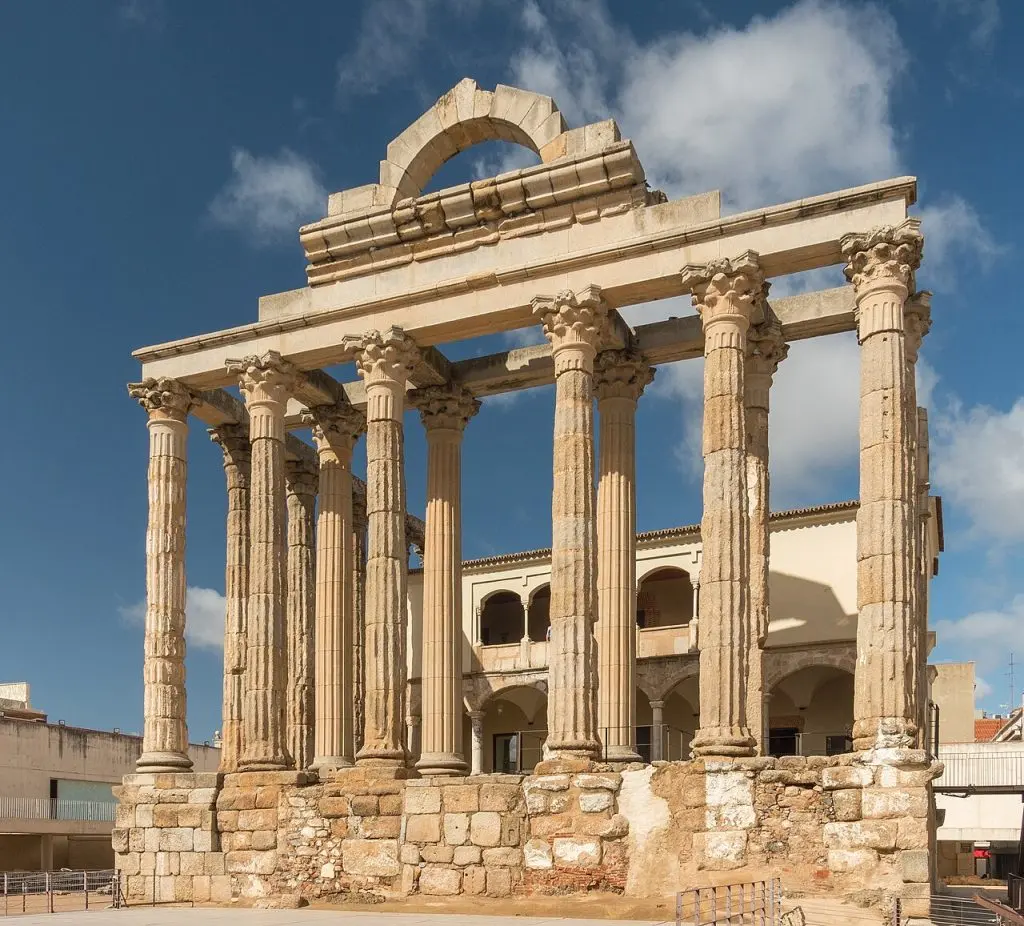
An ancient Roman temple dedicated to imperial worship, part of the city’s former forum square and one of the most photographed spots in Mérida.🍂 Otoño
Si visitas Mérida en otoño, el clima sigue siendo agradable y hay menos aglomeraciones que en verano. Es un buen momento para pasear por el Circo Romano o el Acueducto de San Lázaro con temperaturas suaves. Lleva un paraguas plegable por si cae alguna lluvia ligera.
What to do in Mérida
Mérida offers a unique combination of living Roman heritage, international festivals and authentic local life. The International Festival of Classical Theatre, held in the Roman Theatre, is the oldest in Spain and turns every summer into an unrepeatable experience: watching a play by Plautus or Sophocles on the same stage where they were performed two thousand years ago has no comparison. Holy Week in Mérida, declared of International Tourist Interest, is unique in that several of its events take place among the Roman monuments, creating scenes you won’t see anywhere else. For everyday life, the Mercado de Calatrava on Calle Félix Valverde Lillo is a benchmark for fresh produce, while the Plaza de Abastos de Mérida, formerly a convent, is a landmark of the city centre. The neighbourhoods of Santa Eulalia and San Juan invite you to get lost without a destination, combining tradition and modernity just a few steps from the centre.Mérida in a day: express itinerary
If you only have one day, this route will let you capture the essence of the city without rushing:- 09:00 – Roman Theatre and Amphitheatre: Start early to avoid the crowds and enjoy the stands, the arena and the *fossa bestiaria* at your leisure. These are the two most iconic monuments and they share a ticket.
- 11:30 – National Museum of Roman Art: Just a few steps from the theatre, it gives you the context you need to understand everything you’re seeing. Allow at least an hour.
- 13:00 – Temple of Diana and Portico of the Forum: Stroll through the historic centre and discover these remains at street level, with no ticket required.
- 14:00 – Lunch: Try the lamb caldereta or some migas extremeñas in any bar in the centre. Expect to pay between 12 and 20 € per person.
- 16:30 – Arab Alcazaba and Roman Bridge: Climb up to the fortress for the best views of the Guadiana River and cross the longest bridge of antiquity still standing.
- 18:30 – Los Milagros Aqueduct: End the day with this imposing aqueduct at sunset, when the golden light enhances its arches.
Where to eat in Mérida: local cuisine
Where to stay in Mérida
Centro Histórico
El corazón de Mérida, donde se concentran los impresionantes monumentos romanos como el Teatro, Anfiteatro y Templo de Diana, ideales para sumergirse en la historia.
Santa Eulalia
Un barrio con encanto que combina tradición y modernidad, hogar de la histórica Basílica de Santa Eulalia y bien conectado con el centro.
San Juan
Uno de los barrios más antiguos del centro de la ciudad, ofreciendo un vistazo a la Mérida histórica y tradicional.
How to get to Mérida
From Badajoz, the fastest option is the train: 30 min (Intercity), 12 a day.
| From | Direct train | Direct bus | Car |
|---|---|---|---|
| Badajoz | 30 min · 12/day Intercity | 47 min · 14/day ALSA | 47 min 61 km |
| Cáceres | 32 min · 11/day Intercity | 50 min · 11/day ALSA | 57 min 77 km |
| Sevilla | 3 h 23 min · 3/day Regional | 2 h 10 min · 5/day ALSA | 2 h 10 min 191 km |
| Madrid | 3 h 51 min · 5/day Intercity | — | 3 h 51 min 348 km |
| Plasencia | 1 h 16 min · 5/day Regional | 2 h · 3/day ALSA | 1 h 43 min 152 km |
| Talavera de la Reina | 2 h 23 min · 7/day Intercity | — | 2 h 28 min 224 km |
| Leganés | 3 h 34 min · 5/day Intercity | — | 3 h 41 min 340 km |
| Salamanca | — | 3 h 55 min · 3/day ALSA | 3 h 06 min 274 km |
| Gijón | — | 9 h 20 min · 2/day ALSA | 6 h 38 min 609 km |
| Oviedo | — | 8 h 50 min · 2/day ALSA | 6 h 27 min 590 km |
Direct trains and buses from the official timetables published by the operators on Spain's National Transport Access Point (a reference Wednesday); driving times from OpenStreetMap. Operators that do not publish their timetables may run more services. Check the timetable before you travel.
Getting around Mérida
Mérida is a perfectly walkable city: the main monuments are concentrated in the historic centre and its surroundings, so you will rarely need motorised transport. For longer journeys or to reach areas such as the Acueducto de Los Milagros or the Zona Arqueológica de Morerías, the urban bus covers the main routes with central stops. If you arrive by train, bear in mind that the station is in Calamonte, on the outskirts, so you will need a taxi or bus to get to the centre.Weather in Mérida
Best time to visit Mérida
Day trips from Mérida
Mérida is an excellent base for exploring Extremadura, with two provincial capitals within easy reach. Badajoz, the capital of the province of the same name, offers a historic quarter with an alcazaba and lively local life. Cáceres, with its monumental old town declared a UNESCO World Heritage Site, is one of the best-preserved medieval gems in Spain and deserves an unhurried visit. Both cities are accessible by public transport or private car from Mérida.Curious facts about Mérida you didn’t know
A city born to pension off legionaries. Mérida was founded as a Roman colony in 25 BC by order of Emperor Octavian Augustus to serve as a retirement home for veteran soldiers discharged from the V Alaudae and X Gemina legions. Hence its Roman name Colonia Iulia Augusta Emerita, where “Emerita” refers to the retired soldiers. Spain’s oldest theatre is still in use. The Roman Theatre of Mérida is the heart of the International Classical Theatre Festival, the oldest in Spain. It was founded by Marcus Vipsanius Agrippa in 16-15 BC, and every summer it fills with audiences once again, just as it did two thousand years ago. Holy Week among Roman ruins. Mérida’s Holy Week is declared of International Tourist Interest and has the unique feature that several of its events take place among the Roman monuments. Processions between millennia-old columns and tiers create an atmosphere found nowhere else in Spain. The Treasure of the Temple of Jerusalem in Mérida? According to medieval Arab chronicles such as those of Ahmad al-Razi in the 10th century, part of the Treasure of the Temple of Jerusalem, looted by Nebuchadnezzar and later by the Romans, was said to have been found in Mérida. A legend that adds mystery to an already fascinating city.Who is Mérida for
Mérida is an ideal destination for lovers of history and archaeology, who will find here one of the most complete Roman ensembles in Europe. Couples will enjoy tranquil strolls among illuminated monuments and dinners with acorn-fed Iberian ham, while families will appreciate the accessibility of spaces such as the Roman Columbaria and the Casa Basílica. Backpackers will find reasonable prices in hostels (€20-35/night) and hearty food for €12-20. And foodies have a must-stop at Tuétano (Michelin Selection). With an average stay of just 1.57 nights, many travellers visit it as a stopover, but it deserves at least two full days.💡 ¿Sabías que...?
- ● Mérida fue fundada como colonia romana en el año 25 a. C. por orden del emperador Octavio Augusto para servir de retiro a los soldados veteranos licenciados de las legiones V Alaudae y X Gemina, de ahí su nombre romano de Colonia Iulia Avgusta Emerita. (https://es.wikipedia.org/wiki/M%C3%A9rida_(Espa%C3%B1a))
- ● El Teatro Romano de Mérida es el corazón del Festival Internacional de Teatro Clásico, el más antiguo de España. (https://www.elgallinerodeetc.es/2026/07/23/merida-los-10-secretos-que-parecen-mentira/)
- ● El Teatro Romano de Mérida fue fundado por Marco Vipsanio Agripa en 16-15 a.C. (https://hispaniahistorica.com/ciudades-historicas/historia-de-merida-emerita-augusta-capital-lusitania/)
- ● La Semana Santa de Mérida está declarada de Interés Turístico Internacional y tiene la singularidad de que varios de sus actos transcurren entre los monumentos romanos. (https://xtremadura.es/pueblos/badajoz/merida.html)
- ● Según crónicas árabes medievales como las de Ahmad al-Razi en el siglo X, en Mérida se habría encontrado parte del Tesoro del Templo de Jerusalén, saqueado por Nabucodonosor y luego por los romanos. (https://www.elperiodicoextremadura.com/merida/2026/03/01/joya-oculta-corazon-merida-mas-alla-teatro-romano-127341155.html)
Frequently asked questions about Mérida
How many days do I need to see Mérida?
With an average stay of 1.57 nights according to INE data, many travellers visit it as a short stopover. However, to see the main monuments at a leisurely pace (the Theatre, Amphitheatre, Museum, Alcazaba, Aqueduct, Circus, Temple of Diana and Roman Bridge) and enjoy the local cuisine, the ideal is 2 full days. If you only have one, the express itinerary in this guide will let you capture the essentials.
Is Mérida expensive?
No, Mérida is a fairly affordable destination. An average meal costs between €12 and €20 per person, hostels range from €20 to €35 per night, and a 3-star hotel from €50 to €90. Individual admission to the Roman Theatre and Amphitheatre costs €12 (standard rate), with reductions to €6 and groups at €7. The Pórtico del Foro (Forum Portico) is free to visit.
What is the best time to visit Mérida?
The best time is from April to October, with average summer temperatures of 25.6°C and annual rainfall of only 382.4 mm. If you want to attend the International Festival of Classical Theatre, the oldest in Spain, plan your visit for the summer. Winter (average of 9.7°C) is colder but less crowded and with lower prices.
How do I get to Mérida from Madrid?
Mérida has a train station in Calamonte, though with no AVE connection. The journey from Madrid is made by conventional train or intercity bus, with times varying depending on the connection. Once in the city, the urban bus connects the station with the centre, or you can take a taxi. For up-to-date timetables, check Mérida’s official tourism website.
Is it worth visiting Mérida if I’m not interested in Roman history?
Yes, because Mérida isn’t just ruins: it has excellent cuisine (acorn-fed Iberian ham, lamb caldereta, migas extremeñas), a Holy Week of International Tourist Interest, a unique theatre festival, and charming neighbourhoods such as Santa Eulalia and San Juan. What’s more, the city is compact and pleasant to stroll around, with traditional markets such as the Calatrava and the Plaza de Abastos.