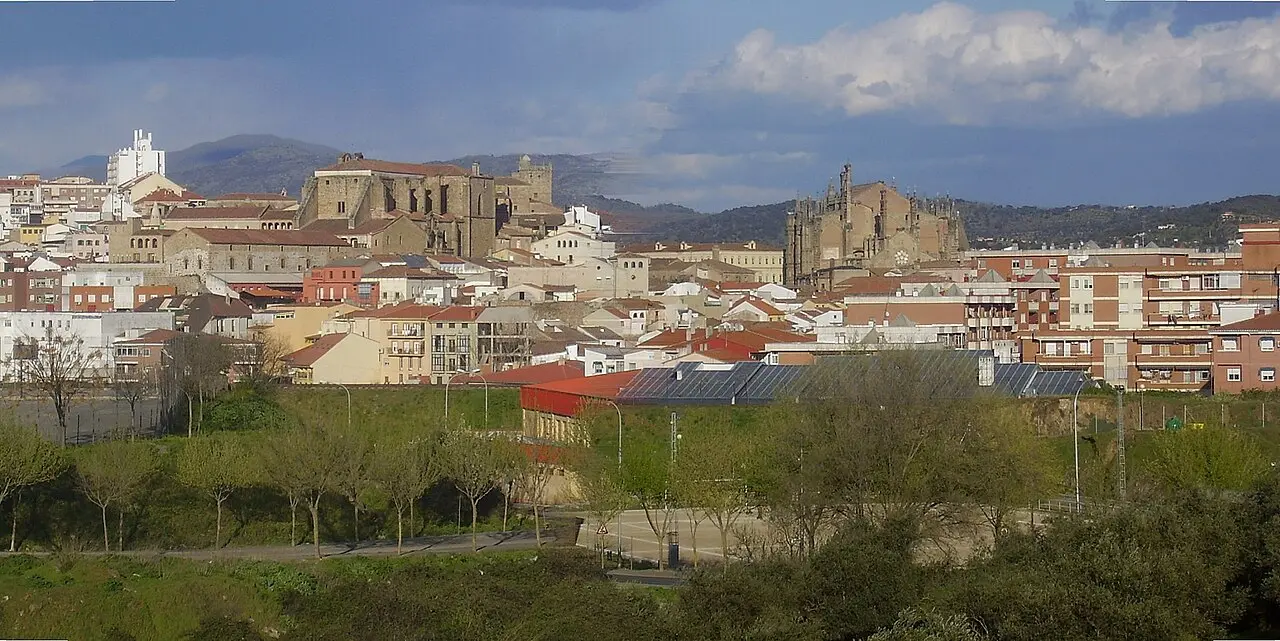
Plasencia
ExtremaduraClimate
Plasencia breaks the mold of Extremadura’s cities: up close it brings together the “city of the two cathedrals,” a walled medieval old town with a Renaissance aqueduct that cost more to build than the New Cathedral itself, and a Latin motto (“Ut placeat Deo et hominibus“) that still presides over its Town Hall. You don’t come here just to see monuments; you arrive at a crossroads between the Jerte Valley, La Vera, and Monfragüe, with 40,000 residents who live by the festival calendar, the Martes Mayor (August’s main market day) in August, and the next batch of Torta del Casar cheese. It’s a city to explore on foot, savor through tapas, and understand best when someone tells you its stories.
The must-seesWhat to see in Plasencia: the essentials
Plasencia Cathedrals (Old Cathedral and New Cathedral)
Plasencia boasts a unique case in Spain: two cathedrals literally attached to each other, one medieval and one Renaissance, because the original idea was to demolish the old one as the new one progressed, but funding ran out and here they both remain, overlapping. The Old Cathedral is a jewel of full Romanesque style from the 13th century, with a Latin cross plan and ambulatory; the New Cathedral, from the 16th century, adds to the appeal with the classicism of Rodrigo Gil de Hontañón. From the upper coracotea of the Old Cathedral, the view stretching to the Jerte River valley meets the city’s Official Viewpoint, the Mirador of painter Sorolla: here the Valencian Joaquín Sorolla painted canvases such as “El Mercado” (The Market) (featuring the walls, the episcopal palace, the two cathedrals, and the Trujillo Bridge) and “La Fiesta del Pan” (The Bread Festival), commissioned by the Hispanic Society of America. It’s one of the most photographed views in Plasencia and a must-stop according to official guides. The practical tip: the combined ticket gives access to the cloister, ambulatory, and coracotea; check opening hours on the official Plasencia tourism website.
New Cathedral of Plasencia
This 16th-century Catholic temple rises just north of the Old Cathedral, with its facade of Renaissance columns and niches already signaling the shift in taste compared to the Romanesque style of the neighboring church. Although it shares much of the spotlight with its neighbor, it deserves a leisurely visit for the crossing vault and the sensation of walking between two centuries in just a few steps.
Parque de los Pinos (Pines Park)
Plasencia’s great green lung spans five hectares with a character all its own: the highest point reaches 415 meters in altitude while the lowest sits at 380 meters, giving the park a rugged relief that turns it into a small mountain pine forest within the city limits. Ash trees and other native tree species grow on its slopes, and the park hosts varied wildlife. It’s the perfect escape for a hot summer afternoon or for stretching your legs between monument visits.
Church of San Esteban
This church in the historic center, documented as the building iglesia de San Esteban, is part of Plasencia’s medieval religious heritage, where Romanesque and Gothic temples abound, open for worship and visits.
Palacio de los Monroy (Monroy Palace)
The Palacio de los Monroy, popularly known as the “Casa de las Dos Torres” (House of the Two Towers), is a 14th-century noble palace built by the powerful Monroy family, one of the most influential in Extremadura. Within its walls stayed figures such as María de Monroy la Brava, King Ferdinand the Catholic, Saint Peter of Alcántara, and Cardinal Bernardino de Carvajal. Its facade, with heraldic coats of arms, was renovated in the 19th century with large openings in neo-Gothic and Renaissance style, and it preserves the famous lions at its doors, a symbol that it could not be under any jurisdiction other than its own.
Puerta de Trujillo
Also known as Puerta de la Salud or Cañacón de la Salud, this gate in the medieval wall dates from the 13th century and was the main entrance to the city, flanked by two round towers or cubes. In 1488 an inscription was carved alluding to the return to royal jurisdiction, and in 1498, after the rule of the Zúñiga lordship, the Catholic Monarchs took Plasencia, an event commemorated in the Lápida de la Libertad (Stone of Freedom). Today, sections of the original route remain and it allows passage through to Calle Trujillo.
Acueducto de San Antón
Built in the 16th century to replace an old clay pipeline of Muslim origin that brought water from the sierras of Cabezabellosa and El Torno, its cost even exceeded that of the New Cathedral. Today it retains ashlar arches and pillars within the Parque de San Antón, also known as Arcos de la Iniciativa. Along with the city walls, it is one of the most photographed structures in Plasencia.
Plaza Mayor de Plasencia
The nerve center of the medieval old town is already documented in the Cántigas of Alfonso X The Wise following the Miracle of the Bull of Plasencia. It historically functioned as a bullring and today is presided over by the Town Hall, whose main tower is popularly known as “el Abuelo Mayorga” (Grandfather Mayorga). The Miracle, recorded in the Cántigas of Alfonso X, tells how a scribe leaving his house on the square did not notice the bullfight and the Virgin interceded so that nothing would happen to him.
Convento de Santa Clara (Capilla de las Claras)
Founded in the 15th century by the Poor Clares, the convent stands out for the Capilla de las Claras (Chapel of the Clares), an example of the extreme Gothic-Mudéjar architecture of Plasencia. It is one of the landmarks of the city’s historical-artistic heritage.
Museo Etnográfico Textil Pérez Enciso
The museum is dedicated to the textile legacy of the region, with collections that include looms, traditional clothing, and tools of the Extremaduran wool industry. It is one of the leading ethnographic museums in northern Extremadura. It is located at Plazuela Marqués de la Puebla s/n and is managed by the Diputación de Cáceres (Provincial Council of Cáceres).
Iglesia de Santa Ana
A church documented as a building in Plasencia that adds to the religious heritage of the old town.
Iglesia del Salvador
Another historic church in Plasencia, included in the monumental route through the medieval old town.
Antiguo cementerio judío del Berrocal
Former Jewish cemetery of Plasencia, a testament to the city’s medieval religious diversity.
Fosa común sin nombre 1025/2009 CACE
A Spanish Civil War mass grave recorded in the map of graves, a site of historical memory.
Canchal
Geodetic vertex in Plasencia, a geographical reference point of the city.
Fuente del Sapo
Geodetic vertex in Plasencia, another geographical reference point of the municipality.
🍂 Otoño
Si visitas Plasencia en otoño las temperaturas bajan y pueden caer lluvias, así que conviene ir con paraguas y alguna capa extra. En octubre se celebra la Feria de la Tapa, ideal para recorrer bares y probar sabores locales después de visitar la Catedral Nueva de Plasencia. Consejo práctico: planifica las visitas a cubierto, como la Catedral Vieja, y deja los exteriores para las horas centrales del día.
What to do in Plasencia
Plasencia offers a unique festive calendar: the Martes Mayor (Great Tuesday) in August recreates the medieval market with farmers, livestock breeders, artisans, and merchants filling the Plaza Mayor and the walled old town, with fruit and vegetable competitions, drummers, crafts, traditional dress, and balcony decorations; the evening before, Lunes Menor (Lesser Monday), brings an artisan market, street parades, traditional craft workshops, and the nighttime runway of the “Inspiración Extremadura” Fashion Show. In January, Noche de Antruejos (Masquerade Night) is celebrated the evening before with costumes, and on the day itself, local associations and the City Council offer wines, liqueurs, typical sweets, and migas extremeñas (Extremaduran fried breadcrumbs) accompanied by drummers, with the presentation of the “San Fulgencio” awards. In June, the Ferias y Fiestas (Fairs and Festivities) fill the center with troupes, brass bands, and social clubs, afternoon bullfights featuring top matadors, nighttime casetas (festival booths) in the Berrocal park, and children’s fairground rides. In August, the International Folk Music Festival turns the Plaza Mayor into a leading musical and cultural stage in Extremadura. And in October, the Feria de la Tapa (Tapas Fair) puts three special tapas per bar up for competition, voted on by a jury and by local residents.
Plasencia in a day: express itinerary
- 09:00 — Breakfast with migas extremeñas at a bar in the Plaza Mayor and a first photo of Abuelo Mayorga on the clock tower of the Town Hall.
- 10:00 — Joint visit to the two Cathedrals (Old and New), with a climb to the Old Cathedral’s rooftop terrace to see the viewpoint that painter Sorolla captured over the Jerte River valley.
- 12:30 — Walk along the medieval wall, passing through the Puerta de Trujillo (Trujillo Gate) and heading down toward the San Antón Aqueduct, one of the must-have photos.
- 14:00 — Tapas crawl through the historic center: patatas revolconas (paprika mashed potatoes), frite de cabrito (fried kid goat) or caldereta (lamb stew), with a glass of local wine.
- 17:00 — Pérez Enciso Ethnographic Textile Museum and, if there’s time, the churches of San Esteban and El Salvador, and the Palacio de los Monroy (Casa de las Dos Torres).
- 19:00 — Stroll through Parque de los Pinos to walk off lunch and enjoy the views at 415 meters above sea level.
- 21:00 — Dinner with trucha a la extremeña (Extremaduran-style trout), cured meats from the dehesa, and a dessert of Jerte cherries if in season.
Where to eat in Plasencia: local gastronomy
Where to stay in Plasencia
| Zona | Perfil | Precio orientativo |
|---|---|---|
| Casco Histórico | Monumental, medieval, junto a Catedrales, muralla y Plaza Mayor. Ideal para todos los viajeros. | Medio-alto |
| Pinar de Trujillo | Residencial, tranquilo, con gran zona verde al norte. Ideal para familias. | Medio |
| La Coronada | Tradicional, cerca del casco histórico y la estación de autobuses. Ideal para mochileros. | Económico |
| San Antón | Histórico extramuros, popular, junto a la Ermita de San Antón y acceso al río Jerte. Ideal para todos. | Medio |
| Las Américas | Expansión urbana del siglo XX, bloques de pisos, sin monumentos. Ideal para familias. | Medio |
| Garganta Caliente | Periférica, cerca de la vía férrea y zonas industriales. Sin atractivo específico para el visitante. | No recomendado |
How to get to Plasencia
From Cáceres, the fastest option is the train: 34 min (Intercity), 8 a day.
| From | Direct train | Direct bus | Car |
|---|---|---|---|
| Cáceres | 34 min · 8/day Intercity | 1 h · 8/day ALSA | 1 h 79 km |
| Mérida | 1 h 18 min · 3/day Regional | 2 h · 6/day ALSA | 1 h 45 min 153 km |
| Sevilla | 5 h 02 min · 3/day Regional | 4 h 20 min · 5/day ALSA | 3 h 46 min 340 km |
| Madrid | 3 h 01 min · 5/day Regional | — | 2 h 56 min 254 km |
| Talavera de la Reina | 1 h 22 min · 6/day Regional | — | 1 h 33 min 130 km |
| Leganés | 2 h 45 min · 5/day Intercity | — | 2 h 46 min 245 km |
| Salamanca | — | 1 h 40 min · 4/day ALSA | 1 h 37 min 129 km |
| Badajoz | 1 h 22 min · 2/day Intercity | 3 h 10 min · 1/day ALSA | 2 h 13 min 169 km |
| Gijón | — | 7 h 05 min · 2/day ALSA | 5 h 10 min 464 km |
| Oviedo | — | 6 h 35 min · 2/day ALSA | 4 h 59 min 445 km |
Direct trains and buses from the official timetables published by the operators on Spain's National Transport Access Point (a reference Wednesday); driving times from OpenStreetMap. Operators that do not publish their timetables may run more services. Check the timetable before you travel.
How to get around Plasencia
Plasencia is easy to explore on foot: the city walls, the Cathedrals, Plaza Mayor, the San Antón Aqueduct and the medieval old town are all within very short distances of each other. For trips to the outskirts or to reach Parque de los Pinos and neighbourhoods such as Las Américas, Pinar de Trujillo or Garganta Caliente, the city has an urban bus service.
Weather in Plasencia
Best time to visit Plasencia
Day trips from Plasencia
Plasencia is the perfect base for exploring northern Extremadura: the municipality borders six comarcas (Jerte Valley, La Vera, Monfragüe and its surroundings, Alagón Valley, Ambroz Valley and Trasierra-Tierras de Granadilla), although it does not form part of any of them. To the north, the gateway to the Jerte Valley is literally in Plasencia, with villages such as Cabezuela del Valle, Jerte or El Torno, famous for their cherries (D.O.P.), the natural pools known as gargantas and the cherry blossom in spring. To the east, La Vera (with Villanueva de la Vera or Jarandilla de la Vera) offers pimentón de la Vera (D.O.P. smoked paprika), monasteries and the Route of Charles V. To the south, Monfragüe National Park, with its castle, the Salto del Gitano rock face and abundant wildlife, is just a few kilometres away. To the west, the Ambroz Valley (Hervás, Granadilla) and the Alagón Valley complete the circle with heritage and nature.
Things about Plasencia you didn’t know
Two cathedrals, one city. Plasencia has two cathedrals that literally overlap because the plan was to gradually demolish the old one as the new one was built, but funding ran out and both have survived to the present day.
Abuelo Mayorga strikes the hours. In the clock tower of Plasencia City Hall, an articulated figure known as Abuelo Mayorga (Grandfather Mayorga) strikes the bells to announce each hour; its origins date back to the 15th century.
A Plasencia-born marquis and falconer. Fadrique de Zúñiga y Sotomayor, born in 1475 in Plasencia, was the 1st Marquis of Mirabel, chief huntsman to Emperor Charles V and author of the «Libro de Cetrería de Caza de Azor» (Book of Falconry for Hunting with Goshawks).
A Latin motto that lives on. Plasencia’s motto is «Ut placeat Deo et hominibus», which in Latin means «To please God and men».
Who Plasencia is for
Plasencia is ideal for lovers of history and medieval heritage (two cathedrals, palaces, city walls, churches), for foodies who want to tuck into migas (fried breadcrumbs), patatas revolconas (mashed potatoes with paprika), caldereta (lamb stew), Torta del Casar and Iberian ham, and for couples and families looking for a walkable historic centre combined with excursions to the Jerte Valley, La Vera and Monfragüe. Backpackers will find budget accommodation in La Coronada, close to the old town, while families will appreciate the quiet of Pinar de Trujillo and the green space of Parque de los Pinos.
💡 ¿Sabías que...?
- ● Plasencia tiene dos catedrales solapadas porque se pensó en ir derribando la vieja a medida que se construía la nueva, pero la financiación desapareció y ambas llegaron hasta nuestros días. (https://www.lasexta.com/viajestic/curioso/catedral-nueva-vieja-plasencia-cual-historia-que-curiosidades-esconde_2023071764b503ff1f11910001f30dbb.html)
- ● El Abuelo Mayorga es una figura articulada en la torre del reloj del Ayuntamiento de Plasencia que golpea las campanas para anunciar cada hora, y su origen se remonta al siglo XV. (https://caceresdiario.com/curiosidades/plasencia)
- ● Fadrique de Zúñiga y Sotomayor nació en 1475 en Plasencia y fue I marqués de Mirabel, montero mayor del emperador Carlos V y autor del «Libro de Cetrería de Caza de Azor». (https://es.wikipedia.org/wiki/Fadrique_de_Z%C3%BA%C3%B1iga_y_Sotomayor)
- ● El lema de Plasencia es «Ut placeat Deo et hominibus», que en latín significa «Para que agrade a Dios y a los hombres». (https://es.wikipedia.org/wiki/Plasencia)
Frequently asked questions about Plasencia
How many days do I need to see Plasencia?
With one full day you can see the two Cathedrals, the Plaza Mayor, the Puerta de Trujillo, the Acueducto de San Antón, the Palacio de los Monroy, the Parque de los Pinos and the Museo Etnográfico Textil Pérez Enciso. With two days, you can add the Templo de Sancto Antaón, San Esteban, El Salvador and the old Jewish cemetery of El Berrocal, and enjoy the tapeo (bar-hopping for tapas) at a relaxed pace.
What is the best time of year to visit Plasencia?
From May to September, according to AEMET, with an average temperature of 26.3°C in summer and 8.6°C in winter, and annual rainfall of 617.4 mm. For cherry blossoms, the Valle del Jerte is best enjoyed especially in March-April.
How do I get to Plasencia from Madrid?
By train, to Plasencia station, with no AVE service, using regional services according to Renfe. You can also arrive by intercity bus from Cááááácerez and other cities in Extremadura.
Does Plasencia have a designated beach?
No. Plasencia is an inland city, in the province of Cááááácerez, with a natural setting of valley and mountains (Valle del Jerte, La Vera, Monfragüe) and no coastal developments.
Where to go for tapas in Plasencia?
The historic center, around the Plaza Mayor, concentrates most of the tapas bars and restaurants, with classic migas, patatas revolconas, dehesa cured meats and Torta del Casar as staples.