Mérida
ExtremaduraClimate
Daily budget
Walking its streets is like traveling directly back to 25 BC, yet with the comforts of a modern capital of 58,000 inhabitants that pulses to the rhythm of history. Mérida is not merely an open-air museum where Roman stone dominates the landscape; it is a living city, seat of government institutions and home to a tradition that blends the solemnity of Holy Week (Semana Santa) with the Classical Theater Festival under the stars. Here, the tranquility of Extremadura gives way to the grandeur of an imperial past that still defines every corner today, from the 800 meters of its bridge to the intimacy of its crypts.
The must-seesWhat to See in Mérida: The Essentials
Mérida boasts an Archaeological Ensemble declared a UNESCO World Heritage Site in 1993, where stone tells the story of the ancient Emerita Augusta.
Roman Theatre and Amphitheatre
These impressive Roman structures are the beating heart of the city, where plays and gladiatorial combats were once held, respectively. The Theatre, with its restored stage, continues to host the International Classical Theatre Festival every summer, while the oval-shaped Amphitheatre showcases the rawness of ancient entertainment. To visit them, note that opening hours vary by season: from 9:00 to 18:30 in winter, extending until 21:00 in summer, and admission is required to access this monumental site.
National Museum of Roman Art
This building, designed by Rafael Moneo, houses a vast collection of Roman artifacts found in Mérida, offering a deep insight into the life and art of the era. It is essential for understanding the context of the ruins you will see later, as it exhibits statues, mosaics, and everyday objects that bring the stone to life. The museum opens from 9:30 to 18:30 in winter and until 20:00 in summer; admission is required, making it a mandatory stop under the UNESCO seal since 1993.
Aqueduct of Los Milagros
This imposing Roman aqueduct is one of the city’s most photographed postcards, standing out for its tall columns of brick and granite rising into the landscape. Its original function was to bring water to the city from the Proserpina reservoir, demonstrating the advanced hydraulic engineering of the colony. Although there are no interior visiting hours as it is an external structure, viewing it from the surroundings is free and essential to understanding the logistics of the ancient city.
Crypt of the Basilica of Santa Eulalia
Included in the itinerary of the Consorcio Ciudad Monumental de Mérida, this crypt preserves the remains of the basilica dedicated to the city’s patron saint. Excavations of the subsoil reveal a fascinating historical evolution of the space, including phases of Roman houses and a Christian necropolis predating the current temple. It is a place of great spiritual and archaeological value that connects religious tradition with the Roman foundations of the city.
Roman Bridge
Nearly eight hundred meters long, this engineering work built at the time of the colony’s foundation is one of the longest preserved Roman bridges. Constructed of concrete faced with granite ashlars featuring sixty arches, its strategic location over the Anas River (Guadiana) made it the main entry point protected by the Muslim fortress. Crossing it allows you to feel underfoot the history of two millennia of uninterrupted transit.
Other Points of Interest
- Alcazaba Árabe (Arab Fortress): Muslim fortress built on Roman structures, offering panoramic views of the Guadiana River and the Roman Bridge.
- Circo Romano (Roman Circus): One of the best-preserved Roman circuses in the world, where chariot races were held.
- Casa del Mitreo and Columbarios: Roman residence with impressive mosaics and a Roman necropolis.
- Área Arqueológica de Morería: Archaeological site of 12,000 square meters next to the river covering Roman, Visigothic, Islamic, and medieval phases.
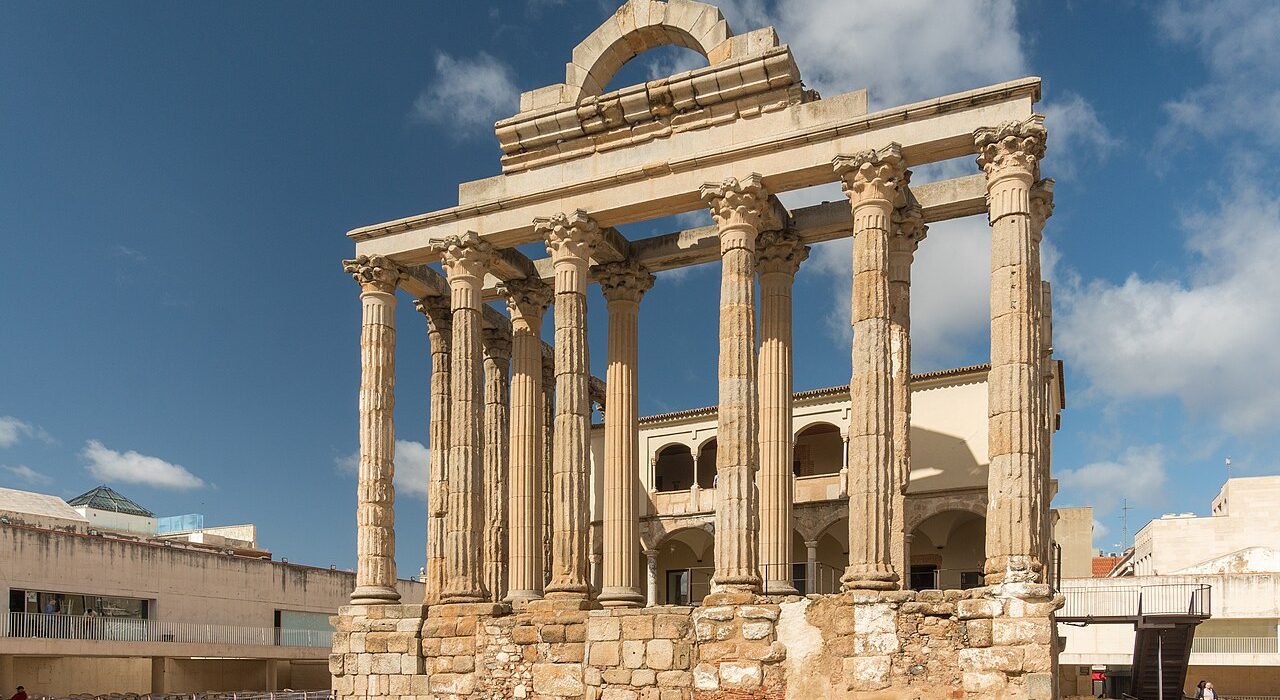
- Templo de Diana (Temple of Diana): Ancient Roman temple dedicated to imperial worship, part of the old forum square of the city.
🍂 Otoño
Si visitas Mérida en otoño, el clima sigue siendo agradable hasta octubre con menos aglomeraciones turísticas. Es el momento ideal para fotografiar los monumentos con una luz más dorada y tranquila. Asegúrate de verificar los horarios de los museos porque comienzan a ajustarse a la temporada baja.
What to do in Mérida
Mérida offers top-tier cultural activities, highlighted by its International Classical Theater Festival in July and August, the most important and oldest in Spain, held at the historic Roman Theater (Teatro Romano). Beyond culture, you can immerse yourself in local life by visiting the Calatrava Market on Calle Félix Valverde Lillo or the Plaza de Abastos, a former convent and a central urban landmark, to buy fresh produce. If you travel in spring, Holy Week (Semana Santa), declared a Festival of International Tourist Interest, transforms the city with processions that wind through the Roman monuments, creating a unique contrast between faith and ancient stone.
Mérida in one day: express itinerary
To make the most of a short visit, follow this optimized route covering the essentials without stress:
- 09:30 – National Museum of Roman Art (Museo Nacional de Arte Romano): Start here to contextualize everything you will see later; the morning light streams wonderfully through its skylights.
- 11:30 – Roman Theater and Amphitheater (Teatro y Anfiteatro Romano): Walk from the museum to the main archaeological site to see the structures where the Romans performed.
- 14:00 – Lunch in the Historic Center: Head to the area of the Temple of Diana (Templo de Diana) to eat something typical near the forum.
- 16:30 – Roman Bridge and Alcazaba: Cross the 800-meter bridge and climb up to the Alcazaba for the best panoramic views of the sunset over the Guadiana.
- 18:30 – Basilica of Santa Eulalia: End the day by visiting the crypt and surroundings of this neighborhood full of charm and history.
Where to eat in Mérida: local gastronomy
Where to stay in Mérida
Centro Histórico
El corazón de Mérida, donde se concentran los impresionantes monumentos romanos como el Teatro, Anfiteatro y Templo de Diana, ideales para sumergirse en la historia.
Santa Eulalia
Un barrio con encanto que combina tradición y modernidad, hogar de la histórica Basílica de Santa Eulalia y bien conectado con el centro.
San Juan
Uno de los barrios más antiguos del centro de la ciudad, ofreciendo un vistazo a la Mérida histórica y tradicional.
How to get to Mérida
Mérida’s connectivity is based mainly on land transport, with the Calamonte train station being the closest rail access point, although it does not have AVE service.
| Medio | Duración | Precio aprox. | Frecuencia |
|---|---|---|---|
| Tren (Estación Calamonte) | Variable según origen | Según Renfe | Diaria |
| Autobús | Variable | Económico | Regular |
| Coche | Depende de la ruta | Combustible | N/A |
Getting around Mérida
Once in the city, the city bus is the main public transport option for moving between different points of interest and neighborhoods. However, given the concentration of monuments in the Historic Center and Santa Eulalia, much of the visit can be comfortably done on foot, enjoying the walk among the ruins.
Weather in Mérida
Best time to visit Mérida
Day trips from Mérida
If you have extra time, Mérida’s location in the north of Badajoz province makes visiting nearby cities easy. Badajoz is a logical choice due to its proximity and status as provincial capital, offering a different urban experience. On the other hand, Cáceres, also in Extremadura, is another excellent destination to complement your trip, allowing you to compare two of the region’s heritage jewels on the same route.
Who is Mérida for?
Mérida is the perfect destination for history lovers and archaeology enthusiasts, given its UNESCO status and density of Roman monuments. It is also ideal for foodies who want to try authentic Extremaduran cuisine in a tranquil setting. With an average stay of 1.57 nights and 25% foreign travelers (INE data), it is a city that attracts quality cultural tourism, suitable for both couples and families seeking education and leisure. Accommodation prices, ranging from hostels at €20 to luxury hotels at €150, make it accessible for backpackers and travelers with larger budgets.
Frequently asked questions about Mérida
How many days do I need to see Mérida?
With an average stay of 1.57 nights according to the INE, a weekend is enough to see the essentials. A full day allows you to visit the Theatre, Amphitheatre, Museum, and Bridge, but two days will give you time for the Crypt of Santa Eulalia and to enjoy the gastronomy without rushing.
Is Mérida expensive?
No, it is quite affordable. An average meal costs between €12 and €20. Accommodation varies from €20-35 per night in hostels to €90-150 in 4-5 star hotels, making it competitive compared to other tourist capitals.
What is the best time to visit Mérida?
The best time is from April to October, avoiding winter cold (average of 9.7°C) and taking advantage of summer temperatures (average of 25.6°C) for outdoor festivals like the Classical Theatre Festival.
How do I get to Mérida from Madrid?
The most direct option is by train to Calamonte station (note that there is no direct AVE to Mérida city center) or by car. There are also regular bus services connecting Spain’s capital with the capital of Extremadura.