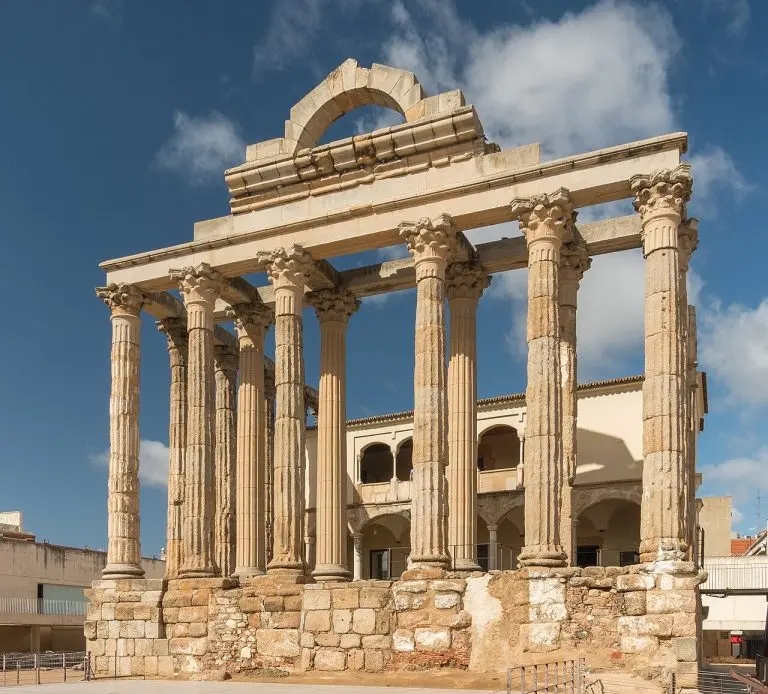
Badajoz → Mérida
60 kmThere is something deeply Extremaduran about covering the mere 60 kilometres that separate Badajoz from Mérida: the sense of travelling through a land that was once a frontier, a crossroads of civilisations and Rome’s larder. In under an hour, you leave behind the most populous city in Extremadura to stand before a Roman theatre that is still standing two thousand years later, with the option of stopping in villages where time is measured in church bells and hearty spoon dishes.
How to get from Badajoz to Mérida: quick summary
There are three direct ways to cover the 60 km between Badajoz and Mérida: by private car on the A-5 (45 minutes), by Renfe train (between 30 and 46 minutes depending on the service) and by ALSA or LEDA bus (47 minutes, for €4-7). If you’re after the fastest and most flexible option, the car just edges out the ALVIA train. If you don’t want to drive, the train is unbeatable for frequency: 12 trains a day between 06:50 and 19:48. The bus is the cheapest alternative for those travelling on a tight budget.
By car from Badajoz to Mérida
The drive is made entirely along the A-5, the Autovía del Suroeste, with no tolls and an estimated duration of 45 minutes for the 60 km route. Of those 60 km, around 51 km run along this motorway, making the trip a comfortable, straightforward drive. The A-5 connects Badajoz with Madrid via Mérida, so the road surface is in good condition and the signage is clear. There are no mountain passes or tricky bends: it’s a route across the Extremaduran plain, with dehesa dotted with holm oaks on both sides and, on clear days, a light that bathes the landscape in golden tones. As it’s a high-capacity road, traffic is usually light, though it’s worth keeping an eye on stretches with access to agricultural estates. If you leave Badajoz early in the morning, you’ll arrive in Mérida with plenty of time to make the most of the day.
By train from Badajoz to Mérida
Renfe operates 12 direct trains a day between Badajoz and Mérida stations, with departures from 06:50 to 19:48. The fastest service is the ALVIA, which covers the route in 30 minutes and runs 3 times a day. There are also MD (Media Distancia) trains with 5 daily departures and a duration of 30 minutes, plus 2 REGIONALES in 43 minutes and 2 REGIONALES EXPRÉS in 45 minutes. The range of timetables makes it easy to plan either a full-day escape or a half-day visit. The departure and arrival stations are central in both cities, making it easy to get around on foot or by urban transport on arrival. Although the exact price isn’t specified, the train is usually slightly more expensive than the bus, but it makes up for it with the speed of the ALVIA and the comfort of the seats.
By bus from Badajoz to Mérida
The direct bus between Badajoz and Mérida is operated by ALSA and LEDA, with a duration of 47 minutes and a price ranging from €4 to €7. It’s the cheapest option for getting between the two cities and, with a duration practically identical to that of the car, it’s highly competitive. Buses usually leave from Badajoz bus station and arrive at Mérida’s, both well connected. For travellers without their own car who want to save money, the bus is the logical choice: for less than €7 you’re in the centre of Mérida in under an hour. The frequency is sufficient to organise your day, though it’s worth checking timetables in advance as they can vary by season.
Recommended stops along the way
If you’re travelling by car, you can turn a 45-minute journey into a route with a taste of Extremadura by making two short stops that barely take you off the A-5.
Montijo
Montijo is the first natural stop when leaving Badajoz. This town in the province of Badajoz, located very close to the motorway, is a good place to stretch your legs and have a coffee before carrying on. Its town centre retains the feel of a large Extremaduran town, with quiet squares and local life revolving around the market and the traditional bars. You don’t need more than 20-30 minutes for a pleasant stop. If you’re travelling with children or simply want to avoid an early start, Montijo is the perfect spot for an unhurried breakfast.
Talavera la Real
Talavera la Real is another convenient stop alongside the A-5. Known for its proximity to the Air Base and its religious heritage, this village offers an authentic picture of Lower Extremadura. It’s ideal for a short stop, to stretch your legs and perhaps buy some bread or local products in one of the shops in the centre. Being so close to Badajoz, many travellers overlook it, but precisely for that reason it retains a leisurely pace that is welcome before plunging into the tourist bustle of Mérida.
Where to stay in Mérida
Mérida concentrates its accommodation offer in three main areas: the historic centre, the area around the train station and the outskirts with car access. Staying in the historic centre is the most convenient option for visiting the Roman Theatre, the Amphitheatre and the National Museum of Roman Art on foot, with hotels and guesthouses in renovated buildings ranging from 50-70 € per night in mid-season to more than 100 € on key weekends. The station area offers functional and somewhat cheaper accommodation, ideal if you arrive by train or bus and don’t want to lug suitcases around. For those travelling by car, the outskirts have roadside hotels and tourist apartments with easy parking, with prices that usually range between 45 and 80 €. Mérida is not an expensive city for accommodation, but in spring and autumn, when the weather is ideal for strolling, it’s worth booking in advance.
Where to eat along the route
Extremaduran cuisine is one of the great draws of this short trip. These are the dishes and products you should try, whether in Badajoz before setting off, at the stops along the way or once you reach Mérida.
Migas extremeñas
A traditional dish made with crumbled stale bread sautéed with garlic, paprika and olive oil, to which torreznos, chorizo or pancetta are added. It is a hearty dish, typical of Extremaduran thrifty cooking, perfect for starting the day with energy or as a lunch on cold days. In roadside bars and in the villages along the route it is easy to find as a generous portion.
Gazpacho extremeño
A cold soup of tomato, pepper, cucumber, garlic, bread and olive oil, typical of the Extremaduran summer. It differs from Andalusian gazpacho in its thicker texture and the use of day-old bread. In the hot months it is the perfect dish for a light stop before continuing on to Mérida.
Torta del Casar
Although its origin is in Casar de Cáceres, this soft-paste cheese made with Merino sheep’s milk and vegetable cardoon rennet can be found throughout Extremadura. With a hard rind and creamy interior, it is eaten spread on bread or as an accompaniment. It is a must if you like cheese with character.
Jamón de bellota ibérico
Coming from Iberian pigs raised on the dehesa and fed on acorns, it is the region’s flagship product. Its intense flavour and melting texture make it the perfect appetiser in any bar along the route. Order a portion with rustic bread and you won’t need much more.
Queso de la Serena
Made with Merino sheep’s milk and vegetable rennet in the Badajoz district of La Serena, this soft-paste cheese has an intense, slightly spicy flavour. It can be cured or fresh, and is an excellent alternative or complement to the Torta del Casar for those who want to compare nuances.
Vino de Ribera del Guadiana
The Ribera del Guadiana designation of origin covers red, white and rosé wines from all over Extremadura, with varieties such as Tempranillo, Garnacha and Cayetano. Pair any of the above dishes with a young local red and you’ll understand why this region is one of the great unknown corners of Spanish wine.
Frequently asked questions about the Badajoz-Mérida route
How long does it take from Badajoz to Mérida?
By car, the journey along the A-5 takes 45 minutes for 60 km. By train, the ALVIA and the MD take 30 minutes, while the REGIONAL and REGIONAL EXPRÉS services take 43 and 45 minutes respectively. By bus, ALSA and LEDA cover the route in 47 minutes.
Which is cheaper, the train or the bus?
The bus is the most economical option, with prices between 4 and 7 €. The Renfe train has no fixed price published here, but it is usually more expensive than the bus, especially on the high-speed ALVIA services. If saving is your priority, choose the bus; if speed is your priority, the ALVIA train gets you there in 30 minutes.
Is it worth renting a car?
It depends on your plan. If you’re only going to visit Mérida, the train or bus are enough and save you the hassle of parking. But if you want to stop in Montijo and Talavera la Real, or explore the surroundings of Mérida freely, a rental car is the best option. The A-5 is free and the journey is short and straightforward.
When is the best time to travel?
Spring and autumn are the best seasons to travel this route: mild temperatures, spectacular light and fewer crowds than in the height of summer. The Extremaduran summer can be very hot for walking around Mérida, while winter, though mild, limits the hours of daylight for combining stops and visits.
📍 También te puede interesar
Qué ver en Badajoz →
Qué ver en Mérida →