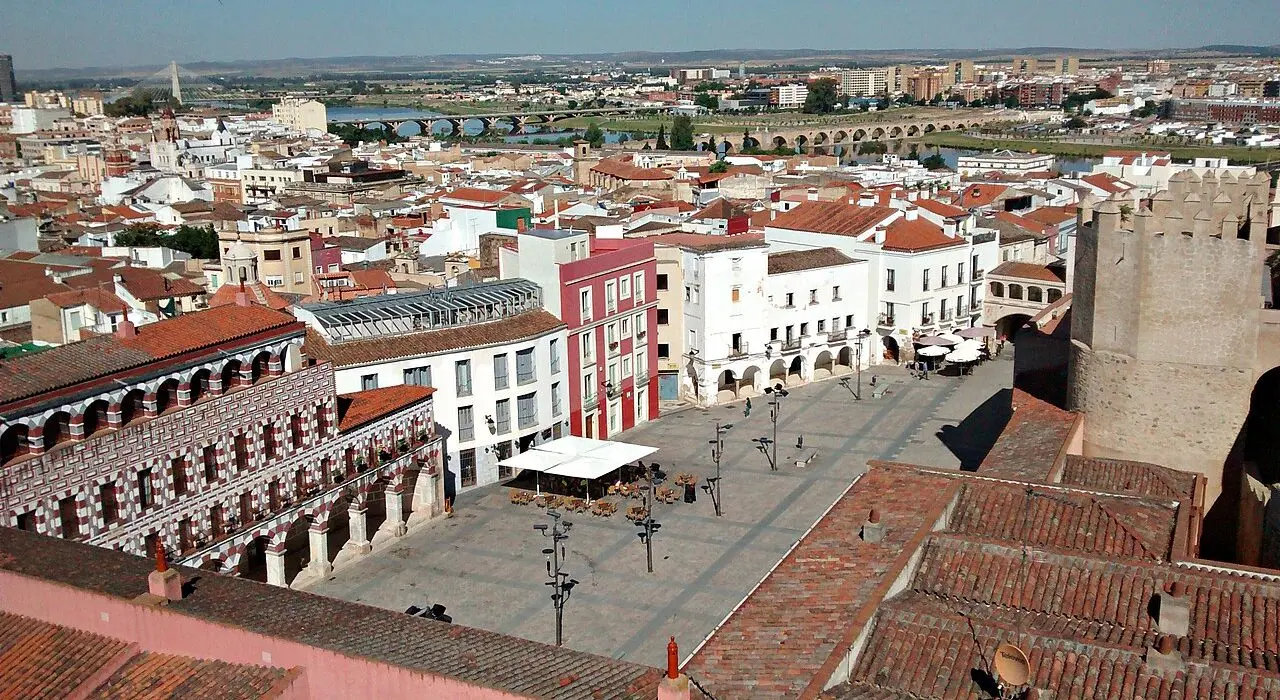
Badajoz
ExtremaduraClimate
Daily budget
It’s seven in the evening and the sun no longer beats down on the Puerta de Palmas. From the bank of the Guadiana, the Renaissance façade with its two crenellated cylindrical towers is reflected in the water while someone orders a caña at a nearby terrace. Badajoz doesn’t announce itself loudly, and perhaps that’s why it draws you in: it lets you discover it at your own pace, among Almohad walls, squares with centuries of history and a cuisine that smells of Iberian ham and freshly made migas.
The must-seesWhat to see in Badajoz: the must-sees
Badajoz concentrates its most valuable heritage in the Old Town (Casco Antiguo), with the Alcazaba as the star attraction. Most of the important monuments can be visited on foot and at a leisurely pace, making it ideal for a weekend.
Alcazaba of Badajoz
The Alcazaba is the city’s great historical and monumental complex and the one visit you simply cannot skip. Its origins date back to the founding of Badajoz in 875 by Ibn Marwan, who built the first adobe and rammed-earth walls in 878. Inside the walled enclosure, towers, stretches of wall and inviting spaces are preserved, offering views over the Guadiana River and much of the city. It opens from 10:00 to 18:00 and admission is charged, so it’s worth checking prices and possible reservations before you go.
Cathedral of San Juan Bautista of Badajoz
This is Extremadura’s metropolitan-ranking Catholic temple, a building with the look of a fortress that sums up centuries of Badajoz history. Its visiting hours are 11:00 to 13:00 and 18:00 to 19:00, and admission is required. It’s well worth approaching both from the outside and within, especially if you’re interested in religious architecture with a defensive character.
Puerta de Palmas
The Puerta de Palmas is Badajoz’s most emblematic gate and one of those places you inevitably end up photographing. It has a Renaissance-style façade with two crenellated cylindrical towers; the side facing the river is structured around a double semicircular arch with coffering, medallions and the imperial coat of arms of Charles V. On the opposite façade you’ll see an attached section with a terrace and a triple niche, as well as an inscription alluding to the faith on the outer face. It’s the best starting point for understanding the city’s relationship with the Guadiana.
Roman villa of La Cocosa
This is an archaeological site corresponding to a Roman villa located within the municipality of Badajoz. It’s a perfect plan for those who want to trace the Roman past of the area beyond the city centre. It’s worth finding out in advance about access and visiting conditions, since its opening arrangements are not always the same as those of the monuments in the centre.
Extremaduran and Ibero-American Museum of Contemporary Art
This museum is a contemporary art centre dedicated to Spain, Portugal and Ibero-America, an unusual combination that reflects Badajoz’s border position. It opens from 10:00 to 20:00, generous hours that make it easy to fit into any part of the day. If you’re interested in current creation, here you’ll find a different perspective on the city.
Puente de Palmas
Monumental Herrerian-style granite bridge crossing the Guadiana River.
Museum of Fine Arts of Badajoz
Museum of the city of Badajoz, Spain.
Provincial Archaeological Museum of Badajoz
Museum in Badajoz, Spain.
López de Ayala Theatre
Theatre in Badajoz.
Veterinary Museum of Badajoz
Spanish museum.
Extremaduran Sports Museum
Museum of Extremaduran sport in Badajoz, Spain.
Hermitage of Bótoa
Marian temple on the outskirts of the city of Badajoz.
Church of Santa Catalina
Church of Santa Catalina.
Luis de Morales City Museum
The museum is structured around the so-called Casa Luis de Morales, in the heart of the Old Town, and includes an attached new-build building. Conceived as an innovative space, it serves as a guide to interpreting the past, present and future of Badajoz. On the ground floor of the annex there is a temporary exhibition room, and the museum also houses the municipal tourist office.
Plaza de Minayo
Square located in the city of Badajoz, Spain.
Plaza Alta
Historical and monumental complex and one of the most characterful squares in Badajoz, Spain.
Plaza de San Francisco
Square in Badajoz, Extremadura, Spain.
🍂 Otoño
Si visitas Badajoz en otoño, el calor remite y el ambiente se vuelve muy cómodo para caminar. Es otra de las mejores épocas para subir a la Alcazaba de Badajoz o asomarte a La Giralda de Badajoz sin sudar. Un consejo práctico: revisa el cielo antes de salir y lleva un paraguas plegable por si cae alguna lluvia breve.
What to do in Badajoz
Badajoz offers strolls through its Old Town, nightlife in Valdepasillas, museum visits and getaways to the surrounding Guadiana area, all without the crowds of other Spanish capitals.
The most natural plan begins by crossing the Puerta de Palmas (Palms Gate) and heading up to the Alcazaba, then getting lost in streets such as San Pedro de Alcántara, where the Museo de la Ciudad Luis de Morales is located. If you’re after atmosphere, Valdepasillas is the modern neighbourhood with the widest choice of bars, restaurants and nightlife. For opening hours, tickets and cultural events, check the official Badajoz tourism website.
Badajoz in a day: express itinerary
- 10:00 – Alcazaba de Badajoz: start with the city’s most important monument, with its foundational walls and views over the Guadiana. It opens at 10:00 and requires a ticket.
- 12:00 – Catedral de San Juan Bautista: time it with its morning opening hours, from 11:00 to 13:00. A brief but unmissable visit.
- 13:30 – Puerta de Palmas and Puente de Palmas: a stroll past the Renaissance façade and a walk across the river to see the city from the far bank.
- 14:30 – Lunch: look for migas extremeñas, acorn-fed Iberian ham or lamb caldereta in the centre or in Valdepasillas.
- 17:00 – Museo Extremeño e Iberoamericano de Arte Contemporáneo: open until 20:00, ideal for the afternoon.
- 19:30 – Plaza Alta and Old Town: round off the day with a walk through the historic squares before dinner.
Where to eat in Badajoz: local cuisine
Where to stay in Badajoz
Casco Antiguo
El corazón histórico de la ciudad, ideal para pasear y descubrir monumentos.
Valdepasillas
Barrio moderno con una gran oferta de bares, restaurantes y vida nocturna.
How to get to Badajoz
From Mérida, the fastest option is the train: 30 min (Intercity), 11 a day.
| From | Direct train | Direct bus | Car |
|---|---|---|---|
| Mérida | 30 min · 11/day Intercity | 44 min · 11/day ALSA | 47 min 62 km |
| Cáceres | 46 min · 10/day Regional | — | 1 h 22 min 91 km |
| Madrid | 4 h 32 min · 4/day Intercity | — | 4 h 27 min 403 km |
| Talavera de la Reina | 3 h 02 min · 5/day Intercity | — | 3 h 04 min 280 km |
| Leganés | 4 h 15 min · 4/day Intercity | — | 4 h 17 min 395 km |
| Ciudad Real | 4 h 12 min · 2/day Regional | — | 3 h 51 min 309 km |
| Plasencia | 1 h 25 min · 1/day Intercity | — | 2 h 10 min 169 km |
Direct trains and buses from the official timetables published by the operators on Spain's National Transport Access Point (a reference Wednesday); driving times from OpenStreetMap. Operators that do not publish their timetables may run more services. Check the timetable before you travel.
Getting around Badajoz
Badajoz has an urban bus service for getting around the city. Even so, the Casco Antiguo (Old Town) and most of the main monuments are easy to explore on foot, especially if you’re staying in the centre. Valdepasillas is a bit further out, so the urban bus comes in handy for going out to dinner or a night out without relying on a car.
Weather in Badajoz
Best time to visit Badajoz
Day trips from Badajoz
The most natural day trip from Badajoz is to Mérida, the capital of Extremadura and a city with an impressive Roman legacy. It’s well connected by road and rail, making it easy to go and return in a day. It’s the perfect complement if you want to add Roman archaeology to your trip, especially after visiting the Roman villa of La Cocosa in the municipality of Badajoz.
Badajoz curiosities you never knew
A city founded in the 9th century with traces of half a million years. Badajoz was founded in 875 by Ibn Marwán, but there’s evidence of human settlements in its surroundings since the Lower Palaeolithic, roughly half a million years ago.
Twice the capital of an independent kingdom. First in the time of the governor Ibn Marwan, in 868, when he built the first adobe and rammed-earth walls in 878; later, after the taifa kingdoms formed when the Córdoba caliphate collapsed in the early years of the 11th century.
Philip II moved the entire Court to Badajoz. It happened in 1580, while the campaign to occupy Portugal was underway. That’s no small thing: for a time, the city was the centre of imperial power.
The most outstanding poet of the 18th century was from the province. Juan Meléndez Valdés was born in Ribera del Fresno, in the province of Badajoz, in 1754, and was a full member of the Royal Spanish Academy.
The only urban SPA in Spain is here. Badajoz is home to the country’s only urban Special Protection Area for Birds, a fact that surprises those who expect nothing but monuments and gastronomy.
The original Arabic name, Batalyaws. It derives from the founding carried out by Ibn Marwán in the 9th century. According to some sources, his initial intention was to settle on the Cerro de San Cristóbal, but he ultimately founded the city on the Cerro de la Muela.
Who Badajoz is for
Badajoz is ideal for history lovers and unhurried travellers who prefer to discover a city without stress. It works very well for couples looking for strolls through the Casco Antiguo, foodies interested in jamón ibérico, migas and Extremaduran cheeses, and backpackers thanks to its moderate prices. It’s not a beach destination or a place for big theme parks, but if you like border tourism, archaeology and unpretentious tapas, it’ll suit you perfectly.
💡 ¿Sabías que...?
- ● Badajoz fue fundada en el año 875 por Ibn Marwán, aunque hay constancia de asentamientos humanos en sus proximidades desde el Paleolítico Inferior, hace aproximadamente medio millón de años. (https://es.wikipedia.org/wiki/Historia_de_Badajoz)
- ● Badajoz fue por dos veces capital de un reino independiente: primero en tiempos del valí Ibn Marwan (868), que construyó las primeras murallas de adobe y tapial en 878, y después tras formarse los reinos de taifas al derrumbarse el califato cordobés en los primeros años del siglo XI. (https://www.aytobadajoz.es/es/ayto/historia)
- ● En 1580, Felipe II trasladó la Corte al completo a Badajoz mientras se desarrollaba la campaña de ocupación de Portugal. (https://es.wikipedia.org/wiki/Badajoz_(Espa%C3%B1a))
- ● El poeta Juan Meléndez Valdés, nacido en Ribera del Fresno (Badajoz) en 1754 y considerado «el poeta más destacado dentro de las corrientes líricas del siglo XVIII», fue académico de número de la Real Academia Española. (https://www.rae.es/academico/juan-melendez-valdes)
- ● Badajoz cuenta con la única Zona de Especial Protección para las Aves (ZEPA) urbana de todo el país. (https://es.wikipedia.org/wiki/Badajoz_(Espa%C3%B1a))
- ● El nombre árabe original de Badajoz, «Batalyaws», deriva de la fundación que Ibn Marwan realizó en el siglo IX; según algunas fuentes su intención inicial era establecerse en el Cerro de San Cristóbal, pero finalmente fundó la ciudad en el Cerro de la Muela. (https://publicaciones.4gatos.es/historiabadajoz/chapter/fundacion-y-anos-posteriores/)
Frequently asked questions about Badajoz
How many days do I need to see Badajoz?
With two full days you can see the essentials: the Alcazaba, the Cathedral, the Puerta de Palmas, the Puente de Palmas and the main museums. If you want to add the Roman villa of La Cocosa or a day trip to Mérida, consider three days.
Is Badajoz expensive?
No. An average meal costs between 15 and 25 €, a hostel between 20 and 35 € per night and a 3-star hotel between 60 and 90 € per night. It is one of the most affordable Spanish capitals for eating and sleeping well.
What is the best time of year to visit Badajoz?
Spring and autumn, according to average temperature data: 26 °C in summer and 9 °C in winter. Summer is the worst time because of the heat, especially at midday.
How do I get to Badajoz from Madrid?
You can arrive by direct train from Madrid to Badajoz Station, without AVE, or by bus with Alsa. By road, the A-5 connects Madrid directly with Badajoz. Check schedules and prices with Renfe or the bus company.
Does Badajoz have an airport?
Yes, Badajoz Airport (BJZ) is 14 km from the city. It is worth checking operations and frequencies before planning, as it does not have the flight volume of other peninsular airports.