Terrassa
CataluñaClimate
What to see in Terrassa: the essentials
The first time you stroll through Terrassa, you understand why this Catalan city of 226,000 inhabitants gets under your skin: in a single morning you can go from a medieval castle with a moat and drawbridge to an old textile factory turned national museum, with stops in between at Modernista gems that look like something out of a Gaudí dream. There are no tourist crowds here, but there is a surprising density of heritage.
Catedral del Sant Esperit
The Catedral del Sant Esperit (Cathedral of the Holy Spirit) is an essential monument in the heart of Terrassa’s old town. Its presence dominates the Plaça Vella and the web of medieval streets that surround it, making it the natural starting point for any exploration of the city. I recommend approaching it both by day, when the light bathes its façade, and at dusk, when the square comes to life with its terraces and the comings and goings of the people of Terrassa.
Museu Nacional de la Ciència i de la Tècnica de Catalunya
The mNACTEC occupies the old Vapor Aymerich, Amat i Jover, built in 1907 by Lluís Muncunill and considered one of the finest examples of Catalan industrial Modernisme. Walking through its interior is a journey back to the era when Terrassa was a textile engine of Catalonia, with machines, looms and spaces that explain the Industrial Revolution. It is a visit that surprises even those who don’t consider themselves museum-goers, because the building itself is already worth the admission.
Masia Freixa
The Masia Freixa is that building you see on postcards and never forget: a Modernista whim inspired by Gaudí, built between 1905 and 1910 by Lluís Muncunill i Parellada on the structure of an old textile factory belonging to the industrialist Josep Freixa. Its rounded profiles and use of the parabolic arch make it one of the architectural jewels of Terrassa’s Modernista heritage. It stands in the Ca n’Aurell neighbourhood, presiding over the Parc de Sant Jordi, and currently houses municipal offices with an assembly hall, lobby and an open-air arcade available for events and catering services.
Estació de Terrassa Estació del Nord (ADIF)
The Estació del Nord is a railway monument that forms part of the city’s architectural legacy. Its heritage value has made it a regular stop on the routes that trace Terrassa’s industrial Modernisme.
Castell Cartoixa de Vallparadís
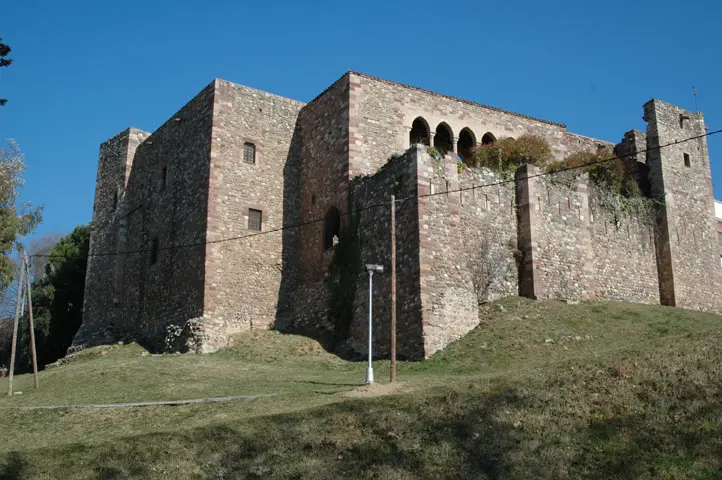
The Castell Cartoixa de Vallparadís is one of those surprises you don’t expect to find in the middle of a city: a 12th-century medieval castle preserved in perfect condition, with a moat, four towers and a drawbridge. Converted into a Carthusian monastery between the 14th and 16th centuries, it now houses the main headquarters of the Museu de Terrassa, with the Sala del Tinellet for temporary exhibitions and a permanent exhibition tracing the evolution of the territory and human settlement in the region. Restored in the 1950s, it is a visit that combines medieval history and museum exhibits in a single space.
Casa Alegre de Sagrera
It is located at Carrer de la Font Vella, 29-31, forms part of the Museu de Terrassa and general admission costs 3.00 €, with a reduced rate of 2.00 € for those over 65, students, groups of more than 20 people, people with disabilities and large families, and is free for children under 6 and residents of Terrassa.
Mercat de la Independència
A Modernista market from the early 20th century included on Terrassa’s industrial Modernisme route, with iron and glass architecture that makes it an active commercial and gastronomic space right in the city centre.
Claustre del Convent de Sant Francesc d’Assís
The cloister of the Convent de Sant Francesc is one of Terrassa’s most outstanding heritage spaces, a testament to the former Franciscan presence in the city, with arcaded galleries combining Gothic and Renaissance elements that is now part of the tourist itineraries of the city’s medieval and modern legacy.
Seu d’Ègara (Episcopal Complex of Ègara: Sant Pere, Sant Miquel and Santa Maria)
The Episcopal Complex of Ègara is an early medieval gem made up of the churches of Sant Pere, Sant Miquel and Santa Maria, the former seat of the diocese of Egara and one of the most important episcopal complexes in Europe. Inside, highlights include the Romanesque frescoes of Santa Maria, the wall paintings of Sant Miquel and the crypt and apse of Sant Pere. It is located on Plaça del Rector Homs, about 15 minutes on foot from the centre, and visits require a ticket with set times, with guided tours available to book on 937 397 072 or at museudeterrassa@terrassa.cat.
Casa Soler i Palet (Tourist Office)
A former Modernista manor house that now houses Terrassa’s Tourist Office at Carrer Font Vella, 28, where, as well as practical information, you can find exclusive products from local artisans and artists inspired by Modernisme, the industrial heritage and the Parc Natural de Sant Llorenç.
Torre del Palau and Centre d’Interpretació de la Vila Medieval
A medieval tower that formed part of Terrassa’s former castle-palace, the only surviving remnant of that fortification and declared a Bé Cultural d’Interès Nacional (Cultural Asset of National Interest), which today houses the Centre d’Interpretació de la Vila Medieval and allows visitors to see in situ a section of the moat, an underground gallery, an ice house and a bread oven from 1839.
Plaça Vella
Plaça Vella is the social and commercial heart of Terrassa, surrounded by bars and cafés, and a regular venue for open-air cultural activities such as the concerts of the Jazz Terrassa festival.
Parc de Sant Jordi
Parc de Sant Jordi is a landscaped space presided over by the Masia Freixa, with paths, shaded areas and trees that make it a benchmark for leisure and relaxation, as well as a setting for cultural activities and popular celebrations.
Museu Tèxtil
The Museu Tèxtil is a museum dedicated to the city’s textile legacy, linked to the industrial history that shaped Terrassa’s identity.
Casa Baumann
Casa Baumann is a monument that forms part of Terrassa’s Modernista architectural heritage.
Sala Muncunill
Sala Muncunill is a monument linked to the legacy of the architect Lluís Muncunill, a key figure in Terrassa’s industrial Modernisme.
Antic Ajuntament de Terrassa
The Antic Ajuntament de Terrassa is a historic monument located in the city centre, a witness to Terrassa’s administrative and urban evolution.
🍂 Otoño
Si visitas Terrassa en otoño, el ambiente se vuelve más tranquilo y el clima empieza a refrescar, ideal para planes de interior. Es una buena ocasión para visitar el Museu Nacional de la Ciència i de la Tècnica de Catalunya o el Museu Tèxtil sin aglomeraciones. Lleva calzado cómodo y una prenda de abrigo ligera para los cambios de temperatura.
What to do in Terrassa
Terrassa offers a range of activities that combine heritage, local life and open-air culture. You can start the day by exploring the municipal markets, such as the Mercat de la Independència with its iron-and-glass architecture, or the Mercat Municipal de Sant Pere with its fresh, local produce stalls, and then follow an industrial Modernisme route that takes you from the Masia Freixa to the mNACTEC. Historic neighbourhoods such as Sant Pere invite you to get lost in narrow streets with a village atmosphere, while the Parc de Sant Jordi is perfect for a shady break among the trees.
Cultural life has its natural stage in Plaça Vella, especially during the Jazz Terrassa festival, when the square fills with open-air concerts. If you’re looking for a more local experience, the Ca n’Aurell neighbourhood is packed with shops and restaurants buzzing with daily life, ideal for unhurried shopping or tapas. And for those travelling at a leisurely pace, the itineraries connecting the Episcopal Complex of Ègara with the Castell Cartoixa de Vallparadís offer a complete immersion in the city’s medieval history.
Terrassa in a day: express itinerary
- 9:30 – Seu d’Ègara: start with the episcopal complex of Sant Pere, Sant Miquel and Santa Maria, one of Europe’s early medieval treasures. Book ahead if you want a guided tour.
- 11:30 – Castell Cartoixa de Vallparadís: cross the Parc de Vallparadís to this 12th-century castle with a moat and drawbridge, home to the Museu de Terrassa.
- 13:00 – Plaça Vella and the old town: stroll through the city’s most emblematic square and climb the Torre del Palau to understand the town’s medieval origins.
- 14:00 – Lunch in the centre: make the most of the bars and restaurants in the area to try local cuisine, with market options such as the Mercat de la Independència.
- 16:30 – Masia Freixa and Parc de Sant Jordi: visit this Modernista gem with its undulating forms and relax in its gardens.
- 18:00 – mNACTEC: end the day at the former Vapor Aymerich, Amat i Jover, one of the finest examples of Catalan industrial Modernisme.
Where to eat in Terrassa: local cuisine
Where to stay in Terrassa
Centre
El centro histórico y comercial de Terrassa, con calles peatonales, plazas y edificios modernistas. Ambiente animado durante el día y vida nocturna moderada.
Vallparadís
Zona residencial tranquila al norte del centro, conocida por el Parc de Vallparadís y el conjunto monumental de las iglesias de Sant Pere. Ideal para pasear y descansar.
Sant Pere
Barrio histórico alrededor de las iglesias de Sant Pere, con calles estrechas y ambiente de pueblo. Alberga parte del conjunto monumental y el mNACTEC.
Ca n'Aurell
Barrio céntrico y comercial, con mucha actividad diaria y una gran oferta de tiendas y restaurantes. Ambiente local y bullicioso.
La Maurina
Barrio obrero y residencial con ambiente auténtico y diverso. No es una zona turística típica, pero ofrece una visión real de la vida local.
Can Palet
Barrio residencial al sur de la ciudad, tranquilo y con servicios básicos. Poco orientado al turismo, pero útil para estancias largas o presupuestos ajustados.
How to get to Terrassa
| Medio | Duración | Precio aprox. | Frecuencia |
|---|---|---|---|
| Tren (Rambla) | Variable según origen | Según tarifa de Renfe | Consultar horarios |
| Bus urbano | Dentro de la ciudad | Tarifa urbana | Frecuente |
Terrassa Rambla train station connects the city with the rail network of the province of Barcelona. Bear in mind that it has no high-speed (AVE) services, so medium- and long-distance journeys require connections. To plan exact times and fares, check Renfe’s official channels.
Getting around Terrassa
Urban transport in Terrassa is built around a network of city buses connecting the main neighbourhoods and points of interest. To get between the centre, Vallparadís, Sant Pere, Ca n’Aurell and other areas, the bus is the most practical option if you don’t want to walk, although the historic centre and the main monuments are perfectly explored on foot. Terrassa Rambla train station serves as a hub for combining city journeys with regional connections.
Weather in Terrassa
Live webcam — Matadepera*
Terrassa* The nearest webcam to Terrassa is in Matadepera, 5.2 km away.
Source: Windy Webcams
Best time to visit Terrassa
Day trips from Terrassa
Terrassa is an excellent base for exploring other cities in the Barcelona region. Its rail connection from Terrassa Rambla station makes for comfortable trips to nearby destinations without the need for a car. Its proximity to the Catalan capital and to other towns in the Vallès Occidental makes Terrassa a strategic point for combining industrial heritage, nature and city life on a single getaway. Check the official Terrassa tourism website for more practical information on opening hours, tickets and what’s on.
Terrassa curiosities you didn’t know
The name Terrassa has Latin roots: it derives from Terracia, which may come from Terracium castellum (‘earth castle’) or mean ‘terrace’ or ‘flat land area’. A hint that the city’s identity has been tied to its territory for centuries.
The Cartoixa de Vallparadís castle is a rarity in Catalonia: a medieval 12th-century castle that preserves its moat, four towers and a drawbridge right in the city centre. Few cities can boast such a complete fortress integrated into their main park.
The Vapor Aymerich, Amat i Jover, now home to the mNACTEC, was built by Lluís Muncunill in 1907 and is considered one of the finest examples of Catalan industrial modernism. It’s proof that factories can be works of art too.
Terrassa is known as the ‘City of Film’ and is home to several universities such as the UPC, ESCAC, Institut del Teatre and EUIT. That university and creative buzz shows in the cultural life and the year-round programme of activities.
In 2024, Terrassa was awarded the Council of Europe’s ‘Europe Prize’ for its outstanding commitment to European values. A recognition that speaks to the city’s open, civic character.
The journalist, writer and politician Josep Roca i Roca was born in Terrassa in 1848 and died in Barcelona in 1924, leaving a cultural mark that connects the city to the history of Catalan journalism and literature.
Who Terrassa is for
Terrassa is a city for those seeking heritage without the crowds, living history and authentic local life. Families enjoy the parks, the markets and the calm of neighbourhoods like Vallparadís; history and architecture lovers have a solid case for staying several days in the industrial modernism, the Episcopal ensemble of Ègara and the medieval castle; and foodies find in the local sweets, proximity cheeses and Bib Gourmand restaurants a dining scene that keeps on giving. Backpackers and budget travellers also have their place in neighbourhoods like La Maurina or Can Palet, where the city shows itself without filters. Terrassa isn’t a single-postcard destination, but a place to explore slowly and discover layer by layer.
Frequently asked questions about Terrassa
How many days do I need to see Terrassa?
With one well-planned day you can cover the essentials: Seu d’Ègara, Castell Cartoixa de Vallparadís, Plaça Vella, Masia Freixa and mNACTEC. But if you want to visit the museums, markets and industrial modernisme at a leisurely pace, two or three days is ideal.
What is the best time of year to visit Terrassa?
From May to August, with an average temperature of 23.0°C in summer, is the most pleasant period for strolling and enjoying terraces and outdoor activities. In winter the average drops to 8.0°C, but museums and indoor spaces can be enjoyed without the crowds.
How do I get to Terrassa from Madrid?
Terrassa does not have an AVE station, so from Madrid the usual route is to take a high-speed train to Barcelona and from there connect with the Cercanías or regional network to Terrassa Rambla station. Check schedules and fares with Renfe.
What typical sweets should I try in Terrassa?
La Palaudina is the most local sweet, a cylindrical cake made with almonds, hazelnuts, chocolate and ratafia created by the Terrassa Pastry Guild. Also highly prized are the Cardinal, made with meringue and cream, and the Rocs de Munt, crunchy pastries with almond and nuts.
Does Terrassa have restaurants recommended by the Michelin Guide?
Yes, Terrassa has two Bib Gourmand restaurants —El Vapor Gastronòmic and El Cel de les Oques— and one restaurant in the Michelin selection, Casa Nita, all offering locally sourced cuisine and good value for money.