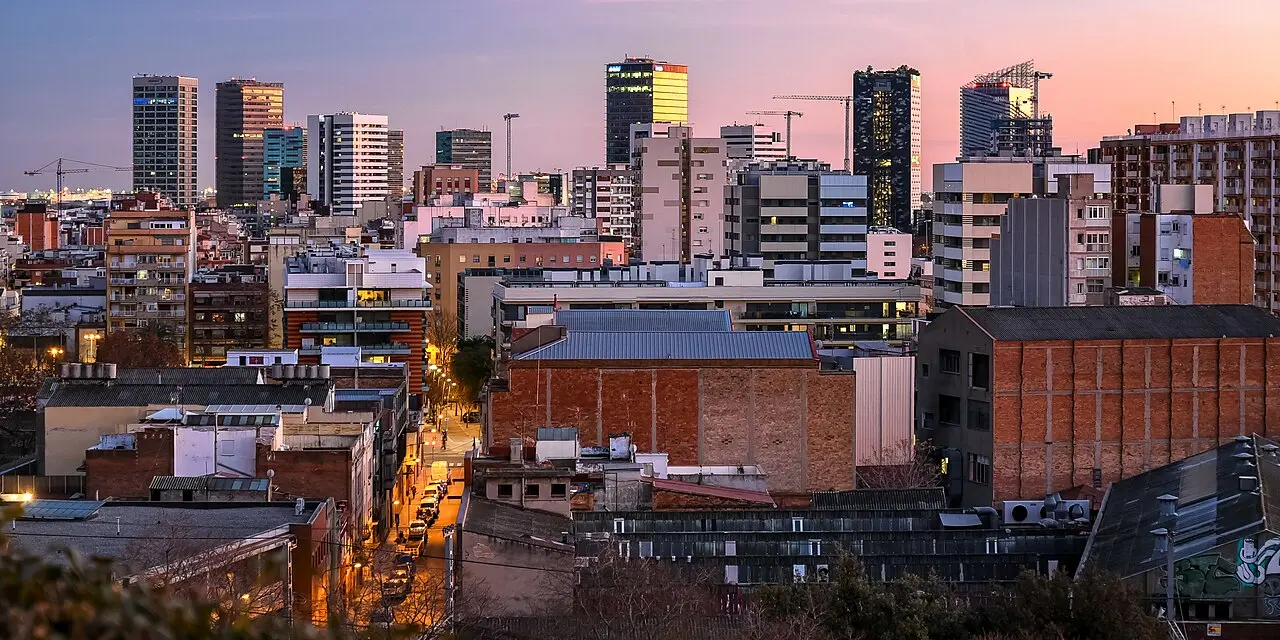
L'Hospitalet de Llobregat
CataluñaClimate
What to see in L’Hospitalet de Llobregat: the essentials
L’Hospitalet doesn’t compete with Barcelona for monuments, and that’s precisely why it has a charm you can enjoy without the crowds. Its heritage is on a human scale, spread across restored mansions, street sculptures with a story, and corners known only to those who live here. If you come with the mindset of discovering an authentic city, without the tourist filter, it will surprise you.
Museu d’Història de l’Hospitalet
This museum is the gateway to understanding why such a densely populated city holds Iberian remains from the 4th century BC. Its main site occupies a restored historic building and preserves the town’s archaeological and documentary heritage, including the legacy of ancient Provençana. It’s a short but very well thought-out visit, ideal for starting any tour of the city with some context. Check opening hours before you go, as they vary by season.
Castell de Bellvís
This palace is one of L’Hospitalet’s most unusual historic buildings, and its name evokes the views once enjoyed from its location. Although it isn’t always open to the public on a regular basis, its exterior and surroundings are well worth a stroll. It’s a reminder that this city was much more than an industrial expansion district.
Can Modolell de la Torre
Another palace that speaks to the area’s seigneurial past, now absorbed into the urban fabric. Its restoration has preserved architectural features of interest and allowed it to host cultural uses. If Catalan civil architecture interests you, it’s a stop that takes just a few minutes and leaves a good impression.
l’Harmonia
This monument is part of L’Hospitalet’s urban landscape and often goes unnoticed by those who aren’t looking for it. Its value lies in the dialogue between public art and everyday space, something very characteristic of this city. Don’t expect a major tourist landmark, but rather a piece you discover on foot.
Al·legoria a l’escut de l’Hospitalet
Two vertical blocks of board-marked concrete mimic the saltire cross of Santa Eulàlia, the symbol that appears on L’Hospitalet’s coat of arms. These two blocks interlock and support four pieces of the same material, in red, which complete the composition. It’s a sculpture that sums up the city’s character very well: direct, without artifice, and with historical roots.
Other points of interest
Monument a Josep Anselm Clavé: Rectangular monolith with a relief plaque showing the musician’s profile portrait and a terracotta figure of a child crowning the ensemble.
Monument a la Sardana: Overlapping blocks with a terracotta figure of a seated person playing an instrument, a tribute to the traditional Catalan dance.
l’Acollidora: Bronze sculpture depicting a female figure with a round tray, on a limestone base.
Monument a Francesc Batallé: Triangular prismatic monolith with a bronze bust of the schoolteacher and side bas-reliefs carved in stone.
XXXI Trobada Mundial de Penyes Barcelonistes: Irregular column with mixed textures that splits into two fragments at the top, with simulated wood below and black stone above.
Mirafielo: Titled “Miracielo”, it is an irregular hollowed copper cylinder on three legs, representing a tree trunk with an opening at the top for contemplating the sky.
Conseqüències d’equilibri: A torso reflecting the female gender on one side and the male on the other, with an arm extended into a square tube that creates a triangle with the ground.
Marxa Atlètica: Cut iron pieces fixed to a cement wall representing a sporting scene with organic shapes of bodies in motion.
Càntic Solidari: Irregular pentagon with two headless anthropomorphic figures, one male and one female, holding hands and topped with a circle and a crescent moon.
Monument a Antonio Machado: On an iron plate, a cut-out silhouette of the poet’s bust and, at the bottom, the silhouette of his hand inside a hollowed square.
Pont de la Llibertat: Two bronze sculptures 4.5 metres tall and 3,500 kilos each, joined by a 20-metre-long stainless steel arch.
Monument a Salvador Espriu: Irregular stone monolith placed directly on the ground, with a text by the poet on one of its carved and polished faces.
🍂 Otoño
Si visitas L'Hospitalet de Llobregat en otoño, el clima empieza a refrescar pero sigue siendo cómodo para caminar. Septiembre aún permite disfrutar de La Mercè y la Festa Major de Ciutat Comtal antes de que llegue la calma. Lleva un paraguas plegable por si llueve y visita el Castell de Bellvís con menos gente.
What to do in L’Hospitalet de Llobregat
L’Hospitalet offers a surprisingly dense festive calendar for a city that many see only as a place to pass through: neighbourhood festivals with Catalan popular culture, multicultural celebrations, carnivals with parades and free community activities throughout the year. The best way to experience it is to join in neighbourhood life, unhurried and eager for conversation.
- Fiesta Mayor de La Florida (July): Catalan popular culture, concerts and free community activities in the La Florida-Les Planes neighbourhood. It is one of the most authentic festivals in the city, far from the tourist circuit.
- Festa Major de Ciutat Comtal (September): Popular, sporting, commercial and cultural activities in the streets of Sant Josep. Perfect for seeing how community life is organised in a residential neighbourhood.
- La Mercè (September): L’Hospitalet’s patron saint festival in honour of the Mare de Déu de la Mercè, with events spread across the whole city.
- Fiestas de Primavera (April): Spring celebration with cultural and festive activities, ideal for combining with good weather and terraces.
- Fiesta de la Diversidad (June): Ethnic and multicultural festival celebrating the city’s cultural diversity, a direct reflection of its demographic reality.
- Carnaval (February): Parades and activities in various neighbourhoods, with the active participation of neighbourhood associations.
L’Hospitalet de Llobregat in one day: express itinerary
With a full day you can capture the essence of L’Hospitalet without rushing. This itinerary combines heritage, public art and neighbourhood life, and can be done on foot or using public transport.
- 9:30 – Museu d’Història de l’Hospitalet: Start here to understand the Iberian origins and the evolution of the old Provençana. It’s a brief visit that gives you the keys to the rest of the day.
- 11:00 – Stroll through the Centre neighbourhood: Wander the narrow streets of the old town and the Plaça de l’Ajuntament. Here you can soak up the administrative and commercial atmosphere among historic buildings.
- 12:30 – Sculpture route: Look for the Al·legoria a l’escut de l’Hospitalet, the Monument a la Sardana and l’Acollidora. These are pieces you discover on foot and that tell the recent history of the city.
- 14:00 – Lunch in Collblanc or La Torrassa: Head down to these neighbourhoods bordering Barcelona to try escudella, migas or couscous in wine cellars and ethnic restaurants. The multicultural atmosphere is part of the journey.
- 17:00 – Castell de Bellvís and Can Modolell de la Torre: Round off the afternoon with these two palaces that showcase the city’s seigneurial past. If they aren’t open, the exterior and surroundings alone justify the walk.
- 19:30 – Tapeo in Sant Josep or Granvia Sud: End the day with calçots in season or cargols in one of the bodegas, toasting to a city that doesn’t look like the typical postcard.
⭐ Carrer Xipreret
Along just over 100 metres, the architectural history of the city is represented, with 27 elements protected on the street by the Special Plan for the Protection of Architectural Heritage. The origin of the street dates back to Roman times, when it served as a boundary between agricultural properties; it is here that the nucleus of L’Hospitalet formed, with the presence of the Torre Blanca (l’Harmonia).
⭐ Can Sumarro
A building of popular construction with modern and contemporary elements, dated between the 16th and 20th centuries (reference year 1580), declared a Bé Cultural d’Interès Nacional (BCIN R-I-51-4191 / MH-129) since 10 November 1975. It is located at Carrer de la Riera de l’Escorxador, 2-22 and 43-48, in the Centre neighbourhood of L’Hospitalet de Llobregat, at an altitude of 10 metres. It is one of the standout heritage elements of the Mapa de Patrimoni Cultural de L’Hospitalet, with record number 08101-79 and inventory IPA 138, and its state of conservation is good. Access is easy.
⭐ Palauet de Can Buxeres
The ancestral home of ca n’Alemany, a neoclassical-style palace with Modernista elements located within the Parc de Can Buxeres, one of the most outstanding heritage and garden complexes in the city of L’Hospitalet de Llobregat. The building, the work of architect Manuel Joaquim Raspall i Mallol, has a chronology spanning the 18th-20th centuries and is in a good state of conservation. It currently has a social use. It is protected as a Bé Cultural d’Interès Local (BCIL, record no. 26 of the PEPPA, 2001) and appears as a standout element in the Mapa de Patrimoni Cultural de L’Hospitalet, with inventory number IPA 20603. It is located in the Sant Feliu neighbourhood, with access via the Carretera d’Esplugues, 3-5.
⭐ Parc de Can Buxeres
It is one of the reference green spaces of L’Hospitalet de Llobregat and appears among the main attractions of the municipality in various sources. The complex preserves a manor house from 1911, accompanied by a nursery, gardens and sculptures by Héctor Cesena and Rafael Solanic. Dogs are allowed entry.
⭐ Teatre Joventut
Teatre Joventut, a municipal facility in L’Hospitalet de Llobregat dedicated to the performing arts and music. The theatre hosts the city’s professional programme of theatre, dance and music, as well as cultural and community activities for audiences in L’Hospitalet and the Barcelona metropolitan area. It has a box office open to the public from 9:00 to 15:00 and contact and information channels via its website and the phone number 934032930.
Local foodWhere to eat in L’Hospitalet de Llobregat: local gastronomy
Where to sleep in L’Hospitalet de Llobregat
Centre
Casco antiguo de L'Hospitalet, con calles estrechas y plazas como la Plaça de l'Ajuntament. Es el centro administrativo y comercial, con ambiente local y algunos edificios históricos.
Collblanc
Barrio denso y popular, limítrofe con Barcelona, con mucha vida comercial y de restauración. Ambiente multicultural y animado, bien conectado por metro.
La Torrassa
Barrio obrero y multicultural, con calles comerciales y plazas concurridas. Tiene un ambiente auténtico y diverso, con buena conexión en metro.
Sant Josep
Zona residencial y comercial con el importante centro comercial Gran Via 2 y el recinto de Fira de Barcelona. Ambiente moderno y bien comunicado.
Bellvitge
Barrio residencial planificado, conocido por el hospital de referencia y por su ambiente tranquilo. Tiene zonas verdes y buena conexión de transporte.
Gornal
Barrio residencial en la zona alta de la ciudad, con ambiente tranquilo y zonas verdes. Menos turístico pero bien conectado.
How to get to L’Hospitalet de Llobregat
L’Hospitalet is integrated into the Barcelona metropolitan area, so getting there is simple and quick from the Catalan capital. Gavarra train station is the local rail reference point, with no AVE service, and the urban bus covers the connection with the rest of the municipality.
| Medio | Duración | Precio aprox. | Frecuencia |
|---|---|---|---|
| Tren (estación Gavarra) | Variable según origen | Tarifa metropolitana | Según Renfe |
| Bus urbano | Variable según recorrido | Tarifa metropolitana | Alta en horas punta |
How to get around L’Hospitalet de Llobregat
The urban bus is the backbone of transport within L’Hospitalet, with lines connecting the different neighbourhoods to each other and to Barcelona. For short distances within the old town or between neighbouring districts such as Collblanc and La Torrassa, walking is perfectly viable and lets you discover the public art dotted around the streets.
Weather in L'Hospitalet de Llobregat
Best time to visit L’Hospitalet de Llobregat
Day trips from L’Hospitalet de Llobregat
L’Hospitalet’s location in the Barcelonés comarca makes it an excellent base for exploring the cities of the region. Barcelona is just a few kilometres away and can be reached by metropolitan transport in a matter of minutes, allowing you to alternate the calm of L’Hospitalet with the intensity of the Catalan capital. Other cities in the metropolitan area and the province are accessible by train or bus for half-day or full-day trips, without the need to change accommodation.
Fascinating facts about L’Hospitalet de Llobregat you never knew
An Iberian origin few would imagine. The first material remains of any significance found in L’Hospitalet date from the 4th century BC and belong to the Iberian culture. Before becoming a commuter town, this was Iberian territory.
The original name wasn’t L’Hospitalet. The municipality was called Provençana, a name that appears in written documents from the 10th century onwards. The name change is one of those stories the Museu d’Història (History Museum) explains very well.
A city by royal decree. On 15 December 1925, King Alfonso XIII granted L’Hospitalet the title of city. It wasn’t organic growth, but an institutional recognition of a population that already carried weight on the Catalan map.
A photographic archive that is a treasure trove. The Municipal Archive holds more than 5,500 historical images taken between 1955 and 1997 in its Geoportal. It’s a time machine for understanding the city’s urban transformation.
Ferran Adrià was born here. The chef who revolutionised world gastronomy was born on 14 May 1962 in L’Hospitalet de Llobregat. The city doesn’t boast about it as much as it should.
A pianist from Sant Josep. Anna Maria Albors was born on 7 September 1940 in the Sant Josep neighbourhood. Another local talent proving that this city has produced far more than factories and apartment blocks.
Who L’Hospitalet de Llobregat is for
L’Hospitalet is for travellers who prefer authenticity to the postcard, who don’t need spectacular monuments to enjoy a city and who value neighbourhood atmosphere over luxury. Backpackers will find affordable accommodation and a vibrant multicultural scene in Collblanc and La Torrassa. Families will enjoy the tranquillity of Bellvitge and Gornal, with green spaces and good connections. History lovers will discover an Iberian and medieval past that few expect. And foodies can go from bodega to bodega sampling escudella, cargols, migas and couscous without paying Barcelona prices. If you’re looking for a city that doesn’t pose for the photo, you’re going to like L’Hospitalet.
💡 ¿Sabías que...?
- ● Los primeros restos materiales de cierta importancia encontrados en L'Hospitalet datan del siglo IV a. C. y corresponden a la cultura ibérica. (https://l-h.cat/laciutat/265229_2.aspx?id=2)
- ● El 15 de diciembre de 1925, el rey Alfonso XIII otorgó a L'Hospitalet el título de ciudad. (https://l-h.cat/laciutat/265229_2.aspx?id=2)
- ● El nombre original del municipio era Provençana, que aparece en documentos escritos a partir del siglo X. (https://l-h.cat/laciutat/265229_2.aspx?id=2)
- ● El Archivo Municipal de L'Hospitalet dispone de más de 5.500 imágenes históricas tomadas entre 1955 y 1997 en su Geoportal. (https://www.elnacional.cat/es/barcelona/hospitalet-llobregat-siglo-xx-portal-comparte-mas-5500-imagenes-histori_1369220_102.html)
- ● El cocinero Ferran Adrià nació el 14 de mayo de 1962 en L'Hospitalet de Llobregat. (http://revistaibellvitge.blogspot.com/2011/12/reportatge-celebritats-de-lhospitalet.html)
- ● La pianista Anna Maria Albors nació el 7 de septiembre de 1940 en el barrio de Sant Josep de L'Hospitalet. (https://inventariarxiu.l-h.cat/index.php/actor/browse)
Frequently asked questions about L’Hospitalet de Llobregat
How many days do I need to see L’Hospitalet de Llobregat?
With a full day you can see the essentials: the Museu d’Història (History Museum), the old town, the palaces and several public sculptures. If you want to explore the neighbourhoods at a leisurely pace, sample the food in wine cellars and coincide with a local festival, two or three days will give you a much more complete experience. The city receives 453,581 travellers a year (INE) with an average stay of 2.15 nights, which confirms that it is a weekend or metropolitan stopover destination.
What is the best time of year to visit L’Hospitalet de Llobregat?
From May to September, with average summer temperatures of 23.3°C (AEMET) and a very busy festive calendar: Fiesta de la Diversidad (Diversity Festival) in June, Fiesta Mayor de La Florida (La Florida Main Festival) in July and La Mercè in September. Winter is mild, with an average of 9.2°C, but many activities are concentrated in the warmer months. Annual rainfall is 618.6 mm, so it is worth taking something for the rain in spring and autumn.
How do I get to L’Hospitalet de Llobregat from Madrid?
The fastest option is to reach Barcelona by high-speed train and from there connect to L’Hospitalet by commuter train to Gavarra station or by city bus. Gavarra station has no AVE service, so changing trains in Barcelona is mandatory. Total time depends on the connection, but the metropolitan leg is short and frequent.
Is L’Hospitalet de Llobregat safe for tourists?
L’Hospitalet is a densely populated city with working-class neighbourhoods, but the tourist experience goes smoothly if you take the usual precautions of any big city. The recommended neighbourhoods to stay in (Centre, Collblanc, La Torrassa, Sant Josep, Bellvitge, Gornal) are busy and have plenty of commercial and community life. As in any metropolitan area, it is worth keeping an eye on your belongings in crowded areas and on public transport.
Is L’Hospitalet de Llobregat a good base for visiting Barcelona?
Yes, it is an excellent option. It is just a few kilometres from the centre of Barcelona, well connected by train and city bus, and with more affordable accommodation prices. 75% of the travellers it receives are foreign (INE), many of whom use it as a metropolitan base. You will be able to return at night to a more local and authentic atmosphere, without giving up the proximity of the Catalan capital.