Elche
Comunidad ValencianaClimate
What to See in Elche: The Must-Sees
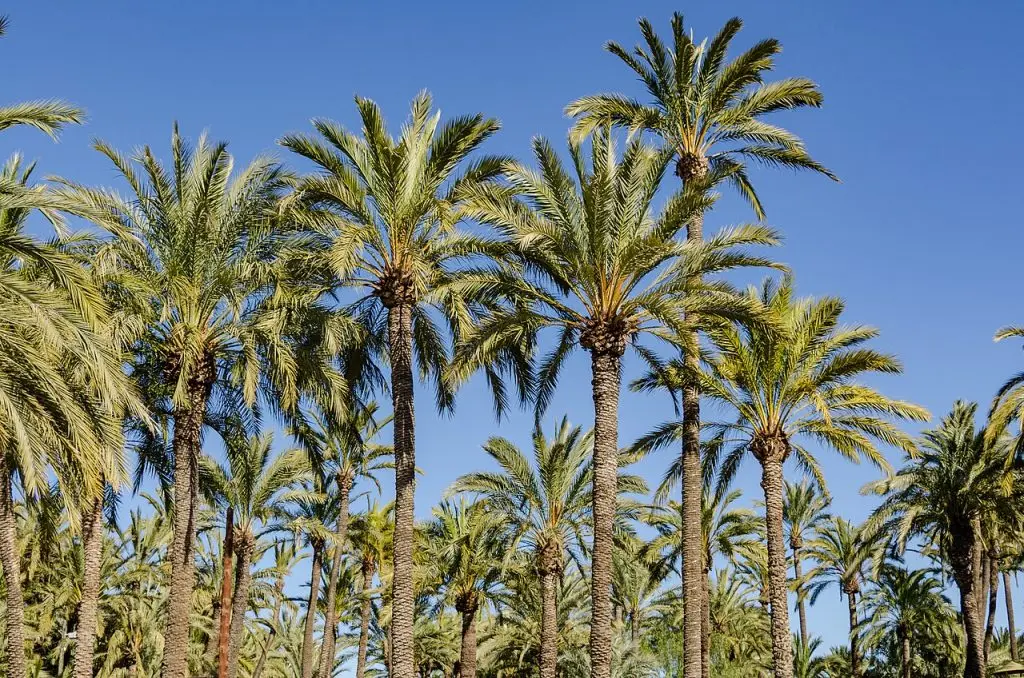
Elche looks like no other Spanish city. It has two faces that coexist without getting in each other’s way: on the one hand, an old town with centuries of history where, every August, the only medieval sacred-lyric drama still performed in the world is staged; on the other, an oasis of more than 200,000 palm trees declared a World Heritage Site that turns the simple act of strolling into something almost unreal. With 228,000 inhabitants, it is the second city in the province of Alicante, yet its pace of life remains surprisingly laid-back.
Palmeral de Elche
The Palmeral de Elche has been a UNESCO World Heritage Site since 2000, and rightly so: more than 200,000 date palms grow right in the city centre, creating a landscape found nowhere else in Europe. The museum dedicated to the Palmeral explains its history, its traditional irrigation system of Andalusian origin and the date palm culture that has shaped Elche’s identity for centuries. It is a visit that helps you understand why this place was recognised as a unique oasis, and it is best explored unhurried, letting the shade of the palms set the pace.
Misterio de Elche (Misteri d’Elx)
The Misteri d’Elx is a sacred-lyric drama of medieval origin depicting the death, assumption and coronation of the Virgin Mary, and it has been performed without interruption since the mid-15th century. Every year, on 14 and 15 August, the Basilica of Santa María and the streets of the old town become the stage for this unique work, declared Intangible Cultural Heritage of Humanity by UNESCO. The music, of medieval and Renaissance origin, is sung in Valencian and preserved in historical scores, with stage elements as singular as the mangrana, the cadafal and an aerial stage machinery for the Coronation. Tickets for the performance inside the basilica require advance booking, while access to the street moments is free. It is the only work of its kind performed without interruption to this day, and seeing it live means witnessing a living piece of European history.
Palacio de Altamira (Alcázar de la Señoría)
Also known as the Alcázar de la Señoría, the Palacio de Altamira was the residence of the lords of Elche. Much of the current building was constructed in the 15th century over pre-existing Muslim defensive structures, with an enlarged keep and elements of a Gothic lordly castle. Today it houses the Elche Archaeological and History Museum, so a visit combines architectural interest with a journey through the city’s past.
L’Alcúdia Archaeological Site
The L’Alcúdia site documents occupation of the area from the Neolithic period to Visigothic times, with remains of walls, baths, Roman houses, an early Christian basilica and a cistern. The Dama de Elche (Lady of Elche) was found here, and the Interpretation Centre and Monographic Museum offer insight into the excavations carried out and the context of that discovery. It is an essential visit to understand the Iberian, Roman and Visigothic worlds layered on this very ground.
Elche Archaeological and History Museum (MAHE)
Housed in the Palacio de Altamira, the MAHE traces the history of Elche from its origins to the present day through archaeological artefacts and interactive resources.
Huerto del Cura
The garden combines palms, cacti and tropical plants in a setting designed for strolling and contemplation, complemented by ponds and sculptures. Admission is charged, with reduced rates for students, retirees and children, and it opens every day of the year with hours that vary by season.
Museu de la Festa
It displays stage elements, costumes, posters, photographs and historical documents related to the Festa d’Elx, including the history and evolution of the Misteri from its medieval origins.
Basilica of Santa María
The Insigne Basílica de Santa María (Minor Basilica of Saint Mary) is the church where the city venerates its patron saint, the Virgin of the Assumption, and the setting of the Misteri d’Elx. Built on the site of the main mosque of the Muslim city, the current church was constructed between 1672 and 1784, and its Portada de la Asunción (Assumption Portal), the work of Nicolás de Bussi, is considered one of the finest examples of Valencian Baroque. It was elevated to minor basilica status in 1951 by Pope Pius XII, and is open to visitors outside worship hours, with access to the bell tower on a guided tour.
Convento de la Merced
A building of medieval origin constructed over some Arab baths donated in 1270 by Infante Don Manuel to the Order of Mercy. The complex combines a layering of styles with a corner tower, a Renaissance portal dedicated to Saint Lucy and a two-level Neoclassical cloister, and beneath it preserves the Arab Baths from the Andalusian period, which can be visited.
Baños Árabes de Elche
Islamic baths from the 12th century located beneath the Convento de la Merced, discovered during archaeological excavations, which retain the typical structure of baths from the Andalusian period with cold, warm and hot water rooms.
Muralla islámica de Elche
The surviving sections, dating from the Almoravid period, are found mainly on the slope of the Vinalopó river and offer an insight into the medieval defensive layout of the medina.
Torre de la Calahorra
Originally freestanding and later joined to the Almoravid-era wall, it is estimated to have had an original height of 30 metres, of which it lost two thirds in the 1829 earthquake. Inside it preserves a Masonic room, frescoes from the early 20th century and Neo-Arab decorative elements.
Ayuntamiento de Elche
A palatial building located in the historic centre of the city.
🍂 Otoño
Si visitas Elche en otoño, el clima sigue siendo muy agradable, con temperaturas suaves y menos turistas. Es una buena época para conocer el Yacimiento Arqueológico de L'Alcúdia o el Palacio de Altamira sin prisas. Aprovecha para combinar cultura y naturaleza, porque las lluvias son escasas y los días aún invitan a pasear.
What to do in Elche
Elche offers a range of experiences that go from attending a medieval theatrical performance unique in the world to getting lost among century-old palms or wandering through markets full of local produce. The city lends itself to unhurried tourism, where the plan is not to tick off boxes but to let yourself be carried along by its neighbourhoods and traditions.
If you happen to visit in August, the Misteri d’Elx is an unmissable date: on the 14th and 15th, the Basílica de Santa María and the streets of the old town fill with singers, amateur actors and a devoted audience that keeps alive a tradition spanning more than five centuries. For the rest of the year, the Palmeral is the star attraction: strolling through the Huerto del Cura or the traditional orchards of the Palmeral is an experience you can only have here, with the shade of the palms as a refuge even in the height of summer.
The markets are also an excellent plan. The Mercado Central de Elche is undergoing a full renovation to become a modern centre with traditional stalls and a food area, while the Mercado Central Provisional and the Mercado de la Plaza de Madrid offer fresh produce and an authentic neighbourhood atmosphere. Wandering through them mid-morning, buying local fruit or nuts and sitting down for a drink nearby is a wonderful way to feel like an ilicitano for a while.
The historic neighbourhoods deserve a walk without a map. The Casco Antiguo is home to the Basílica de Santa María, the Palacio de Altamira and the Ayuntamiento, while El Raval, the oldest quarter of Elche, preserves narrow streets and traditional-style houses that transport you to another era. Between the two stretches a network of pedestrian streets, squares and corners that invite you to stop, look and carry on.
Elche in a day: express itinerary
If you only have one day, this route gives you the essentials of Elche without rushing, walking between the historic centre and the Palmeral:
- 09:30 — Basílica de Santa María: start at the spiritual heart of the city. Go in if it’s outside worship hours and take a look at the Baroque façade by Nicolás de Bussi. If there’s a guided tour of the tower, head up for a first panoramic view.
- 10:30 — Palacio de Altamira and MAHE: just a few steps from the basilica, this 15th-century fortress puts the history of Elche in context, from the Iberians to the present day. Set aside a relaxed hour for it.
- 12:00 — Huerto del Cura: cross over into the Palmeral and step into this garden of palm trees, cacti and ponds. It’s the perfect moment for an unhurried stroll and some photos before the heat sets in.
- 14:00 — Lunch in the centre: head back to the Casco Antiguo and order an arroz con costra or some delicias de Elche at any traditional bar or restaurant. Take the chance to try the tortada for dessert.
- 17:00 — L’Alcúdia archaeological site: on the outskirts, this site reveals the Iberian and Roman city where the Dama de Elche was found. The Interpretation Centre will help you picture what Ilici once was.
- 19:30 — Baños Árabes and Convento de la Merced: end the day beneath the convent, visiting the 12th-century Islamic baths. It’s an intimate and surprising finale, far from the crowds.
Where to eat in Elche: local cuisine
Where to stay in Elche
El Palmeral de Elche
Un extenso oasis de palmeras declarado Patrimonio de la Humanidad por la UNESCO, ofreciendo un paisaje único y exuberante.
Casco Antiguo / Centro
El corazón histórico de Elche, con construcciones de diversas épocas, la Basílica de Santa María y el Palacio de Altamira.
El Raval
El barrio más antiguo de Elche, que conserva un ambiente tradicional con callejuelas y viviendas de estilo popular.
How to get to Elche
From Murcia, the fastest option is the train: 20 min (Ouigo), 34 a day.
Elche/Elx AV (6,4 km from the centre)
| From | Direct train | Direct bus | Car |
|---|---|---|---|
| Murcia | 20 min · 34/day Ouigo | 45 min · 11/day ALSA | 40 min 57 km |
| Alicante | 18 min · 38/day Ouigo | 25 min · 42/day Elx Rodalia, ALSA | 26 min 29 km |
| Orihuela | 12 min · 31/day AVE | 1 h 10 min · 1/day ALSA | 31 min 34 km |
| San Vicente del Raspeig | 53 min · 5/day Regional | 35 min · 14/day Elx Rodalia | 26 min 30 km |
| Valencia | 3 h 01 min · 4/day Regional | 2 h 15 min · 13/day ALSA | 2 h 174 km |
| Madrid | 2 h 14 min · 8/day AVE | 4 h 40 min · 3/day ALSA | 4 h 35 min 417 km |
| Elda | 1 h 14 min · 4/day Regional | 30 min · 9/day ALSA | 29 min 35 km |
| Albacete | 49 min · 6/day Ouigo | 1 h 45 min · 2/day ALSA | 1 h 53 min 165 km |
| Benidorm | — | 1 h 10 min · 5/day ALSA | 56 min 73 km |
| Barcelona | — | 8 h 45 min · 3/day ALSA | 5 h 59 min 533 km |
Direct trains and buses from the official timetables published by the operators on Spain's National Transport Access Point (a reference Wednesday); driving times from OpenStreetMap. Operators that do not publish their timetables may run more services. Check the timetable before you travel.
Getting around Elche
Elche is very easy to explore on foot, especially the Old Town and the Palmeral, both of which are made for strolling. For longer distances or to reach areas such as L’Alcúdia, the city bus is the practical option: it connects the main neighbourhoods and points of interest with reasonable frequencies. If you come by car, bear in mind that the historic centre has access and parking restrictions, so the easiest thing is to leave your vehicle on the outskirts and get around on foot or by city bus.
Weather in Elche
Best time to visit Elche
Day trips from Elche
Elche is an excellent base for exploring the province of Alicante and the Region of Valencia. Its location in the Bajo Vinalopó puts it close to the coast, to other historic cities and to natural areas, making it possible to combine urban sightseeing with beach or mountain getaways without long journeys. The cities of the region offer a variety that ranges from coastal bustle to a quieter inland, and in less than an hour by car or public transport you can change your surroundings completely.
Elche curiosities you never knew
White palm is only made here. Elche is the only place in the world where the artisan tradition of making white palm is still kept alive, an ancient technique that involves tying and covering the palms to prevent them from receiving sunlight. The result is those whitish, flexible palms that are carried in procession on Palm Sunday and that are not produced anywhere else on the planet.
The Lady of Elche was born in the 5th century BC. In the 5th century BC the Iberian city of Ilici was founded, and it was at that moment that the Lady of Elche was sculpted, the sculpture that represents the finest example of Iberian art. Although today it is kept in the National Archaeological Museum, its discovery in L’Alcúdia still shapes the identity of the city.
A man from Elche discovered the mosaic of Galatea. Aureliano Ibarra i Manzoni, considered the most distinguished man from Elche of his time, discovered the mosaic of Galatea and assembled the exceptional collection of antiquities that is now kept in the National Archaeological Museum. His figure is key to understanding the archaeology of Elche in the 19th century.
The name of Elche comes from a Roman colony. With the arrival of the Romans, the colony of Iulia Augusta (Colonia Iulia Ilici Augusta) was founded in Elche, populated with veterans of the Cantabrian Wars. The current place name derives from that settlement, a direct link to imperial Rome that few Spanish cities can trace so clearly.
More than 200,000 palm trees in the heart of the city. The Palmeral of Elche, with more than 200,000 palm trees in the middle of the urban area, was recognised in 2000 as a UNESCO World Heritage Site. It is not a botanical garden or a peripheral park: it is an urban forest integrated into the fabric of the city.
Who Elche is for
Elche is a city for curious travellers looking for more than sun and beach. History and heritage lovers will find a top-tier destination here: two UNESCO World Heritage Sites, an Iberian-Roman archaeological site, Arab baths and an old town full of layers. Families especially enjoy the Palmeral, with its shaded walks and the Huerto del Cura as a relaxed plan. Foodies will find a cuisine with its own identity and two Michelin-starred restaurants. And couples looking for a quiet getaway, with good food and charming corners, fit perfectly into the city’s unhurried atmosphere. If mass tourism or intense nightlife is your thing, Elche isn’t for you; if walking, discovering and eating well is your thing, it will win you over.
💡 ¿Sabías que...?
- ● Elche es el único lugar del mundo donde todavía se mantiene viva la tradición artesanal de elaborar palma blanca, técnica ancestral consistente en atar y cubrir las palmas para evitar que reciban luz solar. (https://www.mycityhunt.es/explorer-blog/10-datos-sobre-elche-que-te-dejaran-boquiabierto-1383)
- ● Aureliano Ibarra i Manzoni, considerado el ilicitano más insigne de su época, descubrió el mosaico de Galatea y formó la excepcional colección de antigüedades que hoy se custodia en el Museo Arqueológico Nacional. (https://www.elche.me/biografia/carrer-aurelia-ibarra)
- ● En el siglo V a. C. se fundó la ciudad íbera de Ilici, momento en el que se esculpió la Dama de Elche, escultura que representa el máximo exponente del arte íbero. (https://es.wikipedia.org/wiki/Historia_de_Elche)
- ● Con la llegada de los romanos se fundó en Elche la colonia Iulia Augusta (Colonia Iulia Ilici Augusta), poblada con veteranos de las guerras cántabras, lo que dio origen al nombre de la ciudad. (https://es.wikipedia.org/wiki/Historia_de_Elche)
- ● El Palmeral de Elche, con más de 200.000 ejemplares de palmeras en pleno casco urbano, fue reconocido en el año 2000 como Patrimonio de la Humanidad por la UNESCO. (https://www.elespanol.com/alicante/vivir/20251203/municipio-antiguo-alicante-patrimonios-origenes-remontan-trt/1003744038886_0.html)
Frequently asked questions about Elche
How many days do I need to see Elche?
With two full days you can see the essentials: the Palmeral, the Old Town, the Basílica de Santa María, the Palacio de Altamira, the MAHE and the L’Alcúdia archaeological site. If you want to add the Huerto del Cura, the Arab Baths and a nearby excursion, three or four days would be ideal. If you coincide with the Misteri d’Elx in August, add at least one more night to experience the performance without rushing.
What is the best time to visit Elche?
The best time is from April to November, with an average temperature of 25.1°C in summer and 12.2°C in winter, and annual rainfall of only 266.0 mm (AEMET). If you’re after the Misteri d’Elx, travel on 14 and 15 August, but book in advance. Spring and autumn are ideal for walking without extreme heat.
How do I get to Elche from Madrid?
There is no direct AVE to Elche: Elx Carrús station receives medium-distance trains. The most common option is to travel by AVE to Alicante and from there continue by regional train, bus or rental car. The total journey varies depending on the connection, but it is a comfortable and well-connected route.
Do you have to pay to enter the Palmeral de Elche?
The Palmeral itself is largely an open, free space, but some specific enclosures such as the Huerto del Cura do charge admission, with reduced rates for students, retirees and children, and an Annual Pass for returning visitors. The museum dedicated to the Palmeral may also have its own fee.
What is the Misteri d’Elx and when is it performed?
The Misteri d’Elx is a sacred-lyrical drama of medieval origin that depicts the death, assumption and coronation of the Virgin Mary. It is performed every year on 14 and 15 August in the Basílica de Santa María and in the streets of the old town. It is the only work of its kind performed without interruption since the 15th century, and tickets for the basilica require advance booking.
For more practical information on opening times, tickets and an up-to-date schedule, check the official Elche tourism website.