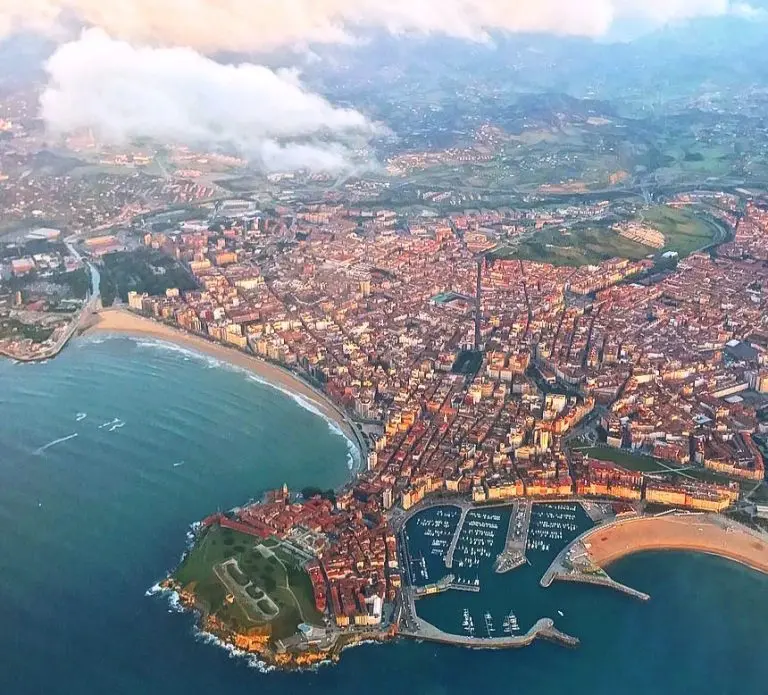
Gijón
AsturiasClimate
Daily budget
What to see in Gijón: the essentials
Between the Cantabrian Sea and the cobbled streets of Cimavilla, Gijón unfurls a catalogue of sights that ranges from a viewpoint crowned by a Chillida sculpture to the largest civil building in Spain. Here is what you cannot miss, ordered by how essential it is.
Elogio del Horizonte
Climb up to Cerro de Santa Catalina and you will come face to face with the concrete sculpture by Eduardo Chillida that has become the city’s unofficial symbol. Its curving forms frame the Cantabrian Sea in a hypnotic way, and it is one of those places where you want to linger for a good while listening to the waves. Access is free 24 hours a day, so you can see it at dawn, at sunset or at midnight with the night lighting. It is the postcard everyone takes home from Gijón, and with good reason.
Universidad Laboral de Gijón (Laboral Ciudad de la Cultura)
Prepare to be staggered by the figures: more than 270,000 square metres that make it the largest civil building in Spain. It was born as a training centre for mining orphans and today is a multi-purpose complex housing cultural institutions, exhibition spaces and an impressive central plaza. You can visit during daytime hours with access to the common areas, and guided tours are available to learn about its history and architecture. The tower, the courtyard and the neoclassical details deserve at least half a morning.
Palacio de Revillagigedo
This imposing 18th-century baroque palace stands next to the Colegiata de San Juan Bautista, forming one of the most photogenic architectural ensembles in the centre. Today it functions as an exhibition centre, so the interior visit depends on the show that is scheduled. Even so, its façade and its location facing the marina justify a closer look. Check opening times according to the current exhibition.
Museo Barjola
Located at Calle Trinidad, 17, this museum dedicated to the Asturian painter Juan Barjola occupies a historic building with a charm all its own. It opens Tuesday to Saturday in the morning (11:30 to 13:30) and afternoon (17:00 to 20:00), and on Sundays and public holidays from 12:00 to 14:00; on Mondays it remains closed. Admission is affordable and there is a newspaper archive service. It is a perfect stop for those who want contemporary art without the crowds.
Museo del Pueblo de Asturias
An open-air ethnographic museum that transports you to the rural Asturias of centuries past, with hórreos (raised granaries), country houses and objects from traditional Asturian life. The route is walked among original buildings moved stone by stone, which makes it a far more immersive experience than a conventional museum. It opens roughly from 10:00 to 19:00, though hours vary by season, and requires a ticket. If you are genuinely interested in Asturian culture, do not skip it.
Playa de San Lorenzo
Gijón’s main urban beach, with a long stretch of sand and a busy seafront promenade known as ‘El Muro’, is the place where the city meets the Cantabrian Sea.
Termas Romanas de Campo Valdés
An archaeological site and museum preserving the city’s Roman public baths, located in the area of the ancient forum.
LABoral Centro de Arte y Creación Industrial
A multidisciplinary space for art, science, technology and advanced creative industries.
La Campa Torres
An Archaeological and Natural Park preserving the largest maritime fortified enclosure on the entire Asturian coast, with 50,000 square metres, a hillfort wall, dwellings and an interpretation centre; check opening times and prices before you go.
La Escalerona
A monumental stairway bridging the level difference between the Muro de San Lorenzo promenade and the beach, now an urban symbol and meeting point, with a tourist information office at Escalera 4.
Cerro de Santa Catalina
The highest point on the peninsula where Cimavilla stands, with natural viewpoints over the Cantabrian Sea, remains of fortifications and free, unrestricted access.
Plaza de Jovellanos
A porticoed square in the old town presided over by the statue of Gaspar Melchor de Jovellanos, the Enlightenment figure from Gijón born in the palatial house that today houses the Museo Casa Natal de Jovellanos (Jovellanos Birthplace Museum).
Jardín Botánico Atlántico
A botanical garden dedicated to the conservation of Atlantic flora, with a significant collection of native plants.
Puerto Deportivo de Gijón
An area for strolling, dining and the starting point for water activities, whose management building is the ‘Antigua Rula’ on Calle Claudio Alvargonzález.
Basílica del Sagrado Corazón de Jesús
Popularly known as ‘La Iglesiona’, this temple built between 1918 and 1922 stands out for its great size, its towers and its interior with a wide nave, with modernist and Gothic influences; visits are allowed during worship hours.
Palacio Valdés
An urban palace integrated into Gijón’s old town, with a long-standing connection to local institutional and educational life; check visitability through the City Council’s official channels.
Barrio de Cimavilla
A former fishermen’s quarter with cobbled streets, colourful houses and cider houses, full of history and charm.
🍂 Otoño
Si visitas Gijón en otoño, el clima se vuelve más fresco y húmedo, con menos turistas y un ambiente tranquilo. Es un buen momento para conocer el Palacio de Revillagigedo o el Museo Barjola sin prisas. Lleva calzado cómodo e impermeable por si llueve.
What to do in Gijón
Gijón offers seaside promenades beside Playa de San Lorenzo, cider houses in the Cimavilla quarter, monthly craft markets and a cultural calendar that makes the most of venues such as Laboral Ciudad de la Cultura and the marina. On the second weekend of every month, Plaza Mayor hosts the Mercado Artesano y Ecológico (Artisan and Organic Market), perfect for buying local produce and Asturian crafts. For everyday shopping, the Mercado del Sur, with its 1899 iron architecture, is a visit in itself as well as a place to stock up on fresh produce. In the afternoon, the classic plan is to walk along the Muro de San Lorenzo, go down via La Escalerona and end up in Cimavilla with a round of poured cider.
Gijón in a day: express itinerary
If you only have one day, this route gives you the essentials of Gijón without rushing too much:
- 09:30 – Cerro de Santa Catalina and Elogio del Horizonte: Start at the top, with views over the Cantabrian Sea and Chillida’s sculpture. It’s the best time for photos without the crowds.
- 10:30 – Barrio de Cimavilla: Walk down through the cobbled streets of the old fishermen’s quarter, pass through Plaza de Jovellanos and take a look at the Colegiata de San Juan Bautista.
- 12:00 – Palacio de Revillagigedo and Puerto Deportivo: Facing the port, admire the palace’s baroque façade and stroll through the dining area of the Antigua Rula.
- 13:30 – Lunch in Cimavilla or by the port: Order a cachopo or a fabada and pair it with natural cider. Budget between 12 and 20 € per person.
- 16:00 – Playa de San Lorenzo and La Escalerona: Head down to the sand via the monumental staircase and walk along El Muro. If the weather cooperates, take a dip.
- 18:00 – Universidad Laboral: Spend the end of the afternoon at the largest civil building in Spain, with its courtyards, tower and common areas open during daylight hours.
Where to eat in Gijón: local cuisine
Where to stay in Gijón
Cimavilla
El corazón histórico y el barrio con más encanto, ideal para pasear, cenar y salir de sidras.
La Arena
Barrio residencial junto a la playa de San Lorenzo, perfecto para un ambiente playero y familiar.
How to get to Gijón
From Oviedo, the fastest option is the bus: 23 min (Automóviles Luarca, ALSA), 215 a day.
| From | Direct train | Direct bus | Car |
|---|---|---|---|
| Oviedo | 26 min · 66/day Intercity | 23 min · 215/day Automóviles Luarca, ALSA | 27 min 33 km |
| Avilés | 45 min · 31/day Cercanías C4 | 25 min · 125/day Automóviles Luarca, ALSA | 23 min 28 km |
| León | 1 h 31 min · 11/day AVE | 2 h · 18/day ALSA | 1 h 45 min 144 km |
| Madrid | 3 h 41 min · 7/day AVE | 5 h 30 min · 14/day ALSA | 5 h 13 min 464 km |
| Valladolid | 2 h 42 min · 10/day AVE | 3 h 45 min · 6/day ALSA | 3 h 33 min 313 km |
| Siero | — | 15 min · 14/day Autocares Mariano | 17 min 19 km |
| Palencia | 2 h 18 min · 9/day AVE | — | 3 h 11 min 269 km |
| Santander | — | 2 h 45 min · 7/day ALSA | 2 h 01 min 176 km |
| Bilbao | — | 4 h · 6/day ALSA | 3 h 05 min 265 km |
| Torrelavega | — | 2 h 40 min · 4/day ALSA | 1 h 43 min 152 km |
Direct trains and buses from the official timetables published by the operators on Spain's National Transport Access Point (a reference Wednesday); driving times from OpenStreetMap. Operators that do not publish their timetables may run more services. Check the timetable before you travel.
Getting around Gijón
Gijón is perfectly walkable, especially the centre, which is pedestrianised. For longer journeys, the city has an urban bus network connecting the neighbourhoods and main points of interest. If you come by car, the A-8, A-66 and AS-II motorways leave you close by, but to get around the old town and the beach area the most practical approach is to park and walk. The marina, Cimavilla, San Lorenzo Beach and the city centre are reasonably close to one another.
Weather in Gijón
Best time to visit Gijón
Day trips from Gijón
Gijón is part of a metropolitan area that includes Oviedo, just 28 km away. The Asturian capital is the natural day trip: a city with a monumental old town, a cathedral and a cultural and culinary offering that perfectly complements a visit to Gijón. It is easily reached by train or road, and lets you spend the day among squares, cider houses and museums before heading back to the coast.
Fascinating facts about Gijón you never knew
Spain’s oldest football stadium is here. El Molinón Municipal Stadium, home to Sporting de Gijón, was inaugurated in 1908. More than a century of football in the same spot, something very few Spanish cities can claim.
Spain’s largest civil building is not in Madrid or Barcelona. The Universidad Laboral de Gijón (Labour University) covers more than 270,000 square metres, a surface area that dwarfs many state complexes. Today it is a living cultural space, but its scale is still impressive.
Gijón paid tribute to Fleming before anyone else. In Parque Isabel la Católica (Isabel the Catholic Park) stands the world’s first monument dedicated to Alexander Fleming, a fact that surprises even many locals.
Jovellanos was born here on 5 January 1744. Asturias’ most important Enlightenment figure came into the world in a palatial house in the old town that is now the Museo Casa Natal de Jovellanos (Jovellanos Birthplace Museum), accessible from the square that bears his name.
Gijón’s first known settlement was not where you think. It was at Campa de Torres, a pre-Roman hillfort founded in the 5th century BC, long before the present-day city existed.
Gijón was the first Spanish city to be ‘Oscar-fied’. Thanks to Asturian-born filmmaker José Luis Garci, the city can boast a link to the Hollywood awards that no other Spanish city had before.
Who is Gijón for
Gijón is a city for almost every type of traveller. Families will find in La Arena and San Lorenzo Beach a calm, beach-friendly setting with safe promenades and a relaxed atmosphere. Couples will enjoy the charm of Cimavilla, dinners in cider houses and sunsets from Cerro de Santa Catalina. History lovers have plenty to work with: the Roman Baths, Campa Torres, Palacio de Revillagigedo and the legacy of Jovellanos. Foodies can go from cider house to cider house and try everything from fabada to Michelin-starred fine dining. And backpackers will appreciate hostels from €25/night and a compact city that can be explored on foot. With 419,309 visitors a year (INE) and an average stay of 1.97 nights, Gijón works both as a short break and as a base for exploring Asturias.
Frequently asked questions about Gijón
How many days do I need to see Gijón?
With two full days you can see the essentials: Cerro de Santa Catalina, Cimavilla, San Lorenzo Beach, the Universidad Laboral and one of the main museums. If you want to add trips to Oviedo or enjoy the food scene and cider houses at a leisurely pace, three or four days are ideal. The current average stay is 1.97 nights, which confirms that many travellers visit as a short break.
Is Gijón expensive?
Not especially. An average meal costs between €12 and €20, hostels range from €25 to €40 per night and a 3-star hotel ranges from €60 to €110. The choice of cider houses and bars in Cimavilla lets you eat well without spending much, and many attractions such as the Elogio del Horizonte, Cerro de Santa Catalina and La Escalerona are free to access.
What is the best time to visit Gijón?
From June to September. The average summer temperature is 19°C, which makes it possible to enjoy the beach and seafront promenades without the extreme heat of other parts of Spain. From November to February the average temperature drops to 10°C and rain is more frequent, making it the least advisable time for outdoor activities.
How do I get to Gijón from Madrid?
The fastest way is the AVE, which arrives at Gijón Sanz Crespo station with direct services from Madrid. You can also travel by bus with Alsa from the Estación de Autobuses de Gijón, or fly to Asturias Airport (OVD), located 40 km from the city, and complete the journey by road.
What typical dishes should I try in Gijón?
Fabada asturiana is a must: a stew of fabes beans with chorizo, morcilla and lacón. Cachopo, two breaded veal cutlets stuffed with ham and cheese, is another local institution. Pastel de cabracho is the milder, more maritime option, and chorizos a la sidra are the perfect appetiser in any cider house. All of it washed down with naturally poured cider.