Palencia
Castilla y LeónClimate
Palencia Guide: the city that guards a 21-metre Christ and a record-breaking cathedral
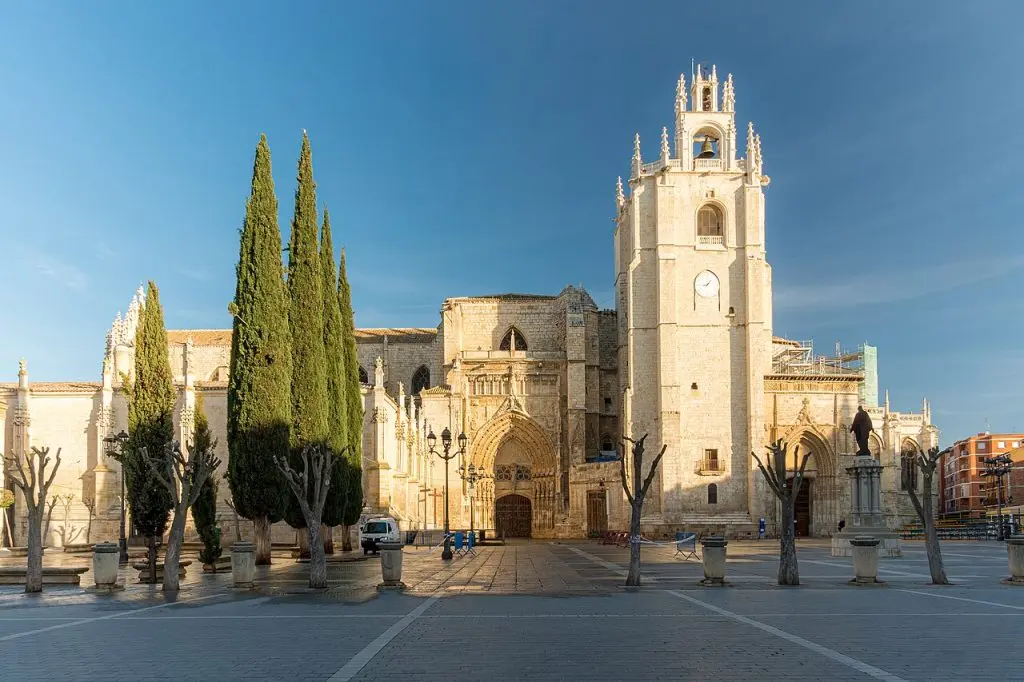
6,000 kilos of bells distributed throughout a cathedral that is the third largest in Spain. A 21-metre, 392-tonne Christ built in just 8 months, between June 1930 and February 1931. Palencia doesn’t need skyscrapers to impress: it does so with a cathedral 130 metres long that overlooks the Carrión river, with a street lined with 199 columns forming an arcade, and with the tallest Christ in the country watching over the Tierra de Campos plain from its hill. This Castilian city of 79,000 inhabitants, just 48 km from Valladolid, packs more than fifteen hundred years of history into an old town that is best explored on foot without rushing, among Romanesque churches, centuries-old bridges and bars where roast suckling lamb (lechazo churro) comes out of the wood-fired oven with crispy skin.
The must-seesWhat to see in Palencia: the essentials
Palencia concentrates its monumental heritage in a compact old town that you can explore on foot in a single day. The cathedral, the Cristo del Otero and the Calle Mayor are the three axes that structure any visit, with half a dozen Romanesque churches and historic bridges dotted along the way.
Catedral de San Antolín
With 130 metres in length, 50 metres in width at the transept and some 43 metres in height at the apse, Palencia cathedral is the third largest in Spain, behind only those of Toledo and Seville. It stands facing the Carrión river, right in the heart of the Roman, Visigothic and medieval city, and is the result of more than fifteen hundred years of extensions and transformations. Its exterior is simple, surprising and sublime, but it is inside where the scale overwhelms. The crypt requires a guided visit, while the rest of the temple can be visited in the morning and afternoon with a paid ticket. Among its sonic treasures are the Zarambombón and Cimbalillo bells, both 5 metres in diameter and 1.4 metres tall, within a total set of 6,000 kilos of bells.
Cristo del Otero
The Cristo del Otero is a sculpture 21 metres tall and weighing 392 tonnes, the tallest Christ in Spain and one of the tallest in the world, comparable to the one in Rio de Janeiro. It was built in just 8 months: the first stone was laid on 15 June 1930 and the work was completed in February 1931. It is the work of Palencia sculptor Victorio Macho (1886-1966), who considered it his most important work and was buried in the crypt of the ermita de Santa María de Otero. Climbing up to the hill where it stands also rewards visitors with impressive panoramic views of the city and the Tierra de Campos region.
Canal de Castilla
The Canal de Castilla is one of the most ambitious hydraulic engineering works of Enlightenment-era Spain, and Palencia is a key point for understanding its scale. Since 2005, the Consorcio para la Gestión Turística del Canal de Castilla has coordinated and promoted the enhancement of this heritage, made up of the provincial councils of Palencia, Valladolid and Burgos. Strolling along its locks and towpaths is a different way of approaching the landscape of Tierra de Campos.
Museo de Palencia
The Museo de Palencia is the provincial archaeological museum and traces the history of the province from prehistory to the modern age. Among its holdings are an easy-read guide featuring twelve selected objects that make the visit easier, as well as notable pieces and an educational programme. It is part of the Sistema de Museos de Castilla y León and depends on the Junta de Castilla y León.
Diocesan Museum of Sacred Art
Housed in the Episcopal Palace, the Diocesan Museum of Sacred Art has been open since 1973 and is one of the oldest and finest of its kind in Spain. Its rooms display more than seven hundred pieces by major artists. Opening hours: Monday 10:30 to 12:30; Tuesday and Wednesday 10:30 to 13:30; Thursday to Saturday 10:30 to 13:30 and 16:30 to 19:30; Sundays 10:30 to 13:30. Standard admission: €5; reduced admission for over-65s and students up to 25 years old.
Puente Mayor
Built in the 16th century from ashlar stone and renovated in the late 19th century, it offers views of the river and the city, with its fortified appearance of semi-cylindrical piers topped with machicolations.
Puente de Puentecillas
Its origins appear to date back to Roman times, possibly to the 1st century BC, and it stands out for its stone structure and riverside setting, making it one of the most characterful and charming spots in the capital of Palencia.
Monastery of Las Claras
A National Monument along with the Cathedral, the Cristo del Otero, the Puente de Puentecillas and the Church of San Francisco, it is a Castilian convent complex of sober forms that remains home to a cloistered community of Poor Clares.
Church of San Miguel
Built in the 13th century over an 11th-century temple, it stands out for its original openwork tower in the transition to Gothic style, religious and military in character, restored after the damage caused by the 1755 Lisbon earthquake. It was declared a National Monument in 1931.
Church of San Juan
Home to the province’s Romanesque Information Point, this small 12th-century Romanesque church was moved stone by stone from Villanueva del Río to save it from the waters of the Aguilar Reservoir. It was declared a National Monument in 1981.
Church of San Francisco
Part of a convent complex of architectural interest, it holds Sunday Mass at 13:00 and in summer opens for tourist visits from Tuesday to Saturday in the afternoon (17:00 to 20:00) with a contribution of one euro per person.
La Casa Grande de Monte el Viejo
Castle located in the municipality of Palencia, Spain.
Plaza Mayor
The nerve centre of the city and a habitual meeting point, presided over by the Town Hall building and lined with arcades and traditional façades. Throughout the year it hosts markets, fairs and cultural activities, including the organic market with local producers.
Calle Mayor
A central axis more than 900 metres long, a commercial and promenade artery considered the backbone of the capital, with 199 columns flanking one side and Modernist buildings from the 19th and 20th centuries. The Palencia Tourist Office is located at number 31.
🍂 Otoño
Si visitas Palencia en otoño, el clima se vuelve más fresco y seco, ideal para caminar por el Puente de Puentecillas o explorar La Casa Grande de Monte el Viejo con paisajes de hojas caídas. Las precipitaciones son escasas, así que es raro que la lluvia arruine tus planes. Lleva calzado cómodo y algo de abrigo para las últimas horas del día.
What to do in Palencia
Palencia offers a combination of monumental strolls through the old town, traditional markets in the Plaza Mayor, riverside routes along the Carrión River and tapas hopping along Calle Mayor and the San Miguel district. The Canal de Castilla invites peaceful walks along its towpaths, while the Huerta de Guadián and the Ribera del Carrión are the perfect green lung for leisure and sport. The organic market with local producers in the Plaza Mayor is a regular event that connects travellers with Palencia’s larder, and the Mercado de Abastos, inaugurated in 1898, remains the place to buy fresh produce from the Castilian countryside.
Palencia in a day: express itinerary
With a well-organised day you can get a very complete picture of Palencia. This walking itinerary links the must-sees without rushing:
- 09:30 – Cathedral of San Antolín: Start with the third-largest cathedral in Spain. Take your time inside, and if you can, book the guided tour of the crypt.
- 11:30 – Calle Mayor and Plaza Mayor: Walk the more than 900 metres of this arcaded street, supported by 199 columns, until you reach the Plaza Mayor. Take the chance to stop by the Tourist Office at number 31 on Calle Mayor.
- 13:00 – Church of San Miguel: Peek at its openwork tower, a transition to Gothic, and discover Palencia’s urban Romanesque. The Barrio de San Miguel is ideal for a first round of tapas.
- 16:30 – Puente de Puentecillas and the banks of the Carrión: Stroll through the city’s most charming riverside setting, with the fortified Puente Mayor as a counterpoint.
- 18:30 – Cristo del Otero: Climb the hill north of the city to see the 21-metre sculpture by Victorio Macho up close and say goodbye with the best views of Tierra de Campos.
Where to eat in Palencia: local cuisine
Where to stay in Palencia
Casco Antiguo / Centro
El corazón histórico y monumental de Palencia. Aquí se concentran la Catedral, la Plaza Mayor y la Calle Mayor, principal arteria comercial. Es una zona con mucho ambiente, ideal para pasear, tapear y descubrir la historia de la ciudad.
Barrio del Cristo
Situado en un cerro al norte de la ciudad, este barrio es famoso por albergar el Cristo del Otero, uno de los símbolos de Palencia. Es una zona más tranquila y residencial, con impresionantes vistas panorámicas de la ciudad y la comarca de Tierra de Campos.
Huerta de Guadián / Ribera del Carrión
Zona verde junto al río Carrión. Es el principal pulmón de la ciudad, un lugar perfecto para el ocio, el deporte y el relax. El Parque del Salón de Isabel II es un jardín romántico y el lugar de encuentro por excelencia para los palentinos.
Barrio de San Miguel
Un barrio con encanto alrededor de la iglesia de San Miguel, de aspecto fortificado y con una torre gótica singular. Es una zona con sabor medieval, más tranquila que el centro pero a pocos pasos de la Calle Mayor, con algunos bares de tapas muy recomendables.
Ave María
Un barrio residencial y popular, conocido por su ambiente animado y su mercado. Ofrece una visión más auténtica de la vida local palentina, alejada del circuito puramente turístico. Ideal para quienes buscan una experiencia local y gastronomía casera.
How to get to Palencia
From Valladolid, the fastest option is the train: 22 min (AVE), 34 a day.
| From | Direct train | Direct bus | Car |
|---|---|---|---|
| Valladolid | 22 min · 34/day AVE | 45 min · 10/day ALSA | 42 min 48 km |
| Madrid | 1 h 21 min · 21/day AVE | 3 h · 4/day ALSA | 2 h 57 min 256 km |
| León | 35 min · 23/day AVE | — | 1 h 41 min 133 km |
| Santander | 2 h 28 min · 8/day Intercity | 2 h 30 min · 2/day ALSA | 2 h 15 min 200 km |
| Torrelavega | 2 h 04 min · 8/day Intercity | 2 h 05 min · 2/day ALSA | 1 h 57 min 172 km |
| Burgos | 35 min · 5/day Intercity | 1 h 15 min · 4/day ALSA | 1 h 03 min 90 km |
| Oviedo | 1 h 49 min · 7/day AVE | — | 3 h 250 km |
| Gijón | 2 h 20 min · 6/day AVE | — | 3 h 11 min 270 km |
| Vitoria-Gasteiz | 2 h 05 min · 5/day Intercity | 3 h 15 min · 1/day ALSA | 2 h 17 min 200 km |
| Salamanca | 2 h 19 min · 1/day Regional | 2 h 15 min · 5/day ALSA | 1 h 53 min 165 km |
Direct trains and buses from the official timetables published by the operators on Spain's National Transport Access Point (a reference Wednesday); driving times from OpenStreetMap. Operators that do not publish their timetables may run more services. Check the timetable before you travel.
Getting around Palencia
Palencia is perfectly explored on foot: the old town is compact and Calle Mayor connects most of the points of interest. For longer journeys, the city has a urban bus covering the outlying neighbourhoods, including access to the Cristo del Otero hill. If you stay in the centre, you probably won’t need public transport except to go up to the Cristo or over to the banks of the Carrión.
Weather in Palencia
Best time to visit Palencia
Day trips from Palencia
Palencia is an excellent base for exploring the cities of the region, thanks to its location right in the heart of Tierra de Campos and its proximity to Valladolid, just 48 km away. The capital of Valladolid is the most obvious and quickest excursion, with frequent train connections. The Canal de Castilla (Castile Canal) also allows routes through the riverside villages of the provinces of Palencia, Valladolid and Burgos, following the course of this historic hydraulic engineering work. For more practical information on schedules, tickets and events, check the official Palencia tourism website.
Curiosities about Palencia you didn’t know
6,000 kilos of bells with names of their own. Palencia Cathedral is not only the third largest in Spain: it houses a collection of bells weighing a total of 6,000 kilos, and the most famous are the Zarambombón and the Cimbalillo, both with a diameter of 5 metres and a height of 1.4 metres. Hearing them peal from the banks of the Carrión is an experience that gives you goosebumps.
A Christ built in record time. The Cristo del Otero, standing 21 metres tall and weighing 392 tonnes, was erected in just 8 months: the first stone was laid on 15 June 1930 and the work was completed in February 1931. Victorio Macho, its creator, considered it his most important work and chose to be buried in the crypt of the chapel of Santa María de Otero, at the feet of his creation.
The name Palencia comes from a rock. The place name Palencia derives from Pallantia, and according to one theory it comes from the pre-Roman root “palla”, meaning “rock”. A clue to the origins of a city that was already significant in Roman and Visigothic times.
Visigothic relics in the cathedral. In the year 672, the Visigothic king Wamba had the relics of the martyr Saint Antolín brought to Palencia. That gesture forever linked the city to the saint who gives his name to its cathedral.
One of the tallest sculptures in Europe. The Cristo del Otero is not only the tallest Christ in Spain: it is among the tallest sculptures in Europe, rubbing shoulders with monuments of continental scale.
Who is Palencia for
Palencia is a city for lovers of history and Romanesque art, for couples looking for a charming old town without crowds, and for families who want to combine culture with green spaces by the river. Foodies will find in lechazo churro (roast suckling lamb) and menestra palentina (Palencia-style vegetable stew) compelling reasons to stay, with a Bib Gourmand and a Michelin-selected restaurant as the icing on the cake. Backpackers can opt for the Ave María neighbourhood for a more local and affordable experience. It is not a city of mass tourism, and that is precisely why it is best enjoyed: everything is close, prices are reasonable and you set the pace.
💡 ¿Sabías que...?
- ● La catedral de Palencia es la tercera más grande de España, solo por detrás de las de Toledo y Sevilla. (https://www.lasexta.com/viajestic/escapadas/datos-curiosos-catedral-palencia-que-quiza-desconocias_202310256538d9fbe8e7a5000140f5f8.html)
- ● La catedral de Palencia tiene un total de 6.000 kilos de campanas, y las más famosas son la de Zarambombón y la de Cimbalillo, ambas con un diámetro de 5 metros y una altura de 1.4 metros. (https://www.lasexta.com/viajestic/escapadas/datos-curiosos-catedral-palencia-que-quiza-desconocias_202310256538d9fbe8e7a5000140f5f8.html)
- ● El nombre de Palencia procede de Pallantia, y según una teoría deriva de la raíz prerromana «palla» que significa «roca». (https://es.wikipedia.org/wiki/Palencia)
- ● En el año 672, el rey visigodo Wamba hizo traer las reliquias del mártir San Antolín a Palencia. (https://www.condadodecastilla.es/lugares/palencia-en-la-alta-edad-media/)
- ● El Cristo del Otero, obra de Victorio Macho, es una de las esculturas más altas de Europa. (https://www.hotelcastillavieja.com/palencia-secreta:-leyendas-curiosidades-y-rincones-ocultos-que-no-te-p.html)
Frequently asked questions about Palencia
How many days do I need to see Palencia?
With a full day you can see the essentials: the Cathedral of San Antolín, Calle Mayor, Plaza Mayor, the Church of San Miguel and the Cristo del Otero. If you want to add the Museo de Palencia, the Museo Diocesano de Arte Sacro and a leisurely stroll along the banks of the Carrión, two days are ideal. To include a day trip to the Canal de Castilla or to Valladolid, consider three days.
What is the best time of year to visit Palencia?
From June to September, when the average summer temperature is 19.3°C according to AEMET. Winters are cold, with an average of 3.7°C, and annual rainfall is only 337.8 mm, so rain is rarely a problem.
How do I get to Palencia from Madrid?
By conventional train from Madrid, the journey takes between 2 hours 30 minutes and 3 hours 30 minutes, with approximate prices of €25 to €50 depending on Renfe. Palencia has no AVE station, but the rail connection is comfortable and frequent.
Is it true that Palencia Cathedral is one of the largest in Spain?
Yes. At 130 metres long, 50 metres wide at the transept and around 43 metres high at the apse, it is the third largest cathedral in Spain, behind only those of Toledo and Seville.
Can you climb up to the Cristo del Otero?
The Cristo del Otero stands on a hill north of the city, in the Barrio del Cristo, and can be reached on foot or by city bus. The 21-metre sculpture by Victorio Macho is viewed from the outside, and the ermita de Santa María de Otero houses the crypt where the sculptor was buried.