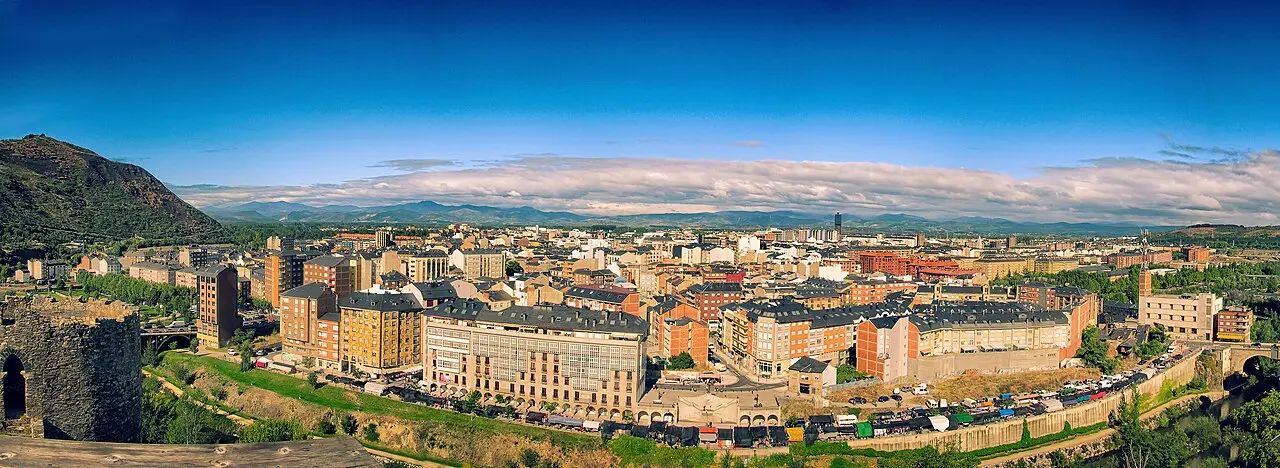
Ponferrada
Castilla y LeónClimate
What to see in Ponferrada: the essentials
Ponferrada is a city that unfolds at two paces: that of the old town, where the stones tell stories of Templars and pilgrims, and that of contemporary El Bierzo, with its museums, its market and its lively neighbourhoods. This is not a postcard city; it is a city to be walked, smelled and savoured.
Castle of the Templars of Ponferrada
It is the star attraction of any visit and the castle with the largest restored surface area in all of Castile and León, welcoming 140,000 visitors every year. Inside, you can explore the walls, courtyards and outbuildings, with exhibitions on Templar history and the city itself. If you are lucky enough to coincide with one of its theatrical tours, such as ‘El Señor de Bembibre. Un paseo por la leyenda’ by the Conde Gatón company, don’t hesitate: they are held inside the grounds on specific dates, generally in the evening. Tickets for these activities are purchased at the Ponferrada Tourist Office, whose usual hours are Monday to Saturday from 10:00 to 14:00 and in the afternoons. Check updated opening times and prices, as they vary by season.
Basilica of Nuestra Señora de la Encina
A Renaissance temple with a Latin cross floor plan, begun before 1573 to designs by Juan Alvear, located in the historic centre and home to the city’s patron saint. Inside, the main altarpiece stands out, from the school of Gregorio Fernández, in polychrome wood and dated between 1630 and 1640. The basilica houses the image of Nuestra Señora de la Encina, found according to tradition by the Templars in the trunk of a holm oak while they were building the fortress. It also preserves the image of the Cristo de la Fortaleza, from the 13th century, apparently from the Templar castle. It is open for free visits during worship hours, with guided tours available depending on the season.
Museo de El Bierzo
An archaeological and ethnographic museum located in the old town at Calle del Reloj, 5, housed in a historic building constructed between 1565 and 1572 that once served as the town council’s meeting place, the corregidor’s residence and the town jail. Opened in 1996, it brings together pieces offering a complete journey through the history of Ponferrada and El Bierzo, from the Palaeolithic to the early years of the present century. Highlights include prehistoric material culture, the Roman occupation and Las Médulas, the Visigothic period and monastic life in the Valle del Oza, a room devoted entirely to the study of Ponferrada Castle, goldsmithing, a numismatic collection spanning the Middle Ages to the 20th century, and examples of industrial archaeology. It has visiting hours from Tuesday to Sunday and affordable or free admission on certain days.
Plaza de la Virgen de la Encina
A square facing the Basilica de la Encina, a meeting point in the historic centre and a key space in the celebrations honouring the city’s patron saint. The museum brings together pieces from the region that help explain the evolution of Christianity in the area and the deep devotion to the Virgen de la Encina, with sculpture, painting, goldsmithing and liturgical documents. The visit concludes with a climb to the tower-viewpoint, from which panoramic views of the entire city and its surroundings unfold. The square is thus a landmark both heritage-wise and devotionally within the historic centre.
Museo de la Energía – La Fábrica de Luz
Its exhibition narrative addresses the history of electricity, how a thermal power station works and the relationship between energy and the territory of El Bierzo, while also offering science outreach activities for all audiences.
Ponferrada Railway Museum
A museum devoted to the history of the railway in the region, closely tied to the mining and railway tradition of El Bierzo. It traces the history of passenger and coal transport for the Minero Siderúrgica de Ponferrada (MSP) between the stations of Villablino and Ponferrada, a railway regarded as unique in Europe. It displays steam locomotives and other historical material from manufacturers such as Baldwin, Krauss & Co., MACOSA, A. Borsig, Freudenstein, J.A. Maffei, Tubize, Haine St. Energie Marcinelle and Nasmith Wilson, along with carriages and pieces illustrating the evolution of rail and mining transport in the area.
Church of San Andrés
A religious temple in the old town, located at calle Gil y Carrasco, 21. Its location makes it easy to include in itineraries combining religious architecture, historic streets and other nearby monuments. It remains closed from Monday to Saturday and opens only on Sundays from 20:00 to 20:35, so it is worth checking the municipal information before planning a visit.
Plaza del Ayuntamiento de Ponferrada
The Casa Consistorial (Town Hall) presides over an urban space representative of Bercian civil architecture. The town hall façade follows the canons of Spanish institutional civil architecture, with a main balcony, clock and coat of arms, and forms one of the most photographed ensembles in the old town. Its immediate surroundings include plaza Rosalía de Castro and parque de la Concordia, which link the old town with the promenade along the river Sil.
Ponferrada Green Ring Route
A collection of peri-urban itineraries that surround the city and connect its parks and riverside spaces, forming a network of routes for walking and cycling in contact with nature. Notable among them is the Ruta de la Abadía de Compludo (Compludo Abbey Route), the longest, which starts at the Castillo de los Templarios (Templar Castle) and runs for nearly 28 km to the Abadía de Compludo. Another signposted route is the Ruta de los Romeros – Embalse de Bárcena (Pilgrims’ Route – Bárcena Reservoir), which begins near the Museo de la Energía (Energy Museum) and covers the roughly 5 km separating the city from the Embalse de Bárcena.
Other points of interest
Victoria de Samotracia (monument), Castillo Viejo (palace), Museo del Bierzo (museum), Museo de la Radio (museum), Fuente Romana De Campo (monument), La Térmica Cultural (museum), Museo de las Cofradías (museum) and Puente de Ponferrada (Pons Ferrata) (bridge) complete the city’s heritage offering.
🍂 Otoño
Si visitas Ponferrada en otoño, encontrarás temperaturas suaves en septiembre y octubre, con menos lluvia que en otras épocas y sin calor sofocante. Puedes acercarte a la Fuente Romana De Campo o al Museo de El Bierzo con tranquilidad. Lleva calzado cómodo y algo de abrigo fino para los cambios de temperatura al atardecer.
What to do in Ponferrada
Ponferrada offers a range of activities that run from historical exploration of the old town to nature routes along the Green Ring, by way of a food scene built around Botillo del Bierzo and authentic neighbourhood life in areas such as Flores del Sil or La Puebla.
- Ponferrada Carnival (Entroido Berciano) in February: A Carnival celebration featuring a recreation of the traditional Entroido Berciano, a children’s carnival, fun activities and a fancy-dress parade and competition that fills the streets with music and colour.
- Mercado Municipal de Abastos: A traditional food market with grocery stalls and dining spaces, where you can buy local produce and enjoy tapas. It is a commercial and culinary benchmark for the El Bierzo region.
- Theatrical castle tours: Staged performances of ‘El Señor de Bembibre’ by the Conde Gatón company are held inside the grounds on specific dates, generally at night.
- Routes along the Green Ring: Peri-urban itineraries that surround the city and connect parks and riverside spaces, ideal for walking and cycling in contact with nature.
- Neighbourhood life: Flores del Sil offers a more authentic, less touristy experience, with a lively atmosphere and a wide variety of bars and restaurants, especially at weekends.
Ponferrada in a day: express itinerary
With a well-planned day you can get a very complete picture of Ponferrada. This is the route I would take:
- 10:00 – Castillo de los Templarios (Templar Castle): Start with the city’s icon. Explore the walls, courtyards and outbuildings, and take time for the exhibitions on Templar history. It is the castle with the largest restored surface area in Castile and León.
- 11:30 – Basílica de la Encina and Plaza de la Virgen de la Encina: Just a few steps from the castle. Go in to see the main altarpiece from the school of Gregorio Fernández and the image of the patron saint. If you can, climb the tower-viewpoint for the panoramic views.
- 12:30 – Museo de El Bierzo: At Calle del Reloj, 5. A journey through the history of the region from the Paleolithic to the 20th century, in a building that was once a prison and town hall. Affordable entry or free on certain days.
- 14:00 – Lunch in the old town or La Puebla: Try the Botillo del Bierzo with cachelos or an empanada de batallón in one of the traditional bars.
- 16:30 – Plaza del Ayuntamiento and the river Sil promenade: Head down through Plaza Rosalía de Castro and Parque de la Concordia to the river Sil promenade, the backbone of the city.
- 18:00 – Museo de la Energía or Museo del Ferrocarril: Choose according to your interest: the history of electricity and the thermal power station, or the steam locomotives of the unique mining railway in Europe.
Where to eat in Ponferrada: local gastronomy
Where to sleep in Ponferrada
Casco Antiguo
El corazón histórico de Ponferrada, con calles empedradas y edificios medievales. Aquí se encuentra la impresionante fortaleza templaria y la basílica de la Encina. Ambiente pintoresco y tranquilo, ideal para pasear y descubrir la historia.
El Plantío
Zona residencial moderna y tranquila, con amplias avenidas y parques. Alberga el centro comercial El Rosal y varios supermercados. Es una zona bien comunicada y con fácil aparcamiento.
La Puebla
Barrio tradicional situado al otro lado del río Sil, con ambiente local y calles tranquilas. Cerca del centro histórico pero con precios más asequibles. Tiene pequeños comercios y bares de barrio.
Flores del Sil
Barrio residencial popular, con ambiente animado y diversidad de bares y restaurantes. Es una zona concurrida por los locales, especialmente los fines de semana. Ofrece una experiencia más auténtica y menos turística.
Centro (Ensanche)
Zona comercial y de servicios de la ciudad, con tiendas, bancos y oficinas. Incluye la avenida de España y la plaza del Ayuntamiento. Es el área más concurrida durante el día y cuenta con una buena oferta gastronómica.
Compás de San Andrés
Zona de expansión reciente, con modernos edificios y amplias zonas verdes. Es un barrio residencial tranquilo, con parques y servicios. Ideal para familias que buscan comodidad y aparcamiento.
How to get to Ponferrada
Ponferrada is well connected by road and rail, although it does not have AVE. These are the main options:
| Medio | Duración | Precio aprox. | Frecuencia |
|---|---|---|---|
| Tren (Renfe, sin AVE) | Variable según origen | Medio | Consultar horarios |
| Bus (Estación de Autobuses) | Variable según origen | Bajo-medio | Consultar horarios |
| Coche | Variable según origen | Combustible + peajes | Flexible |
Ponferrada’s train station connects with other cities on the conventional network. The bus station offers regional and national services. If you come by car, the city is accessible from the A-6, which links Madrid with A Coruña.
Getting around Ponferrada
Ponferrada has a city bus service for getting between neighbourhoods, but the old town and most of the main attractions are perfectly walkable. The Anillo Verde (Green Ring) is ideal for cycling or walking around the outskirts. To reach neighbourhoods such as El Plantío or Compás de San Andrés, the city bus is the most practical option if you don’t have a car.
Weather in Ponferrada
Best time to visit Ponferrada
Day trips from Ponferrada
Ponferrada is an excellent base for exploring the Bierzo region and its surroundings. The Ruta de la Abadía de Compludo (Compludo Abbey Route), which starts at the Castillo de los Templarios (Templar Castle) and runs for nearly 28 km, combines historic heritage and landscape. The Ruta de los Romeros – Embalse de Bárcena (Pilgrims’ Route – Bárcena Reservoir) brings walkers to this watery, green setting in around 5 km from the Museo de la Energía (Energy Museum). Las Médulas, the stunning Roman mining landscape, lies within the region and is an essential excursion from Ponferrada.
Ponferrada curiosities you never knew
The name Ponferrada literally means ‘Iron Bridge’. It derives from ‘Ponte Ferro’ after the bridge over the river Sil was reinforced with iron in 1086. So every time you cross the river, you’re walking on the very reason the city exists.
A king gave Ponferrada to the Templars. In the 12th century King Alfonso IX of León donated the town of Ponferrada to the Order of the Temple. From that era remains the most impressive castle in the region.
According to tradition, the Virgen de la Encina was found by the Templars around 1200 in the hollow of a holm oak. Hence the name of the patron saint and of the basilica that houses her.
Ponferrada did not become a city until 1908. On 4 September 1908 King Alfonso XIII granted Ponferrada the Title of City. Before that it was a town with plenty of history but without that status.
The Templar castle receives 140,000 visitors every year. It has the largest restored surface area in all of Castile and León, and is one of the most visited monuments in the province.
The Templar legend is recreated every first full moon of summer during the Noche Templaria (Templar Night). According to tradition, the monks return to the castle bearing the Ark of the Covenant and the Holy Grail. It is one of the most special nights of the year in Ponferrada.
Beneath the castle lie the remains of a settlement from the Early Iron Age. Excavations on the castle hill brought to light remains dating from between the 7th and 5th centuries BC. In other words, the hill has been inhabited for more than 2,500 years.
Who Ponferrada is for
Ponferrada is a city for curious travellers seeking history without crowded museums, hearty food and a comfortable base for exploring El Bierzo. History and architecture lovers will delight in the Templar castle, the Renaissance basilica and the old town. Foodies have in Botillo del Bierzo (cured pork sausage), cecina (cured beef) and empanadas more than enough reason to come. Families will find quiet neighbourhoods such as El Plantío or Compás de San Andrés, with parks and amenities. Backpackers will appreciate the more affordable prices of La Puebla and the authentic atmosphere of Flores del Sil. And hikers and cyclists have in the Anillo Verde (Green Ring) a network of routes that surrounds the city and connects with the river Sil and the Bárcena Reservoir.
💡 ¿Sabías que...?
- ● El nombre de Ponferrada significa Puente de Hierro, y deriva de 'Ponte Ferro' tras reforzarse con hierro el puente sobre el río Sil en 1086. (https://guiasbierzo.com/guias-bierzo-5-cosas-que-no-sabias-de-ponferrada/)
- ● En el siglo XII el rey Alfonso IX de León donó la villa de Ponferrada a la Orden del Temple. (https://guiasbierzo.com/guias-bierzo-5-cosas-que-no-sabias-de-ponferrada/)
- ● La tradición atribuye a los templarios el hallazgo de la imagen de la Virgen de la Encina hacia 1200 en el hueco de una encina. (https://guiasbierzo.com/guias-bierzo-5-cosas-que-no-sabias-de-ponferrada/)
- ● El 4 de septiembre de 1908 el rey Alfonso XIII concedió a Ponferrada el Título de Ciudad. (https://turismoponferrada.com/ponferrada/historia/)
- ● El castillo templario de Ponferrada es el de mayor superficie rehabilitada de toda Castilla y León y recibe 140.000 visitantes cada año. (https://www.leonoticias.com/culturas/patrimonio/fortaleza-forja-leyenda-castillo-templario-ponferrada-20220816182621-nt.html)
- ● La leyenda templaria se recrea cada primera luna llena de verano en la Noche Templaria, cuando los monjes regresan al castillo portando el arca de la alianza y el santo grial. (https://www.leonoticias.com/culturas/patrimonio/fortaleza-forja-leyenda-castillo-templario-ponferrada-20220816182621-nt.html)
- ● Las excavaciones en el cerro del castillo de Ponferrada sacaron a la luz restos de un poblado de la Primera Edad del Hierro, entre los siglos VII y V a. C. (https://oppidum.es/oppidum-16/opp16.03_blanco.et.alii_el.poblado.de.la.i.e.h.de.ponferrada.pdf)
Frequently asked questions about Ponferrada
How many days do I need to see Ponferrada?
With two full days you can see the essentials: the Castillo de los Templarios (Templar Castle), the Basílica de la Encina, the Museo de El Bierzo, the Plaza del Ayuntamiento and one of the themed museums (Energy or Railway). If you want to do a route on the Anillo Verde or a day trip to Las Médulas, add a third day. A single day is enough for an express itinerary focused on the old town.
What is the best time of year to visit Ponferrada?
According to climate data, the best time is from May to June and from September to October, with mild, pleasant temperatures, a lower risk of rainfall and no stifling heat. The average temperature in summer is 20.8°C and in winter 6.0°C. Avoid December and January due to low temperatures, persistent humidity, frequent frosts and dense fog caused by thermal inversion.
How do I get to Ponferrada from Madrid?
Ponferrada has no AVE, but it does have a Renfe train station (conventional network) and a bus station with services from Madrid. By car, the A-6 connects Madrid with A Coruña and passes through Ponferrada. Duration and prices vary depending on the means of transport and how far in advance you book; check updated schedules on Renfe or at the bus station.
What typical dish should I try in Ponferrada?
Botillo del Bierzo is the most emblematic dish of the region: a thick casing stuffed with pieces of marinated pork, cured and seasoned sausage, which is boiled and served with cachelos (boiled potatoes) and sometimes berza (cabbage). It can be tried in numerous restaurants in Ponferrada and El Bierzo, especially in the winter season.
Does the Castillo de los Templarios offer guided or theatrical tours?
Yes. The castle hosts theatrical tours, such as the staging of ‘El Señor de Bembibre. Un paseo por la leyenda’ by the Conde Gatón company, held inside the grounds on specific dates, usually in the evening. Tickets for these activities are purchased at the Ponferrada Tourist Office, whose usual hours are Monday to Saturday from 10:00 to 14:00 and in the afternoons. It is advisable to check updated opening hours and prices, as they vary by season.
For more practical information on opening hours, tickets and the schedule of activities, see the official Ponferrada tourism website.