Pontevedra
GaliciaClimate
Daily budget
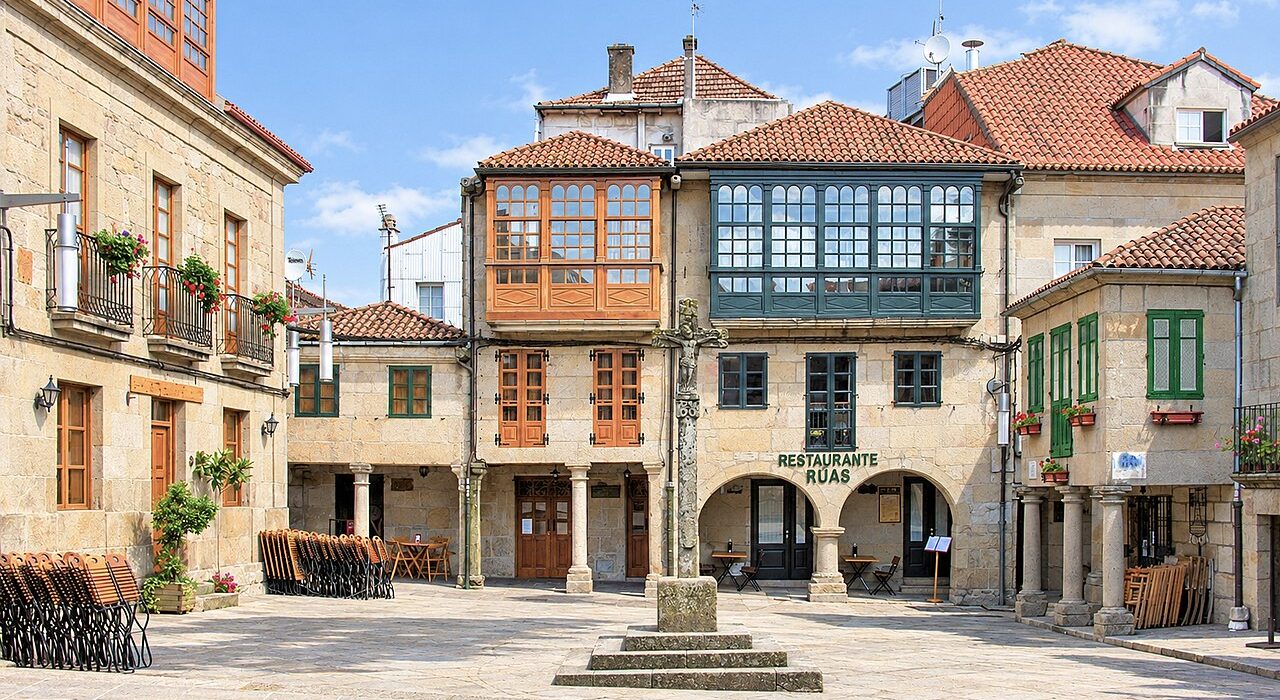
The unmistakable aroma of fresh seafood and freshly brewed coffee greets you the moment you step into the Mercado de Abastos (Provisions Market), while the evening light bathes the granite facades of Plaza da Leña in gold. Here, in the heart of the Rías Bajas, time seems to have stood still, allowing you to enjoy a city that has managed to eliminate almost all traffic from its center, offering an urban silence broken only by laughter on the terraces and the songs of pilgrims. Pontevedra is not just a stop on the map; it is a sensory experience where medieval history blends with an enviable quality of life.
The must-seesWhat to see in Pontevedra: the essentials
Ruins of the Convent of Santo Domingo
Considered one of the main examples of Gothic architecture in Galicia, this convent originally dates back to the late 13th century, although today mainly its ruins remain, integrated into the Museo de Pontevedra. Visitors can contemplate the remains of the church and cloister, which house medieval sculptural elements and tombs of the nobility. It is a place of solemn atmosphere where history can be breathed in every stone worn down by the centuries.
Santuario de la Virgen Peregrina (Shrine of the Pilgrim Virgin)
Built between 1778 and 1794, it features a unique floor plan shaped like a scallop shell inscribed within a cross, making it an unmistakable architectural landmark. On the exterior, a giant natural Pacific scallop shell stands out, serving as a holy water font, a gift from Admiral Méndez Núñez. The sanctuary remains open for daily worship and is a mandatory reference point on the Portuguese Way.
Puente del Burgo (Burgo Bridge)
Of Roman origin and reconstructed in the Middle Ages, this stone bridge crosses the Lérez River, connecting the center with the Burgo neighborhood. Integrated into the Portuguese Way, its pillars display carved pilgrim shells and offer views towards the riverside promenade. It is the perfect place to stop and observe the flow of water that gives life to the estuary.
Monumento aos Heroes de Ponte Sampaio (Monument to the Heroes of Ponte Sampaio)
It commemorates the Battle of Ponte Sampaio during the Napoleonic Wars in the early 19th century, recalling a crucial moment of local resistance. This monument stands as a testament to the fighting spirit of the area’s inhabitants against the French invasion.
Statue of Valle-Inclán
This monument pays homage to one of the most important writers in Spanish literature, Ramón María del Valle-Inclán, who had a special connection with the city. His presence in the urban landscape invites lovers of letters to remember the figure of the creator of “esperpento” (a literary style of grotesque distortion).
Plaza da Leña
A historic square located in the old town where the Casa da Luz is situated, a corner full of charm and tradition.
Historic Center of Pontevedra
Founded in 1929, it safeguards a collection of archaeology and fine arts outstanding in the national context, with prehistoric pieces and fundamental works by Castelao.
Monastery of San Salvador de Lérez
Located next to the river that crosses the city and converges with the estuary of Pontevedra, marking the development of the urban core.
Convent of Santa Clara
An ancient convent founded in the 14th century, located on Santa Clara Street next to the old wall, notable for its religious Gothic architecture dedicated to Clare of Assisi.
Church of San Bartolomé
An Italian Baroque-style church founded in 1714, designed by the architect Pedro Monteagudo, distinguished by its characteristic concave facade.
Abanca Foundation Exhibitions
A cultural space offering temporary exhibitions of great artistic interest in the city center.
Casa de Colón (Columbus House)
A museum exploring the theory of Christopher Columbus’s Galician origin and his connection to these lands.
Castro das Croas
An archaeological site testifying to ancient settlements in the area prior to the Roman foundation.
Cruz dos Caídos
Commemorative monument located on high ground offering views over the urban surroundings.
Chozo do Pinar do Rei
Traditional stone construction reflecting rural architecture and historical land use.
Alexandre Bóveda Iglesias
Monument dedicated to a prominent figure in Galician culture and politics, integrated into the cityscape.
Escultura “Dorna” Homenaxe ao Camiño de Santiago
Artistic work paying tribute to pilgrims and the Jacobean tradition that crosses the city.
Miradoiro de Monte Porreiro
Viewpoint offering panoramic vistas of the city and its natural environment.
Basílica de Santa María la Mayor
This late Gothic basilica began construction in the 16th century atop an earlier structure; its main façade with portico is noteworthy. The single-nave interior with Baroque altarpieces surprises visitors, as does the exterior roof, which resembles a ship’s hull and symbolizes the city’s maritime history.
Edificio de Correos
Historic building designed by architect José Gómez Román, built during the 1920s and inaugurated around 1929 on Calle de la Oliva. It stands out for its eclectic style with Modernist influences on the façade, representative of early 20th-century public civil architecture in Galicia.
🍂 Otoño
Si visitas Pontevedra en otoño, el clima se vuelve más fresco y lluvioso, con el río Lérez bajando caudaloso bajo el Puente del Burgo. Es un momento perfecto para visitar el Santuario de la Virgen Peregrina con su planta de venera y descubrir el Monumento aos Heroes de Ponte Sampaio sin aglomeraciones. Un consejo práctico: hazte con un buen chubasquero y calzado impermeable, porque las lluvias otoñales pueden ser persistentes y te arruinarán el plan si vas con zapatillas de tela.
What to Do in Pontevedra
Pontevedra offers vibrant cultural activities and unique gastronomic experiences that define its Galician character. You can immerse yourself in history during the Feira Franca (Free Fair) in September, a medieval fair commemorating the tax-free market privilege of 1467 with falconry shows and artisan stalls. If you visit the city in August, do not miss the Fiestas de La Peregrina, celebrated for nine days in honor of the Virgin with floral offerings, concerts, and fireworks. For a more everyday experience, getting lost in the Mercado de Abastos (Supply Market) is essential to feel the city’s real pulse and buy fresh products from the estuary.
Pontevedra in One Day: Express Itinerary
If you are short on time, this route will allow you to see the essentials of the city without rushing but without pauses.
- 10:00 AM – Basílica de Santa María la Mayor: Start the day admiring the Gothic architecture and the boat-shaped roof, a unique symbol of the city.
- 11:30 AM – Santuario de la Virgen Peregrina: Visit the church with its scallop-shell floor plan and touch the holy water font made from a Pacific shell.
- 13:30 PM – Mercado de Abastos and Plaza da Leña: Smell the scents of the municipal market and enjoy a light lunch in the historic squares of the old town.
- 16:00 PM – Ruinas de Santo Domingo: Stroll through the Gothic ruins integrated into the museum and enjoy the tranquility of the cloister.
- 18:00 PM – Puente del Burgo: End the day walking across the Roman-medieval bridge while watching the sunset over the Lérez River.
Where to eat in Pontevedra: local gastronomy
Where to sleep in Pontevedra
Centro Histórico
El corazón de Pontevedra, declarado conjunto histórico-artístico, ofrece plazas encantadoras, arquitectura tradicional y una vibrante vida cultural.
A Moureira
Antiguo barrio marinero con calles estrechas y ambiente tradicional, perfecto para quienes buscan la esencia marítima de la ciudad.
O Burgo
Ubicado cerca del emblemático puente medieval, este barrio ofrece un ambiente histórico y vistas al río Lérez.
How to get to Pontevedra
The city is well connected by land, although it is important to note that the train station currently has no direct AVE services.
| Medio | Duración | Precio aprox. | Frecuencia |
|---|---|---|---|
| Tren (Pontevedra) | Variable según origen | Variable | Diaria (sin AVE) |
| Bus Urbano/Interurbano | Variable | Económico | Frecuente |
How to get around Pontevedra
Getting around the city is extremely easy thanks to its pedestrian model. The main urban transport is the city bus, which covers the different areas of the city. However, the best way to explore Pontevedra is on foot, as the historic center is mostly pedestrianized, facilitating access to all major attractions without the need for a vehicle.
Weather in Pontevedra
Best time to visit Pontevedra
Day trips from Pontevedra
Pontevedra’s location in the center of the Rías Baixas makes it an ideal starting point for exploring the region. You can visit nearby towns in the province to learn more about seafood culture and Galician history. Places like the town of Arcade, famous for its oysters, or Lalín, a benchmark for cocido, are a short distance away and perfectly complement a stay in the capital.
Curiosities about Pontevedra You Didn’t Know
Did you know that Pontevedra received the prestigious UN-Habitat Award in 2014? Since 1999, the city has reduced traffic in its center by 97%, eliminating fatal road accidents and creating an internationally admired pedestrian urban model.
The name ‘Pontevedra’ comes from the Latin ‘Pons Vetus’, meaning ‘Old Bridge’, referring to the first Roman bridge built over the Lérez River that gave rise to the settlement.
One of the most unique traditions is the burial of the ‘Loro Ravachol’ (Ravachol the Parrot). Ravachol was a real parrot, the pet of a pharmacist, who lived between 1891 and 1913 and became famous for his vocabulary; his death has been commemorated since 1985 with a satirical funeral that marks the end of Carnival.
There is a theory supported by historians that Christopher Columbus was actually of Galician origin, specifically from the Pontevedra area, based on place names used by the admiral that match locations in the Rías Baixas.
The city has the youngest average age in all of Galicia, a fact that contrasts with the general aging of the population in the autonomous community and in Spain.
The actor Martin Sheen (Ramón Estévez) has roots in Parderrubias, a parish in the province of Pontevedra, where his father was originally from before emigrating to the United States.
Who Is Pontevedra For?
Pontevedra is ideal for travelers seeking tranquility, culture, and great food without the crowds of major capitals. It is perfect for couples who want to stroll through cobblestone streets, foodies eager to taste top-quality seafood, and history lovers interested in the Camino de Santiago and medieval art. With an average stay of 1.59 nights and more than 150,000 annual visitors (INE), it is an accessible and welcoming destination.
Frequently Asked Questions about Pontevedra
How many days do I need to see Pontevedra?
With an average stay of 1.59 nights according to the INE, two days are enough to see the main attractions such as the Basilica of Santa María, the Sanctuary of la Peregrina, and enjoy the local gastronomy without rushing.
Is Pontevedra expensive?
Not necessarily. You can find hostels from €20-50 per night and eat a set menu or tapas for between €10-25. Four- and five-star hotels range from €90-200, offering options for different budgets.
What is the best time to visit Pontevedra?
The best time is from June to September, when the average temperature is 19.8°C. Avoid winter if you don’t like rain, as annual precipitation is 1,585.8 mm and temperatures drop to 10.0°C.
How do I get to Pontevedra from Madrid?
You can reach it by train to Pontevedra station (note that there is currently no direct AVE) or by bus. The city also has urban transport to get you from the station to the center.