Gijón → Oviedo
30 kmSome journeys leave you wanting more, and this is one of them: 30 kilometres separating the Cantabrian breeze from the green heart of Asturias. Between Gijón and Oviedo there’s no time to get bored, because in less than half an hour you can go from a seaside promenade to an arcaded square, with a cider stop along the way if you feel like it.
How to get from Gijón to Oviedo: quick summary
The Gijón-Oviedo route offers three main transport options: private car (25 minutes via the AS-II), direct Renfe train (between 25 and 53 minutes depending on the type of service) and direct bus with ALSA or Automóviles Luarca (24 minutes). For those seeking total flexibility and wanting to stop in La Pola Siero, the car is unbeatable. For those prioritising price and frequency, the Cercanías C1 train with 41 daily departures is the most practical option. The bus, with tickets from €2.55, is a very competitive budget alternative if the schedules fit your plan.
By car from Gijón to Oviedo
The car journey takes just 25 minutes via the AS-II, the Autovía Industrial that connects both cities along some 24 km of the total 30 km route. It’s a fast road, with good surfacing and no tolls, designed to absorb daily traffic between the two major Asturian cities. The natural exit from Gijón heads directly south, and within minutes the urban landscape gives way to a green corridor dotted with industrial estates and gentle hills. As you approach Oviedo, the motorway flows into the accesses to the capital, leaving you just a step from the city centre. Drive with caution during weekday rush hours, when the AS-II carries heavy intercity traffic.
By train from Gijón to Oviedo
Renfe operates 67 direct trains daily between Gijón-Sanz Crespo station and Oviedo station, with a journey time ranging from 25 to 53 minutes depending on the type of train. The fastest service is the ALVIA, with 2 daily departures completing the route in 25 minutes. It’s followed by the AVE (6 departures, 27 minutes), the AVLO (1 departure, 27 minutes), the MD (1 departure, 27 minutes) and the Cercanías C1, which is the workhorse of the line with 41 daily departures and 28 minutes of travel. There are also REGIONAL trains (2 departures, 31 minutes) and Cercanías C5a (14 departures, 53 minutes). The first train leaves at 05:58 and the last at 23:30, covering practically the whole day. Indicative prices range from €2.65 to €14.85, with Cercanías services being the cheapest and the ALVIA/AVE the most expensive but also the fastest and most comfortable.
By bus from Gijón to Oviedo
The direct bus between Gijón and Oviedo is operated by Automóviles Luarca and ALSA, with an average duration of 24 minutes and a price ranging from €2.55 to €5.70. It’s a particularly interesting option for those travelling light and wanting a hassle-free journey: the buses are usually comfortable, with regular departures throughout the day. Gijón’s bus station is well connected and arriving in Oviedo leaves you close to the centre, which avoids the extra transfer that the train sometimes involves. If you’re after the cheapest possible ticket, the bus usually beats the Cercanías by a few cents, although the C1 train has greater frequency.
Recommended stops along the way
The most recommendable stop on this route is La Pola Siero, a town that serves as a crossroads between Gijón and Oviedo. Although it isn’t directly on the AS-II, it’s reached with a short detour that’s well worth it if you want to stretch your legs and see a less touristy Asturias. La Pola Siero is known for its authentic Asturian town atmosphere, with a lively main square, traditional cider houses and a weekly market that draws locals from across the region. It’s a good spot for a quick coffee or a pincho before resuming the journey to Oviedo. If you’re travelling by train, the C5a line passes through this area, making it an accessible stop by public transport too.
Where to stay in Oviedo
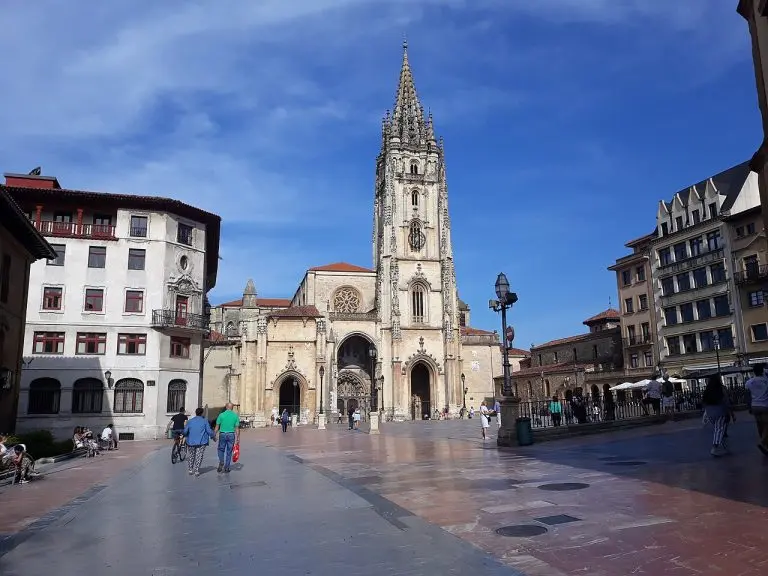
Oviedo concentrates most of its hotel offering in three areas: the old town, the surroundings of Calle Uría and the area around the train station. The old town is ideal for those who want to sleep a stone’s throw from the Cathedral, Plaza del Fontán and the cider houses of Calle Gascona, with options ranging from family-run guesthouses to boutique hotels in historic buildings. The Uría area, the city’s main shopping artery, offers mid-range and upscale hotels with easy access to shops and restaurants. Near the train station there are more functional and affordable accommodations, perfect for short stays or for those arriving late and leaving early. Prices vary depending on the season, but in general you can find a double room from around €50-60 in guesthouses and pensions, ranging from €80-120 in three- and four-star hotels, and exceeding €150 in luxury accommodations or on key dates such as the Princess of Asturias Awards.
Where to eat along the route
Asturian cuisine is one of the great reasons to take this trip without rushing. Fabada asturiana is the most iconic dish: a hearty stew of fabes (Asturian white beans) with compango, which includes chorizo, Asturian morcilla and lacón, perfect for cold days or to regain strength after walking. Cachopo is another essential specialty: two large breaded and fried veal cutlets, stuffed with serrano ham and cheese, often accompanied by potatoes; in Oviedo and Gijón there are authentic temples dedicated to this dish. To start, chorizo a la sidra is a cider-house classic: Asturian chorizo cooked in natural cider and served hot, ideal for sharing. Cabrales cheese, made artisanally with raw cow, goat and/or sheep’s milk and aged in natural caves in the Picos de Europa, brings a strong, spicy flavor that pairs wonderfully with a little bread and a sip of cider. Precisely Asturian cider, low in alcohol and obtained from the fermentation of apple juice, is poured from a height to oxygenate it and enhance its properties; it is the region’s drink par excellence. For those who prefer wine, Cangas wine, produced in southwestern Asturias with native grape varieties, represents the winemaking tradition of Asturias and is an interesting discovery.
Frequently asked questions about the Gijón-Oviedo route
How long does it take to get from Gijón to Oviedo?
The fastest journey is by car, taking 25 minutes along the AS-II. By train, the ALVIA takes 25 minutes, the AVE and AVLO 27 minutes, the Cercanías C1 28 minutes, the MD 27 minutes, the REGIONAL 31 minutes and the Cercanías C5a 53 minutes. By direct bus, the journey takes 24 minutes.
Which is cheaper, the train or the bus?
The bus tends to be slightly cheaper, with tickets ranging from €2.55 to €5.70. The Renfe train has an indicative price range of €2.65 to €14.85, with Cercanías services being the cheapest and the ALVIA/AVE the most expensive. The minimum difference is just 10 cents, so the choice will depend more on schedules and personal preference.
Is it worth renting a car?
It depends on your plans. If you’re only going to travel between Gijón and Oviedo, public transport is excellent: 67 trains a day and direct buses every few minutes. However, if you want to make stops along the way such as La Pola Siero or explore the surroundings of both cities, a car gives you a freedom that the train and bus don’t offer. For a purely urban getaway, there’s no need to rent a car.
When is the best time to travel?
Asturias is pleasant all year round, but the best time for this route is from May to October, when the weather is milder and the days are longer. In autumn, especially in October, the green landscapes are tinged with ochre and hearty spoon dishes (fabada, cachopo) are especially appealing. Avoid the months of July and August if you don’t like tourist crowds, and bear in mind that the Princess of Asturias Awards are held in Oviedo in September, drawing large numbers of visitors.
📍 También te puede interesar
Qué ver en Gijón →
Qué ver en Oviedo →