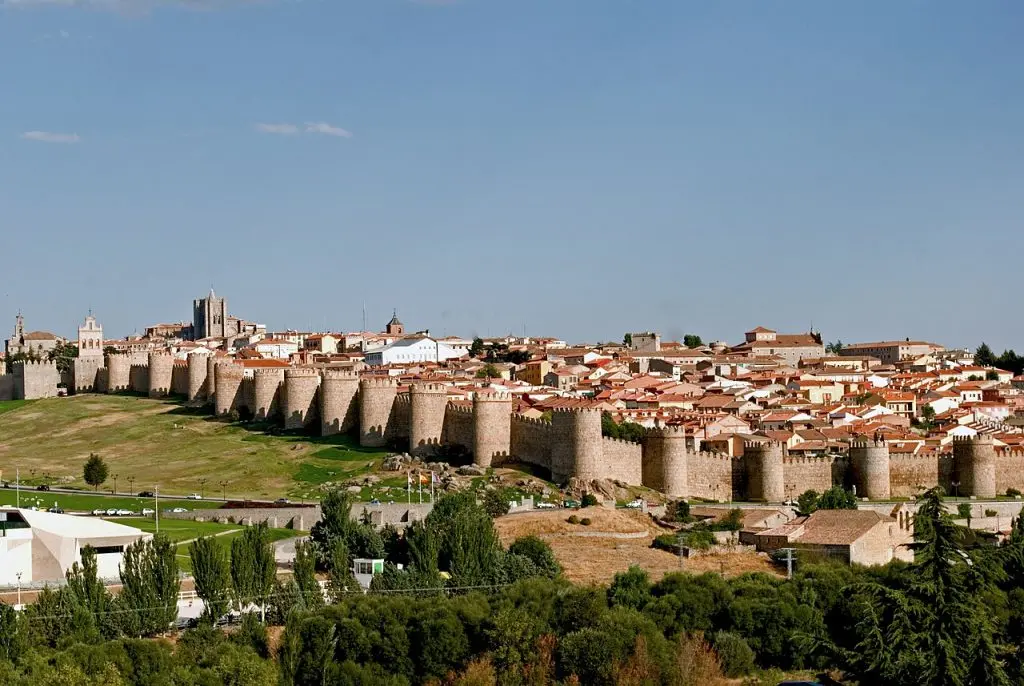
Ávila
Castilla y LeónClimate
Daily budget
What to see in Ávila: the must-sees
The smell of paprika and torreznos wafts out of the bars on Calle de los Reyes Católicos just as the afternoon sun hits the granite of the city wall and turns it an almost edible golden hue. Ávila isn’t visited: it’s walked, savoured and heard in the clatter of the storks that nest in its towers. With 58,000 inhabitants and a medieval wall that preserves its entire 2,516-metre layout intact, it’s one of those cities where the past isn’t in a museum, but beneath your feet.
Walls of Ávila
The wall of Ávila is the star of the show and the best place to start. Construction began on 3 May 1090 by order of Raymond of Burgundy and was finished just nine years later, a breakneck pace for the time. It has 88 towers, some 2,500 battlements and a perimeter of 2,516 metres, with walls averaging 3 metres thick and 12 metres high. You can climb up onto the adarve (wall walk) and stroll along a long stretch of the sentry path, with views over the old town and the River Adaja. It’s open from 10:00 to 20:00 and requires a ticket.
Ávila Cathedral
The Holy Apostolic Cathedral Church of El Salvador, known as Ávila Cathedral, is one of the oldest cathedrals in Spain and the country’s first Gothic cathedral. Its fortified apse, known as the cimorro, is literally embedded in the city wall, something you won’t see anywhere else. The temple has a Latin cross floor plan with three naves, a transept and an ambulatory, and inside it holds numerous artistic treasures, as well as a cloister and chapels with works from different periods. The address is Plaza de la Catedral, 8, and opening hours are 10:00 to 20:00 with a paid ticket. To confirm current prices, check the official Ávila tourism website.
Basilica of San Vicente
A masterpiece of Romanesque architecture in Spain, the Basilica of San Vicente stands on the spot where, according to tradition, the saints Vicente, Sabina and Cristeta were martyred. Its cenotaph is a sculptural gem and the western portico is simply spectacular. It forms part of the ensemble declared a UNESCO World Heritage Site in 1985. It’s open from 10:00 to 19:30 and requires a ticket.
Palacio de los Verdugo
Built in the first third of the 16th century at the initiative of Suero del Águila, this Renaissance palace stands out for its austerity and the sheer bulk of its volumes. Its Plateresque granite ashlar façade is flanked by two barely protruding towers that hint at its defensive character. Don’t miss the unfinished central courtyard with floral-decorated arcades and the coffered ceiling of the staircase.
Church of San Pedro
A temple of Romanesque origin whose most singular feature is the Mudéjar apse built in brick, with arcades and friezes of esquinillas and sardinel brickwork. It has undergone renovations over the centuries, so it combines Romanesque, Mudéjar and later elements. It can be visited during worship and tourist hours, but it’s worth checking the schedule at the tourist office before you go.
Puerta del Alcázar
The main historic entrance to the walled enclosure, it retains its monumental and military character within a wall that adapts to the terrain’s topography with stretches and towers that follow the irregularities of the ground.
Plaza del Mercado Chico
This is the main square and the heart of the old town, arcaded and with the Town Hall on one side, a meeting and celebration place for the people of Ávila.
Convent of Santa Teresa de Jesús
The conventual church, the work of fray Alonso de San José, was inaugurated on 15 October 1636, and the convent was suppressed by the government on 20 February 1836.
Convent of La Encarnación
Founded in 1515 by Discalced Carmelite nuns, it preserves the cell of Saint Teresa and a Teresian museum, with guided tours available.
Ávila Cathedral
Considered Spain’s first Gothic cathedral, its fortified apse is embedded in the city wall and houses a valuable cathedral museum inside.
Adaja Bridge
One of the access gates to the walled enclosure, integrated into the historic complex and with access to the adarve (wall walk) from the Visitor Reception Centre at Avenida de Madrid, 39.
Royal Monastery of Santo Tomás
It was the summer residence of the Catholic Monarchs and houses the tomb of their only son, Prince Don Juan, with three cloisters and a museum of Oriental art.
Los Cuatro Postes
A humilladero (wayside shrine) formed by four Doric columns, offering the most famous and complete panoramic view of the walled city, especially popular at sunset.
🍂 Otoño
Si visitas Ávila en otoño, el ambiente se vuelve fresco y tranquilo, ideal para una escapada sin prisas. La luz otoñal realza el Palacio de los Verdugo y la Puerta del Carmen, y las tardes invitan a un paseo sosegado por la Plaza del Mercado Chico. Lleva ropa de abrigo moderada y consulta el cielo antes de salir, porque las lluvias son escasas pero posibles.
What to do in Ávila
Ávila offers strolls along the wall’s adarve at sunset, fresh produce shopping at the Mercado de Abastos, local life around the Mercado Grande and the Paseo del Rastro, and guided tours of Teresian convents such as the Encarnación. The city is also an excellent base for day trips to Segovia and Salamanca, and its pedestrian centre invites you to explore it without rushing.
Ávila in a day: express itinerary
- 09:30 – Ávila Walls: head up to the adarve early to walk along the best-preserved walled enclosure in the world, with views over the old town and the Adaja river.
- 11:00 – Ávila Cathedral: visit Spain’s first Gothic cathedral and its cimorro embedded in the wall, along with its cloister and chapels.
- 12:30 – Basílica de San Vicente: admire the cenotaph and the western portico of this masterpiece of Spanish Romanesque architecture.
- 14:00 – Lunch around the Mercado Grande: try a chuletón de Ávila or patatas revolconas in the bars and restaurants next to the wall.
- 16:30 – Plaza del Mercado Chico and Palacio de los Verdugo: stroll through the arcaded square and pop into the palace’s Renaissance courtyard.
- 19:00 – Los Cuatro Postes: end the day with the most famous panoramic view of the walled city at sunset.
Where to eat in Ávila: local gastronomy
Where to stay in Ávila
Casco Antiguo (Intramuros)
El corazón medieval amurallado de la ciudad, donde se encuentran la Catedral, palacios y la mayoría de atractivos turísticos.
Barrio de San Vicente
Zona monumental extramuros que alberga la Basílica de San Vicente, un punto clave del románico español.
Zona del Mercado Grande y Paseo del Rastro
Área vibrante junto a la muralla con abundantes tiendas, bares y restaurantes, ideal para experimentar la vida local.
How to get to Ávila
From Salamanca, the fastest option is the train: 1 h 05 min (Regional), 8 a day.
| From | Direct train | Direct bus | Car |
|---|---|---|---|
| Salamanca | 1 h 05 min · 8/day Regional | — | 1 h 18 min 109 km |
| Segovia | — | 53 min · 4/day Avanza | 58 min 65 km |
| Madrid | 1 h 26 min · 22/day Regional | — | 1 h 24 min 108 km |
| Collado Villalba | 53 min · 21/day Regional | — | 54 min 71 km |
| El Escorial | 45 min · 21/day Regional | — | 57 min 59 km |
| Valladolid | 1 h 09 min · 12/day Regional | — | 1 h 44 min 119 km |
| Palencia | 1 h 41 min · 7/day Regional | — | 2 h 11 min 184 km |
| Vitoria-Gasteiz | 3 h 58 min · 5/day Regional | — | 4 h 13 min 372 km |
| Burgos | 2 h 39 min · 5/day Regional | — | 2 h 58 min 263 km |
| San Sebastián | 6 h 04 min · 3/day Regional | — | 5 h 19 min 471 km |
Direct trains and buses from the official timetables published by the operators on Spain's National Transport Access Point (a reference Wednesday); driving times from OpenStreetMap. Operators that do not publish their timetables may run more services. Check the timetable before you travel.
Getting around Ávila
Ávila’s centre is pedestrianised, which makes walking the best way to get around the old town and its surroundings. For longer journeys there’s an urban bus service connecting the centre with the outlying neighbourhoods. If you arrive by car, the most practical option is to park in the designated areas outside the walls and explore the city on foot.
Weather in Ávila
Best time to visit Ávila
Day trips from Ávila
Ávila is an excellent base for exploring other World Heritage cities in Castile and León. Segovia, with its Roman aqueduct and alcázar, is a short drive away and a classic day trip. Salamanca, with its Baroque Plaza Mayor and historic university, is also within reach for a full-day escape. Both pair perfectly with Ávila if you want a tour through the monumental heart of Spain.
Fun facts about Ávila you didn’t know
The walls still hold 54 Roman funerary stelae embedded in them. Yes, you read that right: when the walls were built in the Middle Ages, Roman tombstones were reused and can still be seen today as pieces of an open-air historical puzzle.
Two master builders, one Roman and one French, oversaw the construction of the walls. According to tradition, the Roman Casandro and the Frenchman Florín de Pituenga were responsible for raising this 2,516-metre enclosure in just nine years.
Philip II saved the walls in 1596. The king ordered a series of restoration works that were crucial to ensuring you can walk along the adarve today without a single section having collapsed.
St Teresa of Jesus was born here on 28 March 1515. Spain’s most important mystic and writer left her mark on convents such as La Encarnación, where her cell is preserved.
San Segundo, Ávila’s patron saint, is celebrated on 2 May beside the Adaja river. The hermitage bearing his name becomes the centre of a pilgrimage that blends devotion, outdoor dining and music.
Ávila is the highest provincial capital in Spain. At 1,131 metres above sea level, in winter snowfall frequently blankets the walls and old town in white.
Who Ávila is for
Ávila is ideal for lovers of history and Romanesque art, for couples seeking a getaway with medieval charm and for foodies who want to try authentic Castilian meats and stews. Backpackers will find hostels from 18 euros a night and a pedestrianised centre that’s perfect for exploring on foot. Families enjoy the walls, the open spaces along the Adaja river and the proximity of day trips to Segovia and Salamanca. With 308,848 visitors a year according to the INE, 20% of them foreign, Ávila remains an authentic destination without the crowds.
💡 ¿Sabías que...?
- ● La muralla de Ávila conserva íntegramente su trazado con 2.516 metros, 87 cubos, nueve puertas y unas 2.500 almenas. (https://lamaletainquieta.com/curiosidades-avila/)
- ● Según la tradición, la dirección de la construcción de la muralla recayó en dos maestros: el romano Casandro y el francés Florín de Pituenga. (https://es.wikipedia.org/wiki/Muralla_de_%C3%81vila)
- ● El rey Felipe II ordenó en 1596 una serie de obras de restauración en la muralla que fueron cruciales para su conservación posterior. (https://www.lasexta.com/viajestic/escapadas/muralla-avila-5-curiosidades-que-probablemente-desconocias_202101156001ae6b22c7670001fa2ba5.html)
- ● Santa Teresa de Jesús nació en Ávila el 28 de marzo de 1515. (https://www.santopedia.com/santos/santa-teresa-de-avila)
- ● San Segundo es el patrón de Ávila y su fiesta se celebra el 2 de mayo en torno a la ermita que lleva su nombre, junto al río Adaja. (https://www.avila.es/ciudad/historia/item/564-avila-para-sentirte-parte-de-la-historia)
- ● Ávila es la capital de provincia más alta de España, a 1131 metros sobre el nivel del mar. (https://es.wikipedia.org/wiki/%C3%81vila)
- ● En los muros de la muralla hay identificadas 54 estelas funerarias epigráficas de época romana incrustadas. (https://exa.ai/library/publication/5ftb7nhtc17)
Frequently asked questions about Ávila
How many days do I need to see Ávila?
With one full day you can see the essentials: the walls, the cathedral, the Basilica of San Vicente, Plaza del Mercado Chico and Los Cuatro Postes. If you also want to visit the Royal Monastery of Santo Tomás, the Teresian convents and take a day trip to Segovia or Salamanca, the ideal is two or three days. The average stay for travellers is 1.49 nights according to the INE.
Is Ávila expensive?
No, Ávila is quite affordable. An average meal costs between 12 and 18 euros, hostels range from 18 to 30 euros per night, and a 3-star hotel runs between 50 and 80 euros. Even 4- and 5-star hotels rarely exceed 200 euros per night.
What is the best time to visit Ávila?
From June to September, when the average temperature is 20.1°C and the days are long and pleasant. Winter is cold, with an average of 4.1°C and frequent snowfall, as it is the highest provincial capital in Spain. Annual rainfall is only 398 mm, so rain rarely ruins your plans.
How do I get to Ávila from Madrid?
By train, Ávila station has direct services to Madrid with a journey time of approximately 1 hour and 30 minutes according to Renfe. By bus, the companies Jiménez Dorado and Avanzabus cover the route in a similar time. By road, the AP-6 and AP-51 are the fastest routes, with a journey of approximately 1 hour and 15 minutes.
Can you walk on the walls of Ávila?
Yes, the walls have a visitable section of the parapet walk (adarve) open from 10:00 to 20:00 with a paid ticket. Access to the Puente Adaja section is through the Visitor Reception Centre at Avenida de Madrid, 39, with opening hours that vary depending on the season.