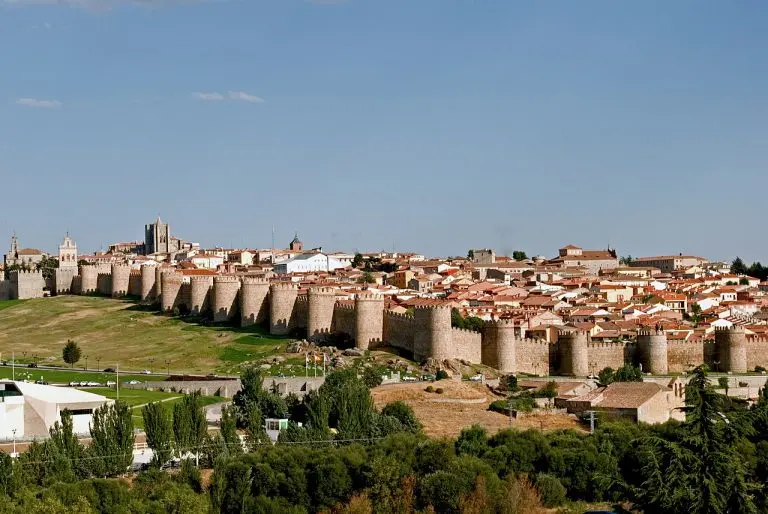
Segovia → Ávila
67 kmThere are no high-speed trains or airports between Segovia and Ávila to shorten the distance, but there is one of those Castilian roads that cuts through the Sierra de Guadarrama with the asphalt hugging the pine forests and a horizon that shifts from granite to adobe without you even noticing. It’s a 67-kilometre journey that smells of suckling pig at the start and chuletón at the end, with a direct bus that costs less than a menú del día.
How to get from Segovia to Ávila: quick summary
The fastest way to travel between Segovia and Ávila is by car, with a 67 km route that takes about 50 minutes combining the SG-20, the N-110 and the AP-51. The direct Avanza bus is the alternative for those without their own vehicle: it takes 53 minutes and costs €6.20. There is no direct train or direct flight between the two cities. For those who prioritise comfort and price, the bus is unbeatable; for those who want to stop in Guadarrama or El Espinar and explore at their own pace, the car is the recommended option.
Driving from Segovia to Ávila
The drive covers 67 km in approximately 50 minutes, combining three main roads: the SG-20 to leave Segovia, the N-110 as the backbone of the route and the AP-51 for the final approach to Ávila. The natural exit from Segovia is via the SG-20, the Segovia ring road, which accounts for about 3 km of the journey and avoids crossing the city centre. Then you take the N-110, the road from Soria to Plasencia, which makes up about 30 km of the route with no tolls and crosses the foothills of the sierra with gentle curves and open views. The final stretch is on the AP-51, a toll motorway covering about 22 km that allows a quick entry into Ávila from the east. It’s worth carrying cash or a card for the AP-51 toll and checking traffic conditions on public holidays, when the N-110 can build up with slow-moving vehicles.
By bus from Segovia to Ávila
There is a direct bus between Segovia and Ávila, operated by Avanza, with a journey time of 53 minutes and a fare of €6.20 per trip. It’s the cheapest option and saves you dealing with the AP-51 toll and finding parking in Ávila. It’s worth checking schedules on the Avanza website or at Segovia bus station, as frequency can vary between weekdays and public holidays. For a car-free day trip, the direct bus is the most practical alternative and the best value for money.
Recommended stops along the way
The two verified stops on the route are Guadarrama and El Espinar, both on the Segovian side of the sierra and accessible from the N-110 without long detours. Guadarrama, in the municipality of the same name, is a good spot to stretch your legs and grab a coffee before tackling the AP-51 stretch; its mountain setting and proximity to the Sierra de Guadarrama National Park make it a pleasant stop for a short break. El Espinar, also in the province of Segovia, lies somewhat further southwest and stands out for its mountain atmosphere and its proximity to pine forest areas; it’s a suitable stop for those who prefer to pause before the final stretch into Ávila. Both towns allow you to refuel and make a quick food stop without deviating much from the main route.
Where to stay in Ávila
The best area to stay in Ávila is the walled old town, where boutique hotels, guesthouses and tourist apartments in restored buildings cluster together, with prices typically ranging from €60 to €120 per night in mid-season. Sleeping inside the walls lets you explore the city on foot and head out early to the Cathedral or the Convent of Santa Teresa without relying on a car. For tighter budgets, the ensanche area and the surroundings of the bus station offer guesthouses and pensions with prices between €40 and €70 per night, about 10-15 minutes’ walk from the centre. Those travelling by car can opt for rural accommodation around Ávila, with country houses and inns that combine tranquillity with easy access via the AP-51, although in this case a vehicle is essential for getting around.
Where to eat en route
The food between Segovia and Ávila is one of the great attractions of the journey, with hearty dishes that reflect the inland Castilian kitchen. In the Segovia area, roast suckling pig is the star dish: a young piglet slowly roasted in a wood-fired oven with pork lard, salt and water, served with crispy skin and tender meat. The judiones de La Granja, typical of La Granja de San Ildefonso, are a hearty stew made with large white beans, chorizo, morcilla, pancetta and pig’s ear, slow-cooked until the beans are tender and the broth is thick. To finish, the ponche segoviano is a traditional dessert of rolled sponge cake filled with pastry cream and covered in icing sugar, made with eggs, sugar, flour, milk and cinnamon. In the province of Segovia and Burgos, wine from the DO Ribera del Duero, made mainly with Tempranillo grapes, pairs well with any meat dish thanks to its intense colour, aromas of ripe fruit and barrel ageing. Once in Ávila, the chuletón de Ávila is the essential dish: a cut of mature beef, typically of the Avileña-Negra Ibérica breed, grilled, served rare and with coarse salt, accompanied by potatoes or peppers. The patatas revolconas, with boiled potatoes mashed with paprika, garlic and olive oil, often accompanied by torreznos, are the perfect starter. And for dessert, the yemas de Santa Teresa, made with egg yolk and sugar, cooked and coated in icing sugar, with an elongated shape and an intense egg flavour, are Ávila’s typical sweet.
Frequently asked questions about the Segovia-Ávila route
How long does it take from Segovia to Ávila?
By car, the 67 km journey takes about 50 minutes via the SG-20, the N-110 and the AP-51. On the direct Avanza bus, the duration is 53 minutes. There is no direct train or direct flight between the two cities.
Which is cheaper, the train or the bus?
The bus is the only direct public transport option between Segovia and Ávila, with a price of €6.20 per journey. There is no direct train between the two cities, so comparing prices with the train does not apply on this route.
Is it worth renting a car?
Yes, especially if you want to stop in Guadarrama or El Espinar, two recommended stops on the route that are not accessible on the direct bus. A car also allows greater flexibility with timings and avoids depending on Avanza’s schedules, although you have to add the cost of the AP-51 toll and fuel.
When is the best time to travel?
The best time to do this route is spring and autumn, when temperatures are mild and the Guadarrama mountain landscape is at its best. In summer, Ávila tends to be less hot than other Castilian cities thanks to its altitude, while in winter it is advisable to check the condition of the N-110 in case of frost or snow in the mountains.
💡 ¿Sabías que...?
- ● La muralla de Ávila tiene 2.516 metros de longitud y en origen tuvo 88 cubos o torreones, desapareciendo uno en el siglo XVI para construir la Capilla de San Segundo, por lo que actualmente cuenta con 87. (https://avilaturismo.gvam.es/actividades/la-muralla)
- ● Ávila es la capital de provincia más alta de España, a 1131 m sobre el nivel del mar. (https://es.wikipedia.org/wiki/Avila)
- ● La ciudad de Ávila fue declarada Patrimonio de la Humanidad en 1985, incluyendo su casco histórico medieval y las iglesias de Extramuros San Vicente, San Segundo, San Andrés y San Pedro. (https://patrimoniocultural.jcyl.es/web/es/conocimiento-difusion/ciudad-avila.html)
- ● En el siglo XVI, Ávila es conocida por ser la cuna de Santa Teresa de Jesús. (https://patrimoniocultural.jcyl.es/web/es/conocimiento-difusion/ciudad-avila.html)
- ● La catedral de Ávila es la más antigua del gótico español. (https://patrimoniocultural.jcyl.es/web/es/conocimiento-difusion/ciudad-avila.html)
- ● La muralla de Ávila fue mandada reconstruir por Alfonso VI tras la conquista de Toledo y tuvo una nueva intervención con Alfonso VIII que es la que ha llegado a nuestros días. (https://avilaturismo.gvam.es/actividades/la-muralla)
- ● Ávila posee los títulos de «Ávila del Rey» otorgado por Alfonso VII, «Ávila de los Leales» otorgado por Alfonso VIII y «Ávila de los Caballeros» otorgado por Alfonso X. (https://es.wikipedia.org/wiki/Avila)