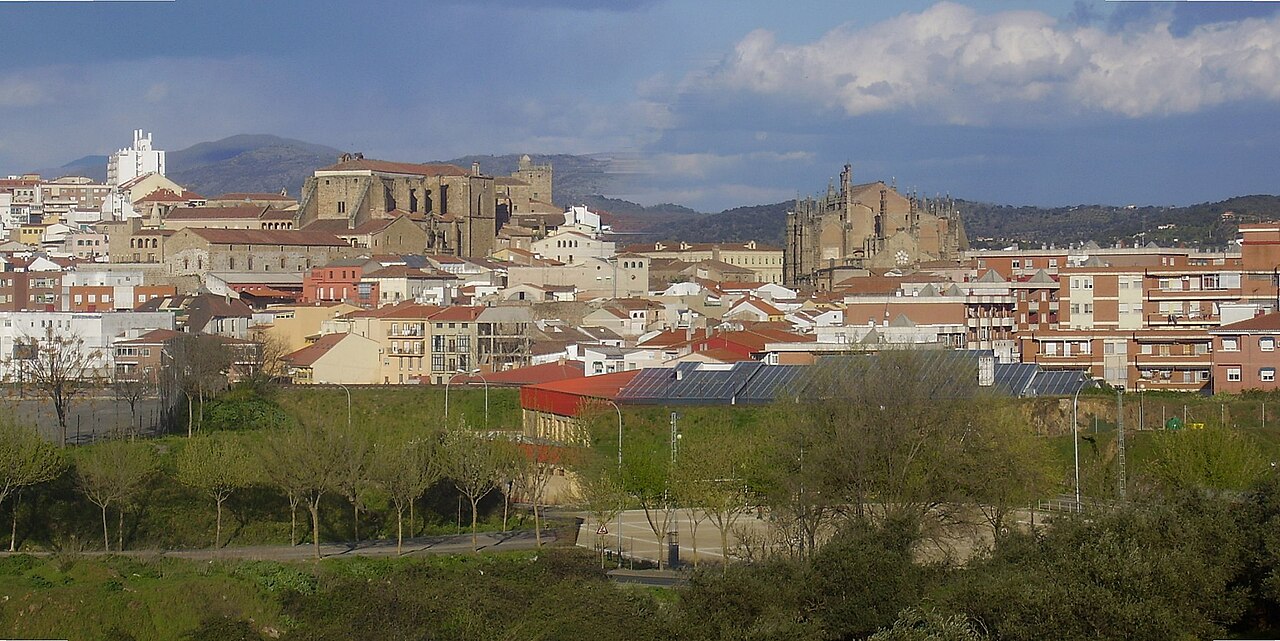
Plasencia
ExtremaduraClimate
Plasencia is far more than a technical stop on the route north; it’s a city that harbors an architectural secret unique in all of Spain: two cathedrals joined within a single monumental complex. With a population of 40,000, this town in Cáceres province packs a surprising historical density, where the streets of the old quarter have served as a set for major HBO series and where the founding motto of 1186, ‘Ut placeat Deo et hominibus’ (To please God and men), still resonates around every corner. Get ready to walk among stones that have witnessed the passage of kings, conquistadoras like Inés Suárez, and, more recently, fictional dragons, all of it watered by the Jerte River and crowned by a Renaissance aqueduct that still retains 55 of its original arches.
The must-seesWhat to See in Plasencia: The Essentials
Plasencia offers a concentrated monumental heritage that allows you to journey through centuries of history in just a few kilometers. Below, I detail the must-sees so you don’t miss anything important.
Centro Cultural Las Claras (Las Claras Cultural Centre)
This cultural complex is one of the most versatile spaces in the city, housed in the former Convento de Santa Clara (Santa Clara Convent), which functioned as such for nearly four hundred years until its exclaustration around 1836 due to the Desamortización de Mendizábal (Confiscation of Mendizábal). Today, after its adaptation for cultural use, it offers spacious exhibition areas open from Monday to Friday with very accessible hours, from 9.00 to 22.00. Best of all, admission is free for all visitors, making it an obligatory stop to understand the building’s evolution at no cost.
Plaza de Toros de Plasencia
Although its name suggests a bullfighting function, this listed monument is actually a religious building located in Cáceres and declared a Bien de Interés Cultural (Asset of Cultural Interest). Its architecture stands out for its unique design, which often confuses unsuspecting visitors looking for a bullring, only to find a structure of great heritage value instead. It is a fascinating example of how local nomenclature and history can play with travelers’ expectations.
Cañón de la Salud
This monument is one of the most emblematic entrances to the city, functioning as a wall gate that integrates a chapel into its defensive structure. When you visit, you are not just seeing a fortification, but a key spiritual point in Plasencia, Spain, that combines military protection with religious devotion. It is the perfect place to begin sensing the blend of functions that buildings had in the Middle Ages.
Palacio de Mirabel
As a Bien de Interés Cultural (Asset of Cultural Interest), the Palacio de Mirabel is an architectural gem representing the noble power of the region. Its façade and interior structure reflect the importance of the families that governed the city for centuries. It is an unmissable visual landmark when strolling through the historic quarter and deserves a stop to admire its construction details.
Iglesia de Santa Ana
This religious monument has a unique technical peculiarity: it also serves as a geodesic vertex in Plasencia, Spain. Beyond its spiritual and architectural value, this scientific fact makes it a key cartographic reference point in the area. It is a prime example of how sacred and scientific functions have historically coexisted in urban planning.
Other Points of Interest
- La iglesia del Salvador (Church of El Salvador) is another essential religious monument that completes the ecclesiastical landscape of Plasencia.
- La Iglesia de la Magdalena (Church of La Magdalena) stands out for its architecture and its importance within the city’s monumental ensemble.
- The antiguo cementerio judío del Berrocal (Old Jewish Cemetery of Berrocal) is a fundamental historical testimony to the ancient Jewish community of Plasencia, Spain.
- La Fosa común sin nombre 1025/2009 CACE (Unnamed Mass Grave 1025/2009 CACE) is a commemorative monument that remembers a Spanish Civil War grave recorded on the map of mass graves.
- El Canchal, la Fuente del Sapo, el Gordo, and el Merengue are all monuments that function as geodesic vertices in Plasencia, Spain, marking key points in the local topography.
- The Paseos del Río Jerte (Jerte River Walks) offer green areas watered by the river that contrast with the stone of the city center, including the Parque del Cachón (Cachón Park), a former 19th-century cattle fair depicted by Sorolla.
- Calle Rey and Calle Sol are commercial and historic streets in the old town, essential for exploring the city and connecting the Plaza Mayor with other points of interest.
- La iglesia de San Esteban (Church of San Esteban) and la Iglesia de San Andrés (Church of San Andrés) are other monumental religious buildings that enrich the route through the city.
🍂 Otoño
Si visitas Plasencia en otoño, el ambiente es tranquilo y las temperaturas bajan, así que el clima acompaña para disfrutar de la arquitectura con calma. Tienes tiempo de sobra para visitar la Catedral de Plasencia y el Palacio de Mirabel sin las aglomeraciones de otras épocas. Mi consejo: lleva un paraguas, porque las lluvias se hacen más frecuentes, y viste por capas.
What to do in Plasencia
Plasencia offers cultural and leisure activities rooted in its rich medieval history and its natural riverside setting. You can immerse yourself in the past by visiting the judería (Jewish quarter), one of the most important in the Crown of Castile, or stroll along the banks of the Jerte River where the painter Sorolla found inspiration. If you visit the city in August, don’t miss the ‘Martes Mayor’ (Great Tuesday), a festival declared of National Tourist Interest that revives the original medieval market with more than 200 stalls. The city also lends itself to film tourism, as you can walk the same streets where scenes from ‘House of the Dragon’ or ‘La Catedral del Mar’ were shot.
Plasencia in one day: express itinerary
If you’re short on time, this itinerary will let you see the city’s essentials without rushing, combining history, culture, and gastronomy.
- 10:00 AM – Cañón de la Salud (Health Ravine): Start your day at this wall gate with a chapel to understand the historic entrance to the city and take your first photos.
- 11:30 AM – Centro Cultural Las Claras: Visit the former convent; being free and with generous opening hours, it’s perfect for seeing exhibitions before lunch.
- 13:30 PM – Calles Rey and Sol: Walk these commercial and historic streets to soak up the local atmosphere and make your way to the Plaza Mayor area.
- 15:00 PM – Lunch in the old town: Take your time to sample the local cuisine in the bars of the historic quarter.
- 17:00 PM – Jerte River walks: End the day with a stroll through the Parque del Cachón to see the city from the riverbank and relax among green spaces.
Where to eat in Plasencia: local gastronomy
How to get to Plasencia
The city has overland connections that make access easy from different parts of the peninsula, with train and road being the main options.
| Medio | Duración | Precio aprox. | Frecuencia |
|---|---|---|---|
| Tren (Estación de Plasencia) | Variable según origen | Según Renfe | Diaria (sin AVE) |
| Autobús | Variable según origen | Económico | Regular |
| Coche | Depende de la ruta | Combustible | Libre |
It is important to know that Plasencia train station does not have AVE (high-speed train) service, so train travel times can be longer than those to other provincial capitals connected by high-speed rail.
How to get around Plasencia
Urban transport in Plasencia is mainly based on the city bus, which connects the different neighbourhoods and points of interest. However, since the old town and most of the verified attractions such as the Centro Cultural Las Claras (Las Claras Cultural Centre) or the Iglesia de Santa Ana (Church of Saint Anne) are very close to each other, the city is highly walkable. For longer distances or to reach the peripheral geodetic vertices like Canchal or Merengue, the bus is the available public option.
Weather in Plasencia
Best time to visit Plasencia
Day trips from Plasencia
From Plasencia you can take day trips to cities in the region that complement your visit. The city’s geographical location, at the gateway to the Jerte Valley and bordering districts such as La Vera, Monfragüe, or the Ambroz Valley, makes it an ideal base camp. You can explore the villages of these neighbouring regions to enjoy different natural landscapes, from cherry blossoms to mountain gorges, taking advantage of the fact that the municipality does not form a commonwealth with the surrounding villages but is physically integrated into its environment.
Curious facts about Plasencia you didn’t know
Did you know that the city’s name is a royal decree? It comes from the motto given by its founder, King Alfonso VIII of Castile, in 1186: ‘Ut placeat Deo et hominibus’, which means ‘To please God and men’.
Another surprising fact is that Plasencia has the peculiarity of having two cathedrals in one. The Catedral Vieja (Old Cathedral) and the Catedral Nueva (New Cathedral) are joined, but the construction of the latter was abruptly halted because the funds were diverted to build the Monastery of El Escorial.
The city is also the birthplace of historical heroines: Inés Suárez was born here in 1507, the only Spanish woman registered as a conquistador, who played a fundamental role in the founding of Santiago de Chile.
The film industry has recently discovered Plasencia, turning it into a set for major productions such as HBO’s ‘House of the Dragon’, ‘La Catedral del Mar’ (Cathedral of the Sea), and ‘Carlos, Rey Emperador’ (Charles, King Emperor), thanks to the preservation of its medieval streets.
Furthermore, in 1485, Pope Pius II issued a papal bull to create a ‘Estudio General’ (General Study) in Plasencia, which represents the first documented attempt to found a university in all of Extremadura.
Who is Plasencia for
Plasencia is an ideal destination for lovers of history and architecture seeking authenticity without the crowds of other tourist cities. It is perfect for foodies who want to try genuine Extremaduran cuisine based on Iberian pork and paprika, as well as for travellers who enjoy film location tours and medieval festivals like the Martes Mayor (Great Tuesday). Its size of 40,000 inhabitants makes it manageable for couples and families wanting a relaxed pace, far from urban stress but with all the necessary services.
Frequently asked questions about Plasencia
How many days do I need to see Plasencia?
With one day you can see the essentials like the Centro Cultural Las Claras (Las Claras Cultural Centre) and the main churches, but 2 days are recommended to enjoy the gastronomy at a relaxed pace, the walks along the Río Jerte (Jerte River), and to visit the Mercado de Abastos (Market Hall) without rushing.
What is the best time of year to visit Plasencia?
The best time is from May to September, according to climate data, with an average summer temperature of 26.3°C. Avoid winter if you are looking for mild temperatures, as the average drops to 8.6°C.
How do I get to Plasencia from Madrid?
You can get there by car or bus. There is also the Estación de tren de Plasencia (Plasencia Train Station), although keep in mind that it does not have AVE service, so the train journey can be longer than on other high-speed routes.
Where can I find updated information on opening times?
For further practical information on museum opening times, tickets, and the cultural agenda, I recommend checking the official Plasencia tourism website, which is the most reliable source for planning your visit.