Salamanca
Castilla y LeónClimate
Daily budget
The Plateresque façade of Spain’s oldest university and the majestic Plaza Mayor, considered the most beautiful in the country, are the beating heart of this university city of 143,000 inhabitants. It is not just a tourist destination; it is a place where 2,700 years of history blend with student buzz on every corner of golden stone. Here, time seems to have stood still to let you enjoy a heritage declared a World Heritage Site by UNESCO in 1988, where every step brings you closer to legends like that of Calixto and Melibea or unique gastronomic traditions such as the hornazo (a meat-filled pastry).
The must-seesWhat to see in Salamanca: the essentials
University of Salamanca (Historic Building)
This is the crown jewel, Spain’s oldest university, whose Plateresque façade is a stone book where visitors tirelessly search for the famous figure of the frog as a good luck charm. Inside the historic building, you cannot miss the Patio de Escuelas Menores and the classrooms where historical figures taught, feeling the weight of centuries of knowledge in its walls. Visiting hours are from 10:00 to 19:00, and purchasing a ticket is mandatory to access this essential monument. It is the obligatory starting point to understand the city’s academic soul.
New Cathedral of Salamanca
This impressive cathedral complex masterfully fuses Late Gothic, Renaissance, and Baroque styles with the original Romanesque style of the adjacent Old Cathedral. Declared a World Heritage Site by UNESCO in 1988, it allows visitors to explore its naves and chapels between 10:00 and 20:00 upon purchasing a ticket. It is a must-visit to admire architectural evolution within a single sacred space.
Convent of San Esteban
This is a 16th-century Dominican convent distinguished by its impressive Plateresque façade and an altarpiece by Churriguera. Included on the UNESCO list, it represents one of the most sublime examples of religious art in the city. Its interior breathes peace and grandeur, offering a perfect contrast to the outside bustle.
Palace of Monterrey
This 16th-century Plateresque palace is the prototype of the Monterrey style and is currently owned by the House of Alba, although it is open to the public. Its architecture has influenced numerous buildings in the Americas and Europe, serving as a benchmark of the Spanish Renaissance. The visit allows you to approach the nobility and historical power of Salamanca.
Art Nouveau and Art Déco Museum (Casa Lis)
Housed in a modernist mansion, this museum holds an important collection of decorative arts ranging from the late 19th century to World War II. It also holds UNESCO distinction since 1988 and offers a fascinating visual journey through European design. Opening hours are from 11:00 to 20:00 and require a ticket, making it an ideal plan for art and aesthetics lovers.
La Clerecía
Former Royal College of the Holy Spirit of the Jesuits, this Baroque building allows visitors to climb its towers via the Scala Coeli to enjoy spectacular views.
Church of San Martín
A 12th-century Romanesque temple known as San Martín del Mercado, it is the most significant Romanesque building after the Old Cathedral and preserves its historical structure among modern properties.
Casa de las Conchas
This 15th-century Gothic-Plateresque palace is unmistakable due to the 300 scallop shells of Saint James adorning its façade and today functions as a public library.
Escuelas Menores
A Renaissance building linked to the 15th-century foundation that originally served for grammar teachings, whose inner courtyard preserves the historic academic structure.
Ieronimus (Cathedral Towers)
This experience allows you to visit the medieval towers of the Cathedral to enjoy unique panoramic views of all of Salamanca.
Roman Bridge
This is a bridge of Roman origin that crosses the Tormes River and offers the most iconic and photogenic views of the city from the bank.
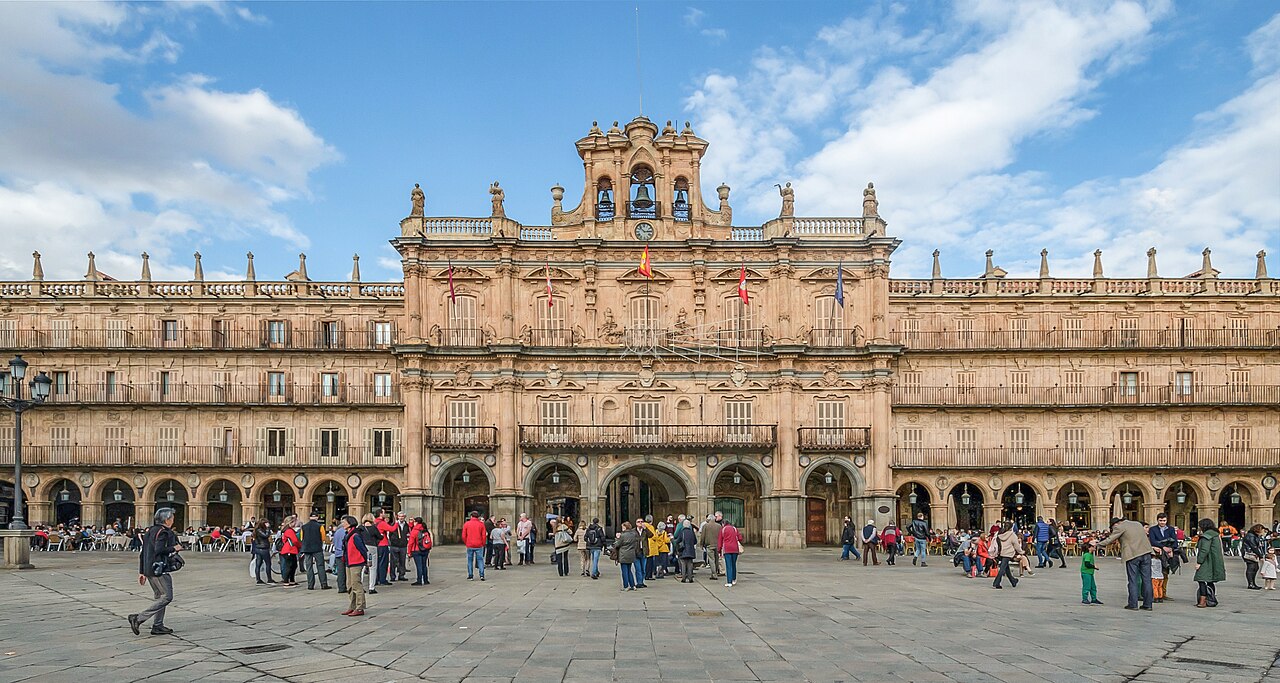
Plaza Mayor de Salamanca
Considered the most beautiful main square in Spain, it is an 18th-century Baroque work designed by Alberto Churriguera and declared a Site of Cultural Interest (Bien de Interés Cultural).
New Cathedral and Old Cathedral
This impressive cathedral complex combines late Gothic, Renaissance, and Baroque styles with the original Romanesque, forming a religious site of incalculable value.
Huerto de Calixto y Melibea
It is a literary garden located on the city wall with views of the Tormes River, intimately linked to the work La Celestina by Fernando de Rojas.
🍂 Otoño
Si visitas Salamanca en otoño, la luz dorada ilumina la piedra de la ciudad de forma espectacular. Es otra de las mejores épocas para sentir el ambiente universitario sin agobios. Lleva siempre una chaqueta ligera por si refresca por la noche.
What to do in Salamanca
Salamanca offers vibrant cultural activities such as the Ferias and Fiestas de la Virgen de la Vega in September and the tradition of Lunes de Aguas in April, in addition to exploring the street art of the Barrio del Oeste. You can immerse yourself in history by touring the Historic Center (Casco Histórico), where most monuments are concentrated, or enjoy the nightlife in the alternative bars of the west. For an authentic local experience, visit the Mercado Central de Salamanca, a Modernist building of iron and glass filled with fresh products.
Salamanca in one day: express itinerary
If you only have 24 hours, this itinerary will allow you to see the essentials without rushing too much, taking advantage of the compactness of the center:
- 10:00 – University of Salamanca: Start early at the oldest university in Spain to see the façade and look for the frog before it gets crowded.
- 12:00 – Plaza Mayor: Walk to the heart of the city to admire the Baroque architecture of Alberto Churriguera and have a drink under its arcades.
- 14:00 – Cathedrals and Ieronimus: Visit the cathedral complex and climb the towers for the best aerial perspective of the city.
- 16:00 – Casa de las Conchas: Stroll to this unique palace to see its 300 shells and enjoy the library atmosphere.
- 18:00 – Roman Bridge and Huerto de Calixto y Melibea: End the day with a sunset walk along the Tormes River and in this literary garden with spectacular views.
Where to eat in Salamanca: local gastronomy
Where to sleep in Salamanca
Casco Histórico
Concentra la mayoría de monumentos, restaurantes y tiendas. Ideal para sumergirse en la historia de la ciudad.
Barrio del Oeste
Conocido por su arte urbano y ambiente bohemio, lleno de galerías de arte, bares y locales alternativos.
How to get to Salamanca
The city is well connected by land and air, facilitating access from different points of the peninsula. Here are the available transport options:
| Medio | Detalles | Conexiones / Carreteras |
|---|---|---|
| Tren | Estación de Salamanca (Vialia) con servicio AVE. | Destinos directos: Madrid, Ávila, Valladolid, Zaragoza. |
| Autobús | Estación de Autobuses de Salamanca. | Compañías: Avanza, Alsa, Monbus. |
| Avión | Aeropuerto de Salamanca (SLM). | Ubicado a 17 km de la ciudad. |
| Coche | Acceso por red de carreteras principal. | Carreteras: A-62, A-66, A-50, N-620, N-630. |
Getting around Salamanca
Once in the city, urban transport is simple and efficient. You can use the city bus to move between different zones. However, it is highly recommended to enjoy the pedestrian center, as most tourist attractions are very close to each other and perfectly walkable.
Weather in Salamanca
Best time to visit Salamanca
Day trips from Salamanca
If you have extra time, Salamanca’s location allows for quick excursions to nearby cities of great historical interest. Recommended destinations for these day trips are Zamora, Ávila, and Valladolid, all accessible and rich in heritage.
Who is Salamanca for?
Salamanca is a versatile destination attracting 728,126 travelers annually (INE), with 39% being foreigners. It is ideal for history and architecture lovers thanks to its UNESCO status, for students and backpackers due to its university atmosphere and hostel prices (20-35€), and for foodies interested in Castilian gastronomy. The average stay of 1.61 nights suggests it is perfect for intensive weekend getaways.
Frequently Asked Questions about Salamanca
How many days do I need to see Salamanca?
With an average stay of 1.61 nights according to the INE, a weekend is enough to see the main attractions such as the University and the Plaza Mayor (Main Square), although you might need more time to explore museums like Casa Lis or take day trips to Zamora and Ávila.
Is Salamanca expensive?
It is not excessively expensive; you can find hostels from €20–35 per night and 3-star hotels between €60–90. An average meal usually costs between €12 and €20, making it accessible for various budgets.
What is the best time to visit Salamanca?
The best time is spring and autumn, avoiding winter, which is the worst season with average temperatures of 5°C. Summer is pleasant with an average of 22°C, but spring and autumn offer the ideal climate for walking around the city.
How do I get to Salamanca from Madrid?
The fastest option is the AVE train from Salamanca station (Vialia), which has direct destinations from Madrid. You can also arrive by bus with companies such as Avanza, Alsa, or Monbus, or by car via the A-50 highway.
🗺️ Rutas desde Salamanca
- How to Get from Zamora to Salamanca: Distance, Train, Bus and Car
- How to Get from Burgos to Salamanca: Distance, Train, Bus and Car
- How to Get from Avila to Salamanca: Distance, Train, Bus and Car
- How to Get from Salamanca to Avila: Distance, Train, Bus and Car
- How to Get from Salamanca to Zamora: Distance, Train, Bus and Car
- How to Get from León to Salamanca: Distance, Train, Bus and Car
- How to Get from Salamanca to León: Distance, Train, Bus and Car
- How to Get from Salamanca to Burgos: Distance, Train, Bus and Car