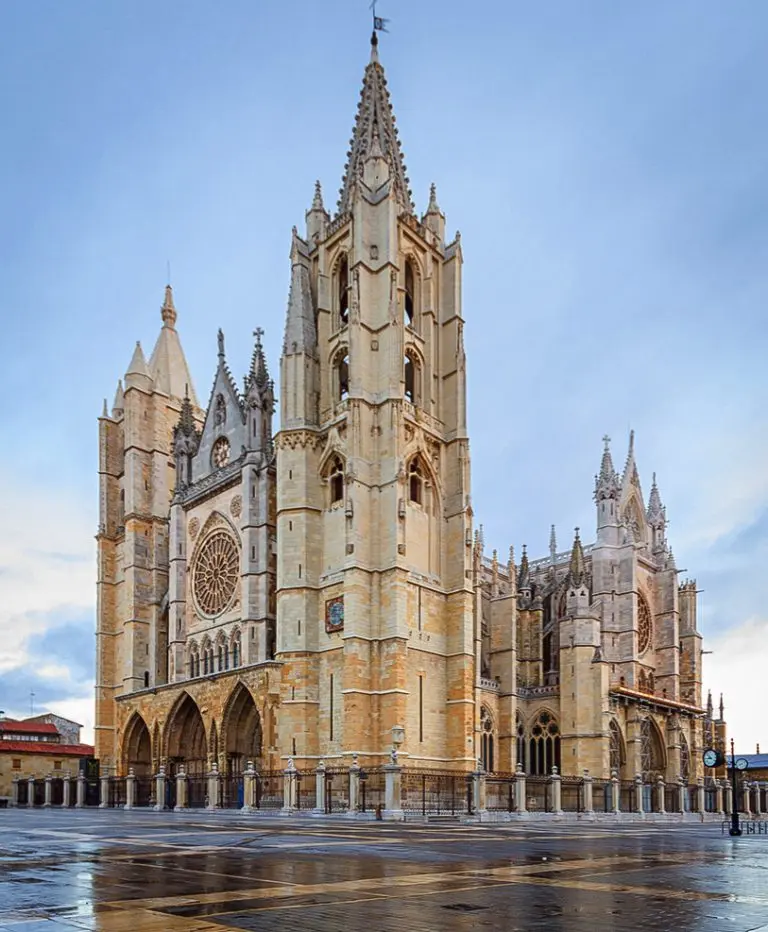
Salamanca → León
212 kmThe Ruta de la Plata unfolds before you like a corridor of history and endless plains, linking two of the most monumental cities in northwestern Spain. In just over two hours, the journey from Salamanca to León treats you to gentle transitions between golden stone, cereal fields and the Leonese mountains rising on the horizon.
How to get from Salamanca to León: quick summary
The fastest and most flexible option is by car, with 212 km along the motorway and an estimated time of 2h 15min with no tolls. The direct bus covers the route in 190 minutes with regular departures from ALSA and Avanza – Auto Res. There is no direct train between the two cities, so rail is ruled out for this route. For travellers without their own vehicle, the bus is the most practical alternative; for those who want to explore the stops along the way, the car is clearly superior.
By car from Salamanca to León
The drive is resolved in a practically straight line north along the A-66, the Autovía Ruta de la Plata, which covers some 176 km of the route toll-free. From Salamanca, you take the A-66 towards Zamora and keep heading north past Benavente. As you approach León, you link up with the A-6, Autovía del Noroeste, for about 11 km, and finally take the LE-11, the southern access road into León, which in about 7 km leaves you at the gates of the city centre. The road surface is good, traffic tends to flow smoothly and the scenery alternates between the dehesas of Salamanca, open fields and the first mountain foothills as you near the Leonese capital.
By bus from Salamanca to León
There is indeed a direct bus between Salamanca and León, operated by ALSA and Avanza – Auto Res. The journey takes 190 minutes, roughly 3 hours and 10 minutes. The bus departs from Salamanca bus station and arrives at León bus station, with frequencies that vary depending on the day and season. It is a comfortable option for those who don’t want to drive, with reclining seats and, on many services, wifi and power sockets. The ticket price is not specified in the verified data, so it is worth checking directly on the ALSA or Avanza – Auto Res websites for updated fares and early booking offers.
Recommended stops along the way
The route between Salamanca and León allows for three interesting stops, all well connected to the motorway and with charm of their own.
Benavente is the most natural stop on the journey, located roughly halfway. This town in Zamora is a historic communications hub and preserves an old quarter with Romanesque churches, a keep and arcaded squares. It is ideal for stretching your legs, having a coffee and recharging before tackling the second half of the trip. Its location beside the A-66 makes it a quick stop with no detour.
Santa Marta de Tormes sits practically attached to Salamanca, on the other side of the Tormes river. If you don’t want to stray far at the start of the journey, it is an option for a brief first stop. Its proximity to the city of Salamanca makes it less appealing as a long stop, but useful if you need fuel, something to eat or simply to leave Salamanca without rushing.
Trobajo del Camino is already in the metropolitan area of León, a few kilometres from the centre. It is the last possible stop before entering the Leonese capital. Its name evokes the Camino de Santiago (Way of St James), which passes through this area, and it can serve as a quiet final stop before plunging into León’s urban traffic. It is practical if you arrive with time to spare and want to avoid the crowds in the centre for lunch or a rest.
Where to stay in León
León offers accommodation for every budget, concentrated mainly in three areas: the historic centre, the Barrio Húmedo and the surroundings of the train and bus station. The historic centre is ideal for those seeking a monumental atmosphere, with the cathedral and San Isidoro just a few steps away; prices here tend to be higher, with boutique hotels and charming guesthouses. The Barrio Húmedo, famous for its tapas bars, is perfect for younger travellers or those who want to go out for dinner without taking transport, with a wide range of guesthouses and tourist apartments. The station area is cheaper and more functional, with chain hotels and simple pensions. Approximate price ranges go from 40-60 € per night in basic pensions and guesthouses, 60-100 € in three-star hotels, and more than 100 € in four-star or charming hotels in the centre.
Where to eat en route
Although the route between Salamanca and León does not pass through the places of origin of all these dishes, many of them can be found in restaurants in both cities and in nearby towns. Cecina de León (cured beef) is a must when you reach the Leonese capital: cured and smoked beef, made from cow or ox legs, salted and air-dried, with an intense flavour and firm texture. It is served thinly sliced, on its own or with bread and oil.
Cochinillo asado (roast suckling pig), typical of Segovia, consists of a whole suckling pig slowly roasted in a wood-fired oven with pork lard, salt and water. The skin comes out crispy and the meat tender. Judiones de La Granja (large white beans), originally from La Granja de San Ildefonso (Segovia), are a hearty stew with large beans, chorizo, morcilla, pancetta and pork ear, cooked slowly until the beans are tender and the broth is thick.
Lechazo asado (roast suckling lamb), typical of Aranda de Duero (Burgos) and the Ribera del Duero, is oven-roasted suckling lamb with lard and salt. The meat is very tender and is served with salad or potatoes. Morcilla de Burgos (black pudding) is a sausage made with pork blood, rice, onion and spices, stuffed into natural casing, eaten fried or roasted.
To drink, Ribera del Duero wine, with Denominación de Origen, is made mainly from Tempranillo grapes and stands out for its intense colour, red fruit aromas and spicy notes. Tierra de León wine, with a Protected Designation of Origin, uses native grapes such as Prieto Picudo and Mencía, producing reds and rosés with good acidity and fruity aromas, perfect for accompanying cecina and roasts.
Frequently asked questions about the Salamanca-León route
How long does it take to get from Salamanca to León?
By car, the 212 km journey takes approximately 2h 15min via the A-66, A-6 and LE-11, with no tolls. By direct bus, the duration is 190 minutes (3h 10min) with ALSA or Avanza – Auto Res. There is no direct train, so rail is not an option for this route.
Which is cheaper, the train or the bus?
The bus is the only direct public transport option between Salamanca and León, since there is no direct train between the two cities. The comparison therefore does not apply: if you are travelling without a car, the ALSA or Avanza – Auto Res bus is your alternative. The exact ticket price is not specified in the verified data, so it is worth checking the companies’ websites for updated fares.
Is it worth renting a car?
Yes, especially if you want to make stops in Benavente, Santa Marta de Tormes or Trobajo del Camino, or if you are travelling with a flexible schedule. A car gives you the freedom to stop wherever you like and complete the journey in 2h 15min, compared with the 190 minutes by bus. If your priority is price and you don’t mind fitting in with the bus timetable, the bus is a solid alternative. To explore the province of León and its surroundings, a car is clearly advantageous.
When is the best time to travel?
Spring and autumn are the best seasons for this route, with mild temperatures and green or golden landscapes depending on the season. Summer can be hot on the plateau (meseta), although León tends to keep cool nights. Winter offers the advantage of fewer tourists and a special light, but it is worth checking the weather forecast for possible fog on the A-66 and snow in the high areas near León.
💡 ¿Sabías que...?
- ● El Arco de la Calzada se construyó en 1896 para conmemorar el aniversario de la Independencia y originalmente no tenía el icónico león en la cima; la escultura actual, de bronce, fue inaugurada en 1958. (https://enterate.leon.gob.mx/10-datos-que-debes-conocer-sobre-leon-el-corazon-del-bajio/)
- ● León se fundó el 20 de enero de 1576 por orden del virrey Martín Enríquez de Almanza, quien encomendó al Dr. Juan de Orozco establecer el poblado; se iba a llamar Villa de Señora, pero finalmente recibió el nombre de León por el lugar de origen del virrey. (https://www.calendariomexico.com/fechas/leon-datos-curiosos)
- ● El 2 de julio de 1830 León se convirtió en ciudad y adoptó su nombre actual, León de los Aldama, en honor a los hermanos Aldama, héroes de la independencia. (https://www.calendariomexico.com/fechas/leon-datos-curiosos)
- ● El patrono de la ciudad es San Sebastián, escogido porque su fiesta se celebra el 20 de enero, mismo día de la fundación de León. (https://www.calendariomexico.com/fechas/leon-datos-curiosos)
- ● El primer león que posó sobre el Arco Triunfal de la Calzada de los Héroes no fue diseñado por un arquitecto ni un escultor célebre, sino por un maestro albañil llamado Daniel Herrera Jiménez, quien lo hizo en 1948. (https://www.calendariomexico.com/fechas/leon-datos-curiosos)
- ● Buenaventura Durruti nació en León el 14 de julio de 1896 y se convirtió en un ilustre anarquista; empezó a trabajar a los catorce años como mecánico ferroviario. (https://www.diariodeleon.es/cultura/230127/625933/conoces-15-personas-notables-leon.html)
- ● La compositora María Grever, cuyo nombre real era María Joaquina de la Portilla Torres, nació en León en 1885 y representó a México en el extranjero con su música. (https://www.telediario.mx/local/personajes-ilustres-nacidos-en-leon)
- ● El poeta y narrador Efrén Hernández nació en León en 1904 y es conocido como el «Cuentista más extraño del siglo XX» en México. (https://www.telediario.mx/local/personajes-ilustres-nacidos-en-leon)
📍 También te puede interesar
Qué ver en Salamanca →
Qué ver en León →