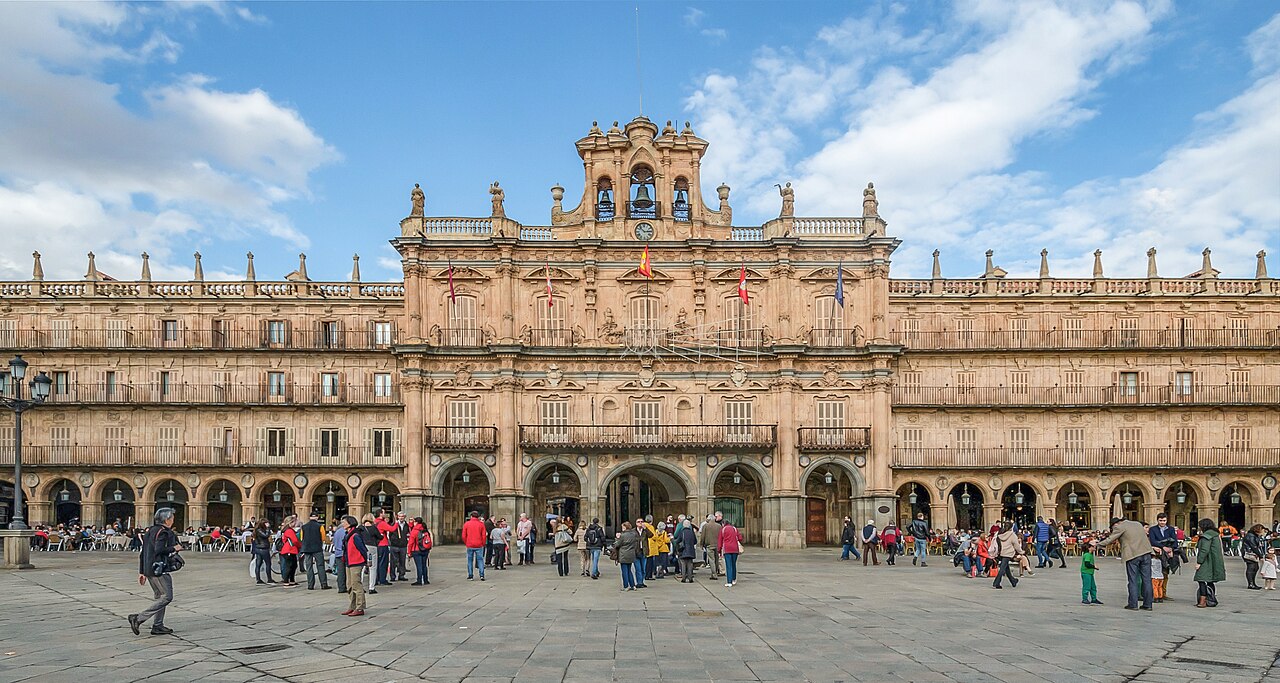
Burgos → Salamanca
214 kmImagine crossing the vastness of the Castilian meseta (plateau), where the horizon widens and time seems to stand still as you connect two of Spain’s most important medieval cities. This journey is not just a 214-kilometer transfer; it is a bridge between the Gothic history of Burgos and the Plateresque splendor of Salamanca, a route where the freedom of the road meets the comfort of modern rail travel.
How to get from Burgos to Salamanca: quick overview
The connection between Burgos and Salamanca is surprisingly efficient, offering three main options to suit different travel styles: complete independence by car, the speed of the Alvia train, or the affordability of the bus. If you are looking for flexibility to explore the towns along the way and enjoy the scenery at your own pace, driving is the winning option, covering the distance in just 2 hours and 15 minutes. On the other hand, if you prefer to relax and read a book while crossing Castile, Renfe’s direct train gets you there in 145 minutes, albeit with limited frequency. For budget-conscious travelers, the Alsa bus offers a solid alternative with prices ranging from 13 to 28 euros. The choice will depend on whether you value freedom of movement or the convenience of public transport more.
By car from Burgos to Salamanca
Driving from Burgos to Salamanca is a smooth experience thanks to an excellent network of toll-free highways crossing the heart of Castile and León. The total distance to cover is 214 km, a journey completed in approximately 2 hours and 15 minutes of actual driving time, not counting stops. The best part of this route is that you won’t have to worry about tolls, as the main roads are free of additional costs. The backbone of this journey is the A-62, known as the Autovía de Castilla (Castile Highway), which provides a direct connection between the two capitals. You can also connect with other vital arteries in the region such as the A-60 (Autovía Valladolid-León) or the A-1 (Autovía del Norte) if your starting point varies slightly within the province.
The road infrastructure is robust and allows for interesting alternatives. If you decide to explore areas further south or detour towards Zamora, the N-122 offers a classic route towards Portugal passing through Zamora’s lands. For those coming from the north or looking for connections with Cantabria, the A-67 and A-73 are available as part of the toll-free network. Other highways such as the A-66 (Ruta de la Plata), the A-11 (Autovía del Duero), the A-50 (Ávila-Salamanca), the A-6 (Autovía del Noroeste), the A-52 (Rías Baixas), the A-65 (Tierra de Campos) and the N-627 complete a mosaic of secondary roads and highways that, although not all are the direct route, ensure traffic flows without interruptions across the meseta. The N-1 is also available as a toll-free alternative route. In short, driving here is synonymous with freedom and savings on toll costs.
By train from Burgos to Salamanca
The train is the fastest and most comfortable option for traveling between these two cities, operated exclusively by Renfe. The star service is the ALVIA train, which covers the distance in a record time of 145 minutes, allowing you to arrive almost as quickly as by car but without the stress of driving. However, planning ahead is crucial because frequency is limited: only 1 train is available per day. This single service departs at 15:41 from the origin station, Burgos Rosa Manzano, with Salamanca station as its final destination. Being a single daily train, tickets can sell out quickly, so booking as far in advance as possible is recommended. It is the ideal option for business travelers or tourists who want to maximize their time at the destination without worrying about traffic or parking.
By bus from Burgos to Salamanca
If budget is your number one priority, the bus is the most economical alternative, operated by the company Alsa. This direct service connects both cities in a travel time of 210 minutes, which is equivalent to 3 and a half hours on the road. Although it is the slowest option of the three, the savings are significant, with fares ranging between 13 and 28 euros depending on how far in advance you book and demand. It is a reliable means of transport that allows you to rest during the journey, although you should bear in mind that the travel time is considerably longer than by train or private car. It is perfect for backpackers or students looking to reach Salamanca spending as little as possible on transport.
Recommended stops along the way
If you decide to make the journey by car, you have the opportunity to turn the trip into a small sightseeing route through some of the most emblematic towns in the region. Although the direct route is fast, making a slight detour or taking advantage of the proximity of these points greatly enriches the experience.
- Segovia: Although it requires a detour southwards, Segovia is a first-class stop. Its Roman aqueduct and its Alcázar (fortress) are reason enough to stop, offering a fascinating historical contrast with the cities on the main route.
- Valladolid: Located almost halfway, Valladolid is a logical and necessary stop. As the former capital of the empire, it offers top-tier museums and a cuisine based on the famous “pinchos” (bar snacks), ideal for stretching your legs.
- Arévalo: This town, historically linked to Isabella the Catholic, offers a well-preserved old town and walls that invite a leisurely stroll away from the hustle and bustle of large cities.
- Benavente: Situated further west, near the Ruta de la Plata (Silver Route), Benavente is famous for its tower del Caracol (of the Snail) and its strategic location at the confluence of rivers, being a historic resting point for travelers.
- Peñafiel: Dominated by its impressive ship-shaped castle, Peñafiel is the wine capital of the Ribera del Duero. It is the perfect stop for wine lovers who want to taste a good red before arriving in Salamanca.
- Arroyo de la Encomienda: Right next to Valladolid, this municipality has grown a lot but still preserves areas of interest and serves as an excellent service area or entry point to the capital of the Pisuerga.
- La Cistérniga: Another town near Valladolid that offers a more residential and quiet atmosphere, ideal for seeing local life in the province without the rush of the urban center.
- Tudela de Duero: Known for its wineries and its location on the banks of the Duero River, Tudela is a strategic point for understanding the importance of wine in this region of Castile.
Where to stay in Salamanca
Salamanca is a compact city but with a very varied accommodation offer that suits all budgets. For an immersive experience, the ideal is to look for accommodation in the Casco Histórico (Historic Quarter), near the Plaza Mayor and the University. Staying here will allow you to go out at night and return walking in minutes, although prices tend to be higher due to high tourist demand. If you are looking for something more economical, peripheral areas such as Vistahermosa or near the train station offer good urban bus connections and more affordable prices.
As for types of accommodation, the city has a wide range. From youth hostels perfect for students, with very competitive prices, to four- and five-star hotels occupying restored historic buildings. It is also very common to find tourist apartments and rural houses in the surrounding area if you are traveling in a group. Price ranges vary drastically: you can find beds in shared rooms for less than 25 euros, while a double room in a central hotel can range between 80 and 150 euros, rising considerably during weekends and university festivities.
Frequently asked questions about the Burgos-Salamanca route
How long does it take from Burgos to Salamanca?
Travel time varies depending on the mode of transport: by car it takes 2 hours and 15 minutes (214 km), by ALVIA train it is 145 minutes and by bus approximately 210 minutes.
Which is cheaper, the train or the bus?
The bus is generally the most economical option, with prices between 13 and 28 euros, while the ALVIA train, being faster and more exclusive, usually has higher fares and less flexibility.
Is it worth renting a car?
Yes, it is worth it if you plan to make stops on routes such as Peñafiel, Valladolid or Segovia, as it gives you total freedom and the journey is short (2h 15min) on toll-free highways.
When is the best time to travel?
Since the train only has one daily departure at 15:41, it is better to travel on weekdays to avoid crowds, or book well in advance if you are traveling on weekends.
📍 También te puede interesar
Qué ver en Burgos →
Qué ver en Salamanca →