Cuenca
Castilla-La ManchaClimate
Daily budget
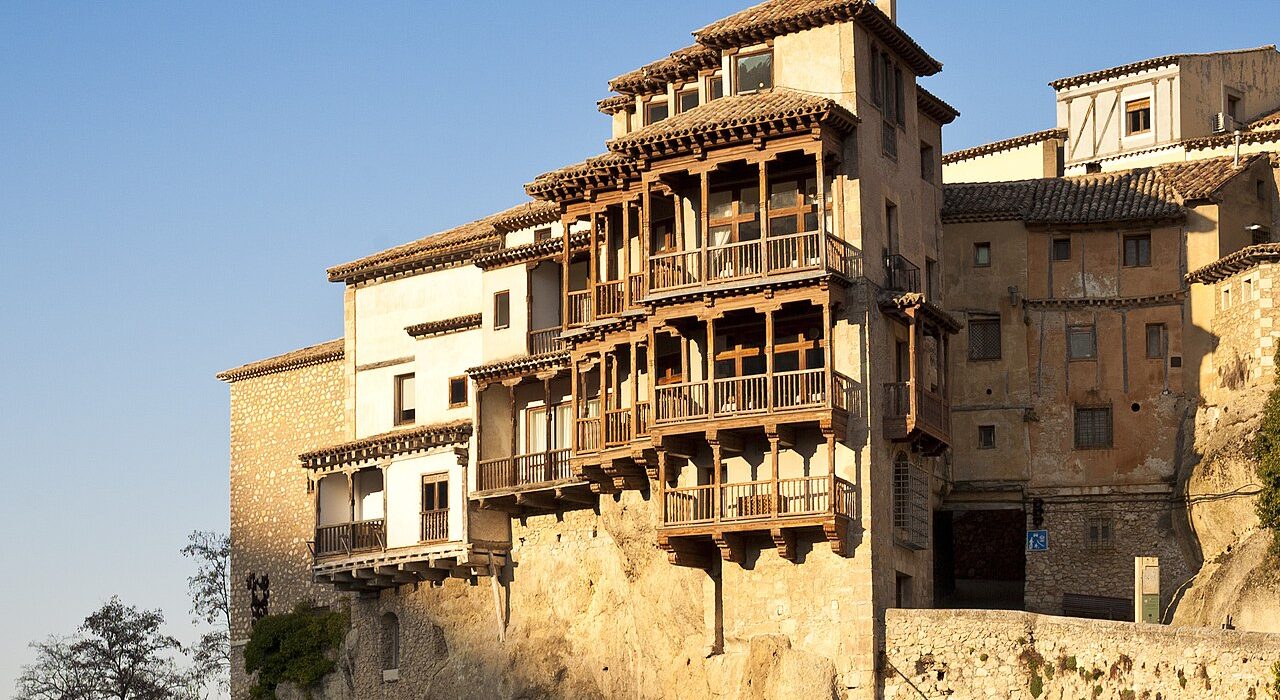
Hanging over the void and defying gravity, these medieval homes are the image that defines a city declared a UNESCO World Heritage Site in 1996. It is not just an urban landscape; it is a natural fortress where the Júcar and Huécar rivers have carved deep gorges protecting a historic center unique in Spain. With a population of 56,000, Cuenca offers an intimate yet monumental experience, where Anglo-Norman Gothic architecture merges with nature in a perfect balance you have to see to believe.
The must-seesWhat to See in Cuenca: The Essentials
Casas Colgadas (Hanging Houses)
This is the undisputed symbol of the city, a group of three palatial houses whose exact origins oscillate between the 14th and 15th centuries, possibly of Muslim or medieval root. The most striking feature is their location overlooking the Huécar gorge, supported by carved beams and Gothic latticework that seem to spring from the rock itself. Inside, they house the Museum of Spanish Abstract Art, founded in 1966 by Fernando Zóbel, making them a cultural as well as architectural landmark. Their cantilevered balconies offer unique panoramic views that alone justify the visit, although access to the interior usually requires a ticket and booking in advance is highly recommended during high season.
Cathedral of Santa María and San Julián
Considered the first Gothic-style cathedral built in the Kingdom of Castile, its construction began in 1182, marking one of the earliest examples of this style in Spain. It stands out for its Anglo-Norman influenced architecture, unique in the country, and for the beauty of its stained-glass windows that illuminate the interior with vibrant colors. Declared part of the World Heritage ensemble, the temple opens its doors from 10:00 to 19:30 and requires an entrance fee to visit its naves and appreciate the magnitude of this pioneering work on the peninsula.
Rascacielos de San Martín (San Martín Skyscrapers)
In the San Martín neighborhood, you will encounter an urban curiosity that has led to these homes being called the “first skyscrapers of Europe.” What appears from Alfonso VIII street as a three- or four-story house extends downward on its rear façade facing the Huécar Gorge, clinging to the rocks to reach nine or ten stories in height. This peculiarity reflects the popular character of the neighborhood and how its inhabitants leveraged the terrain’s slope to create homes that grow both upward and into the abyss, offering an unmatched colorful and vertical aesthetic.
Museum of Cuenca
Located in Plaza de la Merced within the old town, this interactive space consists of two buildings: an old convent and a contemporary extension. It offers educational tours on science, technology, life, and earth, including a paleontology section connected to the province’s rich fossil heritage. It is an essential visit to understand the evolution of the region’s natural and human environment, integrating perfectly into the UNESCO-protected ensemble.
Torre de Mangana
This city icon currently functions as the public clock tower and stands on the ruins of the old Arab alcazaba. Originally a watchtower protecting the city entrance, today it dominates the historic center’s skyline as a reminder of its defensive past. Its reconstruction on the original foundations keeps it as a mandatory visual reference point for any visitor walking the cobblestone streets.
Other Points of Interest
- Puente de San Pablo (San Pablo Bridge): Iron footbridge crossing the Huécar gorge, offering the most famous and spectacular views of the Casas Colgadas (Hanging Houses).
- Hoces del Júcar y Huécar (Júcar and Huécar Gorges): Natural canyons carved by the rivers that define the city’s vertical geography and protect the historic center.
- Plaza Mayor: The nerve center of the old town, home to the Cathedral and City Hall, filled with terraces and social life.
- Barrio del Castillo (Castle Quarter): The highest area of the old town, where the remains of the ancient Arab fortress are located, offering unparalleled panoramic views.
- Ciudad Encantada (Enchanted City): Limestone rock formations eroded by the elements over centuries, taking on whimsical shapes amidst endless pine forests in the Serranía region.
- Convento de los Descalzos (Convent of the Discalced): Former 16th-century Convento de San Pablo converted into a Parador de Turismo hotel, featuring a glassed-in cloister facing the Casas Colgadas.
- Museo Paleontológico (Paleontological Museum): The Paleontological Museum of Castilla-La Mancha exhibits dinosaur remains and prehistoric fauna found in the region since 2015.
- Casa de las Rejas (House of Grilles): Historical monument that is part of the city’s rich civil heritage.
- Casa-Palacio de los Clemente de Aróstegui: Noble building noted for its architecture and historical relevance within the urban core.
- Monumento a los Turbos (Monument to the Turbos): Commemorative sculpture paying homage to a specific local tradition of the city.
- Monumento a las Víctimas del Terrorismo (Monument to the Victims of Terrorism): A place of remembrance and tribute located in a visible spot in the city.
- Túneles de Alfonso VIII (Tunnels of Alfonso VIII): Historical structure forming part of the city’s ancient defenses and access points.
- Casa de los Marqueses de Priego (House of the Marquises of Priego): Another example of noble architecture populating the streets of the historic center.
- Mirador Rincón Seco (Rincón Seco Viewpoint): A strategic spot to observe the city from a different and privileged perspective.
- Mirador de la Hoz (Gorge Viewpoint): Positioned to allow direct contemplation of the depth of the river gorges.
- Mirador Cerro del Socorro (Cerro del Socorro Viewpoint): Although it requires a short hike, it offers the most complete and spectacular panoramic view of the entire city and its gorges.
- Centro de Arte Contemporáneo (Contemporary Art Center): Space dedicated to current artistic creation within Cuenca’s cultural environment.
- Castillo y restos Murallas (Castle and Wall Remains): Vestiges of the ancient fortification demonstrating the original defensive character of the square.
- Antiguo Colegio de San José (Former College of San José): Historical building contributing to the monumental density of the old town.
- Nacimiento del Río Cuervo (Source of the Cuervo River): Natural Monument in the mountain range where water springs from between the rocks, creating a humid, forested landscape.
- Museo de Arte Abstracto Español (Spanish Abstract Art Museum): Cultural establishment located inside the Casas Colgadas, a pioneer in its genre.
🍂 Otoño
Si visitas Cuenca en otoño, los colores de las hojas y el aire fresco crean un ambiente mágico para fotos increíbles. La precipitación anual es moderada, así que lleva siempre un paraguas pequeño por si acaso mientras exploras las calles empedradas.
What to Do in Cuenca
Cuenca offers specific activities focused on its cultural heritage, nature, and festive traditions declared of Tourist Interest. You can walk the trails and viewpoints enabled in the Hoces del Júcar y Huécar to observe the depth of the gorges protecting the city, or visit the Mercado de Abastos (Supply Market) in Pasaje Antonio Maura to buy local products such as Cuenca cheese. If you travel during key dates, it is essential to attend Holy Week, famous for the ‘Camino del Calvario’ procession where the crowd plays drums and bugles, or the Fiestas de San Mateo in September, which commemorate the conquest of 1177 by drinking ‘zurra’ (a fruit-based drink) and eating roasted potatoes.
Cuenca in one day: express itinerary
To make the most of a 24-hour visit, follow this route covering the essentials without rushing:
- 10:00 – Cathedral of Santa María and San Julián: Start your day here to see the first Gothic cathedral of Castile before the crowds arrive.
- 11:30 – Plaza Mayor and Torre de Mangana (Mangana Tower): Walk to the nerve center to see the City Hall and the city’s iconic clock tower.
- 13:00 – Rascacielos de San Martín (San Martín Skyscrapers): Stroll along Calle Alfonso VIII to understand the neighborhood’s peculiar vertical architecture.
- 14:30 – Lunch in the Old Town: Enjoy a menu with typical dishes on the terraces in the historic area.
- 16:30 – Casas Colgadas (Hanging Houses) and Puente de San Pablo (San Pablo Bridge): Cross the iron footbridge for spectacular photos and visit the museum inside.
- 18:30 – Mirador de la Hoz or Cerro del Socorro: End the day watching the sunset over the city’s vertical geography.
Where to eat in Cuenca: local gastronomy
Where to stay in Cuenca
Casco Antiguo (Ciudad Alta)
Es el corazón turístico de Cuenca, albergando la mayoría de monumentos y puntos de interés en sus callejuelas empedradas y arquitectura medieval.
Barrio de San Martín
Uno de los barrios más antiguos, famoso por sus 'rascacielos' medievales y casas estrechas con fachadas coloridas en la Calle Alfonso VIII.
Barrio del Castillo
Ubicado en la parte más alta de la ciudad, ofrece vistas panorámicas espectaculares a pesar de las pocas ruinas del castillo original.
How to get to Cuenca
The city has rail and bus connections linking it with other major urban centers.
| Medio | Estación/Origen | Detalles |
|---|---|---|
| Tren | Estación Cuenca Fernando Zobel | Conexión ferroviaria disponible (sin AVE según datos proporcionados). |
| Autobús | Estación de Autobuses | Conexiones regulares con ciudades cercanas como Toledo y Valencia. |
Getting around Cuenca
The old town is perfectly walkable, although for longer distances or climbing certain hills, the city offers an urban bus service. Given the vertical geography and steep streets of the Old Town and the Barrio del Castillo, walking is the best option to discover hidden corners, but the bus is useful for connecting with outer areas or if you have reduced mobility.
Weather in Cuenca
Best time to visit Cuenca
Day trips from Cuenca
If you have extra time, the nearby cities of Toledo and Valencia are excellent destinations for day trips. Toledo, also a UNESCO World Heritage Site, offers an immersion into the history of the three cultures, while Valencia provides a total contrast with its modern Mediterranean atmosphere. Both are well-connected and allow you to expand your travel experience through Castile-La Mancha and the eastern coast.
Curiosities about Cuenca You Didn’t Know
Did you know that Cuenca was a filming location for James Bond? The city served as the setting for the movie ‘The World Is Not Enough’ (1999), where the opening scenes were supposedly set in Bilbao but were actually filmed here, showcasing the viaduct. Another surprising fact is that in the San Martín Quarter you will find what are considered the ‘first skyscrapers in Europe’, buildings that have 3 or 4 floors on the upper street but reach up to 10 or 11 stories on their rear façade due to the slope. Furthermore, the Cathedral of Santa María and San Julián is no ordinary church; it was the first Gothic-style cathedral built in the Kingdom of Castile, construction beginning in 1182. Historically, the region was key during Roman times as the main extraction center for ‘lapis specularis’, a translucent gypsum used as glass in the windows of the Empire’s wealthy. Finally, the municipality of Cuenca is one of the largest in Spain with 911 km², and more than 80% is forested land, a European record for a provincial capital.
Who is Cuenca For?
Cuenca is an ideal destination for history and architecture lovers who want to see a preserved medieval complex, as well as for couples seeking a romantic weekend with spectacular views and excellent gastronomy. Backpackers will also find budget-friendly options in hostels and a compact city to explore on foot, while foodies will enjoy a deeply rooted traditional cuisine. With 177,203 annual travelers (INE) and an average stay of 1.85 nights, it is perfect for short getaways.
💡 ¿Sabías que...?
- ● La Catedral de Santa María y San Julián de Cuenca fue la primera catedral de estilo gótico construida en el Reino de Castilla, iniciada en 1182. Es uno de los ejemplos más tempranos de arquitectura gótica en España. (Catedral de Cuenca, Wikipedia)
- ● La ciudad fortificada histórica de Cuenca fue declarada Patrimonio de la Humanidad por la UNESCO en 1996, gracias a la excelente preservación de su paisaje urbano medieval original, incluyendo las famosas Casas Colgadas. (UNESCO)
- ● En el Barrio de San Martín se encuentran los considerados 'primeros rascacielos de Europa'. Debido al desnivel del terreno, algunos edificios tienen 3 o 4 plantas en la entrada por la calle superior, pero alcanzan hasta 10 u 11 pisos en su fachada trasera, que da a la hoz del Huécar. (Turismo de Castilla-La Mancha)
- ● Dentro de las Casas Colgadas se encuentra el Museo de Arte Abstracto Español, fundado en 1966 por el artista Fernando Zóbel. Fue una iniciativa pionera y hoy es una de las colecciones más importantes de su género. (Fundación Juan March)
- ● Cuenca sirvió como escenario para la película de James Bond 'El mundo nunca es suficiente' (1999). Las escenas iniciales, que supuestamente transcurren en Bilbao, fueron en realidad rodadas en Cuenca, mostrando el viaducto de la ciudad. (IMDb, Artículos de prensa)
- ● En la época romana, la región de Cuenca fue el principal centro de extracción de 'lapis specularis', un tipo de yeso selenítico translúcido que se usaba a modo de cristal para las ventanas de las casas de los ricos del Imperio Romano. (Artículos de arqueología, Cuenqueando)
- ● El término municipal de Cuenca, con una superficie de 911,06 km², es uno de los más extensos de España. Más del 80% de este territorio es masa forestal, lo que lo convierte en un récord a nivel europeo para una capital de provincia. (Xataka, Datos del Ayuntamiento de Cuenca)
- ● La Semana Santa de Cuenca, declarada de Interés Turístico Internacional, es famosa por sus 'turbas'. En la procesión 'Camino del Calvario', una multitud acompaña al paso de Jesús Nazareno tocando tambores y clarines, representando la burla que sufrió Cristo. (Turismo de España)
Frequently Asked Questions about Cuenca
How many days do I need to see Cuenca?
With an average stay of 1.85 nights according to the INE, a weekend is enough to see the main attractions such as the Hanging Houses (Casas Colgadas) and the Cathedral, although you might need more time to explore the Serranía and the Enchanted City (Ciudad Encantada).
Is Cuenca expensive?
Not necessarily; you can find hostels from €18-30 per night and eat for an average of €12-18, making it accessible for different budgets, although 4-5 star hotels can reach €200.
What is the best time to visit Cuenca?
The best time is from May to September, with average summer temperatures of 22.9°C, avoiding the winter cold where the average is 5.7°C.
How do I get to Cuenca from Madrid?
You can arrive by train at the Cuenca Fernando Zobel station or by bus, both being common options to connect the capital with this Manchegan city.
What can’t I miss in Cuenca?
It is mandatory to visit the Hanging Houses (Casas Colgadas) and the San Pablo Bridge for the views, the Gothic Cathedral, and stroll through the San Martín Quarter to see the medieval “skyscrapers”.