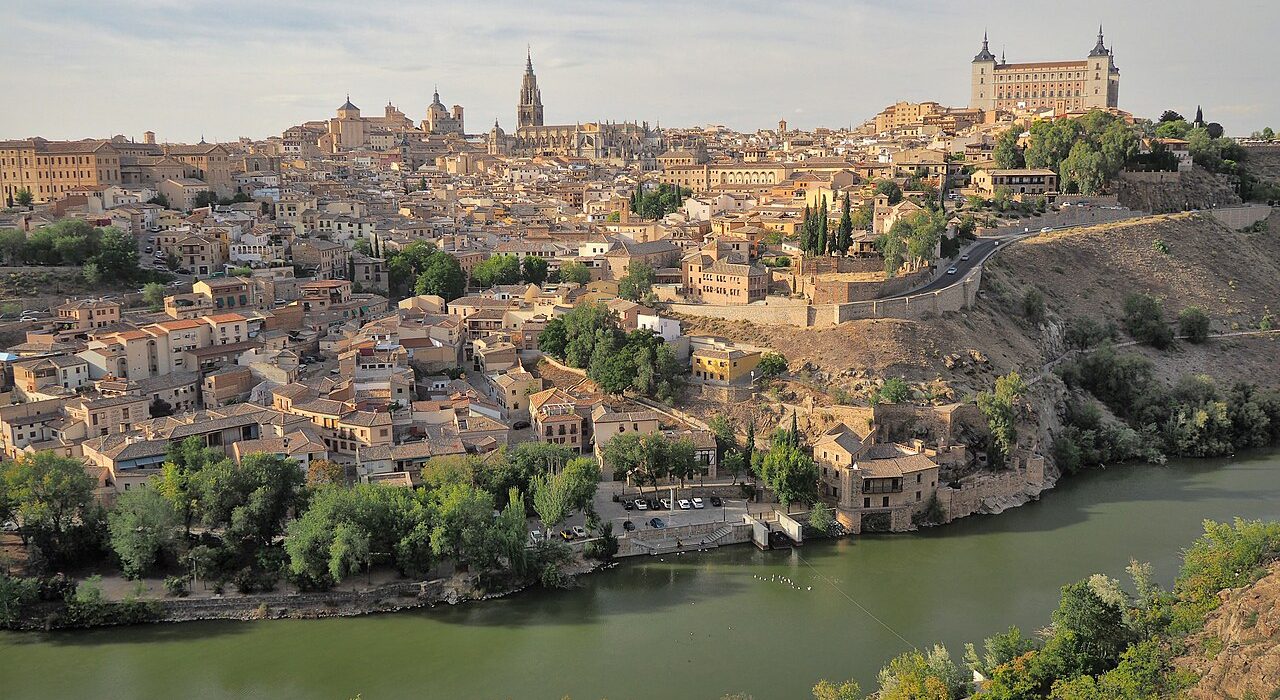
Cuenca → Toledo
180 kmLeaving behind Cuenca’s Casas Colgadas (Hanging Houses) to delve into the imperial history of Toledo is one of the most fascinating journeys you can take through the heart of Castile-La Mancha. In barely two hours, the landscape shifts from the Cuenca highlands to the golden plains of La Mancha, offering you a route full of modern highways connecting two of Spain’s most important World Heritage cities.
How to get from Cuenca to Toledo: quick overview
The best way to travel from Cuenca to Toledo depends entirely on whether you prioritize schedule flexibility or journey speed. If you want the freedom to explore the surrounding area, driving is the winning option with an estimated time of 1 hour and 55 minutes; however, if you prefer not to drive, Renfe’s AVANT train gets you there in 124 minutes, though with a limited offering of just two daily trains, while the bus operated by Aisa stands out as the most economical alternative with fares between 13 and 21 euros.
For the independent traveler who wants to make the most of the day, driving is highly recommended given that the distance is short—barely 180 kilometers—and the entire route runs on toll-free highways that make driving much easier. On the other hand, travelers in no hurry who want to save money will find the bus a perfect ally, since its 120-minute duration is even slightly shorter than driving under normal traffic conditions. The train, while comfortable and fast, requires strict planning due to its limited frequencies, making it ideal only if your schedule aligns with the morning departures.
Driving from Cuenca to Toledo
The driving route from Cuenca to Toledo covers a distance of 180 kilometers and takes approximately 1 hour and 55 minutes using exclusively toll-free highways. This is one of the most comfortable routes in the region because you won’t have to worry about tolls or slow secondary roads; the entire journey is designed for smooth, fast travel.
The route begins by taking the A-3 (Autovía del Este), a road in excellent condition that will take you out of Cuenca’s mountainous area and into the plains. Once you have traveled far enough west, you’ll need to merge onto the A-40 (Autovía de la Meseta Sur). This road is the backbone of your journey, crossing the province of Toledo from east to west. It’s important to pay attention to the signs, as the A-40 will eventually connect you with the A-42 (Autovía de Toledo), which is the direct access route to the imperial city. On some stretches, depending on your exact departure point in Cuenca or on temporary roadworks, you might briefly use sections of the A-4 (Autovía del Sur) to connect, but the main and most direct combination will always be A-3 to A-40 and finishing on A-42. Since there are no tolls on any of these highways, the cost of the trip comes down solely to fuel and vehicle wear, making it very competitive compared to public transport if you’re traveling in a group.
By train from Cuenca to Toledo
The train journey from Cuenca to Toledo is operated exclusively by Renfe through its AVANT services, with a fixed duration of 124 minutes and a very limited frequency of only two trains per day. This option is ideal for those who value the comfort of not driving and prefer to arrive rested, although it requires rigorous schedule planning due to the scarcity of frequencies.
Trains depart from Cuenca Fernando Zobel station, a modern terminal located on the outskirts of the city, and have as their final destination Toledo station. According to current Renfe data, the available schedules are very early in the morning: the first train leaves at 6:15 a.m. and the last at 9:45 a.m. This means that, if you take the first train, you will arrive in Toledo mid-morning, perfect for enjoying a full day; however, if you miss the 9:45 train, you will have no other direct rail option until the following day. The type of train available is the AVANT, known for its speed and comfort, which justifies the 124-minute journey through the interior of the peninsula. It is essential to buy tickets in advance, especially if you are traveling on weekends or holiday bridges, as capacity is limited with only two daily departures.
By bus from Cuenca to Toledo
The bus is the most economical option for traveling from Cuenca to Toledo, with tickets ranging between 13 and 21 euros and a journey time of 120 minutes operated by the company Aisa. This alternative is perfect for backpackers, students, or travelers on a tight budget who do not want to give up the convenience of direct transportation.
The company in charge of this service is Aisa, an operator with extensive experience in regional routes. The most notable aspect of this option is its time efficiency: with a duration of 120 minutes, the bus is technically 2 minutes faster than the average car journey (1h 55min) and barely 4 minutes slower than the AVANT train, which is surprising for road transport. Price is its greatest competitive advantage; while the train usually has higher fares due to the speed of the AVANT, the bus maintains a range of 13 to 21 euros that makes it very accessible. Although the exact frequency may vary depending on the season, the existence of a direct service eliminates the need to make transfers in Madrid or other cities, making the bus a very valid “door-to-door” option for this 180-kilometer journey.
Recommended stops along the way
If you decide to make the journey by car, the route is dotted with charming towns that deserve a pause to stretch your legs or enjoy the local gastronomy, with Tarancón, Ocaña and Aranjuez being the standout points on the verified list. Below, I detail what you can expect at each of the recommended stops so you can organize your route in the best possible way.
- Tarancón: Strategically located on the route, Tarancón is known as the “Gateway to La Mancha.” It is the perfect place for a first coffee stop just after leaving the Cuenca area. Its main square and the Church of the Assumption are quick points of interest that allow you to break up the journey without deviating too much.
- Ocaña: This town is a historical gem halfway along the route. Ocaña boasts one of the largest and most beautiful main squares in Spain, surrounded by arcades that invite a leisurely stroll. It is an ideal spot to have lunch and enjoy Castilian architecture before getting back on the highway.
- Aranjuez: Although it requires a small detour from the most direct route along the A-40, Aranjuez is a must-stop if you have time. Famous for its Royal Palace and its gardens declared a World Heritage Site, it is the place where the Tagus River turns green and lush. It is the most touristy and visually striking stop on the entire journey.
- Seseña: Popularly known in recent years for its urban development, Seseña is a key geographical point just before entering the metropolitan area of Toledo. It is a functional stop, ideal if you need to refuel or find basic services before the final arrival.
- Yuncos: Located very close to Toledo, Yuncos is a town that serves as a prelude to the capital. It is a quiet place, less touristy than Ocaña or Aranjuez, but one that offers an authentic glimpse of the towns surrounding the imperial city. Perfect for a quick technical stop.
- Bargas: This is the last stop before crossing the threshold of Toledo. Bargas has grown significantly as a residential area of the capital of Toledo. Stopping here means you are just a few minutes from your final destination, so it is useful if you want to avoid traffic entering the city at peak times or simply grab a final refreshment before visiting the monuments.
Where to stay in Toledo
For staying in Toledo, the choice of area depends on whether you are looking for the full historical experience within the Old Town or the comfort and savings of the areas outside the walls with easy car access. There is no single right area, but understanding the division between the monumental center and the outskirts will help you decide.
If your priority is cultural immersion and you don’t mind walking through steep streets or paying a little more, the Historic Center is the recommended area. Here you will find charming hotels, paradores and guesthouses located in old buildings. The advantage is obvious: you wake up surrounded by history, steps from the Cathedral and the Alcázar. However, prices tend to be higher and car access can be complicated due to traffic restrictions and the difficulty of parking.
On the other hand, if you are traveling by car and looking for peace and better prices, the areas of North Toledo or the surroundings of the Bus and Train Station are ideal. In these areas, located outside the walls but very well connected, you will find chain hotels and guesthouses with more affordable price ranges. The great advantage of staying here is the ease of parking, often free on the street or in low-cost public garages, and the quick connection to the exit highways (A-42 and A-40) to continue your journey the next day without having to navigate the chaos of the historic center.
Frequently asked questions about the Cuenca-Toledo route
How long does it take to get from Cuenca to Toledo?
Travel time varies depending on the mode of transport: by car it takes 1 hour and 55 minutes, by AVANT train it is 124 minutes, and by bus the journey takes 120 minutes.
Which is cheaper, the train or the bus?
The bus is generally cheaper, with prices between 13 and 21 euros, while the AVANT train tends to have higher fares due to its speed and comfort, although exact train prices are not specified in the base data.
Is it worth renting a car?
Yes, it is worth it if you want the freedom to make stops on routes such as Tarancón, Ocaña or Aranjuez, since public transport is direct but does not allow tourist detours and the train has very few frequencies.
When is the best time to travel?
It is best to travel early in the morning if you use the train (first train at 6:15) to make the most of the day in Toledo, or during off-peak hours if you go by car to avoid traffic on the A-3 and A-40 motorways.