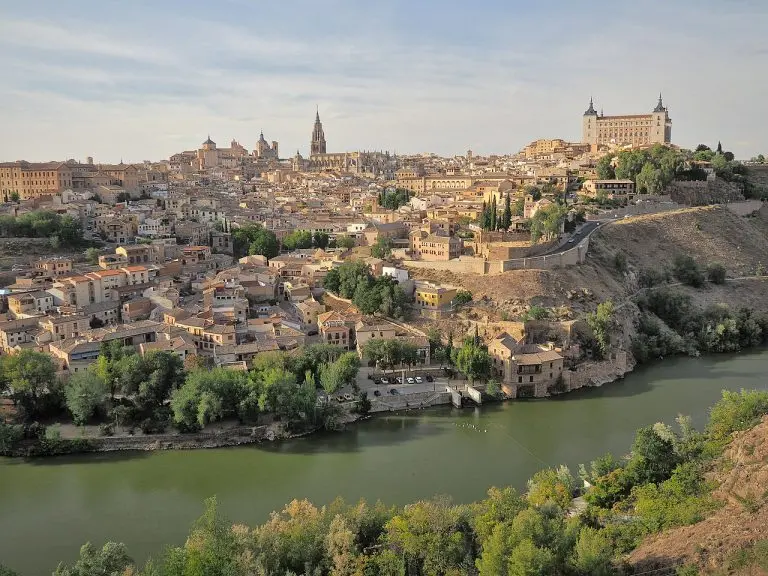
Madrid → Toledo
75 kmThere’s something deeply evocative about a journey that whisks you out of Madrid’s hustle and bustle in under an hour and sets you down before the walls of a city that was once the capital of an empire. The route from Madrid to Toledo is a compressed time tunnel: you leave the Gran Vía behind, cross the Manchegan plain and, suddenly, the sharp silhouette of the Alcázar appears on the horizon like a stone mirage. Whether you’re on a train that barely gives you time to finish your coffee or in a car winding through villages that smell of freshly baked bread, this 75 km trip is one of those travel pleasures to be savoured from the very first kilometre.
How to get from Madrid to Toledo: quick summary
There are three realistic ways to cover the 75 km separating Madrid from Toledo: by car (55 minutes along the A-42), on a Renfe AVANT train (34 minutes from Madrid-Puerta de Atocha) or by bus with ALSA or Samar (50 minutes for between €5 and €6). The train is unbeatable for a day trip: fast, frequent and it leaves you a short stroll from the historic centre. The bus is the cheapest option. The car only pays off if you want to make stops along the way or explore the surroundings of Toledo at your own pace. For most travellers, the AVANT is the logical choice.
Driving from Madrid to Toledo
The drive takes 55 minutes and is done almost entirely along the A-42, the Autovía de Toledo, which covers some 67 km of the total 75 km route with no tolls at all. It’s a comfortable motorway, with two or three lanes in each direction depending on the stretch, and scenery that shifts from the industrial estates of southern Madrid to the cereal fields and Manchegan olive groves. The natural exit from central Madrid is to link up with the A-42 from the M-30 or M-40 heading south. Traffic is usually free-flowing except during weekday rush hours, especially between Móstoles and Fuenlabrada. Once in Toledo, it’s best to leave the car in the park-and-ride car parks in the lower part of town or in the Safont car park, because the historic centre is a labyrinth of narrow streets where parking is a mission impossible.
By train from Madrid to Toledo
The train is the fastest option: Renfe’s AVANT covers the journey in 34 minutes, with no intermediate stops and a frequency of 15 trains a day. According to Renfe, the first train leaves at 6:45 in the morning and the last at 20:45, which allows for both an early escape and a late dinner in Toledo before heading back. All trains depart from Madrid-Puerta de Atocha-Almudena Grandes station and arrive at Toledo station, located about a 10-15 minute walk from the historic centre. The journey is direct and the view from the window, with the Manchegan plain unfolding south of Madrid, is a perfect prologue to what awaits in Toledo. Tickets can be bought at ticket offices, machines or through the Renfe app, and it’s worth booking in advance at weekends and on public holidays.
By bus from Madrid to Toledo
The direct bus is the cheapest alternative: between €5 and €6 each way, with a journey time of 50 minutes. The companies ALSA and Samar operate the route, with departures from Madrid’s Estación Sur de Autobuses (South Bus Station). The frequency is good throughout the day, though less regular than the train. The bus is an excellent option for budget-conscious travellers or for those staying near the Estación Sur. The journey is comfortable and, just like the train, it drops you at Toledo’s bus station, from where the historic centre is a pleasant stroll away.
Recommended stops along the way
The route along the A-42 and its surroundings allows for slight detours to discover several towns in southern and western Madrid that, while not mass tourism destinations, have their own charm. All of these stops are verified and accessible from the Madrid-Toledo corridor.
Pozuelo de Alarcón
Pozuelo de Alarcón is one of the most affluent towns in the western metropolitan area, with extensive green spaces and a quiet urban centre. It isn’t a classic tourist stop, but its residential atmosphere and tree-lined avenues make it a pleasant break if you’re looking for a coffee without the crowds before heading onto the A-42.
Boadilla del Monte
Boadilla del Monte surprises visitors with its Palacio del Infante Don Luis (Palace of the Infante Don Luis), an 18th-century neoclassical building surrounded by gardens. It’s a brief but interesting stop to stretch your legs and take in a historic corner rarely visited by mass tourism.
Navalcarnero
Navalcarnero is the most flavourful stop on the route. Its Plaza de Segovia, arcaded and Castilian in character, invites you to enjoy a vermouth or a local wine before continuing on your way. The town is known for its winemaking tradition and for centuries-old wineries dug into the subsoil. If you’re travelling by car, this is the most recommended stop for a bite to eat.
Villanueva de la Cañada
Villanueva de la Cañada is another residential town in western Madrid, with a 15th-century castle-palace that now houses a university centre. It’s a discreet stop, useful above all for those seeking a quiet, green setting without straying too far from the main route.
Fuenlabrada
Fuenlabrada is one of the large cities in southern Madrid, with an extensive urban sprawl and a busy commercial life. It isn’t a tourist destination, but its proximity to the A-42 makes it a practical spot to refuel, stock up on supplies or take a logistical break.
Alcorcón
Alcorcón, also in southern Madrid, offers a mix of residential and commercial areas. Its Castillo de San José de Valderas (Castle of San José de Valderas), from the 15th century, is a small historic footnote amid the urban fabric. A functional stop rather than a tourist one.
Móstoles
Móstoles is known for its symbolic role in the uprising of 2 May 1808. Its pedestrian centre, with the Casa de Andrés Torrejón and the Plaza del Pradillo, allows for a brief stroll and an easy food stop. It’s one of the liveliest stops along the southern corridor.
Leganés
Leganés, a neighbour of Fuenlabrada and Alcorcón, has a compact urban centre with the cathedral of San Salvador and several parks. As a stop, it works well for a quick coffee or some last-minute shopping before tackling the final stretch to Toledo.
Where to stay in Toledo
The best area to stay in Toledo is the historic centre, within the city walls: it lets you stroll through medieval streets at night and see the city without the daytime crowds of day-trippers. The downside is that prices go up and driving access is tricky. The second option is the Santa Teresa neighbourhood or the area around the train station, which is quieter and has functional hotels at more moderate prices. In general, a double room in Toledo can range from 60 to 120 € per night depending on the season and location. For tighter budgets, there are hostels and guesthouses in the old town from around 50 €. Accommodation with views of the Tagus or the Alcázar tends to be the most sought-after.
Where to eat along the route
The Madrid-Toledo route is a journey between two larders: Madrid’s and La Mancha’s. Before leaving the capital, it’s worth paying tribute to the tavern classics: cocido madrileño, served in three courses (soup, chickpeas with vegetables, and meats such as morcillo, chorizo, tocino and hen), is the quintessential dish of the cold months. Callos a la madrileña, stewed with chorizo, morcillo, paprika and spices, are served piping hot in a clay pot. And the bocadillo de calamares, with its crispy batter and a squeeze of lemon, is the perfect snack before boarding the train or getting in the car.
Once in La Mancha territory, the repertoire shifts gear. Migas, made with crumbled stale bread, garlic, paprika and olive oil, are enriched with torreznos, chorizo or grapes. Pisto manchego, with sautéed tomato, pepper, courgette and onion, works on its own, with egg, or as a side dish. Manchego cheese, cured and made from sheep’s milk, is essential on any platter. To drink, the wines of Tierra de Castilla, with varieties such as Tempranillo, Airén or Garnacha, pair well with all these dishes.
In Toledo city, the offering becomes sweeter and more traditional. Carcamusas, a pork stew with tomato, onion, peas and white wine, are the classic of Toledo’s bars. Perdiz escabechada, served cold or warm, is a seasonal game dish with deep roots. And to finish, mazapán de Toledo, made only with ground almond and sugar, is the city’s most emblematic sweet, especially at Christmas.
Frequently asked questions about the Madrid-Toledo route
How long does it take from Madrid to Toledo?
It depends on the mode: on a Renfe AVANT train, 34 minutes; by bus with ALSA or Samar, 50 minutes; and by car along the A-42, 55 minutes for the 75 km of the journey. The train is the fastest option, closely followed by the bus and the car.
Which is cheaper, the train or the bus?
The bus is clearly cheaper: between €5 and €6 per journey with ALSA or Samar. The Renfe AVANT train is more expensive, although the exact price varies depending on how far in advance you book and demand. For tight budgets, the bus is the best option; for comfort and speed, the train is worth the difference.
Is it worth renting a car?
It depends on your plans. If you’re only going to visit Toledo, public transport is more practical and avoids parking problems in the historic centre. A car is only worth it if you want to make stops along the route such as Navalcarnero, Pozuelo de Alarcón or Boadilla del Monte, or if you plan to explore the surroundings of Toledo freely. For a day trip, the train is unbeatable.
When is the best time to travel?
Spring and autumn are the best seasons: mild temperatures for strolling through the historic centre and fewer crowds than in summer. Winter is ideal for enjoying cocido madrileño and La Mancha stews, although mornings can be cold. Toledo’s summer is very hot, with highs exceeding 35 °C, so it’s best to get up early and avoid the middle hours of the day.
📍 También te puede interesar
Qué ver en Madrid →
Qué ver en Toledo →