Bilbao
País VascoClimate
Daily budget
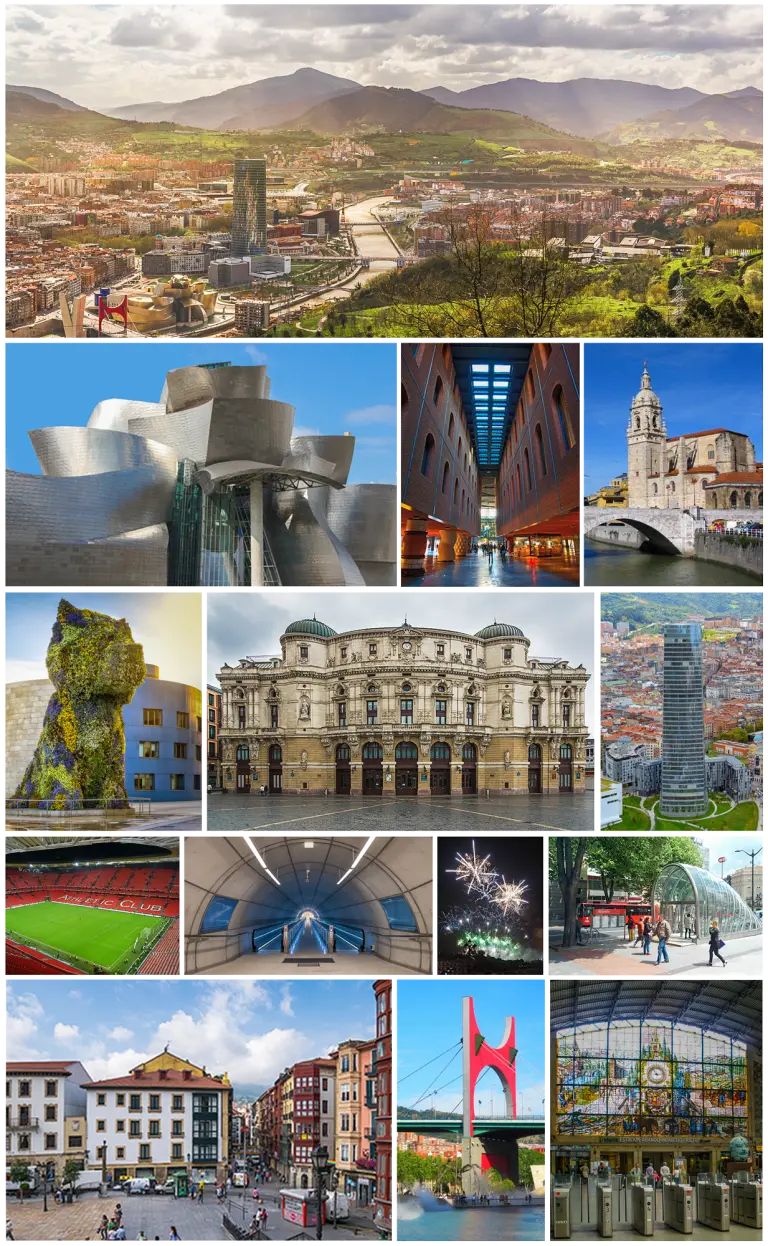
It’s six in the evening and the light draws impossible sparkles from the titanium panels of the Guggenheim Museum Bilbao, while just a few feet away the Puppy dog gazes at you with its flower-covered face. You sit at one of the terraces along the Abandoibarra promenade, with the Nervión estuary at your feet and the Iberdrola Tower silhouetted against the sky, and you realize that Bilbao is not just a destination: it’s a city that reinvented itself and now tells you its story through architecture, pintxos, and breathtaking views.
The must-seesWhat to see in Bilbao: the must-sees
Guggenheim Museum Bilbao
Designed by Canadian architect Frank Gehry and inaugurated in 1997, the Guggenheim Museum Bilbao is the ultimate icon of the city’s regeneration and one of the most recognizable architectural works of the 20th century. Inside, be sure not to miss the main gallery, where large-format contemporary works are exhibited, as well as the rooms dedicated to site-specific installations created expressly for the museum. It opens every day from 10:00 to 19:00 and admission is paid, so it’s worth booking online in advance to avoid queues, especially in high season.
Vizcaya Bridge (Hanging Bridge)
The Vizcaya Bridge, popularly known as the Hanging Bridge, was the world’s first transporter bridge, inaugurated in 1893, and in 2006 UNESCO declared it a World Heritage Site. It is a small gem of iron engineering that links Portugalete and Getxo across the Nervión estuary, and crossing it in its gondola is a unique experience. It operates 24 hours a day for vehicles and from 10:00 to 19:00 for the pedestrian walkway, although access to the upper viewing platform and the gondola is paid.
San Mamés Stadium (La Catedral)
The new San Mamés Stadium, known among fans as La Catedral (The Cathedral), is the temple of Athletic Club and one of the most modern sporting venues in Europe. It hosts league matches and is a must-stop for any football lover who wants to feel the passion of the red-and-white team.
Cathedral of Santiago de Bilbao
The Cathedral of Santiago is a 14th-century Gothic temple located right in the Casco Viejo (Old Town) and is one of the official stops on the Camino de Santiago (Way of St. James) as it enters Bilbao. Beyond its spiritual value, it houses pieces of religious art of enormous interest inside. It opens from 10:00 to 18:00 and admission is paid.
Bilbao Fine Arts Museum
The Bilbao Fine Arts Museum is a public museum housing more than 10,000 works spanning from the 13th century to the present day, distributed across three main sections: ancient art, modern art, and applied arts. Its collection stands out especially for the Spanish school, Basque art, and international movements, and includes pieces by Basque artists such as Darío Urzay, Jesús Mari Lazkano, and Cristina Iglesias. It is an essential visit for understanding the visual history of the Basque Country.
Euskalduna Palace
The Euskalduna Palace can be visited freely from the outside at any time, and on Saturdays it offers guided tours at 10:15 and 12:00, with a maximum of 40 people per group, although visits can also be arranged on other days for groups of up to 20 people, at a price of €115 + VAT.
Iberdrola Tower
The Iberdrola Tower, designed by Argentine-American architect César Pelli, reaches a height of 165 m and has 41 floors, 485 parking spaces, and 50,000 square meters above ground, making it the tallest office building in the Basque Country. Its glass façade, shaped like an isosceles triangle with slightly curved tips that suggests a great glass obelisk, can be admired from much of the estuary, and inside, the 2,800-square-meter lobby functions as an art gallery with works by Basque artists.
Teatro Arriaga
The Teatro Arriaga, built in neo-Baroque style and declared a historic-artistic monument, is Bilbao’s most emblematic cultural symbol. Its façade can be admired freely from the outside by any passerby, while access to the interior requires a ticket for performances or scheduled guided tours that include the collection of opera figurines and the spectacular auditorium.
Parque de Doña Casilda Iturrizar
This is the largest park in Bilbao’s urban area, with ducks, a children’s play area, cedars, plane trees, and camellias, and within its grounds you can also visit several monuments and museums. It is a free-access space, open every day of the year.
Casco Viejo de Bilbao (Siete Calles)
Popularly known as ‘El Botxo’, the Casco Viejo (Old Town) is the founding nucleus of Bilbao, laid out around the Siete Calles (Seven Streets) originally traced in the 14th century, where you’ll find the Plaza Nueva, the Iglesia de San Antón, and the Catedral de Santiago, as well as numerous pintxos bars. It is a fully walkable area every day of the year and visiting is free.
Azkuna Zentroa
Azkuna Zentroa is a former wine warehouse converted into a modern leisure and culture center by Philippe Starck that is worth a visit for its interior architecture.
Mercado de la Ribera
The Mercado de la Ribera is one of the largest covered markets in Europe, where you can buy fresh local produce and enjoy a gastropub area inside.
Paseo de Abandoibarra
The Paseo de Abandoibarra runs along the Nervión estuary and forms the backbone of the urban regeneration undertaken by Bilbao Ría 2000, with works that began in 1998 and whose first major milestone was the simultaneous inauguration of the promenade, the Ribera del Nervión park, and a pedestrian footbridge in 2003.
Iglesia de San Antón
The Iglesia de San Antón occupies one of the most storied sites in Bilbao’s history, as the occupation of this plot may date back even a century before the founding of the town by Diego López de Haro in the year 1300. Its Flemish Gothic portico with three pointed arches is one of its most recognizable architectural elements.
Plaza Nueva
The Plaza Nueva is a neoclassical square in the Casco Viejo famous for its pintxos bars and its lively Sunday market.
Mirador de Artxanda
The Mirador de Artxanda offers the best panoramic views of Bilbao and is accessible via a century-old funicular.
🍂 Otoño
Si visitas Bilbao en otoño, notarás cómo bajan las temperaturas y las lluvias ganan protagonismo, así que es buena idea refugiarse en sitios como la Catedral de Santiago de Bilbao, el Palacio Euskalduna o el Teatro Arriaga. El ambiente es más tranquilo y se puede disfrutar de la ciudad sin aglomeraciones. Un consejo práctico: apuesta por la gastronomía local en días frescos, que marida de maravilla con el clima otoño.
What to do in Bilbao
Bilbao offers activities for all tastes. Food lovers can follow the pintxos route through the Casco Viejo and the Siete Calles, where classic bars like those in the Plaza Nueva compete for the best pintxo in the city. For a market visit, the Mercado de la Ribera opens every day with fresh produce from the Cantabrian Sea, and every December 21 the city celebrates the Mercado de Santo Tomás, a great festival of Basque country life. For a complete panoramic view, nothing beats taking the funicular up to the Mirador de Artxanda and getting the best views of Bilbao. For practical information, updated schedules, and the events calendar, check the official Bilbao tourism website.
Bilbao in a day: express itinerary
- 10:00 h — Casco Viejo and Santiago Cathedral: Start the day in the Siete Calles (Seven Streets), have breakfast in the Plaza Nueva (New Square), and enter the 14th-century Gothic cathedral before the tourist crowds build up.
- 12:00 h — Mercado de la Ribera: Tour the largest covered market in Europe, sample local cheese and preserves, and make a stop in its gastropub area.
- 14:00 h — Pintxos lunch: Hop between several bars in the Casco Viejo and order bacalao al pil-pil, kokotxas in green sauce, or marmitako for full immersion in Basque cuisine.
- 16:00 h — Guggenheim Museum Bilbao: Enter Frank Gehry’s icon, don’t miss Puppy outside, and set aside at least two hours to explore its galleries.
- 19:30 h — Abandoibarra promenade at sunset: Walk along the riverside promenade, enjoy views of the Iberdrola Tower, and end the day by taking the funicular up to the Artxanda viewpoint for a nighttime panorama.
Where to eat in Bilbao: local gastronomy
Where to stay in Bilbao
Casco Viejo (Siete Calles)
Ideal para sumergirse en la historia, ir de compras y disfrutar de la ruta de pintxos.
Indautxu
Zona elegante y céntrica con muchos bares de copas, restaurantes de moda y ambiente nocturno.
How to get to Bilbao
From Vitoria-Gasteiz, the fastest option is driving: 53 min.
Matiko-Bilbao (1,0 km from the centre)
| From | Direct train | Direct bus | Car |
|---|---|---|---|
| Vitoria-Gasteiz | — | 55 min · 52/day Autobuses La Unión, ALSA, Bilmanbus | 53 min 65 km |
| San Sebastián | 2 h 35 min · 15/day Euskotren E1 | 1 h 12 min · 37/day Avanza Movilidad Gipuzkoa, ALSA | 1 h 16 min 102 km |
| Santander | 3 h 04 min · 3/day Regional | 1 h 15 min · 23/day ALSA, Bilmanbus | 1 h 18 min 100 km |
| Madrid | 5 h 10 min · 2/day Intercity | 4 h 10 min · 14/day ALSA | 4 h 30 min 398 km |
| Pamplona | — | 2 h · 7/day Álavabus | 1 h 52 min 155 km |
| Barcelona | 7 h 03 min · 1/day Intercity | 8 h · 3/day ALSA | 6 h 38 min 607 km |
| Barakaldo | 16 min · 90/day Cercanías C2 | 10 min · 336/day Bizkaibus, ALSA, Autobuses La Unión | 13 min 10 km |
| Getxo | — | 32 min · 78/day Bizkaibus, Autobuses La Unión | 17 min 15 km |
| Logroño | 2 h 58 min · 1/day Intercity | 1 h 45 min · 14/day Álavabus, ALSA, Bilmanbus | 1 h 33 min 136 km |
| Burgos | 3 h 13 min · 2/day Intercity | 1 h 45 min · 7/day ALSA | 1 h 50 min 159 km |
Direct trains and buses from the official timetables published by the operators on Spain's National Transport Access Point (a reference Wednesday); driving times from OpenStreetMap. Operators that do not publish their timetables may run more services. Check the timetable before you travel.
How to get around Bilbao
Bilbao has an urban transport network that combines metro, city bus, tram, and a well-signposted pedestrian center, making it very easy to get around without a car. For longer journeys within the metropolitan area, the tram and metro connect the city’s key points, while the city bus covers areas that aren’t within walking distance. Much of the center, including the Casco Viejo (Old Town), Abandoibarra, and the Guggenheim area, is perfectly walkable.
Weather in Bilbao
Best time to visit Bilbao
Day trips from Bilbao
From Bilbao you can take highly recommended excursions to nearby cities. Vitoria-Gasteiz, the capital of the Basque Country, is a short distance away and well connected by road. San Sebastián, with its La Concha beach and its gastronomy, is another classic for a one-day getaway. Santander, in Cantabria, is also within a reasonable distance for a full day out.
Curious facts about Bilbao you didn’t know
Puppy, the floral sculpture in front of the Guggenheim Museum Bilbao, is considered the largest floral sculpture in the world and is one of the most photographed icons of the city.
Bilbao’s colloquial nickname is “el botxo,” which means “hole” in Basque and refers to the fact that the city is nestled between mountains.
The first electric tram in all of Spain ran in Bilbao, a fact that placed the city at the forefront of urban transport in the 19th century.
The famous “Siete Calles” (Seven Streets) of Bilbao’s Casco Viejo were originally only three: Somera, Tendería, and Artecalle; the other four were added in the 15th century.
In 1872, on the occasion of the visit of King Amadeo of Savoy, Bilbao’s Plaza Nueva was flooded and filled with gondolas to recreate a Venetian postcard scene.
Sabino Arana, founder of the Basque Nationalist Party and considered the father of contemporary Basque nationalism, was born in Abando, Bilbao, on January 26, 1865.
Who Bilbao is for
Bilbao is an ideal city for couples looking for a cultural and gastronomic getaway, with a Guggenheim Museum that will take your breath away and a pintxos route that will win your heart. Families will find outdoor plans for all ages at the Doña Casilda Iturrizar Park and the Artxanda viewpoint. Backpackers will enjoy the Casco Viejo and budget accommodation right in the center, and history lovers can lose themselves around the Cathedral of Santiago and the Casco Viejo. Foodies have one of their sanctuaries in Bilbao: eight restaurants recommended by the Michelin Guide, signature pintxos, and the Mercado de la Ribera for buying fresh produce.
Frequently asked questions about Bilbao
How many days do I need to see Bilbao?
With two full days you can see the main attractions: the Casco Viejo (Old Town), the Guggenheim Museum Bilbao, the Abandoibarra riverside walk, and a couple of museums. If you want to add day trips to San Sebastián or Vitoria-Gasteiz, it is worth setting aside at least three days. Remember that Bilbao receives around 1,202,454 travelers a year according to the INE, with an average stay of 1.96 nights, which shows that many visitors opt for a short getaway.
Is Bilbao expensive?
Not necessarily. An average meal costs around €15-25 per person, there are hostels from €25-40 a night, and 3-star hotels from €70-120, with 4-5-star hotels in the €120-250 per night range. Most of the major cultural attractions charge admission, but exploring the Casco Viejo, the Abandoibarra riverside walk, and Doña Casilda Iturrizar Park is completely free.
What is the best time of year to visit Bilbao?
The best time is between May and September, according to AEMET data, when average temperatures hover around 21°C in summer and 9°C in winter. The worst time is from November to February, due to the rain and cold.
How do I get to Bilbao from Madrid?
From Madrid you can arrive by train at Bilbao-Abando Indalecio Prieto station (no AVE service, according to Renfe data), by bus to Bilbao Intermodal station with companies such as Alsa or Flixbus, or by plane to Bilbao Airport (BIO), located 12 km from the city center.
Is it worth going up to the Artxanda viewpoint?
Without a doubt. The Artxanda viewpoint offers the best panoramic views of Bilbao and is reached by a century-old funicular that is an experience in itself. It is perfect for a visit at sunset or at night.
🗺️ Rutas desde Bilbao
- How to Get from Bilbao to Santander: Distance, Train, Bus and Car
- How to Get from Santander to Bilbao: Distance, Train, Bus and Car
- How to Get from San Sebastián to Bilbao: Distance, Train, Bus and Car
- How to Get from Bilbao to San Sebastián: Distance, Train, Bus and Car
- How to Get from Pamplona to Bilbao: Distance, Train, Bus and Car
- How to Get from Bilbao to Pamplona: Distance, Train, Bus and Car
- How to Get from Bilbao to Barcelona: Distance, Train, Bus and Car
- How to Get from Barcelona to Bilbao: Distance, Train, Bus and Car