Total Solar Eclipse in Burgos, Spain — August 12, 2026: Exact Times and Where to Watch
In Burgos, the eclipse will be TOTAL, with totality beginning at 20:28 local time and lasting 1 minute and 44 seconds. This event marks a historic moment for Spanish astronomy: it is the first total solar eclipse visible from the Iberian Peninsula since August 30, 1905, ending a 121-year wait. Burgos sits directly on the centerline of the path of totality, offering one of the longest durations of darkness available on the mainland. This guide provides the verified schedule, specific viewing locations that account for the low summer sun, and essential safety protocols for international travelers.
Eclipse timeline in Burgos
The event unfolds over nearly two hours on the evening of August 12, 2026. The partial phases begin in the late afternoon, but the critical window is the brief period of totality. All times listed below are in Central European Summer Time (CEST/UTC+2), which is the local time in Spain during August. The sun will be descending toward the western horizon throughout the event, meaning the light will change rapidly as the moon covers the solar disk.
| Phase | Local time in Burgos (CEST) |
|---|---|
| First contact (partial begins) | 19:33:21 |
| Totality begins | 20:28:24 |
| Maximum eclipse | 20:29:17 |
| Totality ends | 20:30:08 |
| Last contact (partial ends) | 21:20:12 |
| Totality duration | 1 min 44 s |
| Magnitude | 1.0139 |
Source: NASA Five Millennium Catalog. Local times CEST (UTC+2), August 12, 2026.
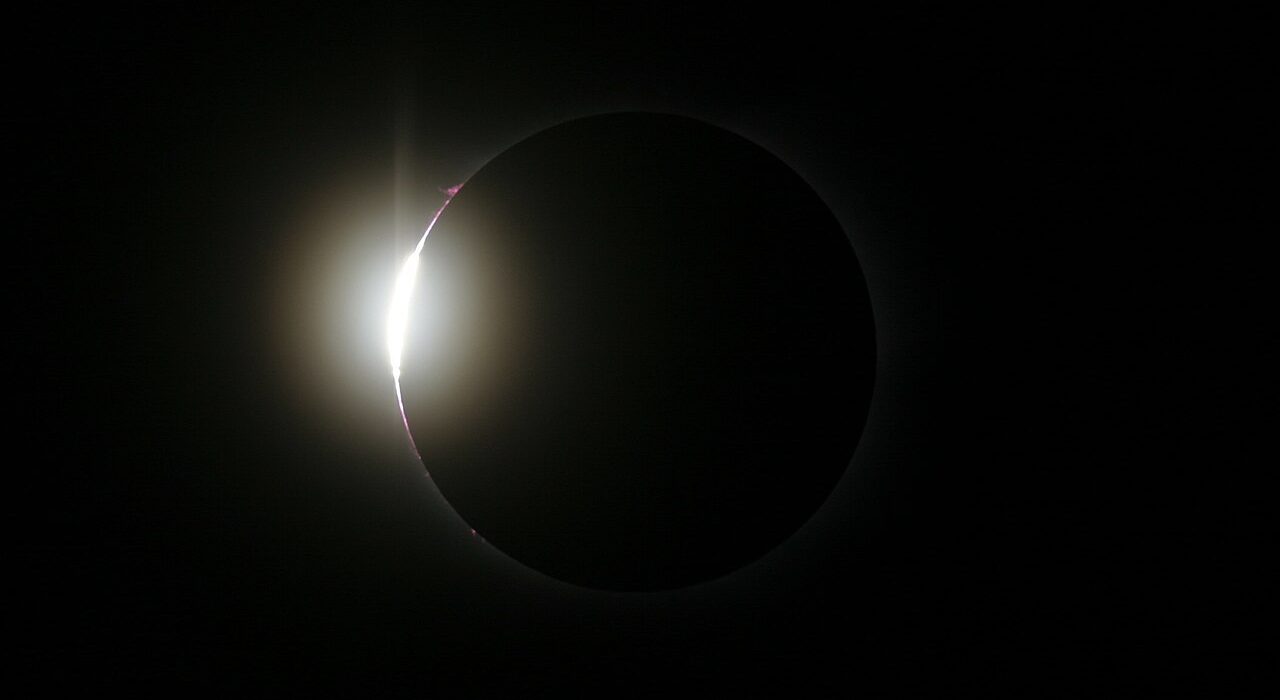
Burgos offers a privileged position for this celestial event. With a totality duration of 1 minute and 44 seconds, it falls just short of the peninsular maximum found in Oviedo (1 minute 49 seconds), but the difference is negligible to the human eye. Crucially, Burgos is located on the centerline of the eclipse path. This means the moon will cover the sun symmetrically, maximizing the duration of darkness and ensuring the “diamond ring” effect appears evenly on both sides of the lunar silhouette. Being on the centerline also reduces the risk of missing totality due to slight navigational errors if you are driving to a viewing spot.
Where to watch it in Burgos
Selecting a viewing spot in Burgos requires specific attention to the sun’s altitude. At the moment of maximum eclipse (20:29), the sun will be extremely low, hovering only between 10° and 12° above the horizon in the west-northwest direction. This is roughly the height of a two-story building held at arm’s length. Consequently, any location with tall buildings, dense tree lines, or hills to the west will block the view. You need an unobstructed western horizon.
Based on the city’s topography and the eclipse geometry, here are the three most viable locations within the urban area, though elevated areas outside the city center remain the scientific ideal:
- Paseo del Espolón: This is the city’s main promenade and a natural gathering point. While it offers ample space for large crowds, the surrounding buildings and mature trees can obstruct the low western sky. To view successfully here, you must position yourself at the westernmost end of the promenade, near the Arco de Santa María, facing the river. Avoid the eastern sections near the theater, where the view will be blocked.
- Plaza Mayor: The main square provides a large, open paved area. However, it is surrounded by multi-story buildings. Viewing from ground level will likely be impossible as the sun dips below the roofline before totality. This location is only viable if you have access to a rooftop terrace or a high balcony facing west. For ground-level observers, this spot is risky for the total phase, though suitable for the early partial phases.
- Río Arlanzón y Puentes Históricos: The banks of the Arlanzón River offer the best potential for a clear horizon within the city limits. The river flows roughly west-to-east in sections, opening up the skyline. Areas near the Puente de San Pablo or the walkways downstream from the cathedral provide fewer vertical obstructions. The “Páramos elevados” (elevated plateaus) mentioned in astronomical notes are not in the city center; therefore, the riverbanks are your best urban compromise for a clean horizon.
For the absolute best experience, astronomical data suggests leaving the urban core. The observation note for Burgos highlights “Páramos elevados con horizonte limpio” (elevated plateaus with a clean horizon). Driving 10-15 minutes west of the city toward the villages on the plateau will guarantee an unobstructed view of the sun setting into the moon’s shadow.
August skies in Castilla y León: real odds
Weather is the single greatest variable in eclipse chasing. According to data from AEMET (the Spanish State Meteorological Agency), the region of Castilla y León, which includes Burgos, La Rioja, Aragón, and Navarra, boasts some of the best statistical conditions in Europe for mid-August. The clear sky probability ranges between 70% and 85%. This high probability is due to the continental climate, which typically features stable high-pressure systems in late summer.
However, travelers must prepare for specific risks. “Calor extremo” (extreme heat) is common, with temperatures frequently exceeding 35°C (95°F) during the day. While the eclipse occurs in the evening when temperatures drop, the ground will retain heat. Additionally, while rare, isolated afternoon thunderstorms (“tormentas vespertinas aisladas”) can develop due to thermal convection. The smart strategy is to monitor the forecast 24 to 48 hours in advance. If clouds threaten Burgos, the high clear-sky probability in the surrounding plateau means a short drive of 30 minutes in any direction can often find a break in the clouds.
Getting to Burgos for the eclipse
Burgos is a major transport hub in northern Spain, well-connected by high-speed rail (AVE) and highway. While we do not have specific published route guides for this event yet, the city is easily accessible from Madrid (approximately 2 hours by train) and Barcelona (approximately 4.5 hours by train). For international travelers flying into Madrid-Barajas Airport, the train connection to Burgos is direct and efficient.
Be aware that on August 12, 2026, roads leading into the path of totality will experience heavy traffic. Thousands of astronomers and tourists will be converging on this narrow strip of northern Spain. The most strategic move is to arrive in Burgos at least one day prior, on August 11. This allows you to secure your viewing spot, acclimate to the time zone, and avoid the gridlock that will inevitably occur on the morning of the eclipse. If you must travel on the day, aim to be in your final viewing position by 18:00 at the latest.
Where to stay: book now or arrive the day before
Accommodation inside the path of totality has been booking up rapidly since early 2025. Burgos, being a major city on the centerline, is a prime target for eclipse chasers. Honest advice: if you have not booked yet, do so immediately with a free cancellation policy. If city hotels are fully booked or prohibitively expensive, consider staying in a nearby city outside the path, such as Valladolid or Logroño, and driving into Burgos on the morning of the 12th. However, given the traffic warnings, staying within Burgos is the superior option for stress reduction.
Safety: the 30 seconds you must read
Watching a solar eclipse requires strict eye protection to prevent permanent retinal damage. You must wear ISO 12312-2 certified eclipse glasses during ALL partial phases of the eclipse. This includes the time from first contact (19:33) until the very instant totality begins (20:28). It is only during the 1 minute and 44 seconds of totality that it is safe to look at the sun with the naked eye. The moment the sun begins to reappear (the “diamond ring” effect at 20:30), you must immediately look away and replace your glasses.
- ISO 12312-2 certified eclipse glasses — one per person, bought well in advance. Do not use sunglasses, smoked glass, or exposed film. See options on Amazon ES.
For a comprehensive breakdown of safety protocols and how to verify your gear, please read our complete guide to the 2026 eclipse in Spain.
The eclipse near Burgos
If you are unable to secure accommodation in Burgos or prefer a different environment, several nearby towns also fall within the path of totality. The duration of totality varies slightly depending on your distance from the centerline. The table below compares Burgos with neighboring locations to help you plan your logistics.
| City | Distance | Totality duration | Totality begins |
|---|---|---|---|
| Palencia | 78 km | 1 min 43 s | 20:29:08 |
| Vitoria-Gasteiz | 101 km | 1 min 04 s | 20:27:43 |
| Logroño | 104 km | 1 min 22 s | 20:28:09 |
| Valladolid | 115 km | 1 min 27 s | 20:29:53 |
Make a trip of it: what to see in Burgos
Burgos is a UNESCO World Heritage city with a rich history that predates the eclipse by nearly a millennium. Since the eclipse occurs at sunset on the 12th, the entire day is free for exploration. We recommend visiting the stunning Gothic Cathedral, walking the historic streets, and enjoying the local cuisine. For a detailed itinerary of cultural sites and restaurants, consult our full city guide: what to see and do in Burgos.
Frequently asked questions
What time is the eclipse in Burgos?
The partial phase starts at 19:33:21 CEST. Totality runs from 20:28:24 to 20:30:08, with maximum at 20:29:17. The partial phase ends at 21:20:12.
How long does totality last in Burgos?
1 min 44 s. The city sits on the centerline, close to the maximum possible for Spain.
Will the eclipse be total in Burgos?
Yes. Burgos is inside the path of totality with magnitude 1.0139. The sun will be completely covered by the moon for 1 min 44 s.
Do I need eclipse glasses?
Yes — ISO 12312-2 certified glasses during all partial phases. Only during totality can you safely look at the sun with the naked eye. Sunglasses do NOT protect.
What if it is cloudy in Burgos on August 12?
Clear-sky probability for this zone is 70-85% (AEMET historical data). MEJORES condiciones meteorológicas estadísticas. Hidratación importante. Check the AEMET forecast 24-48 hours before and stay mobile.
When is the next total solar eclipse visible from Spain?
Soon: 2027-08-02. An exceptional back-to-back for the same region.
Conclusion
The August 12, 2026 total solar eclipse is a once-in-a-lifetime event for travellers visiting Spain. With careful planning — picking a centerline location, checking the AEMET forecast 24-48h before, wearing ISO 12312-2 glasses during partial phases and booking accommodation early — you can witness one of nature’s most spectacular phenomena. Use this guide alongside our city guides and itineraries to build the trip of a lifetime.