Total Solar Eclipse of August 12, 2026 in Spain: Where, When and How to See It
On August 12, 2026, Spain will witness its first total solar eclipse visible from the peninsula since 1905. After a gap of 121 years, the Moon’s shadow will sweep across the Iberian Peninsula, turning day into night for a brief but profound moment. For observers positioned within the narrow path of totality, the event will occur in the early evening, approximately one hour before sunset, with the Sun low on the western horizon. The shadow enters Spain via the Atlantic coast of Galicia and exits over the Mediterranean Sea through the Balearic Islands.
This guide provides the definitive logistical framework for planning your trip. It offers precise city-by-city timings verified against NASA and IGN data, identifies the locations with the highest statistical probability of clear skies, and outlines the strict safety protocols required for observation. Whether you are an experienced astrophotographer or a first-time traveler, the following analysis details exactly where the path of totality falls and how to maximize your chances of witnessing this rare celestial alignment.
Why this eclipse is historic
The solar eclipse of August 12, 2026, represents a significant astronomical milestone for the Iberian Peninsula. The last time a total solar eclipse was visible from mainland Spain was on August 30, 1905. That event occurred over 121 years ago, meaning that for the vast majority of the current population, this will be the first and only opportunity to experience totality from Spanish soil in their lifetime. According to data from NASA’s Five Millennium Catalog of Solar Eclipses, this event belongs to Saros cycle 126, a series of eclipses that repeat every 18 years, 11 days, and 8 hours.
What makes the 2026 event particularly unique for travelers is the proximity of the next total eclipse. On August 2, 2027, just one year later, another total eclipse will cross Spain, though its path will be further south, affecting regions like Andalusia and the Strait of Gibraltar. This creates a rare “double event” window for astrotourism, allowing dedicated observers to potentially witness two totalities in consecutive years within the same country. The 2026 eclipse has a magnitude of 1.0386, indicating that the Moon will completely cover the Sun’s disk, allowing the solar corona to become visible. The maximum width of the path of totality globally is 294 kilometers, but as the shadow traverses Spain at a low angle near sunset, the effective duration and width vary significantly by location.
Path of totality across Spain
The trajectory of the Moon’s umbral shadow across Spain follows a distinct northwest-to-southeast vector. The path makes landfall on the Atlantic coast of Galicia, specifically affecting the provinces of A Coruña and Lugo. From there, it moves eastward across the Cantabrian coast, covering Asturias and Cantabria, before dipping slightly south to cross the northern Meseta. It traverses the southern Basque Country, La Rioja, and cuts through Aragón. As the shadow continues southeast, it clips the northern edge of the Valencian Community and southern Catalonia. Finally, the path exits the peninsula and crosses the Balearic Islands—specifically Menorca, Mallorca, and Ibiza—before disappearing into the Mediterranean Sea. It is critical to note that major population centers such as Madrid, Barcelona, and Seville lie outside the path of totality; observers in these cities will only witness a deep partial eclipse.
Banda de totalidad (sombreada) y ciudades dentro de la banda. Haz clic en cada marcador para ver el horario y la duración. Mapa basado en datos de NASA y Wikipedia.
Precise timings by city
Below are the verified totality timings for the main cities and locations situated within the path of the eclipse. The data is ordered from northwest to southeast, following the progression of the shadow across the peninsula. All times are provided in local Spanish summer time (CEST, UTC+2). These figures are derived from calculations by the Spanish National Geographic Institute (IGN) and cross-referenced with NASA ephemeris data. Note that the exact moment of maximum eclipse varies by seconds depending on your precise coordinates within the city limits.
| City | Region | Totality start | Maximum | Duration | Centerline |
|---|---|---|---|---|---|
| A Coruña | Galicia | 20:27:40 | 20:28:19 | 1 min 17 s | No |
| Lugo | Galicia | 20:28:07 | 20:28:50 | 1 min 24 s | No |
| Oviedo | Asturias | 20:27:05 | 20:28:00 | 1 min 49 s | Yes |
| Gijón | Asturias | 20:26:48 | 20:27:40 | 1 min 45 s | Yes |
| Santander | Cantabria | 20:26:57 | 20:27:29 | 1 min 04 s | No |
| Bilbao | País Vasco | 20:27:23 | 20:27:38 | 0 min 31 s | No |
| Vitoria-Gasteiz | País Vasco | 20:27:43 | 20:28:15 | 1 min 04 s | No |
| Logroño | La Rioja | 20:28:09 | 20:28:50 | 1 min 22 s | No |
| Burgos | Castilla y León | 20:28:24 | 20:29:17 | 1 min 44 s | Yes |
| Ponferrada | Castilla y León | 20:28:44 | 20:29:28 | 1 min 27 s | No |
| Palencia | Castilla y León | 20:29:08 | 20:29:59 | 1 min 43 s | Yes |
| Valladolid | Castilla y León | 20:29:53 | 20:30:37 | 1 min 27 s | No |
| Segovia | Castilla y León | 20:31:09 | 20:31:37 | 0 min 57 s | No |
| Zaragoza | Aragón | 20:29:02 | 20:29:44 | 1 min 25 s | No |
| Guadalajara | Castilla-La Mancha | 20:31:21 | 20:31:55 | 1 min 07 s | No |
| Cuenca | Castilla-La Mancha | 20:32:06 | 20:32:33 | 0 min 53 s | No |
| Teruel | Aragón | 20:31:04 | 20:31:51 | 1 min 34 s | Yes |
| Salou (Tarragona) | Cataluña | 20:29:31 | 20:30:05 | 1 min 08 s | No |
| Valencia | Comunidad Valenciana | 20:32:30 | 20:33:00 | 1 min 00 s | No |
| Mahón (Menorca) | Islas Baleares | 20:30:16 | 20:30:51 | 1 min 10 s | No |
| Port de Pollença (Mallorca) | Islas Baleares | 20:30:30 | 20:31:14 | 1 min 28 s | Yes |
| Alcúdia (Mallorca) | Islas Baleares | 20:30:34 | 20:31:19 | 1 min 29 s | Yes |
| Palma | Islas Baleares | 20:31:05 | 20:31:53 | 1 min 36 s | Yes |
| Sant Antoni de Portmany (Ibiza) | Islas Baleares | 20:32:40 | 20:33:13 | 1 min 06 s | No |
| Ibiza | Islas Baleares | 20:32:45 | 20:33:18 | 1 min 04 s | No |
Source: NASA Five Millennium Catalog and Wikipedia. All times local CEST (UTC+2) on August 12, 2026.
Analysis of the timing data reveals significant disparities in the duration of totality depending on your position relative to the central line. The longest durations on the peninsula are found in Oviedo (1 minute 49 seconds) and Gijón (1 minute 45 seconds), as the central line passes directly through Asturias. Burgos and Palencia also offer excellent durations exceeding 1 minute 40 seconds. Conversely, locations on the extreme edges of the path experience drastically shorter totalities. For instance, Bilbao, situated on the northern limit, sees only 31 seconds of totality. Similarly, Segovia (57 seconds) and Cuenca (53 seconds) are on the southern edge. Travelers prioritizing the length of the dark phase should aim for the central band in Asturias, Castile and León, or the Balearic Islands, where Palma offers a substantial 1 minute 36 seconds.
Best viewing locations
Selecting the optimal viewing site requires balancing three critical variables: the duration of totality, the statistical probability of clear skies in August, and the quality of the western horizon. Since the eclipse occurs approximately one hour before sunset, the Sun will be at a low altitude, ranging between 10° and 20° above the horizon. This necessitates a location with an unobstructed view to the west-southwest. Mountains, buildings, or dense tree lines in that direction can block the event entirely. Furthermore, coastal areas face a higher risk of marine layer fog or low clouds in the evening, while inland plateaus generally offer clearer skies but require travel to reach a suitable horizon.
Asturias and the Cantabrian coast: maximum duration
For observers prioritizing the length of the total phase, Asturias is the premier destination on the peninsula. The central line of the eclipse passes directly through Oviedo and Gijón. In Oviedo, totality lasts 1 minute 49 seconds, the longest duration achievable on the mainland. Gijón offers 1 minute 45 seconds with the added advantage of a coastal horizon at locations like the Cerro de Santa Catalina. However, this region carries a meteorological risk. According to historical data from AEMET (Spanish Meteorological Agency), the Cantabrian coast has a 30-50% probability of clear skies in August. Evening sea breezes can generate low cloud cover (‘orballo’) precisely at sunset. To mitigate this, observers should identify elevated inland alternatives nearby, such as the Naranco hills in Oviedo, which provide a clear western view above the coastal fog layer while remaining within the central path.
Castile and León and La Rioja: best weather odds
If clear skies are your primary concern, the interior plateau of Castile and León and the Ebro Valley in La Rioja offer superior statistical probabilities. AEMET climatology indicates a 70-85% chance of clear skies in these regions during August. Burgos is exceptionally well-positioned, lying near the central line with a duration of 1 minute 44 seconds. The surrounding ‘páramos’ (high plains) offer unobstructed horizons. Similarly, Logroño in La Rioja provides a duration of 1 minute 22 seconds with very dry atmospheric conditions. The trade-off here is the lack of a dramatic coastal backdrop and potentially higher temperatures, often exceeding 35°C in the afternoon. Travelers should plan to view from elevated terrain or open fields west of the cities to ensure the low-hanging sun is not obscured by local topography.
Aragón and the Starlight skies of Teruel
Aragón presents a compelling option for those combining eclipse viewing with dark-sky tourism. Zaragoza sits within the path with a duration of 1 minute 25 seconds and a high probability of clear, dry skies. However, the standout location is the province of Teruel. The town of Teruel experiences 1 minute 34 seconds of totality. More importantly, the nearby Sierra de Gúdar-Javalambre and Sierra de Albarracín are certified Starlight Reserves. These areas boast some of the lowest light pollution levels in Europe. The Javalambre Astrophysical Observatory is located here, underscoring the region’s astronomical quality. While the terrain is mountainous, requiring careful selection of a west-facing viewpoint, the combination of long duration, high clear-sky probability, and exceptional darkness makes this a top-tier choice for astrophotographers.
Valencia, Catalonia and the Balearic Islands
For travelers seeking to combine the eclipse with a summer beach holiday, the eastern coast and the Balearic Islands are ideal. Valencia is on the southern edge of the path, offering 1 minute of totality. While the duration is shorter, the horizon over the Albufera or the beaches is typically clear, though maritime haze is a possibility. The Balearic Islands offer a robust alternative. Palma de Mallorca sees 1 minute 36 seconds of totality, comparable to the best mainland sites. The north coast of Mallorca, specifically Port de Pollença and Alcúdia, lies on the central line with durations exceeding 1 minute 28 seconds. The advantage here is the open Mediterranean horizon to the west. However, accommodation in the Balearics during August is at a premium, and bookings must be secured well in advance. The risk of maritime haze increases shortly before sunset, so northern coasts are generally preferred over southern ones for this specific event.
Galicia: the shadow’s first Spanish landing
Galicia marks the entry point of the eclipse into Spain. A Coruña experiences the phenomenon at 20:28 CEST with a duration of 1 minute 17 seconds. The iconic Tower of Hercules offers a historic vantage point, but the Atlantic exposure brings significant weather risks. The probability of clear skies on the Galician coast in August is the lowest in the path (30-50%). Coastal fog is a frequent occurrence in the evenings. Travelers targeting Galicia should have a contingency plan to move inland towards Lugo (1 minute 24 seconds) if coastal clouds develop. The interior of Galicia offers better visibility odds, though the duration is slightly reduced compared to the optimal central line further east.
How to view the eclipse safely
Observing a solar eclipse requires strict adherence to safety protocols to prevent permanent eye damage. The Sun’s radiation is intense, and looking directly at it without protection during the partial phases can cause solar retinopathy, burning the retina without pain. This damage is irreversible. The rules for viewing change depending on whether the Sun is partially or totally covered by the Moon.
Before and after totality: ISO 12312-2 eclipse glasses
During the partial phases—before totality begins and after it ends—you must use certified solar filters. Standard sunglasses, even very dark ones, are not sufficient. You need eclipse glasses that comply with the ISO 12312-2 international safety standard. These filters block 100% of harmful UV and infrared rays and reduce visible light to safe levels. It is crucial to inspect your glasses before use; if they are scratched or damaged, do not use them. Due to high global demand, legitimate ISO-certified glasses often sell out months in advance. We recommend purchasing them from reputable astronomical suppliers or verified vendors early. Avoid homemade filters, X-ray films, or exposed photographic negatives, as these do not block invisible infrared radiation which can cook the retina.
During totality: naked-eye viewing
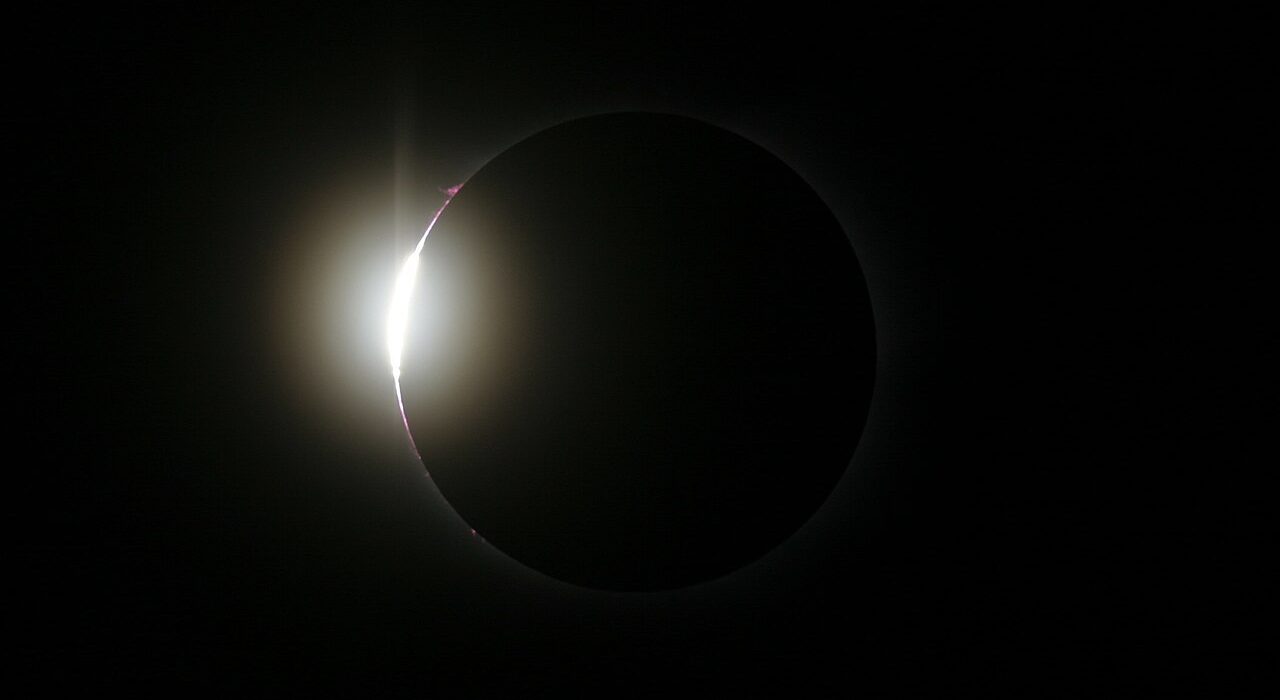
There is only one brief window when it is safe to look at the Sun without filters: during the phase of totality. This occurs when the Moon completely covers the Sun’s photosphere. At this moment, the dangerous visible light is blocked, and the faint white corona becomes visible to the naked eye. This is the only time you can remove your glasses. However, you must be vigilant. The moment the first sliver of sunlight reappears (the “diamond ring” effect), you must immediately put your eclipse glasses back on. Totality lasts between 30 seconds and 2 minutes depending on your location; ensure you know the exact timing for your spot so you do not miss the safe window or expose your eyes too early.
Indirect methods for groups and children
For groups, schools, or young children where monitoring individual eye safety is difficult, indirect projection methods are the safest option. A simple pinhole camera can be made by poking a small hole in a card and projecting the Sun’s image onto a second card held behind it. During the partial phases, you will see crescent shapes projected on the ground or card. Another method is to use binoculars or a telescope to project the Sun’s image onto a white surface, but never look through the optics without a proper solar filter mounted on the front objective lens. This allows multiple people to view the eclipse safely without risking direct eye exposure.
Recommended equipment
Whether you are capturing images or simply observing, having the right gear enhances the experience. The low altitude of the Sun (10°-20°) means atmospheric turbulence may be higher than at noon, so stability is key for photography. Below is a list of essential equipment for the August 12 event.
- ISO 12312-2 certified eclipse glasses: Essential for all partial phases. Ensure you have one pair per person in your group. Browse on Amazon.
- Baader AstroSolar filter for telescope or binoculars: If using optics, a full-aperture solar filter must be mounted on the front of the instrument, NEVER on the eyepiece. Browse Baader filters.
- Solar ND filter for cameras: To photograph the partial phases, you need a specialized solar filter (ND 16+ stops or Baader solar film) to protect your camera sensor. Without it, the concentrated sunlight can destroy the sensor instantly. Browse ND filters.
- Sturdy tripod: Because the eclipse occurs near sunset, light levels will be lower than midday. A stable tripod is essential to prevent motion blur during long exposures, especially for capturing the corona during totality. Browse tripods.
Astrotourism: Starlight Reserves in the path
Spain is a global leader in astrotourism, hosting several destinations certified by the Starlight Foundation. These reserves guarantee low light pollution and initiatives to protect the night sky. Four Starlight Reserves lie partially or fully within the path of the 2026 eclipse, offering unique viewing environments.
The Starlight Reserve Sierra de Gúdar-Javalambre in Teruel (Aragón) is one of the darkest areas in Europe. It hosts the Javalambre Astrophysical Observatory, home to large survey telescopes. Viewing the eclipse from these high-altitude plains offers exceptional atmospheric stability. The Starlight Reserve Albarracín, also in Teruel, combines medieval heritage with Bortle Class 1 skies, ideal for viewing the corona and zodiacal light immediately after the eclipse.
In the north, the Starlight Reserve Picos de Europa spans Asturias, Cantabria, and León. This area coincides with the central line of the eclipse. While the mountainous terrain requires careful site selection to ensure a clear western horizon, the dark sky status ensures that once the Sun sets, the emerging stars and planets will be vivid. Finally, the Starlight Reserve Trevinca-Sanabria-Ancares on the border of Galicia and Castile and León offers dark skies near the entry point of the shadow. These certified locations provide infrastructure and local expertise that can enhance the educational value of your trip.
Suggested itineraries
To make the most of your trip, we recommend structuring your travel around one of three thematic itineraries. Each combines the eclipse with regional tourism highlights.
1. The Northern Central Line (Asturias & Cantabria): Focus on maximum duration. Base yourself in Oviedo or Gijón. Spend the days exploring the Picos de Europa National Park and the coastal villages of the Asturian coast. This route offers the longest totality on the mainland but requires a weather contingency plan to move slightly inland if coastal fog forms.
2. The Inland Clear Sky Route (La Rioja & Aragón): Focus on weather reliability. Start in Logroño for wine tourism, then move to Zaragoza or Teruel. This route offers the highest statistical chance of seeing the Sun. You can combine the eclipse with visits to the Javalambre Observatory and the medieval architecture of Albarracín. The dry climate minimizes cloud risk.
3. The Mediterranean Eclipse (Balearic Islands): Focus on leisure and horizon. Fly into Palma de Mallorca. Enjoy beach days in Alcúdia or Pollença, which are on the central line. This itinerary allows for a relaxed vacation where the eclipse is the highlight of a broader summer holiday. Booking accommodation here requires the most lead time due to high summer demand.
August climatology: clear-sky probability
Weather is the single greatest variable in eclipse chasing. Based on historical data from AEMET, the probability of clear skies varies significantly across the path. The following table summarizes the risk profile for each zone. Travelers should monitor forecasts closely 48 hours before the event and be prepared to relocate if necessary.
| Region | Clear Sky Probability (August) | Primary Risk | Recommendation |
|---|---|---|---|
| Galicia & Cantabrian Coast | 30-50% | Coastal fog, marine layer | Have an inland Plan B (e.g., Lugo, Oviedo heights) |
| Castile & León / La Rioja | 70-85% | Afternoon heat, isolated storms | Best statistical odds. Stay hydrated. |
| Aragón / Teruel | 75-85% | Dry heat, wind | Excellent for dark sky viewing post-eclipse. |
| Valencia / Catalonia South | 70-80% | Coastal haze | Good balance of duration and weather. |
| Balearic Islands | 75-85% | Maritime haze at sunset | North coast (Mallorca) preferred for horizon. |
It is crucial to understand that “clear sky probability” is a historical average, not a guarantee. In the 24 hours leading up to August 12, 2026, consult real-time satellite imagery and local meteorological models. Mobility is your best asset; if you are driving, you can move 100 kilometers to escape a localized cloud bank. If you are flying into a specific island or city, your flexibility is reduced, making the choice of destination even more critical.
Booking accommodation: don’t wait
The 2026 eclipse is a global event, and Spain is a top destination for international travelers. Hotels and rural accommodations within the path of totality are already seeing increased inquiries. In popular areas like the Balearic Islands, Asturias, and the vicinity of major observatories, inventory for August 2026 is expected to be fully booked by early 2025. We strongly recommend securing your accommodation immediately. Look for rates with free cancellation policies; this allows you to lock in a room now while retaining the flexibility to move closer to the central line or a clearer weather zone as the date approaches. Do not rely on finding last-minute lodging in the path of totality.
City-by-city eclipse guides
Exact timings, best viewpoints and logistics for each city inside the path of totality:
- A Coruña — 1 min 17 s
- Bilbao — 0 min 31 s
- Burgos — 1 min 44 s
- Gijón — 1 min 45 s
- Ibiza — 1 min 04 s
- Logroño — 1 min 22 s
- Oviedo — 1 min 49 s
- Palma — 1 min 36 s
- Santander — 1 min 04 s
- Segovia — 0 min 57 s
- Valencia — 1 min 00 s
- Vitoria-Gasteiz — 1 min 04 s
- Zaragoza — 1 min 25 s
Frequently asked questions
When is the next total solar eclipse visible from Spain?
August 12, 2026. It will be the first total solar eclipse visible from peninsular Spain since August 30, 1905 — 121 years ago.
Where will the August 12, 2026 total eclipse be visible in Spain?
The path of totality crosses northern and eastern Spain: Galicia, Asturias, Cantabria, northern Castile and León, La Rioja, southern Basque Country, Navarre, Aragón, northern Valencia region, southern Catalonia and the Balearic Islands. Madrid and Barcelona fall just outside the path and will see only a deep partial eclipse (98–99% obscuration).
What time is the eclipse on August 12, 2026 in Spain?
Maximum totality occurs between 20:27 and 20:33 local time (CEST, UTC+2) depending on the city. The partial phase begins around 19:30. The whole event happens roughly an hour before sunset.
How long will totality last in Spain?
Duration varies by location: from about 30 seconds at the band edge (Bilbao) up to 1 minute 49 seconds in Oviedo, one of the longest-totality locations in peninsular Spain.
What is the best place to view the eclipse in Spain?
The best spots combine three factors: proximity to the centerline (longer totality), high August clear-sky probability and an unobstructed west-southwest horizon. Top picks: Burgos, Palencia, Logroño, Teruel and inland Mallorca. Asturias offers long totality but a higher cloud risk.
Can I watch the eclipse from Madrid?
Madrid lies just outside the path of totality. It will see a very deep partial eclipse (~98–99% sun coverage), but without the corona, stars or true totality. To experience full totality you need to travel at least 50–80 km north — to Guadalajara or Segovia, which are inside the band.
And from Barcelona?
Barcelona is also outside the totality path. Tarragona and Salou are inside: 100 km south puts you in the band of totality.
How do I view the eclipse safely?
During every partial phase (before and after totality), you must use eclipse glasses certified to ISO 12312-2. Only during the seconds of totality (when the moon completely covers the sun) can you look unaided. Regular sunglasses, X-ray film and homemade filters do NOT protect — they can cause permanent retinal damage.
Where can I buy certified eclipse glasses?
From specialised astronomy shops or verified online retailers. The label must clearly read ‘ISO 12312-2’. Warning: many glasses sold on marketplaces don’t meet the standard. Buy early — shortages are common in the months before any major eclipse.
What will the weather be like that day?
Statistical August weather varies sharply by region. Best historical clear-sky odds (70–85%) are in Castile and León, La Rioja, Aragón and inland Catalonia. The Cantabrian coast typically has more cloud cover (30–50% clear sky). Plan a Plan B and check the AEMET forecast 24–48 hours before.
How high will the sun be during totality?
Very low: roughly 10–20° above the horizon depending on location. Totality occurs about an hour before sunset, so a clear west-southwest horizon is essential — a building, mountain or tree could hide the event.
Do I need to book accommodation in advance?
Yes — urgently. This will be the highest tourist demand of summer 2026 in cities along the path. Many hotels in northern Spain and the Balearics have been booked since 2025. Book as soon as possible, ideally with free cancellation.
When is the next total eclipse visible from Spain after 2026?
August 2, 2027 — less than a year later. That one will mainly cross southern Spain (Andalusia, Murcia) and northern Africa. Spain will live an exceptional run with two total eclipses in under twelve months.
What can you see during a total eclipse?
During totality: the sun is fully covered, the solar corona becomes visible, the sky darkens like dusk, the brightest stars and planets appear (likely Venus, Jupiter and Mercury), the temperature drops several degrees, nocturnal animals may activate and birds fall silent.
Can I photograph the eclipse with a phone?
Only during totality, and you must not point the phone at the sun during partial phases (it can damage the sensor). For serious camera photography, use a dedicated solar filter (Baader AstroSolar or ND ≥16 stops) and a tripod. A phone without filter is safe ONLY during the seconds of totality.
Are there organised eclipse tours?
Yes. Astronomy associations, astrotourism agencies and observatories — including Starlight Reserves — are programming eclipse experiences. Book early; some tours are already sold out.
Can children wear eclipse glasses?
Yes, with constant adult supervision. ISO 12312-2 certified glasses are safe for children, but make sure they keep them on at all times during partial phases. For very young children (<5), consider indirect methods (projection) instead.
What if it’s cloudy on eclipse day?
Heavy clouds will block the sun, though you’ll still feel the sky darken. That’s why mobility is critical: check the AEMET forecast 24–48h before. The path is wide (294 km) and driving 100–200 km can save your view.
Will the eclipse affect the power grid or telecoms?
There will be a temporary drop in national solar PV generation during the event — Spain’s grid operator (Red Eléctrica) is already planning the balance. Telecoms won’t be affected, though mobile networks in popular viewing areas may be congested.
Can I combine the eclipse with other tourism?
Absolutely. The path crosses regions with huge tourism appeal: the Camino de Santiago, the Picos de Europa, La Rioja wine country, the Pyrenees, Mallorca and the Costa Daurada. Plan at least 3–5 days in your chosen area — our city guides and itineraries can help.
Sources and references
- NASA — Five Millennium Catalog of Solar Eclipses
- Wikipedia — Solar eclipse of August 12, 2026
- Spanish National Geographic Institute — Astronomy
- AEMET — Spanish Meteorological Agency
- Starlight Foundation
- Institute of Astrophysics of the Canary Islands (IAC)
Conclusion
The total solar eclipse of August 12, 2026, is more than a celestial event; it is a historic opportunity to witness a phenomenon that has not graced the Spanish peninsula in over a century. Whether you choose the long durations of Asturias, the clear skies of Aragón, or the Mediterranean horizons of Mallorca, success depends on preparation. Verify your location against the path of totality, secure ISO-certified safety gear, and monitor weather forecasts diligently. This article serves as your primary reference for planning, but the sky remains the ultimate variable. Start your bookings now, remain flexible, and prepare for the brief, awe-inspiring moment when day turns to night over Spain.