Chiclana de la Frontera
AndalucíaClimate
The salty aroma of the wind blowing in through the Caño de Sancti Petri, mingling with the intense perfume of freshly fried chicharrones (pork cracklings) in a tavern in the center, is the true welcome to this land. Here, where Phoenician history merges with the modern tourism of the Bay of Cádiz, every corner tells a story 3000 years old, long before King Ferdinand IV founded the present-day Chiclana in 1303.
The must-seesWhat to see in Chiclana de la Frontera: the must-sees
Museo de Chiclana
This museum is essential for understanding why Chiclana has 3000 years of history and not just the 700 that were once attributed to it. Here you can view the archaeological findings from the cerro del Castillo (castle hill) that demonstrate the Phoenician presence in the territory. It is the ideal place to situate yourself in time before exploring the city, connecting the current founding with the most remote past.
Punto Mágico “La Espartosa”
This is a singular monument that stands out for its artistic design and its integration into the urban landscape. It is a visual reference point within the city that invites contemplation and photography, marking an obligatory stop on any cultural tour of the municipality.
Batería de San Judas
This monument is a historical vestige of the coastal defense that protects the bay. Its structure allows you to imagine the strategic importance this area has always had for maritime control. It is a brief but intense visit that connects the traveler with the military and maritime history of the province of Cádiz.
Punto mágico de Santa Ana
If you are looking for the best views, this lookout point is the perfect option for observing the city from an elevated perspective. From here you can appreciate the expanse of the metropolitan area of the Bay of Cádiz, the third most populated in the autonomous community. It is the ideal place to understand the urban layout and enjoy a complete panoramic view at sunset.
Birdwatching at Canal de Carboneros
This natural lookout is a paradise for lovers of ornithology and nature within the municipal boundaries. The canal environment allows for birdwatching in their natural habitat, offering an experience of tranquility far from the tourist bustle. It is proof of the ecological richness that coexists with the hotel development of the area.
Other points of interest
- The bust dedicated to Pepin Jiménez pays homage to a relevant local figure in a public space.
- The sculptures Melkart 6 (Salt) and Melkart 7 (Agriculture: Olive Oil) celebrate the traditional resources of the land.
- The work Melkart 5 Colonization completes the artistic series dedicated to Phoenician history.
- The monument to the Atún (tuna) recalls the vital importance of fishing and the almadraba (traditional tuna trap) in the local economy.
🍂 Otoño
El otoño mantiene el calor residual permitiendo baños tranquilos hasta octubre. Es la estación ideal para degustar la gastronomía local con menos turistas. Consulta siempre el pronóstico ya que las lluvias pueden aparecer ocasionalmente.
What to do in Chiclana de la Frontera
Chiclana de la Frontera offers vibrant activities ranging from immersion in centuries-old traditions to enjoying modern music festivals. You can immerse yourself in Semana Santa (Holy Week) in April, with its 14 hermandades (brotherhoods) and saetas (flamenco religious songs), or experience the euphoria of the Feria y Fiestas de San Antonio in June with its casetas (festival booths) and horses. In summer, the Concert Music Festival in Sancti Petri brings together renowned artists, while in September the Festividad de la Patrona, the Virgen de los Remedios, includes the traditional ‘Pisa de la Uva’ (grape stomping).
Chiclana de la Frontera in a day: express itinerary
If you’re short on time, this route will let you see the essentials and sample the best of the local cuisine in 24 intense hours.
- 09:00 – Museo de Chiclana: Start the morning by understanding the 3000 years of Phoenician history and the town’s founding in 1303.
- 11:30 – Punto mágico de Santa Ana: Climb to the viewpoint for an aerial perspective of the Bay of Cádiz before the midday heat sets in.
- 14:00 – Lunch in La Banda: Head to this residential neighborhood to try the atún encebollado (tuna stewed with onions) in a local bodega with panoramic views.
- 16:30 – Batería de San Judas and Punto Mágico “La Espartosa”: Explore these historic and artistic monuments while you walk off your lunch.
- 19:00 – Poblado de Sancti Petri: End the day in this former fishing settlement, now restored, to watch one of the most beautiful sunsets in Cádiz.
Where to eat in Chiclana de la Frontera: local gastronomy
Where to stay in Chiclana de la Frontera
El Lugar (Casco Antiguo)
Es la parte más antigua y tradicional de Chiclana, situada en la margen izquierda del río Iro. De calles estrechas, plazas peatonales y casas señoriales, concentra el latido histórico, administrativo y comercial de la ciudad.
La Banda
La zona surgida a partir de la expansión histórica en la margen derecha del río Iro. Es de carácter muy residencial y con gran arraigo popular, albergando importantes bodegas locales y parques con excelentes panorámicas.
Playa de La Barrosa (Pistas 1 y 2)
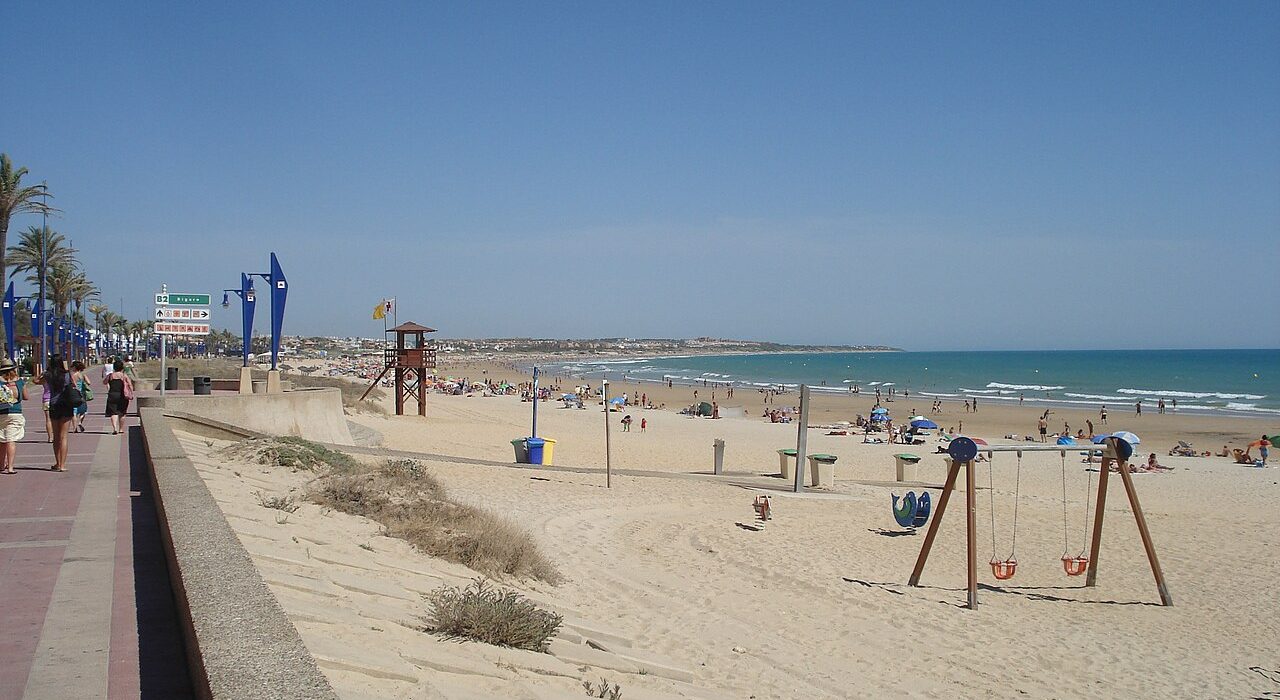
El principal motor vacacional de Chiclana, caracterizado por una vibrante vida turística en torno a su playa de arena dorada. Cuenta con un animado paseo marítimo repleto de chiringuitos, restaurantes y heladerías.
Novo Sancti Petri
Exclusivo desarrollo residencial y hotelero de gran prestigio internacional situado junto a dunas espectaculares. Alberga resorts de lujo, spas y campos de golf diseñados por grandes leyendas del deporte en un entorno idílico.
Poblado de Sancti Petri
Antiguo y pintoresco asentamiento pesquero de almadraba con un aire nostálgico, rehabilitado hoy como puerto náutico y deportivo. Es el epicentro de las actividades acuáticas y ofrece una de las puestas de sol más hermosas de Cádiz.
Fuente Amarga
Un barrio tranquilo y residencial situado al sur del núcleo urbano. Es ampliamente reconocido por su histórico e idílico balneario de aguas medicinales, lo que lo convierte en un rincón perfecto para el relax.
How to get to Chiclana de la Frontera
The city’s connectivity makes it easily accessible from different points, although direct transport options vary depending on your origin.
| Medio | Duración | Precio aprox. | Frecuencia |
|---|---|---|---|
| Aeródromo de La Ina | Variable según origen | Variable | Bajo (Aviación general) |
| Bus Urbano/Interurbano | Depende de la ruta | Económico | Regular |
How to get around Chiclana de la Frontera
To get around within the municipality, the main option is the urban bus, which connects the different population centers such as the center, La Barrosa, and Sancti Petri. It’s a practical system for avoiding parking problems, especially during the summer months when tourist occupancy soars and exceeds 230,000 inhabitants, tripling the demand for services.
Weather in Chiclana de la Frontera
Best time to visit Chiclana de la Frontera
Day Trips from Chiclana de la Frontera
As part of the metropolitan area of the Bay of Cádiz, the town is a strategic starting point for exploring other cities in the region. You can plan routes to the surrounding areas to delve deeper into the province of Cádiz and its historical and natural charms.
Things You Didn’t Know About Chiclana de la Frontera
Did you know that the name ‘Chiclana’ probably comes from the Roman villa ‘Cippiana’, meaning ‘belonging to Cippianus’? This Latin name evolved phonetically until it was first documented in the year 1232.
On the present-day islet of Sancti Petri stood the famous Temple of Hercules Gaditanus, dedicated to the Phoenician god Melqart. It was here that Hannibal Barca offered sacrifices before departing for Italy and where Julius Caesar wept before a statue of Alexander the Great.
Chiclana is the birthplace of Antonio García Gutiérrez, author of the romantic drama ‘El trovador’ (The Troubadour, 1836). This play was so revolutionary that the audience called the author out to take a bow for the first time, and it served as the basis for Giuseppe Verdi’s opera ‘Il trovatore’.
The village and the almadraba (traditional tuna trap) of Sancti Petri served as the setting for ‘La niña de la venta’ (The Girl from the Inn, 1951), starring Lola Flores and Manolo Caracol, with many local residents participating as extras.
The town preserves the artisanal technique of ‘despesque’ (fish harvesting) in its saltwater estuaries, a sustainable method that uses the tides to catch sea bream, sea bass, and sole raised naturally in the salt flats.
On March 5, 1811, the Battle of Chiclana (or Barrosa) took place, where an allied Anglo-Spanish army defeated the French forces of Marshal Victor that were besieging the bay.
Who Chiclana de la Frontera Is For
With 459,257 annual travelers (INE) and 34% foreigners, this destination is perfect for couples seeking luxury in Novo Sancti Petri, families needing relaxation in Fuente Amarga, and history lovers interested in the Phoenician legacy and the Napoleonic battles. It is also a paradise for foodies who want to try the best almadraba tuna.
💡 ¿Sabías que...?
- ● La hipótesis etimológica más respaldada sitúa el origen de 'Chiclana' en la villa romana de 'Cippiana', que significaba 'perteneciente a Cippianus'. Con el transcurso de los siglos y la evolución fonética medieval, este nombre latino derivó en Chiclana, apareciendo documentado por primera vez en el año 1232. (Ayuntamiento de Chiclana)
- ● En el actual islote de Sancti Petri se ubicaba el célebre Templo de Hércules Gaditano, originalmente dedicado al dios fenicio Melkart. En este santuario de gran relevancia en la antigüedad, el general cartaginés Aníbal Barca ofreció sacrificios antes de partir hacia Italia en la segunda guerra púnica, y Julio César lloró ante una estatua de Alejandro Magno. (Wikipedia)
- ● Chiclana de la Frontera es la cuna de Antonio García Gutiérrez, nacido el 5 de julio de 1813. Su célebre drama romántico 'El trovador' (1836) no solo supuso un hito en el teatro español al ser la primera vez que el público hizo salir al autor a saludar, sino que además sirvió de base a Giuseppe Verdi para componer su famosa ópera homónima 'Il trovatore'. (Real Academia de la Historia)
- ● El poblado y la almadraba de Sancti Petri en Chiclana sirvieron como escenario principal para el rodaje de 'La niña de la venta' (1951), una de las películas más famosas del cine folclórico español protagonizada por Lola Flores y Manolo Caracol, donde numeroso vecindario local participó de figuración. (IMDb)
- ● Chiclana cuenta con la mayor planta y concentración hotelera de categoría de 4 y 5 estrellas de toda la provincia de Cádiz, localizada principalmente en la exclusiva urbanización Novo Sancti Petri. Este desarrollo turístico, inaugurado en 1990, constituye uno de los destinos de lujo y golf más importantes de toda España. (Patronato de Turismo de Cádiz)
- ● La localidad experimenta una variación demográfica masiva durante el año. Cuenta con una población oficial empadronada de aproximadamente 85.000 habitantes, pero durante los meses de verano la ocupación turística se dispara y llega a superar los 230.000 habitantes, triplicando de manera temporal sus necesidades y servicios urbanos. (INE)
- ● Chiclana conserva la técnica artesanal del 'despesque' en sus tradicionales esteros de agua salada. Este método sostenible e histórico aprovecha las mareas para capturar de forma tradicional pescados como la dorada, el róbalo o el lenguado, criados de forma natural en los antiguos laberintos de las salinas de la bahía gaditana. (Ayuntamiento de Chiclana)
- ● El 5 de marzo de 1811 tuvo lugar en la Loma del Puerco la Batalla de Chiclana (o Batalla de la Barrosa), un hito bélico de la Guerra de la Independencia Española donde un ejército aliado anglo-español de unos 14.000 soldados derrotó a las fuerzas francesas del mariscal Victor, que asediaban la bahía de Cádiz. (Ministerio de Defensa)
Frequently Asked Questions About Chiclana de la Frontera
How many days do I need to see Chiclana de la Frontera?
With an average stay of 4.58 nights according to the INE, you have enough time to explore the old town, enjoy the beaches of La Barrosa, and visit historical monuments such as the Batería de San Judas (San Judas Battery) at a leisurely pace.
What is the best time to visit Chiclana de la Frontera?
The best time is from April to October, taking advantage of average summer temperatures of 24.2°C to enjoy festivals such as San Antonio in June or the Virgen del Carmen in July.
Where can I find updated official information?
For more practical information on opening hours, tickets, and event schedules, you can consult the official tourism website of Chiclana de la Frontera.