Ibiza
Islas BalearesClimate
Daily budget
What to See in Ibiza: The Essentials
The capital of the Pitiusas concentrates three UNESCO World Heritage sites within a surprisingly compact radius, something very few Spanish cities can claim. From Phoenician settlements dating back 2,700 years to seagrass meadows that explain the turquoise colour of the water, here heritage is experienced with your feet in the sand and your gaze on the horizon.
Phoenician Settlement of Sa Caleta
Founded in the mid-7th century BC, this open-air archaeological site is considered Ibiza’s first Phoenician settlement and offers a direct window into the island’s birth as a Mediterranean trading post. It sits next to Es Bol Nou beach and the natural harbour of Sa Caleta, in the municipality of Sant Josep, and preserves the remains of dwellings, kilns and industrial structures that bear witness to activities such as metalworking, the production of precious purple dye and various crops. Visits follow an open-air itinerary with recreations, information panels and virtual content that help you imagine the daily life of those first settlers. Admission is free, and sturdy footwear is recommended for walking the terrain. A UNESCO Heritage site, this place gives you a completely different perspective on the island, far from the glitz of the nightclubs.
Punic Necropolis of Puig des Molins
With more than 5,000 tombs spanning from Punic to Roman times, this necropolis is one of the most important funerary complexes in the western Mediterranean and a UNESCO World Heritage site. The Monographic Museum of Puig des Molins, established in 1968 in a building designed by Antonio Roca between 1931 and 1966, displays grave goods, amulets, jewellery, ceramics and anthropoid sarcophagi from the site’s excavations. My advice: visit the museum first to understand the historical context of the burials, then walk through the open-air necropolis. A single ticket covers both museum and site, with discounts for students and seniors.
Posidonia Oceanica Meadows
The posidonia oceanica meadows are largely responsible for the clarity and quality of Ibiza’s waters, as they oxygenate the water, stabilise sediments and maintain the balance of the coastal ecosystem. This marine plant — with roots, stems and leaves — forms meadows that can be centuries old and harbour rich biodiversity, serving as shelter and breeding grounds for numerous species. They are an indicator of clean, well-preserved waters and are protected by local, national and international regulations. Although they aren’t always visited as a traditional attraction, understanding their role completely changes the way you look at the sea from any cove on the island. A UNESCO Heritage site, they are the Mediterranean’s best-kept secret.
Ibiza Cathedral
The Cathedral of Santa María de Eivissa was originally a fortified church that was expanded and remodelled in various stages, which explains the coexistence of Gothic, Renaissance and Baroque elements in a single building. Its square bell tower offers panoramic views of the city, the port and the coast, and inside, the Baroque high altarpiece stands out alongside various chapels and works of sacred art. It houses an adjoining diocesan museum exhibiting goldwork, paintings and sculptures related to the island’s religious history. Check updated opening hours before heading up, as they vary by season.
Dalt Vila
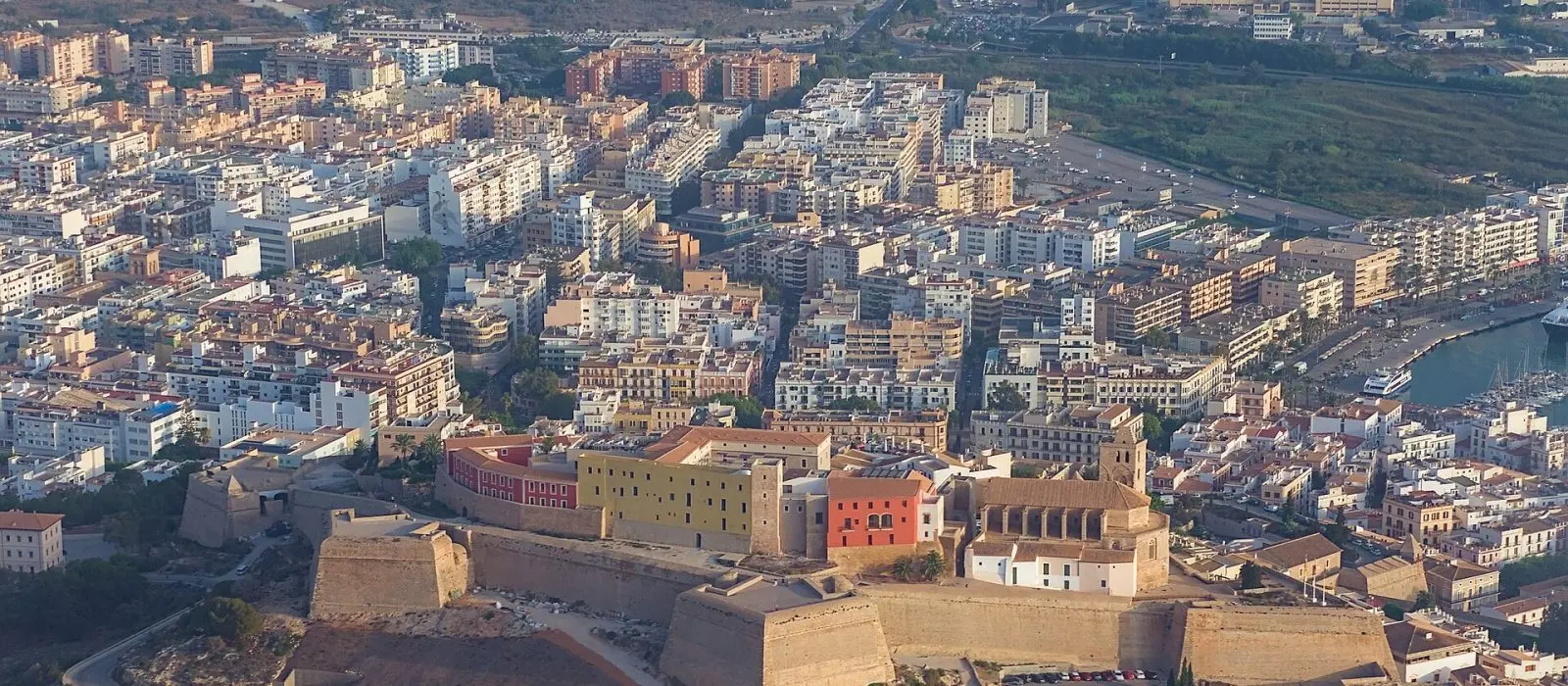
Ibiza’s walled old town is a site of cultural interest crowning the city from the Puig de Vila, offering some of the best views of the port and the coast. Strolling through its cobbled streets, lined with whitewashed houses and courtyards full of bougainvillea, is like travelling back in time. It’s the perfect place to lose yourself without a map, discover charming corners and end up at one of its viewpoints at sunset.
Castillo de Eivissa (Castell d’Eivissa)
Castillo de Eivissa is the last defensive bastion from the Muslim era in Ibiza and stands at the top of Puig de Vila, the highest point of Dalt Vila. It is accessed via the Ronda Calvi, a route that climbs from the walls to the summit and offers spectacular views of Dalt Vila, the port and the city from bastions such as Sant Bernat and the keep. The complex is being refurbished to house a Parador de Turismo, which will make it one of the most unique places to stay on the island.
Playa d’en Bossa
Playa d’en Bossa is a holiday resort with the longest beaches on the island, characterised by large hotel complexes, restaurants and clubs such as Ushuaïa and Sankeys.
Cala Conta (Platges de Comte)
Also known as Platges de Comte, this is a sandy cove approximately 120 metres long and 22 metres wide, with a mountainous setting, calm waters and a high level of occupancy, especially in high season. It forms part of a protected natural environment listed as an ANEI (Àrea Natural d’Especial Interès), and offers services such as nautical equipment rental, sun loungers, parasols and adapted access.
Las Dalias hippy market
A historic market in Sant Carles de Peralta, running since 1954, with crafts, adlib fashion and live music.
Archaeological Museum of Ibiza and Formentera
A museum of the Balearic Islands that complements a visit to the island’s archaeological sites.
Carthaginian necropolises in Ibiza
Archaeological sites that bear witness to the Carthaginian presence on the island.
Church and convent of the Dominicans
A religious building located in the city of Ibiza.
Museo Aloe Vera Ibiza
A museum dedicated to aloe vera in Ibiza, Balearic Islands.
Ibiza bullring
A unique building in the city of Ibiza.
Ibiza (Samian Ware Discovery Site)
An archaeological site linked to the discovery of Samian ware on the island.
Palau
A geodetic vertex in Eivissa, Spain.
🍂 Otoño
Si visitas Ibiza en otoño, el calor del verano se suaviza y el mar sigue templado, ideal para disfrutar de la costa sin multitudes. Puedes alternar un baño en la Playa de ses Salines con una visita al Museo de Arte Contemporáneo de Ibiza. Lleva algo de abrigo ligero, porque las tardes ya refrescan.
What to do in Ibiza
Ibiza offers a unique combination of archaeological heritage, world-famous nightlife, long-established markets and turquoise coves protected by posidonia meadows. The island attracts 474,854 travellers a year according to the INE, with 78% of visitors from abroad and an average stay of 3.08 nights, reflecting intense but short-lived tourism.
Nightlife is one of the island’s great driving forces, with Playa d’en Bossa as the epicentre of the world’s biggest clubs. But Ibiza is much more than partying: markets such as Las Dalias, running since 1954, offer local crafts, adlib fashion and live music in an atmosphere that has managed to retain its authenticity. For history lovers, the three UNESCO assets — Sa Caleta, Puig des Molins and the posidonia meadows — allow you to travel through 2,700 years of Mediterranean civilisation in a single day. And for those seeking calm, areas such as Santa Eulalia del Río offer a quieter, more sophisticated atmosphere, ideal for families and couples.
Ibiza in a day: express itinerary
- 09:00 – Dalt Vila and Eivissa Castle: Start early with a climb up the Ronda Calvi to the castle to enjoy panoramic views of the city and the port before the heat sets in. The walled old town is a site of cultural interest that deserves an unhurried stroll.
- 11:00 – Cathedral of Santa María de Eivissa: Visit the Gothic-Renaissance-Baroque interior and its diocesan museum. The bell tower offers another perspective of the bay.
- 12:30 – Puig des Molins Punic Necropolis: Tour the monographic museum first to understand the context of the more than 5,000 Punic and Roman tombs. An essential UNESCO Heritage site.
- 14:30 – Lunch at Mercat Nou or Mercat Vell: Try the bullit de peix or a sofrit pagès in the surroundings of the central market, where fresh fish takes centre stage.
- 17:00 – Playa d’en Bossa or Cala Conta: If you’re after atmosphere and convenience, Playa d’en Bossa; if you prefer calm waters and a protected setting, Cala Conta (Platges de Comte) with its 120-metre beach and full services.
- 20:30 – Sunset from Dalt Vila: Return to the old town to bid farewell to the day with views of the illuminated port and the sea tinged with colour.
Where to eat in Ibiza: local cuisine
Where to stay in Ibiza
Dalt Vila
El histórico casco antiguo amurallado de la ciudad de Ibiza, perfecto para explorar la cultura y disfrutar de vistas panorámicas.
Playa d'en Bossa
La zona más famosa por su vibrante vida nocturna, albergando algunas de las discotecas más grandes y famosas del mundo.
Santa Eulalia del Río
Un destino más tranquilo y sofisticado, ideal para familias y parejas que buscan buenos restaurantes y un ambiente relajado.
San Antonio de Portmany
Conocido por sus legendarias puestas de sol en el 'Sunset Strip' y una opción popular para viajeros con un presupuesto más ajustado.
How to get to Ibiza
Ibiza has no train station, so access is by air or sea. Ibiza Airport (IBZ) is 7.5 km from the city and connects the island with the mainland and the rest of Europe. By road, the EI-10 links the airport with Ibiza Town, while the EI-20 connects the capital with San Antonio.
| Medio | Duración | Precio aprox. | Frecuencia |
|---|---|---|---|
| Avión (desde Madrid) | Aprox. 1h 15min de vuelo | Variable según temporada | Varios vuelos diarios |
| Bus desde el aeropuerto (EI-10) | Aprox. 20-30 min | Variable | Frecuente en temporada |
| Coche por EI-10 | Aprox. 15 min desde el aeropuerto | Variable | Acceso directo |
Getting around Ibiza
The city of Ibiza has an urban bus network run by Ibiza Bus Oficial, with the CETIS Eivissa central station as its main hub. The historic centre of Dalt Vila is pedestrianised, so the best way to explore it is on foot. For journeys between the capital and other parts of the island, local roads and intercity bus lines cover the main tourist centres such as San Antonio, Santa Eulalia and Playa d’en Bossa. In high season, frequencies increase considerably, but it is worth planning night-time journeys in advance.
Weather in Ibiza
Best time to visit Ibiza
Day trips from Ibiza
From Ibiza, the most obvious excursion is to Madrid, although it involves a flight of around an hour and a quarter. It is not a conventional day trip, but the frequent air connection makes it possible to combine the island with an urban escape to the Spanish capital. For those looking for closer alternatives, the municipalities of the island itself —Sant Josep, Santa Eulalia, San Antonio— work as half-day destinations that are perfectly accessible by road.
Ibiza facts you never knew
The largest nightclub in the world is here. Privilege has a main room the size of an aircraft hangar, with a 25-metre-high ceiling, a swimming pool and a capacity of 10,000 people. In 1987, Freddy Mercury and Montserrat Caballé filmed the video for the song “Barcelona” there for the 1992 Olympic Games.
The Salinas de Ibiza have been in operation for more than 2,700 years. Few industries in the world can boast such a long continuity, and its salt-flat landscape is today one of the most photographed on the island.
The marina with the most expensive moorings in Europe is in Ibiza. Ibiza Magna has only 82 berths, a dozen of them for yachts over 60 metres in length, and a rental price that rises to 4,000 euros per day.
Ibicencos are genetically different from the rest of the Spanish population. According to recent scientific studies, the island’s current population descends from a small number of survivors of the famine caused by the Franco-Ottoman attack of the 16th century and the bubonic plague epidemic of the 17th century. 21% of Ibiza’s population has one of the surnames specific to the island, such as Torres or Marí.
Ibiza was declared a UNESCO World Heritage Site in 1999 as a mixed property. This category, of which there are only two examples in Spain, recognises both the cultural and natural value of the island.
The Puig des Molins necropolis has more than 5,000 tombs. This site allows the funerary rituals of the Punic, Roman and Islamic periods to be studied, making it an open book on death and beliefs in the ancient Mediterranean.
The island has had multiple names throughout its history. Aivis, Ebusus, Ibosim, Insula Augusta, Yebisah, Eivissa… Most derive from the word EBS, which apparently refers to the island of the god Bes.
Who Ibiza is for
Ibiza is a surprisingly versatile destination. History and archaeology lovers have three UNESCO sites here spanning 2,700 years of Phoenician, Punic and Roman civilisation. Partygoers find some of the biggest and most famous clubs in the world in Playa d’en Bossa and San Antonio. Families and couples seeking calm take refuge in Santa Eulalia del Río or in coves such as Cala Conta. And foodies can go from market to market —Mercat Nou, Mercat Vell, Mercat Pagès— sampling everything from bullit de peix to flaó. With prices ranging from 35-65 euros per night in a hostel to 450 euros in a luxury hotel, there’s room for every budget.
💡 ¿Sabías que...?
- ● Ibiza tiene la discoteca más grande del mundo, Privilege, con una sala principal del tamaño de un hangar de aviones, un techo alto de 25 metros y una piscina, y un aforo de 10.000 personas. En 1987, Freddy Mercury y Montserrat Caballé grabaron allí el vídeo de la canción Barcelona para los Juegos Olímpicos de 1992. (https://blog.vueling.com/es/inspiracion/8-curiosidades-de-ibiza-que-seguramente-desconocias/)
- ● Las Salinas de Ibiza están en funcionamiento desde hace más de 2.700 años. (https://blog.vueling.com/es/inspiracion/8-curiosidades-de-ibiza-que-seguramente-desconocias/)
- ● En Ibiza está el puerto deportivo con los amarres más caros de Europa, el Ibiza Magna, con solo 82 amarres (una docena para yates de más de 60 metros de eslora) y un alquiler que asciende hasta los 4.000 euros diarios. (https://blog.vueling.com/es/inspiracion/8-curiosidades-de-ibiza-que-seguramente-desconocias/)
- ● Los ibicencos son genéticamente diferentes del resto de la población española. Según estudios científicos recientes, la población actual de la isla desciende de un número reducido de supervivientes a la hambruna que provocaron el ataque francootomano del siglo XVI y la epidemia de peste bubónica del siglo XVII. El 21% de la población de Ibiza tiene alguno de los apellidos propios de la isla, como Torres o Marí. (https://blog.vueling.com/es/inspiracion/8-curiosidades-de-ibiza-que-seguramente-desconocias/)
- ● Ibiza fue declarada Patrimonio Mundial por la UNESCO en 1999 como bien mixto, categoría que solo tiene dos ejemplos en España. (https://www.cultura.gob.es/cultura/areas/patrimonio/mc/patrimoniomundial/bienes-declarados/por-ano-de-inscripcion/1999/ibiza.html)
- ● La necrópolis de Puig des Molins, en Ibiza, tiene más de 5.000 tumbas que permiten estudiar los rituales funerarios de los periodos púnico, romano e islámico. (https://www.cultura.gob.es/cultura/areas/patrimonio/mc/patrimoniomundial/bienes-declarados/por-ano-de-inscripcion/1999/ibiza.html)
- ● La isla de Ibiza ha tenido múltiples nombres a lo largo de su historia: Aivis, Ebusus, Ibosim, Insula Augusta, Yebisah, Eivissa... La mayoría derivan del vocablo EBS, que al parecer hace referencia a la isla del Dios Bes. (https://www.ibizaisla.es/conocer/secretos-de-ibiza)
Frequently asked questions about Ibiza
How many days do I need to see Ibiza?
With three days you can cover the essentials: Dalt Vila and Eivissa Castle, the Cathedral, the Punic Necropolis of Puig des Molins, the Phoenician Settlement of Sa Caleta and a cove such as Cala Conta or Playa d’en Bossa. If you want to add flea markets like Las Dalias and enjoy the nightlife at a relaxed pace, five days is ideal.
Is Ibiza expensive?
It depends on the type of trip. An average meal costs between 25 and 45 euros, a hostel between 35 and 65 euros per night, and a 3-star hotel between 90 and 180 euros. 4-5 star hotels can reach 450 euros per night. Accommodation and nightlife are the items that inflate the budget the most, especially in high season.
What is the best time to visit Ibiza?
April to October is the best time, with an average summer temperature of 25.0°C according to climate data. In winter the average drops to 12.3°C and many establishments close. Annual precipitation is 402.4 mm, concentrated mainly in autumn and winter.
How do I get to Ibiza from Madrid?
There is no direct train to Ibiza. The fastest option is by plane: Ibiza Airport (IBZ) is 7.5 km from the city and connects with Madrid in approximately 1 hour and 15 minutes of flight. From the airport, the EI-10 road leads directly to Ibiza City in about 15 minutes by car or 20-30 minutes by bus.
Do I need to rent a car in Ibiza?
It’s not essential if you’re staying in the city or in well-connected areas such as Playa d’en Bossa, San Antonio or Santa Eulalia, which have regular bus lines from the CETIS Eivissa station. However, to explore remote coves like Cala Conta or the Phoenician Settlement of Sa Caleta freely, a rental car makes getting around much easier.
For more practical information on opening hours, tickets and the events calendar, check the official Ibiza tourism website.