Murcia
Región de MurciaClimate
Daily budget
What to see in Murcia: the must-sees
Murcia’s first university was founded in 1272, making it one of the Spanish cities with the oldest university tradition. But you don’t have to be a student to fall in love with this capital of the southeast: its 460,000 inhabitants live surrounded by Baroque palaces, 18th-century stone bridges and a fertile plain (huerta) that shapes the character of the entire region. Get ready to stroll without rushing, enjoy tapas in flower-filled squares and let yourself be surprised by a city that guards Arab and Baroque secrets — and even a devil of its own named Xaguax.
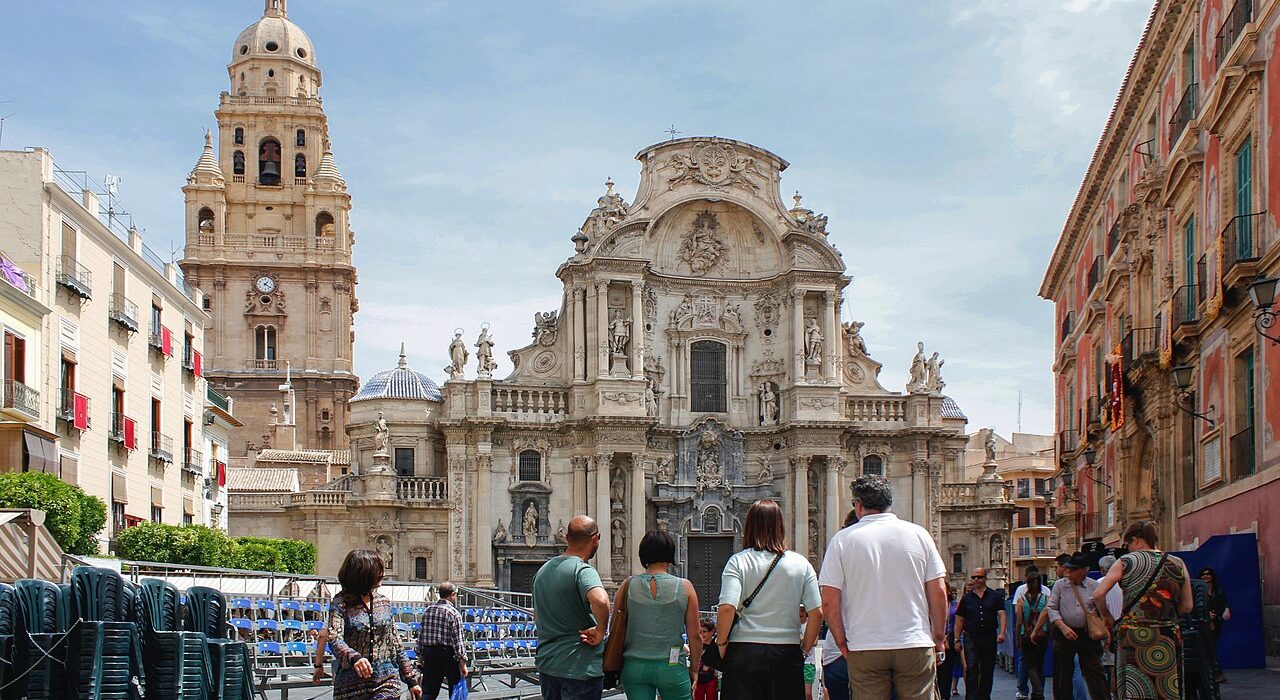
Murcia Cathedral
The Cathedral of Santa María is the monumental heart of the city and a lesson in the history of Spanish architecture packed into a single building. It combines Gothic, Renaissance and Baroque styles, with a bell tower that rises to 93 metres in height and that you can climb for the best views of the old town. It stands on Plaza del Cardenal Belluga, the favourite meeting point for locals and visitors alike. Take your time inside, where chapels from different periods sit alongside first-rate sacred art. Entry to the tower and the cathedral museum requires a ticket, so check the opening hours before you go.
Episcopal Palace of Murcia
Located next to the Cathedral, it forms part of the monumental ensemble of Plaza del Cardenal Belluga and is one of the most representative buildings of Murcia’s architectural heritage. Its façade with three reddish bands presides over the side opposite the Cathedral and remains the official residence of the Bishop of the Diocese of Cartagena. Admission is free and allows you to visit its Baroque courtyard, its imperial staircase and the chapel of perpetual adoration. It is one of the most remarkable examples of Murcian palatial architecture, fully integrated into the monumental setting of the square.
Salzillo Museum
This museum houses the work of the Baroque sculptor Francisco Salzillo, the most important artist Murcia has ever produced and one of the great names in Spanish religious sculpture. His famous Holy Week processional groups (pasos) are the great treasure of the collection: polychrome wooden figures with a realism and expressiveness that will give you goosebumps. Opening hours are 10:00 to 17:00 Monday to Saturday and 10:00 to 14:00 on Sundays. Admission is charged and worth every cent if you’re interested in Baroque art or Murcia’s Holy Week.
Real Casino de Murcia
The Real Casino is one of those places you don’t expect to find and that leave you open-mouthed. This historic building mixes architectural styles with absolute freedom: its Arab Patio looks like it was lifted straight out of the Alhambra and its Ballroom is pure 19th-century luxury. It opens from 10:30 to 19:00 and admission is charged. It’s a short but intense visit, perfect for understanding the bourgeois splendour of 19th-century Murcia.
Puente de los Peligros
Built in stone as an arch bridge between 1718 and 1742, it is the oldest surviving bridge in Murcia and one of the city’s earliest civil engineering works. It connects the historic centre with the outlying Carmen district, linking the two Murcias across the Segura river. It is also known as Puente Viejo (Old Bridge), while the name de los Peligros comes from its religious dedication. It is one of the most recognisable and photographed spots in the city, especially at sunset.
Palacio Almudí
A former historic building from the 15th century, Renaissance in style and with a colonnaded courtyard that evokes Baroque Murcia, it now serves as a municipal art centre and cultural space with exhibitions and a regular programme.
Iglesia de la Merced
The church was built near Puerta Nueva from 1560 onwards, although its current fabric corresponds mainly to Murcian Baroque, and after the 1835 exclaustration the convent passed into the hands of the University of Murcia, which preserves part of the conventual complex and the central cloister integrated into its campus.
Church of San Miguel
The parish church of San Miguel became too small in the 16th century, and the Council decided to expand it at a new location with less uneven ground, although its construction dragged on for two centuries and suffered shortages, economic depression and epidemics during the 17th century that forced the works to be halted until the early 18th century.
Church of Santo Domingo
A Baroque church in the historic centre located between Plaza Romea and Plaza de Santo Domingo, whose current building dates from the 18th century although its origins go back to a Dominican convent founded in the 13th century, and it stands out for its two façades and its Renaissance Rosary chapel.
Sanctuary of the Virgen de la Fuensanta
A Baroque-style sanctuary set on a hill with panoramic views of the city, home to the patron saint of Murcia.
Monastery of Santa Clara la Real
It combines a cloistered convent with a museum housing the remains of a 13th-century Islamic palace.
Verónicas Arab Wall
A section of Murcia’s Islamic defensive wall, one of the tallest and best-preserved stretches, with two towers, a patrol walkway and a barbican visible from the street next to the Mercado de Verónicas, with no admission fee and in the open air.
Cresta del Gallo
It is a popular destination for hiking and outdoor activities.
Teatro Romea
The city’s main theatre, a 19th-century neoclassical building with a rich history and cultural programme.
Plaza de las Flores
A lively square in the heart of the city, famous for its tapas bars and terraces surrounded by flower shops.
🍂 Otoño
Si visitas Murcia en otoño, el calor da una tregua y el ambiente se vuelve muy cómodo para caminar. Es otra época ideal para entrar al Palacio Almudí o al Real Casino de Murcia sin el agobio del verano. Lleva algo de abrigo fino por si refresca al anochecer y disfruta del Puente de los Peligros con calma.
What to do in Murcia
Murcia offers tapas hopping in the Plaza de las Flores, hiking on the Cresta del Gallo, shopping at the Mercado de Verónicas and strolls through the pedestrianised old town among Baroque palaces and historic churches. The Barrio del Carmen, on the other side of the Segura river, combines history with a vibrant modern scene full of shops, bars and restaurants, ideal for a night out. On Thursdays you can browse the Mercado de La Fama, a weekly open-air market where you’ll find clothes, footwear and other assorted goods. And if you’re after culture, the Teatro Romea keeps a steady programme all year round, while the Palacio Almudí hosts contemporary art exhibitions in a 15th-century building. For opening times, tickets and an up-to-date cultural calendar, check the official Murcia tourism website.
Murcia in a day: express itinerary
With a well-planned day you can see the essentials of Murcia on foot, since the centre is pedestrianised and distances are short. This itinerary takes you through the must-sees without rushing:
- 9:00 – Murcia Cathedral: Start at the Plaza del Cardenal Belluga and climb the 93-metre tower to get your bearings and see the city from above.
- 10:30 – Real Casino de Murcia: Go in as soon as it opens (10:30) to admire the Patio Árabe and the Ballroom before the tour groups arrive.
- 12:00 – Museo Salzillo: Spend an hour with Francisco Salzillo’s Holy Week floats, the jewel of Murcian Baroque.
- 13:30 – Plaza de las Flores: Time for tapas: order a marinera and a zarangollo on one of the terraces surrounded by flower shops.
- 16:00 – Puente de los Peligros and Barrio del Carmen: Cross the Segura river over the city’s oldest bridge and wander through this traditional neighbourhood with a local feel.
- 18:00 – Verónicas Arab Wall and Mercado de Verónicas: Finish by seeing the remains of the Islamic wall and buying some fresh produce from the Murcian market gardens.
Where to eat in Murcia: local cuisine
Where to stay in Murcia
El Barrio del Carmen
One of the oldest and most traditional neighborhoods in Murcia, blending history with a vibrant modern life, full of shops, bars, and restaurants.
El Casco Antiguo
The historic heart of Murcia, home to the impressive Santa María Cathedral and the lively Plaza Cardenal Belluga, ideal for immersing yourself in culture and history.
La Plaza de las Flores
An iconic square known for its lively atmosphere and terraces, perfect for enjoying local gastronomy and the famous Murcian tapas.
How to get to Murcia
Murcia is well connected by train, bus, plane and road. Murcia del Carmen train station has AVE and direct services to Madrid, Barcelona, Alicante and Cartagena. The bus station operates with companies such as Alsa, Interbus and Bilman Bus. Murcia Region International Airport (RMU) is 25 km from the city. By road, the main access routes are the A-7, the A-30 and the AP-7.
| Medio | Duración | Precio aprox. | Frecuencia |
|---|---|---|---|
| Tren AVE (desde Madrid) | Consultar según Renfe | Variable según anticipación | Varias al día |
| Autobús (Alsa, Interbus, Bilman Bus) | Variable según origen | Variable según destino | Consultar compañías |
| Avión (RMU) | 25 km desde el aeropuerto | Variable según aerolínea | Consultar aeropuerto |
| Coche (A-7, A-30, AP-7) | Variable según origen | Peajes y combustible | Acceso permanente |
Getting around Murcia
Murcia’s centre is pedestrianised, which makes walking the most pleasant and practical way to get between the main points of interest. For longer journeys, the city has an urban bus network and a tram, which connect the centre with outlying neighbourhoods and the metropolitan area. If you arrive by car, bear in mind that the old town has access restrictions and it’s best to leave it in peripheral car parks. For excursions to the huerta or to the Sanctuary of the Virgen de la Fuensanta, the car or public transport are the most comfortable options.
Weather in Murcia
Best time to visit Murcia
Day trips from Murcia
Murcia is an excellent base for exploring southeastern Spain. Cartagena, on the shores of the Mediterranean, is an essential excursion thanks to its Roman heritage and natural harbour. Lorca, with its castle and baroque old town, offers a deep dive into the history of the Region of Murcia. Valencia, further away but connected by AVE, makes for a day trip to Spain’s third-largest city, with its City of Arts and Sciences. All of these cities are reachable from Murcia by public transport or car.
Murcia curiosities you never knew
A university older than the printing press: Murcia’s first university was founded in 1272, when the printing press did not yet exist in Europe and classes were taught from manuscripts. That makes Murcia one of the Spanish cities with the oldest university tradition.
A name that comes from myrtles: The word “Murcia” may derive from “myrtea” or “murtea”, meaning a place where myrtles grow, a Mediterranean plant that was probably abundant in the area before the city was founded.
A founding with demolition included: The emir Abd al-Rahman II founded Murcia and, at the same time, ordered the destruction of the city of Eio, an ancient settlement that after the Muslim conquest came to be known as Tudmir. In other words, Murcia was born with the building work already underway.
A Murcian with followers in Morocco and Egypt: Al-Mursi, known as “the Murcian”, was born in the city in 1219 and is one of the leading figures of the Shadhili doctrine, with followers in countries such as Morocco and Egypt. A local thinker with international influence.
A devil with a name of his own: The book “Murcia, secretos y leyendas IV” (Murcia, Secrets and Legends IV) notes that the medieval Inquisition acknowledged the existence in the city of a Murcian devil named Xaguax. We don’t know whether he was very frightening, but at least he had a local name.
Who Murcia is for
Murcia is a city for lovers of history and architecture, with a cathedral that blends three styles, baroque palaces and remnants of the Islamic city wall. It’s also perfect for foodies, thanks to its tapas, its pastel de carne (meat pie) and its restaurants recognised by the Michelin Guide. Families will find quiet spots to stroll with children in the Barrio del Carmen and the Jardín de Floridablanca. Backpackers will appreciate the affordable prices: beds from 20 euros and average meals for less than 30 euros. And those looking for nightlife have two unmissable meeting points in the Plaza de las Flores and the Barrio del Carmen. With 578,097 travellers a year (INE) and an average stay of 1.64 nights, Murcia is a destination to be enjoyed intensely in a short time.
Frequently asked questions about Murcia
How many days do I need to see Murcia?
With 1 or 2 days you can see the essentials: the Cathedral, the Real Casino, the Salzillo Museum, the Puente de los Peligros and the Plaza de las Flores. If you want to add day trips to Cartagena, Lorca or the Santuario de la Fuensanta, plan for 3 or 4 days. The average stay is 1.64 nights according to the INE, which confirms that most travellers visit on a short break.
Is Murcia expensive?
No, Murcia is an affordable city. An average meal costs between 18 and 28 euros, a hostel bed between 20 and 35 euros per night, and a 3-star hotel between 55 and 90 euros. 4-5 star hotels range from 80 to 150 euros. Going for tapas in the Plaza de las Flores is a cheap and delicious option.
What is the best time to visit Murcia?
The best time is spring and autumn, with mild temperatures ideal for walking. The average summer temperature is 33°C, which makes July and August the worst time to explore the city on foot. In winter the average is 10°C, a moderate, pleasant chill for strolling around.
How do I get to Murcia from Madrid?
The fastest way is the AVE from Madrid to Murcia del Carmen station, with several trains a day according to Renfe. There are also buses run by Alsa and other companies from the Estación de Autobuses de Murcia. By road, the A-30 and the A-7 connect Madrid with Murcia, and Región de Murcia International Airport (RMU) is 25 km from the city.
What typical dishes should I try in Murcia?
Don’t leave without trying the pastel de carne (puff pastry filled with beef, chorizo, egg and spices), the marinera (a ring-shaped biscuit with Russian salad and anchovy), the zarangollo (scrambled courgette, onion and egg) and paparajotes (battered and fried lemon tree leaves with sugar and cinnamon). You’ll find them in tapas bars in the centre and at the Mercado de Verónicas.
🗺️ Rutas desde Murcia
- How to Get from Lorca to Murcia: Distance, Train, Bus and Car
- How to Get from Murcia to Lorca: Distance, Train, Bus and Car
- How to Get from Cartagena to Murcia: Distance, Train, Bus and Car
- How to Get from Murcia to Cartagena: Distance, Train, Bus and Car
- How to Get from Murcia to Valencia: Distance, Train, Bus & Car
- How to Get from Valencia to Murcia: Distance, Train, Bus & Car