Madrid
Comunidad de MadridClimate
Daily budget
What to See in Madrid: The Essentials
The short answer is that Madrid packs into a walk of just a few kilometers one of the world’s greatest art galleries, the largest royal palace in Western Europe, a UNESCO-listed park and a cathedral consecrated by John Paul II in 1993. Here are the stops you can’t skip.Museo Nacional del Prado
Founded in 1819, the Prado is one of the world’s greatest art galleries and the main reason many people come to Madrid. Inside, Las Meninas by Velázquez, Goya’s Black Paintings, El Greco’s The Nobleman with his Hand on his Chest and Rubens’ grand compositions await. Don’t try to see everything: prioritize the Spanish school, where this museum has no rival. Check opening hours and prices on the official Madrid tourism website, and if you can, book tickets in advance to avoid the queue at the Goya entrance.Santiago Bernabéu Stadium
Opened on December 14, 1947 as Estadio Nuevo Chamartín, it took the name Santiago Bernabéu in 1955 in honor of the president who drove its construction. It stands at Paseo de la Castellana 142, in the Chamartín district, and is one of Europe’s most visited stadiums. Even if you’re not a Real Madrid fan, the stadium tour impresses with its scale and the history that breathes in every corner. Book ahead, especially on weekends and match days.Cathedral of Santa María la Real de la Almudena
Its construction began to take shape on December 22, 1868, when the Congregation of Slaves of the Virgin of Almudena requested permission to erect a new temple after the original church was demolished during that year’s revolution. The exterior is neoclassical to harmonize with the nearby Royal Palace, while the interior is neo-Gothic with a crypt inspired by Romanesque design. It faces the Royal Palace on Plaza de la Almudena and houses the image of the Virgin of Almudena, patron saint of the city. Go down into the crypt, which many consider the best part of the complex.Royal Palace of Madrid
It is the largest royal palace in Western Europe with 3,418 rooms, and although it is the official residence of the Spanish monarchy, today it is used mainly for state ceremonies. The visit takes in state rooms, the Royal Armory and the Royal Pharmacy, among other spaces. In front of it opens Plaza de Oriente, perfect for a photo with the palace facade in the background. Buy tickets well in advance during high season.Museo Nacional Centro de Arte Reina Sofía
Here you’ll find Picasso’s Guernica, the work that justifies the visit on its own, but the museum holds the largest collection of 20th-century Spanish contemporary art. Spend time in the Dalí and Miró rooms and the Spanish Civil War holdings. It’s just a few minutes’ walk from the Prado and the Thyssen.Museo Nacional Thyssen-Bornemisza
It completes the Art Triangle with nearly 1,000 works spanning the 13th to 20th centuries, including Impressionism and Pop Art. It’s the most manageable of the three great museums in terms of size and pace. Ideal if you want to see a lot of art history without wearing yourself out.El Retiro Park
El Retiro is a UNESCO World Heritage Site within the Landscape of Light and connects easily with the Prado Museum. Stroll to the Crystal Palace, the large pond and the hidden gardens. It is the green lung of the city centre and the place where Madrilenians go to run, row or simply sit and read.Sorolla Museum
The house-museum of the painter Joaquín Sorolla, which holds the largest collection of his work. The Andalusian garden is a haven of peace right in the Chamberí district. Perfect for a short, luminous visit.Temple of Debod
A 2nd-century BC Egyptian temple donated by Egypt in 1968 and moved stone by stone; its viewpoint is a privileged spot for watching the sunset.Gran Vía
Madrid’s main commercial artery, inaugurated in 1910, with emblematic buildings such as the Metrópolis and Telefónica.Puerta de Alcalá
A neoclassical monumental gate from 1778 designed by Sabatini, one of Madrid’s most recognisable symbols.Paseo del Prado and Buen Retiro, a landscape of Arts and Sciences (Landscape of Light)
It can be explored on foot free of charge; the museums within it have their own opening hours and rates, with options for advance booking.Palacio de Cibeles
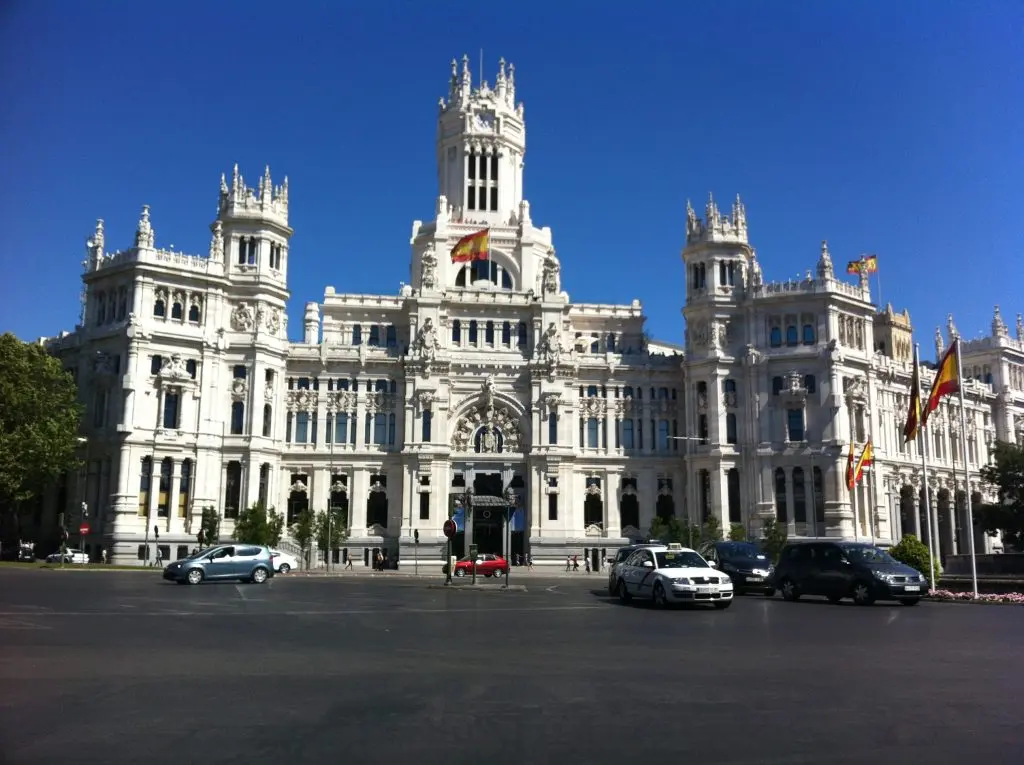
The former Palace of Communications from 1919 and current seat of the City Council; its viewpoint offers 360° views of Madrid.El Rastro Market
Admission is free and open to all, with the usual schedule of 9:00 to 15:00 on Sundays and public holidays.San Miguel Market
A gastronomic market with an iron structure from 1916 next to Plaza Mayor, with more than 30 gourmet stalls.Plaza Mayor
A 17th-century arcaded square with a rectangular layout, featuring the Casa de la Panadería and the equestrian statue of Philip III.Plaza de España
Renovated in 2021, with the monument to Cervantes and views of the Temple of Debod and the Torre de Madrid.Teatro Real
Spain’s leading opera house, inaugurated in 1850, facing the Plaza de Oriente and the Royal Palace.Almudena Cathedral
A neo-Gothic cathedral consecrated in 1993 by John Paul II, next to the Royal Palace, with a neo-Romanesque crypt from 1911.🍂 Otoño
Si visitas Madrid en otoño, el clima vuelve a ser templado y muy cómodo para caminar, otra de las mejores épocas del año. Puedes disfrutar del Museo Nacional Thyssen-Bornemisza o de la Catedral de Santa María la Real de la Almudena con menos turistas. Lleva un paraguas plegable por si llueve algún día suelto.
What to do in Madrid
Madrid offers music, magic, circus and food festivals throughout the year, as well as street markets and a neighbourhood life that ranges from the luxury of Salamanca to the bohemian spirit of Malasaña. In summer, the Veranos de la Villa fill parks and public spaces with concerts and theatre. The Madrid International Magic Festival and the Ibero-American Circus Festival bring unique stage productions. If you come in winter, Inverfest programmes music in venues and theatres. Foodies have a date with Madrid Fusión, and music lovers with Tomavistas or the Noches del Botánico festival, which blends pop, rock, jazz, fusion, flamenco and alternative music outdoors. On Sundays, El Rastro turns the La Latina neighbourhood into a maze of stalls selling all kinds of objects, and any afternoon invites you to enjoy tapas at the San Miguel Market.Madrid in a day: express itinerary
If you only have one day, this walking route gives you the essence of Madrid without rushing too much:- 9:00 – Puerta del Sol and Plaza Mayor: start at kilometre zero and have churros or toast for breakfast before crossing the 17th-century arcaded square with the equestrian statue of Philip III.
- 10:30 – Royal Palace and Almudena Cathedral: visit the largest royal palace in Western Europe with 3,418 rooms and take a look at the cathedral consecrated in 1993.
- 13:00 – San Miguel Market: an early tapas stop in the 1916 iron market with more than 30 gourmet stalls; order a glass of vermouth and something to nibble on.
- 15:00 – Prado Museum: spend two hours with Velázquez, Goya and El Greco in one of the world’s greatest art galleries, founded in 1819.
- 18:30 – El Retiro and Temple of Debod: stroll through the UNESCO World Heritage park and finish by watching the sunset from the viewpoint of the Egyptian temple.
Where to eat in Madrid: local cuisine
Where to sleep in Madrid
Sol and Los Austrias
The historic and bustling heart of the city, filled with monuments and shops.
Malasaña
An alternative and bohemian neighborhood, epicenter of the 'Movida Madrileña' with vibrant nightlife.
Salamanca
A luxury district featuring haute couture boutiques, elegant restaurants, and stately architecture.
How to get to Madrid
From Barcelona, the fastest option is the train: 3 h 01 min (AVE), 35 a day.
Sol (0,1 km from the centre)
| From | Direct train | Direct bus | Car |
|---|---|---|---|
| Barcelona | 3 h 01 min · 35/day AVE | 7 h 25 min · 12/day ALSA | 6 h 52 min 617 km |
| Córdoba | 1 h 54 min · 47/day AVE | — | 4 h 31 min 394 km |
| Valladolid | 54 min · 58/day AVE | 2 h 15 min · 15/day ALSA | 2 h 34 min 190 km |
| Alcalá de Henares | 10 min · 87/day Regional | 28 min · 301/day ALSA, Samar | 35 min 33 km |
| Toledo | 34 min · 16/day AVANT | 50 min · 119/day ALSA, Samar | 59 min 73 km |
| Guadalajara | 36 min · 76/day AVE | 45 min · 79/day ALSA, Samar | 47 min 57 km |
| Segovia | 25 min · 54/day AVE | 1 h La Sepulvedana | 1 h 15 min 91 km |
| Zaragoza | 1 h 46 min · 24/day AVE | 3 h 45 min · 14/day ALSA | 3 h 35 min 311 km |
| León | 1 h 56 min · 17/day AVE | 3 h 30 min · 14/day ALSA | 3 h 53 min 338 km |
| Sevilla | 2 h 36 min · 30/day AVE | — | 5 h 52 min 535 km |
Direct trains and buses from the official timetables published by the operators on Spain's National Transport Access Point (a reference Wednesday); driving times from OpenStreetMap. Operators that do not publish their timetables may run more services. Check the timetable before you travel.
Getting around Madrid
Central Madrid is eminently walkable, and many of the main attractions can be covered on foot. For longer distances, the metro and city buses cover the whole city efficiently. The metro is the fastest option for crossing from one neighbourhood to another, while the bus lets you see the city as you travel. If you’re staying in Sol, Malasaña or Los Austrias, you’ll probably only use public transport to get to the Bernabéu or the airport.Weather in Madrid
Best time to visit Madrid
Day trips from Madrid
Although there are many day-trip options from Madrid, the available data mentions Palma de Mallorca, Ibiza and Menorca as nearby destinations in the sense of quick air escapes from Madrid. Palma offers a compact historic centre and a seafront cathedral; Ibiza combines beaches, coves and a legendary nightlife; Menorca is the quietest option, with protected landscapes and a slow pace. All three can be reached on direct flights from Madrid-Barajas and work well as two- or three-day getaways, not as same-day round trips.Madrid curiosities you didn’t know
Madrid’s first public lighting was introduced by Philip II, and on 15 October 1765 a system was inaugurated with 4,408 cotton lamps soaked in oil, tended by 100 lamplighters. Imagine the city lit by lamplighters who walked the streets lighting each lamp one by one. In Madrid’s Plaza Mayor, 359 executions took place between 1642 and 1809, carried out by garrote or on the gallows. Today that same space is full of terraces and tourists, but its ground has witnessed centuries of dark stories. On 17 October 1919, Alfonso XIII inaugurated Madrid’s first metro line, and it was decided that trains would run on the left, as carriages did. That’s why the Madrid metro runs on the left, a quirk that puzzles many visitors. Madrid has a Statue of Liberty created by the Aragonese sculptor Ponciano Ponzano in 1853, some twenty years before Frédéric Auguste Bartholdi’s. It isn’t as big as the New York one, but it came first. The name Madrid comes from Arabic, according to most experts, and is believed to derive from the word Mayra, meaning water conduits or channels; the term Mayrit translates as mother stream. Luis Candelas, born in the early 19th century in the Lavapiés neighbourhood, went down in history for stealing jewels from wealthy families and sharing them among the poorest; he was executed by garrote in the centre of Madrid. The clock of the Puerta del Sol, which announces the chimes at New Year, was a gift from the clockmaker Losada, who took three years to make it in London and was installed in the Casa de Correos in 1866. In 1835 Madrid’s first covered market was built, the one in the plaza de San Ildefonso, a direct forerunner of the food markets that fill the city today.Who Madrid is for
Madrid works for almost every type of traveller. Couples will find sunsets at the Templo de Debod, dinners in Malasaña and strolls through El Retiro. Families will appreciate the range of museums, the park and quiet neighbourhoods like Salamanca. Backpackers have hostels from €25 a night and a metro network that connects everything. History lovers can spend days between the Prado, the Royal Palace and the streets of the Austrias. And foodies have everything from calamari sandwiches for €3-5 to a three-star restaurant like DiverXO. Madrid doesn’t demand a specific profile: it demands a willingness to walk, eat and let yourself be surprised.💡 ¿Sabías que...?
- ● El primer alumbrado público de Madrid lo impuso Felipe II, y el 15 de octubre de 1765 se inauguró un sistema con 4.408 faroles de algodón empapados en aceite, atendidos por 100 faroleros. (https://www.abc.es/madrid/tops/20141125/abci-curiosidades-diccionario-madrid-201411242109_1.html)
- ● En la Plaza Mayor de Madrid se celebraron 359 ejecuciones entre 1642 y 1809, efectuadas a garrote vil o en la horca. (https://www.timeout.es/madrid/es/que-hacer/madrid-misterios-secretos-leyendas)
- ● El 17 de octubre de 1919, Alfonso XIII inauguró la primera línea de metro de Madrid, en la que se decidió que los trenes circularan por la izquierda como lo hacían los carruajes. (https://www.elconfidencial.com/viajes/2021-05-12/10-secretos-de-madrid-que-probablemente-no-conoces_3072931/)
- ● Madrid tiene una estatua de la Libertad creada por el escultor aragonés Ponciano Ponzano en 1853, unos veinte años antes que la de Frédéric Auguste Bartholdi. (https://www.miradormadrid.com/curiosidades-de-madrid/)
- ● El nombre de Madrid procede del árabe, según la mayoría de los expertos, y se cree que deriva de la palabra Mayra, que significa conducciones o canalizaciones de agua; el término Mayrit se traduce como arroyo matriz. (https://supercurioso.com/curiosidades-de-madrid/)
- ● Luis Candelas, nacido a principios del siglo XIX en el barrio de Lavapiés, pasó a la historia por robar joyas a familias adineradas y repartirlas entre los más pobres; fue ejecutado a garrote vil en el centro de Madrid. (https://www.elconfidencial.com/viajes/2021-05-12/10-secretos-de-madrid-que-probablemente-no-conoces_3072931/)
- ● El reloj de la Puerta del Sol, que anuncia las campanadas de fin de año, fue un regalo del relojero Losada, quien tardó tres años en fabricarlo en Londres y se colocó en la Casa de Correos en 1866. (https://www.miradormadrid.com/curiosidades-de-madrid/)
- ● En 1835 se construyó en Madrid el primer mercado cubierto, el de la plaza de San Ildefonso. (https://www.abc.es/madrid/tops/20141125/abci-curiosidades-diccionario-madrid-201411242109_1.html)
Frequently asked questions about Madrid
How many days do I need to see Madrid?
With 3 days you can see the essentials: one day for the Art Triangle (Prado, Reina Sofía and Thyssen), another for the Royal Palace, Almudena, Plaza Mayor and Sol, and a third for El Retiro, the Templo de Debod and the Bernabéu. If you want to add markets, neighbourhoods and nightlife, 5 days give you much more room.
Is Madrid expensive?
It depends on your plan. An average meal costs between €15 and €30, a hostel between €25 and €40 a night, and a 3-star hotel between €100 and €180. Public transport is affordable and many attractions such as El Retiro, the Paseo del Prado or the Templo de Debod are free. Madrid can be expensive if you’re looking for 4-5 star hotels (€200-450/night) or Michelin-starred restaurants.
What is the best time to visit Madrid?
Spring and autumn are the best seasons, with pleasant average temperatures. In summer the average is 25 °C, but the intense heat can make outdoor sightseeing uncomfortable. In winter the average drops to 6 °C, with cold but sunny days.
How do I get to Madrid from other cities?
Madrid is connected by AVE from Barcelona, Seville, Valencia, Málaga and Zaragoza, with departures from Madrid-Puerta de Atocha station. Adolfo Suárez Madrid-Barajas Airport (MAD) is 15 km away and receives domestic and international flights. The Estación Sur de Autobuses (Méndez Álvaro) operates with Alsa, Avanza and Socibus. By road, the A-1, A-2, A-3, A-4, A-5 and A-6 motorways connect with the entire peninsula.
Is Madrid a walkable city?
Yes, the centre is largely pedestrianised and many of the main attractions are within easy walking distance. For longer distances, the metro and city buses cover the whole city efficiently. If you stay in Sol, Malasaña or Los Austrias, you’ll probably only use public transport to get to the Bernabéu or the airport.
🗺️ Rutas desde Madrid
- How to Get from Madrid to San Sebastián: Distance, Train, Bus and Car
- How to Get from Granada to Madrid: Distance, Train, Bus and Car
- How to Get from Madrid to Guadalajara: Distance, Train, Bus and Car
- How to Get from Guadalajara to Madrid: Distance, Train, Bus and Car
- How to Get from Santiago de Compostela to Madrid: Distance, Train, Bus and Car
- How to Get from Madrid to Santiago de Compostela: Distance, Train, Bus and Car
- How to Get from León to Madrid: Distance, Train, Bus and Car
- How to Get from Madrid to León: Distance, Train, Bus and Car