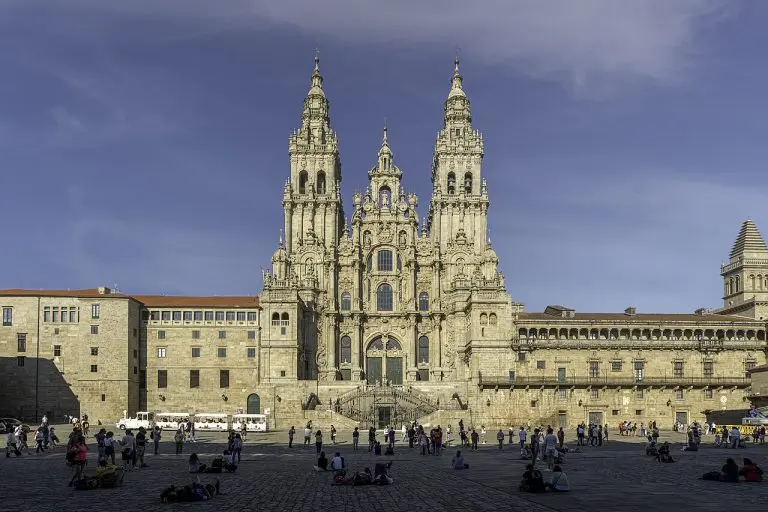
Madrid → Santiago de Compostela
615 kmCrossing half of Spain from the heart of the Meseta to the Atlantic mist of Galicia is one of those journeys that changes its skin every hundred kilometres: oak groves and dehesas (open woodlands), the mountains of León, the vineyards of El Bierzo and, at the end, the unmistakable green of Santiago de Compostela. The 615 km route can be done in just over an hour by air or in a leisurely morning by road, and either way it’s worth lifting your eyes from the asphalt or the window.
How to get from Madrid to Santiago de Compostela: quick summary
There are four direct ways to cover the 615 km separating Madrid from Santiago de Compostela: car (6h 15min via motorway), AVE train (182 min on the fastest option), bus (470 min) and plane (75 min flight). For those seeking pure efficiency, the AVE is unbeatable: 11 daily trains link Madrid-Chamartín with Santiago in just over three hours. If you prefer freedom of schedules and gastronomic stops, driving via the A-6 and A-54 is the most flexible option. The plane makes sense if you book in advance and value arriving after a 75-minute flight, while the bus is the classic budget alternative, with prices from €13.
Driving from Madrid to Santiago de Compostela
The drive covers 615 km and takes around 6 hours and 15 minutes, almost entirely on motorway and with a single toll section on the AP-6. The main route leaves Madrid via the A-6 (Autovía del Noroeste), which covers some 416 km toll-free before heading into Castile and León. On the Guadarrama pass section you use the AP-6, the toll motorway that eases the mountain crossing for about 70 km. After that you rejoin the A-6 heading northwest. Once in Galicia, the A-54 (Santiago-Lugo motorway) takes over for about 64 km toll-free, and the final stretch is completed via the N-547, the road linking Lugo with Santiago de Compostela over some 31 km. It’s a comfortable route, with frequent service areas on the A-6 and landscapes that grow greener as you approach Galicia.
By train from Madrid to Santiago de Compostela
Renfe operates 11 direct trains a day between Madrid-Chamartín-Clara Campoamor and Santiago de Compostela-Daniel Castelao, with departures from 06:30 to 20:23. The fastest option is the AVE or AVLO, which complete the journey in 182 minutes; the ALVIA, with a slightly different route, takes 224 minutes. According to Renfe data, there are 4 AVLO trains a day, 6 AVE and 1 ALVIA. Prices vary depending on how far in advance you book and the type of train, but AVLO tends to be the cheapest high-speed option. The departure station in Madrid is Chamartín-Clara Campoamor, well connected to the rest of the city by metro and Cercanías, and arrival is at Santiago de Compostela-Daniel Castelao station, a short distance from the historic centre.
By bus from Madrid to Santiago de Compostela
ALSA and FlixBus cover the direct route between Madrid and Santiago de Compostela with a duration of 470 minutes (7 hours and 50 minutes). The price range is wide, between €13 and €121, depending on how far in advance you book, the type of seat and the season. It’s the cheapest option if booked early, although the journey is considerably longer than by train or plane. Buses usually depart from Madrid’s Estación Sur and arrive at Santiago’s bus station, very close to the centre.
By plane from Madrid to Santiago de Compostela
There are daily direct flights between Adolfo Suárez Madrid-Barajas Airport (MAD) and Santiago de Compostela Airport (SCQ), operated by Iberia, Iberia Express, Ryanair, Vueling and Wizz Air. The average flight time is 75 minutes, typically ranging from 1h 15min to 1h 37min depending on the airline and conditions. Around 3 flights a day are recorded, although Iberia Express operates between 2 and 4 daily flights and Ryanair maintains 1 daily flight. Typical prices range from €34 to €118, with occasional deals from €23-24. It’s a quick alternative if you add check-in and airport transfer time, but it’s worth comparing with the AVE, which avoids airport transfers.
Recommended stops along the way
The road route allows a slight detour to towns with plenty of character, especially if you take the journey at a leisurely pace. These are the verified stops along the way:
Viseu
A city in north-central Portugal, known for its well-preserved historic centre and its granite cathedral. It’s a pleasant stop for an unhurried stroll and a coffee in one of its arcaded squares.
Braga
One of Portugal’s oldest cities, with a lively historic centre and remarkable religious heritage. Its university atmosphere and cuisine make it a comfortable stopover before heading north.
Vila Real
A Portuguese city in the Trás-os-Montes region, surrounded by mountain landscapes and vineyards. It’s a quiet stop to stretch your legs and discover the area’s traditional architecture.
Bragança
A town in northeastern Portugal, with a well-preserved medieval castle and a walled old town. Its unhurried atmosphere and proximity to the border with Zamora make it a strategic stop on alternative routes.
Lamego
A Portuguese city in the Douro valley, famous for its baroque sanctuary and monumental staircase. It’s a stop with photogenic views and corners, ideal for a brief break along the way.
Mangualde
A small town in the district of Viseu, surrounded by forests and farmland. It’s a discreet, uncrowded stop to rest in a rural setting.
Tondela
A Portuguese municipality located between the Caramulo mountains and the Dão river. Its natural surroundings and calm make it suitable for a short pause before continuing the route.
Where to stay in Santiago de Compostela
The best area to stay is the historic centre, around the Cathedral and the Praza do Obradoiro (Obradoiro Square), where tourist and culinary life is concentrated. It’s the most atmospheric option, although prices tend to be higher and car access can be tricky due to the pedestrian streets. El Ensanche, just south of the old town, offers hotels and tourist apartments with better value for money and easier access. For tighter budgets, pilgrim hostels and guesthouses near the train station are a practical alternative. Price ranges vary greatly depending on the season: in summer and on key dates along the Camino, demand sends rates soaring, while in winter you can find double rooms at moderate prices.
Where to eat along the route
The journey from Madrid to Santiago is a tour through some of Spain’s heartiest and most recognisable cuisines. Around Segovia, roast suckling pig (cochinillo asado) is an almost obligatory stop: a piglet slow-roasted in a wood-fired oven, with crackling skin and tender meat, served with salad and potatoes. Nearby, in La Granja de San Ildefonso, judiones de La Granja is a stew of large white beans with chorizo, morcilla, pork belly and pig’s ear, perfect for refuelling in the cold months. Heading into the Leonese region of El Bierzo, botillo del Bierzo marks the change of scenery: a cured and smoked pork sausage, stuffed with rib and tail, boiled with potatoes and greens and served hot and shredded.
Once in Galicia, pulpo a la gallega is the signature dish: boiled octopus sliced into rounds, served with boiled potatoes, paprika, coarse salt and olive oil. Empanada gallega, with its bread dough filled with tuna, onion, pepper and tomato, works as a tapa or a main course in any bar. And to finish, tarta de Santiago, made with ground almonds, eggs and sugar, with no flour and decorated with the cross of Saint James, is the most typical sweet along the Camino. As for wines, the route crosses first-class wine regions: Ribera del Duero in Castile and León, a Tempranillo red aged in barrel; El Bierzo, a Mencía red with fruity aromas and good acidity; and Ribeiro in Galicia, a young, fruity white ideal for seafood and fish.
Frequently asked questions about the Madrid-Santiago de Compostela route
How long does it take to get from Madrid to Santiago de Compostela?
It depends on the mode of transport: by car it’s 6 hours and 15 minutes for the 615 km by road; by AVE or AVLO train, 182 minutes; by ALVIA, 224 minutes; by bus, 470 minutes; and by plane, 75 minutes in the air, plus check-in and transfer times to the airports.
Which is cheaper, the train or the bus?
The bus is generally cheaper, with prices between 13€ and 121€ depending on ALSA and FlixBus. The train has a more variable range: AVLO tends to be the most economical high-speed option, but AVE prices can far exceed bus fares if you book at short notice. For tight budgets, the bus is the most predictable option.
Is it worth renting a car?
Yes, if you want to make food stops and visit places like Segovia, El Bierzo or the Portuguese stops on the list. A car offers total freedom and the route along the A-6, AP-6, A-54 and N-547 is comfortable. If your priority is arriving quickly and you’re not interested in the stops, the AVE is a better option: 182 minutes versus 6h 15min of driving.
When is the best time to travel?
Spring and autumn are the best seasons: mild temperatures, fewer crowds than in summer and particularly beautiful landscapes in Galicia. Summer brings the largest influx of pilgrims and tourists to Santiago, with higher accommodation prices. Winter is quiet and affordable, although the mountain stretch on the AP-6 can be tricky due to snow or ice.
💡 ¿Sabías que...?
- ● La ciudad antigua de Santiago de Compostela es Patrimonio de la Humanidad por la Unesco desde 1985 y es uno de los tres grandes núcleos de peregrinación del cristianismo, junto con Jerusalén y Roma. (https://es.wikipedia.org/wiki/Santiago_de_Compostela_(La_Coru%C3%B1a))
- ● Santiago de Compostela fue fundada en el siglo IX, es la capital de Galicia y sede de la Junta de Galicia y el Parlamento, con 100 965 habitantes en 2025. (https://es.wikipedia.org/wiki/Santiago_de_Compostela_(La_Coru%C3%B1a))
- ● Los peregrinos medievales que llegaban por mar a Galicia tenían casi como único destino el puerto de A Coruña, y desde allí continuaban a Santiago por tierra, apenas 75 km, dando lugar al Camino Inglés. (https://www.visitcoruna.com/descarga/1453803946891/CaminoIngles_2019_ESP.pdf)
- ● En el siglo IX, el rumor de la tumba del apóstol Santiago llegó a los vikingos, que se hicieron a la mar para conquistar Jakobsland hasta cinco veces a lo largo de cuatro siglos. (https://sge.org/publicaciones/articulos/vikingos-compostela/)
📍 También te puede interesar
Qué ver en Madrid →
Qué ver en Santiago de Compostela →