Cartagena
Región de MurciaClimate
What to see in Cartagena: the must-sees
Roman Theatre Museum (Museo del Teatro Romano)
This is the beating heart of local history, a museum complex that protects one of the most important archaeological discoveries in Spain, dating from the 1st century BC. What you really need to highlight is how the modern building integrates with the ruins, allowing you to see the cavea and the stage from different perspectives while learning about their original use. It is essential to book tickets in advance, especially in high season, to enjoy this journey into the past without rushing.Casa de la Fortuna (House of Fortune)
Located in the heart of the archaeological site, this Roman domus offers you an intimate glimpse into how wealthy families lived in ancient Carthago Nova. Its impressive mosaic of Fortuna, which gives the house its name, and the water channeling system that still survives are particularly noteworthy. It is a must-stop to understand daily life beyond the great public monuments.Pilón de los Burros (Donkeys’ Drinking Trough)
This unique monument is a historic fountain that served for centuries as a water supply point for the city’s pack animals. Its stone structure and its location in a quiet square make it a perfect spot to capture an authentic photo away from the crowds. It is a silent testimony to the hardworking life of old Cartagena.Icue
This cultural space is a modern gem that contrasts with the antiquity of its surroundings, serving as an interpretation center and a civic meeting point. Inside, you can find temporary exhibitions and activities that connect local heritage with contemporary creation. It is the ideal place to take a cultural breather and understand the urban evolution of the area.Batería de Santa Ana Complementaria (Complementary Battery of Santa Ana)
Although listed as a palace in some records, this defensive structure offers a unique perspective on the strategic military importance of the port over the centuries. It stands out for its privileged views over the bay and the solidity of its architecture, designed to withstand the passage of time and the battering of the sea. Visiting it will help you understand why this enclave was so coveted by different empires.Other points of interest
- The Batería de San Isidoro y Santa Florentina (Battery of San Isidoro and Santa Florentina) is another example of the defensive architecture that protects the city.
- In the Artillery Museum (Museo de Artillería) you can learn about the weaponry that defended the stronghold.
- The Naval Museum (Museo Naval) is essential for seeing the Peral submarine and understanding maritime history.
- The Augusteum completes the route of Roman public buildings with its archaeological remains.
- The monument to Christopher Columbus pays homage to the admiral in a central square.
- El Molinete is an archaeological park that combines nature and history on a hill.
- The Coat of Arms of Cartagena is a monumental detail that represents the city’s identity.
- The Monument to the Processionist captures the essence of the famous local Holy Week.
- The statue of San Fulgencio recalls the city’s patron saint in a prominent location.
- The monument to Alfonso Torres honors a relevant figure in local history.
- Antonio Ramos Carratalá has his own monument dedicated to his memory.
- The Chronicler Isidoro Valverde is remembered for his work documenting Cartagena’s history.
- The statue of Charles III presides over an important area of the city.
- Antonio Álvarez Alonso has a monument in his honor.
- The Pied Piper of Hamelin is a curious sculpture that appeals especially to children.
🍂 Otoño
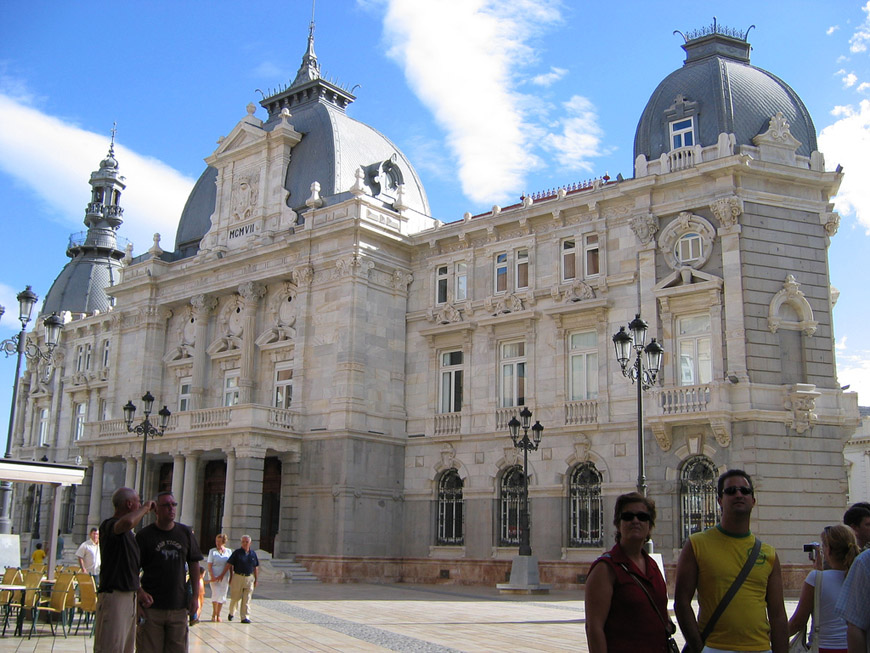
Si visitas Cartagena en otoño, disfrutarás de temperaturas templadas y menos aglomeraciones, perfectas para descubrir la Casa Consistorial y la Plaza del Ayuntamiento con calma. El clima sigue siendo suave, así que puedes combinar cultura y paseos sin problema. Lleva un paraguas por si acaso y un jersey fino para las noches junto al mar.
What to do in Cartagena
Cartagena offers specific activities ranging from immersing yourself in epic historical reenactments to enjoying world-class music festivals. If you visit in September, you can’t miss the Fiestas de Carthagineses y Romanos (Carthaginians and Romans Festival), a grand reenactment of the Second Punic War with parades and mock battles commemorating the conquest by Scipio Africanus. For culture lovers, La Mar de Músicas in July turns the city into a grand stage with concerts and cinema, while in November the Cartagena Jazz Festival brings major international figures to town. Additionally, exploring neighborhoods like the Casco Antiguo (Old Town) or Santa Lucía will let you feel the vibrant pulse of bars and restaurants, or enjoy a more authentic and traditional atmosphere near the port.Cartagena in a day: express itinerary
If you’re short on time, this plan will let you see the essentials without rushing too much, taking advantage of the compactness of the historic center:- 10:00 AM – Roman Theatre Museum: Start the day with energy by visiting the most important archaeological site; at this hour the light is perfect for photos and there are fewer people.
- 12:00 PM – Casa de la Fortuna: Just a few steps from the theatre, immerse yourself in Roman domestic life and observe the details of the mosaics.
- 14:00 PM – Lunch in the Old Town: Set aside two hours to eat something typical in the historic heart, surrounded by modernist buildings.
- 16:30 PM – Naval Museum: After lunch, visit the museum to see the Peral submarine and understand the strategic importance of the port.
- 19:00 PM – Stroll through the Ensanche: End the day walking through this 19th-century commercial district to see the modernist architecture and buy a souvenir.
Where to eat in Cartagena: local gastronomy
Where to stay in Cartagena
Casco Antiguo
El corazón histórico y monumental de Cartagena. Aquí se concentran la mayoría de los restos romanos, museos y edificios modernistas, con un ambiente vibrante de bares y restaurantes.
Barrio del Foro Romano
Una zona específica dentro del Casco Antiguo, centrada en el gran yacimiento arqueológico del Foro Romano. Es ideal para los apasionados por la historia que quieren sumergirse en el pasado de la ciudad.
El Ensanche
La expansión de la ciudad del siglo XIX, caracterizada por su arquitectura modernista y una planificación urbana más ordenada. Es una zona más comercial y residencial, perfecta para ir de compras y sentir el pulso diario de la ciudad.
Barrio de Santa Lucía
Antiguo barrio de pescadores situado junto al puerto, con un carácter más tradicional y popular. Ofrece una visión más auténtica de la vida local, con excelentes restaurantes de pescado fresco.
Cala Cortina
Aunque no es un barrio residencial, es la playa más cercana y accesible desde el centro de la ciudad. Es una zona muy popular para un día de playa, con aguas tranquilas y varios restaurantes.
Barrio de la Concepción
Conocido popularmente como 'El Monte', es uno de los barrios más antiguos, situado en una de las cinco colinas de la ciudad. Ofrece vistas espectaculares y un ambiente tranquilo, alejado del bullicio turístico principal.
How to get to Cartagena
The city is well connected by land, although it’s important to know that the train station does not have AVE services. The best option is usually the bus if you’re coming from other major cities, arriving directly at the Cartagena Bus Station.| Medio | Duración | Precio aprox. | Frecuencia |
|---|---|---|---|
| Tren | Variable según origen | Variable | Diaria (Estación Cartagena, sin AVE) |
| Autobús | Variable según origen | Económico | Frecuente (Estación de Autobuses) |
| Coche | Depende de la ruta | Combustible + Peajes | N/A |
How to get around Cartagena
Once in the city, the best way to explore the historic center is on foot, since most of the main attractions are very close to each other. For longer distances or to reach neighborhoods like La Concepción or Cala Cortina, you can use the city bus, which efficiently covers the main routes.Weather in Cartagena
Best time to visit Cartagena
Day trips from Cartagena
If you want to get out of the city, the closest and most logical option is to visit Murcia, the capital of the region. Located a short distance away, it offers an interesting contrast with its own cathedral, squares, and university atmosphere, making it perfect for a day trip to complement your visit to the coast.Things you didn’t know about Cartagena
Did you know that this city is one of the oldest in Spain and the western Mediterranean? It was founded around 227 BC by Hasdrubal the Fair under the name Qart Hadasht, long before the arrival of the Romans. Another surprising fact is that Isaac Peral, a native of Cartagena, invented the first torpedo submarine in history, the ‘Peral’, launched in 1888. Its design was revolutionary for its time, and you can visit the original at the city’s Naval Museum. The Roman Theatre (Teatro Romano), which dates back to the 1st century BC, remained hidden for centuries beneath other buildings until its discovery. Today it is a museum complex open to the public and one of the most important archaeological finds in the country. Cartagena’s Holy Week (Semana Santa) is declared of International Tourist Interest and is characterized by the military discipline of its processions. It is unique for the artistic richness of its floats and the attire of its brotherhoods, unfolding with great solemnity in the early morning and at night. Geographically, Cartagena boasts one of the largest and best-protected natural harbors in the Mediterranean. This feature has given it crucial military and commercial strategic importance throughout history. In addition, the city preserves remains of the Punic Wall (Muralla Púnica) from the 3rd century BC, one of the few examples of Carthaginian military architecture still standing on the Iberian Peninsula. Finally, La Manga del Mar Menor, which partly belongs to Cartagena, is a natural formation that encloses the largest saltwater lagoon in Europe, a unique ecosystem in the world.Who Cartagena is for
Cartagena is a versatile destination that fits perfectly for history lovers, thanks to its 311,878 annual travelers (INE) seeking Roman remains and museums. It is ideal for families who want to combine culture with beach days at Cala Cortina, and for foodies who want to try the authentic caldero (traditional fish and rice stew). Backpackers will find a welcome in neighborhoods like La Concepción, while couples will enjoy the romance of the Roman Forum Quarter (Barrio del Foro Romano).💡 ¿Sabías que...?
- ● Cartagena fue fundada alrededor del año 227 a.C. por Asdrúbal el Bello, con el nombre de Qart Hadasht. Es considerada una de las ciudades más antiguas de España y del Mediterráneo occidental. (Historia Antigua, Arqueología)
- ● Isaac Peral, natural de Cartagena, inventó el primer submarino torpedero de la historia, el 'Peral', botado en 1888. Su diseño fue revolucionario para la época y se puede visitar el original en el Museo Naval de Cartagena. (Museo Naval de Cartagena, Historia de la Ciencia)
- ● El Teatro Romano de Cartagena, que data del siglo I a.C., es uno de los descubrimientos arqueológicos más importantes de España. Permaneció oculto durante siglos bajo otras edificaciones y hoy es un complejo museístico accesible al público. (Museo del Teatro Romano de Cartagena, Arqueología)
- ● La Semana Santa de Cartagena está declarada de Interés Turístico Internacional. Se caracteriza por la disciplina militar de sus procesiones, la riqueza artística de sus tronos y la vestimenta única de sus cofradías. (Ministerio de Turismo de España, Cultura)
- ● Cartagena posee uno de los puertos naturales más grandes y mejor protegidos del Mediterráneo. Esta característica geográfica le ha conferido una importancia estratégica militar y comercial a lo largo de la historia. (Geografía, Historia)
- ● La ciudad conserva vestigios de la Muralla Púnica, construida en el siglo III a.C. Es uno de los pocos ejemplos de arquitectura militar cartaginesa que aún se conservan en la península ibérica. (Arqueología, Patrimonio Histórico)
- ● La Manga del Mar Menor, que en parte pertenece a Cartagena, es una formación natural que encierra el Mar Menor, la laguna salada más grande de Europa. (Geografía, Ecología)
Frequently asked questions about Cartagena
How many days do I need to see Cartagena?
With an average stay of 3.07 nights according to tourism data, you have enough time to see the Roman Theatre, the Naval Museum, and enjoy the local cuisine at a relaxed pace.
What is the best time of year to visit Cartagena?
The best time is from March to November, when the average summer temperature is 25.7°C and you can enjoy events such as La Mar de Músicas (Sea of Music festival) or the Fiestas de Carthagineses y Romanos (Carthaginians and Romans Festival).
How do I get to Cartagena from Madrid?
You can arrive by train at Estación de Cartagena (Cartagena Station) (keep in mind there is no direct AVE to the city, it sometimes requires a connection) or by bus to Estación de Autobuses de Cartagena (Cartagena Bus Station), the latter being a very common option.
What typical dish should I not miss?
Caldero is the signature dish, a dry rice with fish from the Mediterranean and the Mar Menor, although salted fish and dried broad bean stews are also highly recommended.