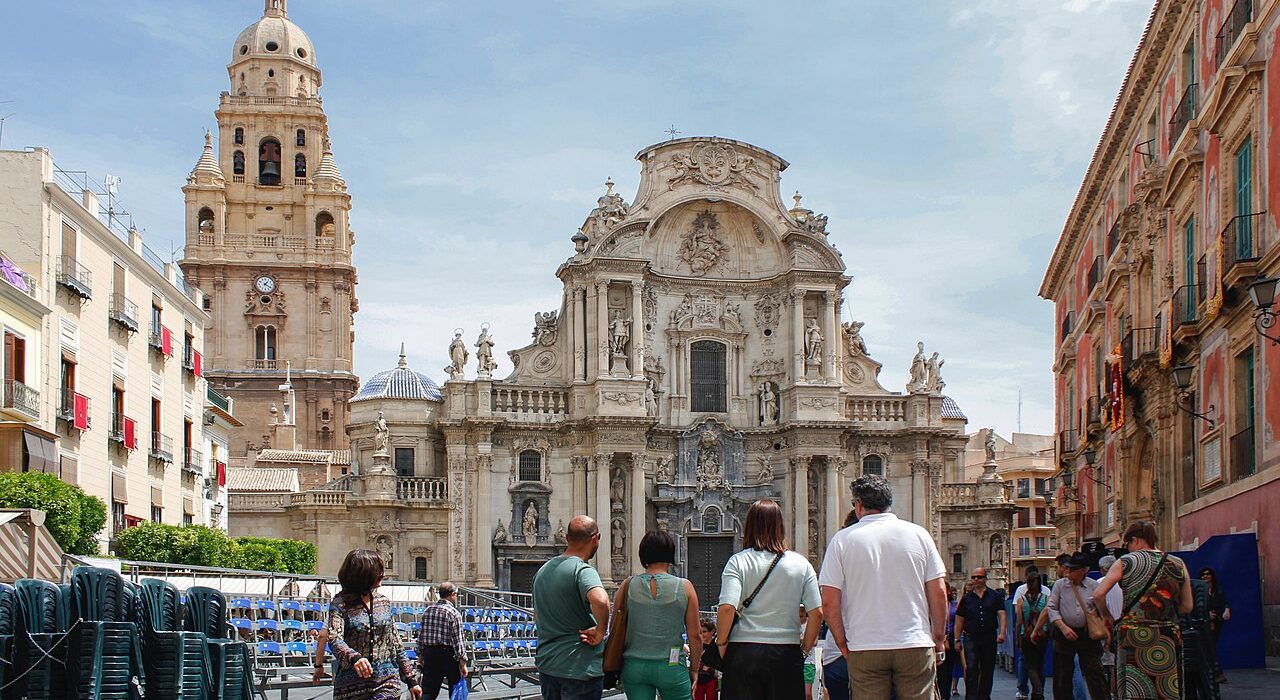
Cartagena → Murcia
48 kmCrossing the region of Murcia from coast to interior is one of those experiences that challenge your perception of time, where the Mediterranean landscape slides past the window at a speed that barely gives you time to blink before you arrive. This journey is not just a geographical movement of 48 kilometers; it is the vital bridge connecting the historic port and naval city with the administrative capital, linking two worlds that, although close, breathe at slightly different rhythms. Whether you seek the absolute freedom of the open road or the comfort of letting someone else drive, the connection between these two cities is so seamless that it becomes the easiest part of your trip.
How to get from Cartagena to Murcia: quick overview
The fastest option for traveling from Cartagena to Murcia is by car, covering the distance in 35 minutes, although the train offers a comfortable and direct alternative with 15 daily departures. For the traveler who prioritizes flexibility and wants to avoid fixed schedules, a private vehicle is the top recommendation, especially if you plan to explore the region afterward. However, if your goal is to reach the center of the capital without worrying about parking or traffic, the Renfe Cercanías (commuter rail) and Media Distancia (mid-distance) network is surprisingly efficient. The final decision depends on your profile: the pragmatic driver will choose the highway, while the relaxed traveler will prefer to read or rest during the approximately 50 minutes of rail travel.
By car from Cartagena to Murcia
The driving route between Cartagena and Murcia is mainly via the A-7 and A-30 motorways, completing the journey in approximately 35 minutes with no toll costs. This is the backbone of land transport in the area, designed to flow quickly from the coast inland. When leaving Cartagena, you will merge onto the A-7, known as the Autovía del Mediterráneo (Mediterranean Motorway). This road is essential for understanding the local geography, as it runs along the coastline and allows for smooth driving. It is worth noting that this stretch is completely free, which is a relief for the traveler’s wallet compared to other toll motorways found in other parts of Spain.
Once you have progressed along the A-7, the route will naturally connect you to the A-30, the Autovía de Murcia (Murcia Motorway). This road is the direct access to the capital and maintains the toll-free motorway standard, ensuring that the 48 kilometers of total distance are covered without interruption. Driving on these roads is generally straightforward, with well-defined lanes and clear signage indicating the direction toward Murcia city. As there are no tolls on either of the two verified motorways (A-7 and A-30), the cost of the trip is strictly limited to fuel and vehicle wear and tear. It is an ideal route for those who value independence, allowing you to stop if you wish or change your departure time without depending on any external schedule.
By train from Cartagena to Murcia
The train is a highly viable and direct option operated by Renfe, with a total of 15 daily trains connecting Cartagena station with Murcia. The frequency of the service is one of its strongest points, meaning you will rarely have to wait long hours to find a seat. The national operator, Renfe, manages this line with different types of trains that adapt to different speed and comfort needs. It is crucial to know that not all trains are the same, although they all share the same origin and final destination.
As for the types of trains available, the offering is mainly divided into three categories according to verified data. First, we find the MD (Media Distancia) trains, of which there are 2 departures a day and which are the fastest, completing the journey in just 50 minutes. Secondly, the most frequent option is the PROXIMDAD (Cercanías) train, with 10 daily trains that also make the journey in 50 minutes, ideal for commuters or travelers looking for schedule flexibility. Finally, there are 3 daily Intercity trains, which take slightly longer, around 58 minutes. The operating schedule is broad and covers from early morning to night: the first train leaves at 5:09, allowing early risers to arrive in time for their errands, and the last train leaves at 21:35, offering coverage for dinners or evening events. The origin station is Cartagena and the destination is Murcia, both located at strategic points in their respective cities.
Where to stay in Murcia
To choose where to stay in Murcia, the ideal is to look for accommodation in the Historic Center to be close to the monuments or in the Ensanche area for greater tranquility and modern services. The city offers a variety of options that adapt to different budgets, although it is important to plan ahead if you travel in high season. As there is no single isolated tourist area, the distribution of accommodation is fairly homogeneous, but it is worth distinguishing the profiles of the areas.
The Historic Center is the most vibrant area, where the Cathedral, the Casino and most of the tapas restaurants are concentrated. Staying here allows you to do everything on foot and enjoy the nightlife without needing transport. Prices in this area usually range from mid to high due to high demand and the privileged location. On the other hand, the Ensanche de Murcia is a more residential and spacious area, characterized by wide streets and modern buildings. Here it is easier to find chain hotels and tourist apartments that offer better value for money, ranging from budget to mid-range. For travelers on a tighter budget, there are options of hostels and guesthouses, generally located on the streets surrounding the center or near the train station, offering more competitive rates. Regardless of the area, Murcia’s offering is sufficient to cover from the backpacker to the tourist seeking luxury, without needing to travel great distances to enjoy the city.
Frequently asked questions about the Cartagena-Murcia route
How long does it take to get from Cartagena to Murcia?
Travel time varies depending on the mode of transport you choose. If you travel by car, the journey is very quick, taking approximately 35 minutes to cover the 48 kilometers of distance. If you opt for the train, the time ranges between 50 and 58 minutes depending on the type of train (MD, Proximidad or Intercity) you take according to the Renfe frequency.
Which is cheaper, the train or the bus?
Based strictly on the data provided for this guide, we do not have verified information about bus lines or their current fares to make a direct comparison. However, the train offers very competitive value for money with 15 daily frequencies. When traveling by car, the cost is limited to fuel since the A-7 and A-30 motorways are toll-free, which can be economical if you travel with several people.
Is it worth renting a car?
Renting a car is worth it if you value total autonomy and plan to visit other points in the region besides the city of Murcia, since the distance is short (48 km) and the roads are free. However, if your only goal is to go from Cartagena station to Murcia station and get around the city center, the train is an excellent alternative that saves you parking and traffic problems.
When is the best time to travel?
The best time to travel depends on your climate preferences, but the transport frequency allows you to travel at any time. With 15 daily trains operating from 5:09 to 21:35, you have coverage throughout the day. Avoiding rush hour traffic by car (weekday mornings and evenings) can make the 35-minute journey even smoother.