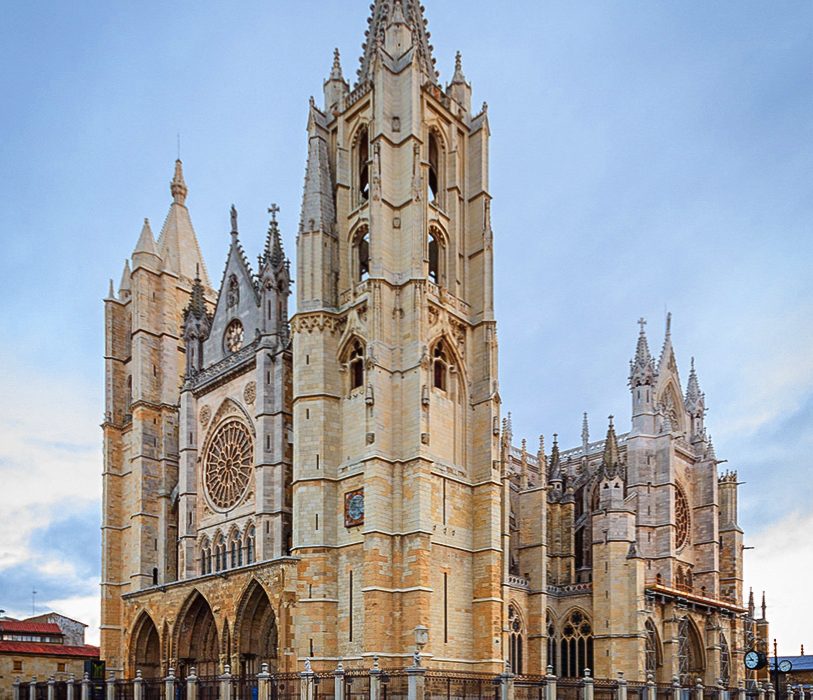
Burgos → León
195 kmCastile and León unfolds in its entirety beneath the windshield when you decide to leave Burgos with its Gothic cathedral still in the rearview mirror and set your course for León. It is barely 195 kilometers crossing endless high plains, sleepy villages at the foot of the Camino de Santiago, and the occasional stop where morcilla (blood sausage) and lechazo (roast suckling lamb) compete to make you ease off the accelerator. The A-66 —the Ruta de la Plata (Silver Route)— is the queen highway of this journey, but there is life beyond the fast asphalt: national roads, towns steeped in history, and even an ALVIA train that links both cities in just over an hour.
How to get from Burgos to León: quick overview
You have three main ways to cover the 195 km separating Burgos from León: by car (2 hours via motorway), by Renfe ALVIA train (79 minutes), or by ALSA bus (105 minutes). There is no direct flight between the two cities.
The car is the most flexible option if you want to stop in towns like Sahagún or Carrión de los Condes. The train wins on comfort and speed if your priority is arriving without worrying about the wheel: just over an hour from Burgos Rosa Manzano to León. The ALSA bus is the most economical alternative, with tickets from €12.90 and journey times close to two hours. For backpackers and travelers on a tight budget, the bus is unbeatable; for couples or families who value comfort, the ALVIA is worth the extra outlay.
By car from Burgos to León
The driving route between Burgos and León covers 195 km in approximately 2 hours via the A-66, the Autovía Ruta de la Plata, with no tolls and good road surface.
The most direct and fastest option is to take the A-66 (Autovía Ruta de la Plata), which connects Burgos with León without passing through any toll and with a modern layout designed to devour kilometers. The journey is completed in about two hours at legal speeds, although the time may vary depending on traffic at the Valladolid junction or on the approaches to León.
If you prefer a more scenic drive, you have several toll-free alternatives that pass through towns with plenty of character:
- N-623 Burgos–Santander: starts from Burgos heading north, a useful option if you are coming from the Cantabrian coast or want to link up with the A-67.
- A-1 (Autovía del Norte): the great artery that comes up from Madrid; you can take it if you are coming from the south and then connect with the A-66.
- A-73 (Autovía A-73): connects Burgos with the A-67 towards Aguilar de Campoo, ideal if your actual starting point is in Cantabria.
- A-62 (Autovía de Castilla): the historic east-west route that crosses the heart of Castile; useful for connections from Valladolid or Palencia.
- A-67 (Autovía Cantabria-Meseta): if you are coming down from Santander, this motorway drops you in Palencia and from there you continue to León via the A-65 or A-66.
- N-627: national road connecting the A-1 with the A-73 in the Burgos area, a toll-free local alternative.
- A-60 (Autovía Valladolid-León): perfect if you start in Valladolid and want to head straight to León on a modern motorway.
None of these roads has tolls, so the toll cost of the trip is zero. You will only need to factor in fuel and, if you wish, a detour to stop for a meal.
By train from Burgos to León
The direct train from Burgos to León is operated by Renfe with a daily ALVIA service lasting 79 minutes, the fastest option on this route.
The operator is Renfe, which offers a single daily train in the evening: it departs at 15:35 from Burgos Rosa Manzano station and arrives in León after a 79-minute journey. Frequency is low (barely one train a day), so it’s wise to book in advance and plan your day carefully.
The train type is ALVIA, a long-distance service that combines speed and comfort, with comfortable seats and, in some cases, an onboard café. For short journeys like this one, it’s a very convenient way to reach central León without worrying about traffic.
By bus from Burgos to León
The direct bus from Burgos to León is operated by ALSA in approximately 105 minutes, with tickets from €12.90 to €24.
The company ALSA runs this route with a travel time of around 105 minutes (just under two hours), a reasonable alternative to the train if the ALVIA schedule doesn’t suit you. Prices range from €12.90 to €24 depending on the fare type, how far in advance you book, and any available promotions.
For students, pilgrims on the Camino de Santiago (Way of St. James), or backpackers, the bus is a solid option: cheap, direct, and with a reasonable frequency. That said, the ALVIA remains almost half an hour faster.
Recommended stops along the way
The best stops along the 195 km between Burgos and León are Sahagún, Carrión de los Condes, Melgar de Fernamental, and Osorno la Mayor, all steeped in Jacobean history and Castilian character.
These four towns line up like beads on a rosary along the French Way of the Camino de Santiago, and any of them is a perfect excuse to stretch your legs, grab a coffee, or photograph adobe and brick façades.
- Sahagún: known as the “Capital of Tierra de Campos.” Its historic center is home to Mudéjar brick churches such as San Lorenzo and San Tirso, a UNESCO World Heritage Site along the Camino. It’s a must-stop if you’re traveling on the A-66 and a perfect place to buy artisanal cheese.
- Carrión de los Condes: another Jacobean town with notable monuments: the church of Santa María del Camino, the monastery of San Zoilo, and the ruins of the Benedictine monastery of San Benito. Its Plaza Mayor retains the most authentic Castilian flavor.
- Melgar de Fernamental: a Tierra de Campos village famous for its arcaded square, its Gothic church of Santa María, and its legacy linked to transhumance. It’s worth stopping to try its artisanal sweets.
- Osorno la Mayor: known for the Castle of the Osorio family and the church of Santa María de la Asunción. It’s a brief but photogenic stop, ideal for a snack before continuing.
Where to stay in León
León offers accommodations for every budget, from central hostels to charming hotels in historic buildings.
The historic center, especially around Plaza Mayor, Plaza del Grano, and Calle Ancha, is the most sought-after area: here you’ll find three- and four-star hotels, lively hostels, and tourist apartments. For tight budgets, there are hostels and guesthouses on pedestrian streets just a few minutes’ walk from the Gothic cathedral, famous for its stained-glass windows.
Another interesting area is the one known as Barrio Húmedo, ideal if you like going out for tapas at night: plenty of dining options and boutique hotels tucked away in restored palaces. For those seeking tranquility or family-friendly accommodations, the outskirts offer hotel chains and more spacious options with good value for money. Prices tend to fall within the typical mid-range of a medium-sized Castilian city, with more availability and better rates on weekdays than on weekends and holidays.
Where to eat along the route
The Burgos-León route is a feast for lovers of Castilian cuisine: morcilla (blood sausage) and lechazo (roast suckling lamb) in Burgos; botillo, cecina, and cocido maragato in León.
- Morcilla de Burgos: the province’s star sausage, made with pig’s blood, rice, onion, lard, and spices. It is fried or roasted and has an intense flavor and unmistakable texture. It is often served as a tapa with bread.
- Lechazo Asado: the other great Burgos classic. Suckling lamb cooked in a wood-fired oven until tender and juicy, with that crispy skin that makes it irresistible. A festive dish par excellence.
- Botillo del Bierzo: a typical sausage from the Leonese region of El Bierzo, made with pork ribs and tail seasoned with paprika, garlic, and salt, stuffed into a thick casing. It is served boiled, accompanied by potatoes and cabbage.
- Cecina de León: cured, smoked, and air-dried beef. With an intense flavor and fibrous texture, it is eaten in thin slices as an appetizer or starter, almost always with a drizzle of olive oil.
- Cocido Maragato: the traditional stew of the Maragatería region, which has the peculiarity of being served “in reverse”: first the meats, then the chickpeas with vegetables, and finally the soup. A hearty and highly nutritious dish.
- DO Bierzo red wine: wine made mainly from the Mencía grape. It produces elegant, fruity wines with good acidity, great varietal expression, and aging potential.
- Prieto Picudo DO León wine: a red from the province of León made with the native Prieto Picudo grape, with an intense character and marked tannins. This same variety is also used to produce highly regarded rosés within the DO Tierra de León.
Frequently asked questions about the Burgos-León route
How long does it take to get from Burgos to León?
The journey between Burgos and León takes approximately 2 hours by car via the A-66 (195 km), 79 minutes on Renfe’s ALVIA train, and about 105 minutes by ALSA bus. The train is by far the fastest option.
Which is cheaper, the train or the bus?
The ALSA bus is clearly more economical: tickets range between €12.90 and €24. Renfe’s ALVIA, although much faster, tends to have higher fares as it is a long-distance train with limited frequency (one train per day).
Is it worth renting a car?
Renting a car is worth it if you want to stop in towns such as Sahagún, Carrión de los Condes, Melgar de Fernamental, or Osorno la Mayor, since public transport does not always connect these localities well. If your plan is to go straight to León and get around the city, the ALVIA train or the ALSA bus cover the route without complications and at a good price.
When is the best time to travel?
The best time to travel between Burgos and León is spring and autumn, when the fields of Tierra de Campos are green or golden and temperatures are mild. Summer, although warm, allows you to extend your stops; winter is cold but quiet, ideal if you prefer to avoid crowds and take advantage of lower accommodation prices.
💡 ¿Sabías que...?
- ● La Casa Botines de León fue diseñada por el arquitecto catalán Antoni Gaudí. (https://lahistoria.info/historia-de-leon/)
- ● León fue capital del reino leonés desde el año 910 y se dotó de fuero propio en 1017. (https://es.wikipedia.org/wiki/Historia_de_Le%C3%B3n_(Espa%C3%B1a))
📍 También te puede interesar
Qué ver en Burgos →
Qué ver en León →