Total Solar Eclipse in Bilbao, Spain — August 12, 2026: Exact Times and Where to Watch
In Bilbao, the solar eclipse on August 12, 2026, will be TOTAL, with totality beginning at 20:27 local time and lasting exactly 0 min 31 s. This event marks a historic milestone as the first total solar eclipse visible from peninsular Spain since August 30, 1905, ending a 121-year wait for observers on the mainland. This guide provides the verified astronomical data, precise timing, and specific location strategy required to witness this phenomenon safely and successfully from the Basque Country.
Eclipse timeline in Bilbao
The eclipse sequence in Bilbao follows a precise astronomical timeline dictated by the Moon’s shadow crossing the Iberian Peninsula. The event begins with the first contact at 19:31:47 CEST, when the Moon first obscures the Sun. This partial phase lasts for nearly an hour, with the Sun’s disk gradually diminishing until the moment of totality at 20:27:23. The final contact, marking the end of the partial phases, occurs at 21:19:07 CEST. All times are in Central European Summer Time (CEST), which is UTC+2.
| Phase | Local time in Bilbao (CEST) |
|---|---|
| First contact (partial begins) | 19:31:47 |
| Totality begins | 20:27:23 |
| Maximum eclipse | 20:27:38 |
| Totality ends | 20:27:54 |
| Last contact (partial ends) | 21:19:07 |
| Totality duration | 0 min 31 s |
| Magnitude | 1.0011 |
Source: NASA Five Millennium Catalog. Local times CEST (UTC+2), August 12, 2026.
While Bilbao sits comfortably inside the path of totality, it is located on the northern edge of the eclipse band. Consequently, the duration of total darkness is brief compared to locations closer to the centerline. The maximum duration in peninsular Spain occurs in Oviedo, where totality lasts 1 minute and 49 seconds. In Bilbao, the magnitude is 1.0011, meaning the Moon barely covers the Sun’s disk. Being off the centerline requires precise positioning; you cannot afford to miss the 31-second window, as there is no margin for error regarding timing or horizon obstructions.
Where to watch it in Bilbao
Selecting a viewing location in Bilbao for this specific eclipse requires prioritizing one factor above all others: an unobstructed western horizon. Because the eclipse occurs just one hour before sunset, the Sun will be extremely low in the sky, hovering between 10° and 12° altitude during totality. Any building, hill, or tree line to the west will block the view.
Puente de La Salve:
This iconic bridge offers a vantage point over the Nervión River estuary. The western span of the bridge provides a clear line of sight toward the sea and the setting sun. The elevation of the bridge deck helps clear some of the immediate foreground obstructions found at street level. However, be aware that the bridge structure itself may cast shadows or block parts of the sky depending on your exact standing position. Arrive early to secure a spot on the western side railing. The open water to the west minimizes the risk of terrestrial obstructions, making this a strong candidate if the weather is clear.
Plaza Nueva:
Located in the heart of the Casco Viejo (Old Town), Plaza Nueva is a spacious, open square surrounded by arcades. While culturally significant, it presents challenges for this specific eclipse. The surrounding buildings are tall, and the square is oriented such that the western horizon may be partially obstructed by the architecture of the old city. It is a viable option only if you can find a position where the rooflines do not intersect with the Sun’s path at 10° altitude. It is best used as a gathering point rather than a primary viewing site unless you have verified the sightline personally.
Mirador de Artxanda:
This is the superior option for astronomical observation in Bilbao. Located on Mount Artxanda, this viewpoint sits significantly higher than the city center, offering a panoramic perspective. The elevation allows you to look down over the city and out toward the horizon, minimizing the risk of local obstructions like buildings or immediate hills. The funicular railway provides access, though expect heavy crowds. The western exposure from the main terrace is generally excellent, making it the most reliable spot within the city limits to catch the low-hanging Sun during the brief total phase.
August skies in País Vasco: real odds
The climatological outlook for the Basque Country in August is mixed, presenting the single greatest risk to your observation. According to AEMET (Spanish State Meteorological Agency), the Galicia and Cantabrian Coast zone has a clear sky probability of only 30-50% in August. The region is prone to ‘orballo’ (drizzle) and coastal fog, particularly in the late afternoon and evening as the land cools. This marine layer can roll in quickly from the Bay of Biscay.
The smart strategy is to monitor the AEMET forecast 24 to 48 hours in advance. If the model predicts coastal cloud cover, your “Plan B” should be to move inland toward Vitoria-Gasteiz or south toward the Ebro valley, where the probability of clear skies increases significantly. Do not stay in Bilbao if the forecast calls for low stratus clouds. The difference between the coast and the interior can be drastic; a 30-minute drive south can take you from total cloud cover to clear skies. Flexibility is your most valuable asset on eclipse day.
Getting to Bilbao for the eclipse
Bilbao is a major transport hub with an international airport and high-speed rail connections. However, on August 12, 2026, standard travel times will not apply. The influx of astro-tourists will cause significant congestion on the AP-8 and A-8 highways. Public transport, including the Cercanías trains and the Metro, will be overcrowded. We strongly advise arriving in Bilbao at least one day prior to the eclipse. If you are driving, park your vehicle the night before and use local transit or walk to your viewing spot on the day of the event. Traffic gridlock is a near certainty during the post-eclipse exodus, so patience and preparation are essential.
Where to stay: book now or arrive the day before
Hotels and rentals within the path of totality have been booking up since early 2025. Availability in Bilbao will be scarce and prices will be at a premium. If you cannot secure accommodation in the city, consider staying in a nearby city outside the path, such as San Sebastián or Vitoria, and commuting in on the morning of the 12th. If you do book in Bilbao, ensure your reservation has a free cancellation policy. This flexibility allows you to pivot to a different location if the weather forecast deteriorates 48 hours before the event.
Safety: the 30 seconds you must read
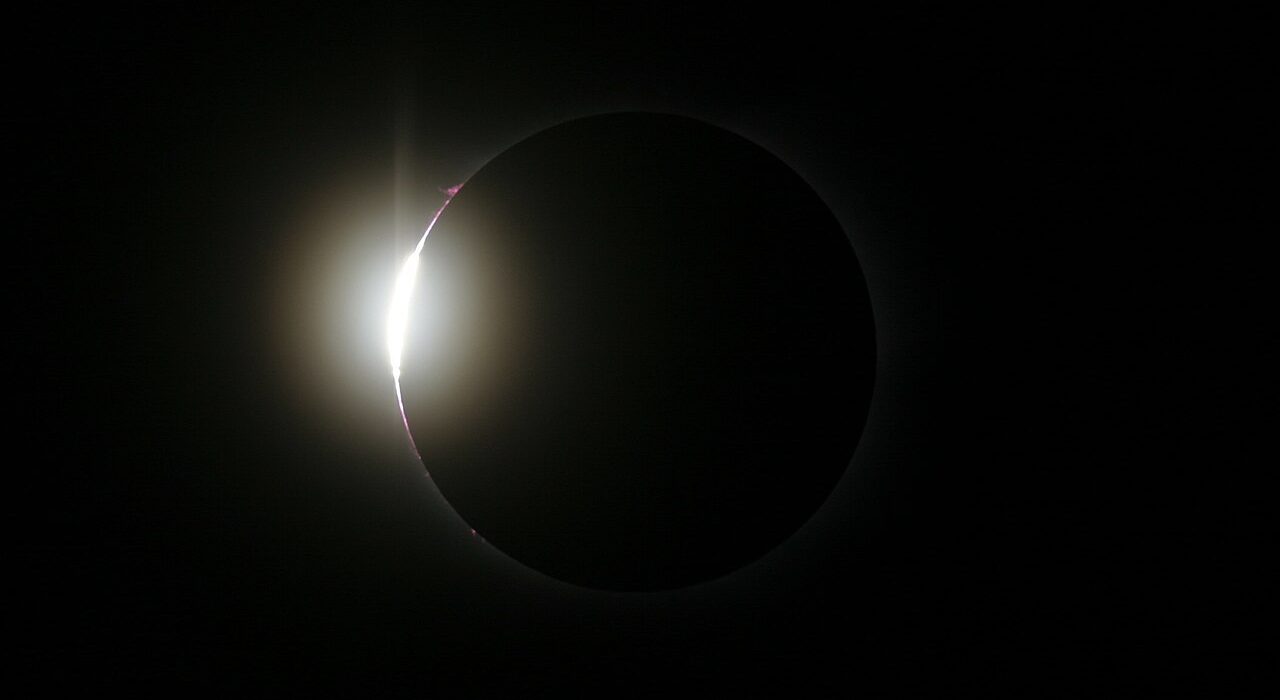
Eye safety is non-negotiable. During the partial phases (19:31 to 20:27 and 20:27 to 21:19), you must wear ISO 12312-2 certified eclipse glasses. Looking at the Sun without protection during these times will cause permanent retinal damage. You may only remove your glasses during the 31 seconds of totality, when the Sun is completely covered. The instant the “diamond ring” effect appears—signaling the end of totality—you must immediately look away or replace your glasses. For a comprehensive safety protocol, consult our complete guide to the 2026 eclipse in Spain.
- ISO 12312-2 certified eclipse glasses — one per person, bought well in advance. See options on Amazon ES.
The eclipse near Bilbao
If Bilbao’s weather forecast looks unfavorable, or if you seek a longer duration of totality, consider relocating to a nearby city. The following table compares key metrics for locations within driving distance.
| City | Distance | Totality duration | Totality begins |
|---|---|---|---|
| Vitoria-Gasteiz | 51 km | 1 min 04 s | 20:27:43 |
| Santander | 74 km | 1 min 04 s | 20:26:57 |
| Logroño | 98 km | 1 min 22 s | 20:28:09 |
| Burgos | 120 km | 1 min 44 s | 20:28:24 |
Make a trip of it: what to see in Bilbao
The eclipse occurs at sunset, leaving the daylight hours of August 12 free for exploration. Bilbao is a compact city rich in culture and gastronomy. You can visit the Guggenheim Museum or explore the pintxos bars in the Old Town before heading to your viewing spot in the evening. For a detailed itinerary, read our full guide on what to see and do in Bilbao.
Frequently asked questions
What time is the eclipse in Bilbao?
The partial phase starts at 19:31:47 CEST. Totality runs from 20:27:23 to 20:27:54, with maximum at 20:27:38. The partial phase ends at 21:19:07.
How long does totality last in Bilbao?
0 min 31 s. Being off the centerline, the duration is shorter than the peninsular maximum (Oviedo, 1 min 49 s).
Will the eclipse be total in Bilbao?
Yes. Bilbao is inside the path of totality with magnitude 1.0011. The sun will be completely covered by the moon for 0 min 31 s.
Do I need eclipse glasses?
Yes — ISO 12312-2 certified glasses during all partial phases. Only during totality can you safely look at the sun with the naked eye. Sunglasses do NOT protect.
What if it is cloudy in Bilbao on August 12?
Clear-sky probability for this zone is 30-50% (AEMET historical data). Tener plan B tierra adentro (Lugo, Oviedo) o moverse según predicción AEMET 24h antes. Check the AEMET forecast 24-48 hours before and stay mobile.
When is the next total solar eclipse visible from Spain?
Soon: 2027-08-02. An exceptional back-to-back for the same region.
Conclusion
The August 12, 2026 total solar eclipse is a once-in-a-lifetime event for travellers visiting Spain. With careful planning — picking a centerline location, checking the AEMET forecast 24-48h before, wearing ISO 12312-2 glasses during partial phases and booking accommodation early — you can witness one of nature’s most spectacular phenomena. Use this guide alongside our city guides and itineraries to build the trip of a lifetime.