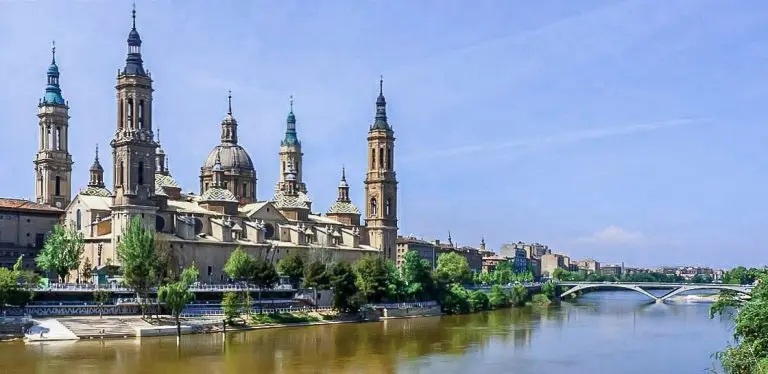
Lleida → Zaragoza
150 kmSome journeys are enjoyed more for what they hide along the way than for the destination itself, and this is one of them. Between Lleida and Zaragoza there is not only 150 kilometres of road: there is a parade of fruit trees, old vineyards, villages that smell of longaniza and the promise of arriving in just over half an hour if you choose the AVE. The AP-2 motorway offers one of the most discreet and beautiful entrances to the Ebro valley, and if you take the trip slowly, the landscape becomes a table set for the curious traveller.
How to get from Lleida to Zaragoza: quick summary
The fastest way is the AVE, which covers the journey in 42 minutes according to Renfe, with 12 direct trains a day. If budget is your priority, the ALSA bus costs between 6.93 and 6.93 € and takes 105 minutes. The car is the best option for those who want to stop in Fraga, Aitona or Pina de Ebro, as the route via the AP-2 and the A-2 takes 1 hour and 35 minutes with no tolls.
By car from Lleida to Zaragoza
The driving route between Lleida and Zaragoza totals 150 km and is completed in 1 hour and 35 minutes using the AP-2, the A-2 and the LL-12. The AP-2 (Zaragoza-Mediterranean Motorway) accounts for about 121 km of the journey and currently has no toll, which makes it the backbone of the trip. It then connects with the A-2 (Northeast Dual Carriageway) for about 17 km, and the last 6 km are covered via the LL-12 until you enter the Aragonese capital. The road surface is good, traffic is usually fluid and service areas are well distributed, although it is worth refuelling before leaving Lleida if travelling at the weekend.
By train from Lleida to Zaragoza
Renfe operates direct trains between Lleida-Pirineus and Zaragoza Delicias with a frequency of 22 trains a day, and the fastest is the AVE with a journey time of 42 minutes. The first train leaves at 06:25 and the last at 21:03. The offer includes AVE (12 a day, 42 min), ALVIA (5 a day, 46 min), Intercity (1 a day, 52 min), REG.EXP. (1 a day, 129 min) and REGIONAL (3 a day, 131 min). Prices vary depending on how far in advance you book and the type of train, but the difference between an AVE and a Regional can be notable; the Regional is the cheapest option for those who are not in a hurry, while the AVE makes up for it in time and comfort.
By bus from Lleida to Zaragoza
ALSA and Alsa offer direct buses between Lleida and Zaragoza with a duration of 105 minutes and a price of between 6.93 and 6.93 €. It is the cheapest and most reliable alternative for travellers on a tight budget or without a car. The schedules are designed to cover both the early morning hours and midday and afternoon, and the arrival station in Zaragoza is usually Delicias or the central bus station, with good connections to the rest of the city.
Recommended stops along the way
These eight stops are verified on the road route between Lleida and Zaragoza, and none of them involves a significant detour if you drive along the AP-2 or the A-2. They are ideal for stretching your legs, buying seasonal fruit or discovering the agricultural landscape of the Ebro valley.
Fraga
Fraga is the first major stop after crossing the provincial border. Known for its old town of Andalusian origin and its surrounding orchards, it is a good place for a quick coffee or to buy sweet fruit from the area, especially peaches and flat peaches in summer. The town centre can be seen from the motorway and access is direct.
La Puebla de Alfindén
La Puebla de Alfindén is already in the metropolitan area of Zaragoza, just a few kilometres from the capital. It is a convenient stop to refuel or grab something before entering the city, with retail parks and petrol stations accessible from the A-2. It has no monumental old town, but it is practical and quick.
Fuentes de Ebro
Fuentes de Ebro overlooks the Ebro river and is known for its horticultural tradition, especially its sweet onions. Stopping here lets you see up close the landscape of meanders and irrigated fields that accompany the final stretch of the journey. There are bars and small shops where you can buy local products.
Pina de Ebro
Pina de Ebro is one of the most characterful stops on the route. Its town centre preserves Mudéjar brick churches and arcaded streets, and the riverside surroundings invite a short stroll. It is a good option for lunch if you are travelling in the morning, with bars serving homemade set menus and quiet terraces.
Aitona
Aitona has become famous for its peach orchards in bloom during February and March, a pink spectacle that attracts visitors from all over Catalonia and Aragon. Outside the blooming season, it is still a pleasant stop for its views over the valley and its country lanes. The detour from the AP-2 is short and well signposted.
El Burgo de Ebro
El Burgo de Ebro is a small, tidy village on the banks of the river, with riverside walks and shaded areas. It is a quiet stop to take a break from the car without the crowds. In summer, its poplar groves by the water offer a cool respite before tackling the last few kilometres.
Alfajarín
Alfajarín is known for its ruined castle and its profile of houses clustered on a hill. The stop here is brief but interesting: you can see the silhouette of the castle from the road and take a quick photo. There are also bars and bakeries with good country bread.
Quinto
Quinto is a less frequented stop but with a charm of its own. Its houses stretch out alongside the Ebro and it preserves remnants of traditional Aragonese architecture. It is a good place to buy cured meats or simply to stretch your legs in an authentic rural setting, far from the noise of the motorway.
Where to stay in Zaragoza
The best area to stay in Zaragoza is around Delicias station and the Paseo de la Independencia, thanks to its connections with the train, the bus and the main monuments. The old town, around the Basílica del Pilar and Calle Alfonso, is home to charming hotels, guesthouses and tourist apartments in renovated buildings. Prices range from €50 to €120 per night in mid-range hotels, while guesthouses and pensions can drop below €40 in low season. For short stays, the Delicias area is practical; for sightseeing, the old town is unbeatable.
Where to eat along the route
The food between Lleida and Zaragoza is one of the great attractions of the trip, with hearty dishes and products with denomination of origin. These are the essentials by area:
Recao de Binéfar
Recao de Binéfar is a typical stew from the La Litera region, in Huesca, made with potatoes, green beans, pork ribs and sausages. It is seasoned with paprika and served piping hot, ideal for replenishing your energy in the cold months. Although Binéfar is not exactly on the main route, its influence reaches the villages near the provincial border.
Ternasco de Aragón
Ternasco de Aragón is young lamb with denomination of origin, slowly roasted with potatoes and garlic. It is the most emblematic dish of the region and can be found in roast houses in Zaragoza and in many villages of the Ebro valley. The meat is tender and juicy, with crispy skin, and is usually served in generous portions.
Longaniza de Graus
Longaniza de Graus is a cured sausage made with pork, paprika and spices, typical of the Ribagorza area of Huesca. It is eaten fried or grilled and is highly prized throughout the eastern part of Aragon. In bars and roadside shops near Fraga or Aitona you can find it as a tapa or to take away.
Chiretas
Chiretas are a traditional dish from the Pyrenean regions of Ribagorza and Sobrarbe, made with rice, lamb meat and spices, all wrapped in lamb tripe and boiled. They have an intense flavour and a unique texture. They are not easy to find outside their area of origin, but some roadside restaurants offer them in season.
Vino de Cariñena
Vino de Cariñena, with protected denomination of origin, is one of the oldest in Spain and is made mainly with garnacha. The Campo de Cariñena area is south of Zaragoza, but its red, white and rosé wines are served throughout the province. A young red from Cariñena is the perfect accompaniment to ternasco.
Vino de Somontano
Somontano, north of the route, in Huesca, is another benchmark denomination of origin in Aragon. Its red, white and rosé wines are made with garnacha, tempranillo and chardonnay, and have a fresh, fruity style. Although the area is not directly on the route, its bottles appear frequently on the wine lists of Zaragoza and the villages along the way.
Frequently asked questions about the Lleida-Zaragoza route
How long does it take from Lleida to Zaragoza?
By car, the 150 km journey takes 1 hour and 35 minutes via the AP-2 and the A-2. By train, the AVE takes 42 minutes, the ALVIA 46, the Intercity 52, and Regional trains between 129 and 131 minutes. By bus, ALSA takes 105 minutes.
Which is cheaper, the train or the bus?
The ALSA bus is the cheapest option, with prices between 6.93 and 6.93 €. The train can be more expensive, especially on the AVE, but Renfe’s REGIONAL and REG.EXP. services offer cheaper fares in exchange for a longer journey time (129-131 minutes).
Is it worth renting a car?
Yes, if you want to stop in Fraga, Aitona, Pina de Ebro or any of the other recommended stops, since public transport does not cover all the intermediate towns with the same flexibility. The car allows you to make the trip in 1 hour and 35 minutes and stop to eat or buy local products without depending on schedules.
When is the best time to travel?
The best season is spring, especially between February and March, when the peach orchards of Aitona are in bloom and the landscape is tinged with pink. Autumn is also pleasant thanks to the mild temperatures and the grape harvest in the nearby wine-growing areas. Summer can be very hot in the Ebro valley, and winter, although cold, is a good option for enjoying hearty spoon dishes.
💡 ¿Sabías que...?
- ● La plaza del Pilar es la plaza peatonal más extensa de la Unión Europea, con 24.000 metros cuadrados de superficie, 500 metros de largo y 80 de ancho. (https://www.hoyaragon.es/zaragoza/curiosidades-zaragoza/20240928075851075430.html)
- ● La Basílica del Pilar es el único edificio cristiano de occidente que mantiene simbología taoísta china, con hexagramas de base matemática binaria. (https://www.hoyaragon.es/cultura/zaragoza-datos-curiosos/20190224132638049371.html)
- ● El casco histórico de Zaragoza, que agrupa los barrios de El Gancho-San Pablo, La Magdalena y San Miguel, es el segundo más grande de España. (https://www.hoyaragon.es/cultura/zaragoza-datos-curiosos/20190224132638049371.html)
- ● El nombre de Zaragoza proviene de Caesaraugusta, la colonia fundada por el emperador Augusto, y tras la conquista musulmana la ciudad se documentó como Saraqusta. (https://es.wikipedia.org/wiki/Historia_de_Zaragoza)
- ● En 1897 se rodó en Zaragoza 'Desfile del Regimiento de Castillejos', el primer largometraje rodado en la capital aragonesa, firmado por Eduardo Jimeno Correas. (https://www.heraldo.es/noticias/viajes/2023/08/18/cinco-curiosidades-zaragoza-conoces-1668219.html)
- ● En septiembre de 1934 se inició en la llamada 'Casa Duende' de Zaragoza la primera investigación oficial en España de un fenómeno paranormal, por unas voces inexplicables oídas en una cocina. (https://www.zaragoza.es/ciudad/turismo/es/profesionales/sala-prensa/curiosidades-historias-leyendas.htm)
📍 También te puede interesar
Qué ver en Lleida →
Qué ver en Zaragoza →