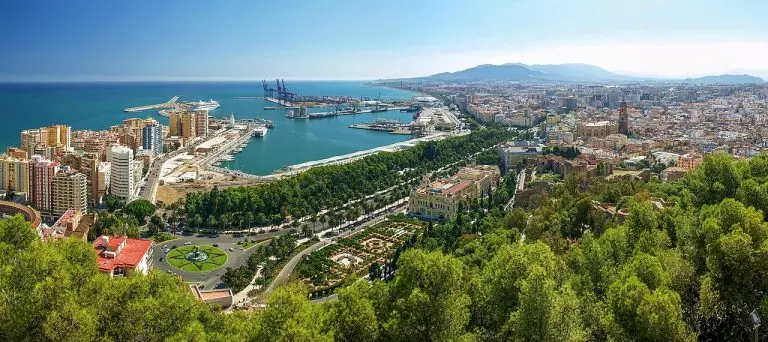
Barcelona → Málaga
997 kmTravel Guide: Barcelona – Málaga
Imagine leaving the Mediterranean bustle of Barcelona and, ten hours later, sitting down to fried fish by the sea in Málaga. This 997 km journey takes you along the Levantine coast, through the arid lands of the southeast and the Andalusian olive groves, with the option of making the trip in just over an hour and a half if you prefer to fly.How to get from Barcelona to Málaga: quick summary
The Barcelona-Málaga route offers four main options: plane (99 min, €19-90), direct AVE train (401 min, 1 train/day), bus (900 min) and car (10 h, 997 km). The plane is unbeatable on time and, with prices from €19, it usually is on price too. The train is the most comfortable option for those who don’t want to deal with airports and prefer to travel from the centre of Barcelona to the centre of Málaga without transfers. The car is ideal for those who want to turn the trip into a route with culinary and scenic stops. The bus, though slow, is the budget alternative for those travelling on a very tight budget and in no hurry.Driving from Barcelona to Málaga
Driving from Barcelona to Málaga covers 997 km and about 10 hours of actual driving, not counting stops. The route combines toll sections and free motorways, crossing four autonomous communities. The journey begins on the AP-7, the Autopista de la Mediterrània (Mediterranean Motorway), which covers about 249 km from Barcelona southwards. It is the fastest stretch but also the only one with tolls. After that, it links up with the A-7, the Autovía del Mediterráneo (Mediterranean Dual Carriageway), which runs for about 174 km along the coast without tolls, passing near Valencia and Alicante. On entering the Region of Murcia, the route takes the A-33, Autovía del Altiplano (High Plateau Dual Carriageway), with 93 km of toll-free road connecting inland Murcia with eastern Andalusia. Next, the A-92N, Autovía de Guadix a Límite de Región de Murcia (Guadix to Murcia Region Border Dual Carriageway), adds 119 km of free dual carriageway through semi-desert landscapes. Finally, the A-92, Autovía de Sevilla a Almería por Granada (Seville to Almería via Granada Dual Carriageway), completes 118 km before joining the network that descends towards Málaga. For a 10-hour trip, it is advisable to split the route into two or three stages with stops in Valencia, Alicante or Albacete. Fuel and the AP-7 tolls are the main expenses.By train from Barcelona to Málaga
Yes, there is a direct train from Barcelona to Málaga operated by Renfe, taking 401 minutes (6 h 41 min) on the fastest AVE service. Frequency is 1 direct train per day, with a single departure at 08:30 from Barcelona-Sants station and arrival at Málaga María Zambrano station. The only type of train available on this direct route is the AVE. As a high-speed service, the ticket includes an assigned seat and air conditioning. Since there is only one daily departure, it is worth booking in advance, especially in high season or on public holiday weekends. The journey is direct, with no need for transfers, making it very comfortable for travellers with luggage or families.By bus from Barcelona to Málaga
Yes, there is a direct bus from Barcelona to Málaga operated by ALSA, taking 900 minutes (15 hours). It is by far the slowest of all the options available for this route. The price is not confirmed in the data provided, but historically ALSA tickets on long-distance routes like this tend to be the cheapest option, especially if booked in advance. The bus departs from and arrives at the central stations of both cities. It is an alternative worth considering only for those with plenty of time, who want to save as much as possible or who prefer to travel overnight sleeping on the bus.By plane from Barcelona to Málaga
There is a direct flight from Barcelona to Málaga operated by Ryanair and Vueling, with a duration of 99 minutes. The departure airport is Barcelona-El Prat (BCN) and the arrival airport is Málaga-Costa del Sol (AGP). There are approximately 9 direct flights per day, with 63 weekly flights according to idealo. One-way prices start at €19-22, with a usual range of €35-90, August being the month with the highest prices. Ryanair tends to offer the cheapest fares, while Vueling provides more frequencies and schedules. At 99 minutes of flight time, it is by far the fastest option, and with prices from €19, it can also be the cheapest if you book with flexible dates.Recommended stops along the way
These are the verified stops you can make if you travel by road between Barcelona and Málaga: **Madrid (Madrid):** Although it involves a considerable detour from the coastal route, Madrid is a strategic stop if you travel by AVE or if you decide to spend the night in the capital. Its cultural, culinary and leisure offerings are immense, and from Madrid you can continue to Málaga by AVE or by motorway. **Alacant / Alicante (Alacant / Alicante):** A coastal city with a pleasant seafront promenade, Santa Bárbara castle and a lively area of bars and restaurants. It is a natural stop on the A-7 route, ideal for stretching your legs and eating rice dishes. **Garrucha (Garrucha):** A small coastal town in Almería, famous for its fishing port and fresh fish restaurants. It is a quiet stop, far from mass tourism, perfect for a gastronomic break. **Huércal-Overa (Huércal-Overa):** A municipality in Almería in the Almanzora valley, near the A-7. It is a practical stop to refuel, rest or do a quick shop before tackling the final stretch to Málaga. **Segovia (Segovia):** Like Madrid, it involves a detour inland. Its Roman aqueduct and historic centre justify the stop if you travel through the centre of the peninsula rather than along the coast. **Albacete (Albacete):** A La Mancha city well connected by motorway, known for its knives and its inland cuisine. It is a comfortable stop to split the journey into two days if you opt for the inland route. **Torrevieja (Torrevieja):** A coastal city in Alicante with wide beaches and a lively seafront promenade. Its salt flats and mild climate make it a pleasant stop at any time of year. **València (València):** The most recommendable stop on the entire coastal route. About 3-4 hours from Barcelona, it is the perfect place to eat an authentic paella, stroll through the old town or visit the City of Arts and Sciences before continuing south.Where to sleep in Málaga
Málaga offers accommodation for all budgets, from hostels and guesthouses in the historic centre to beach hotels and tourist apartments. The historic centre, near calle Larios and the cathedral, is the most sought-after area: it allows you to move on foot among the main monuments, tapas bars and museums. Prices here are higher, especially in high season. The Soho area and the port are ideal for those seeking a more alternative and modern atmosphere, with a good range of apartments and boutique hotels. For tighter budgets, the Huelin and La Palmilla neighbourhoods, somewhat further from the centre but well connected by public transport, offer affordable options. On the coast, Pedregalejo and El Palo are perfect for those who prioritise beach and chiringuitos. Price ranges vary greatly depending on the season: in winter you can find double rooms from €40-60, while in summer and Semana Santa prices soar and it is common to pay more than €100-150 per night in the centre.Where to eat along the route
Food is one of the great attractions of this trip. Each stretch of the route offers typical dishes that are well worth a stop: **Pa amb tomàquet (Catalonia):** Toasted country bread rubbed with ripe tomato, dressed with olive oil and salt. It is usually served with cold meats such as jamón serrano or fuet. It is the perfect breakfast or snack before leaving Barcelona. **Calçots (Valls, Tarragona):** Spring onions roasted over embers, served with romesco sauce. They are eaten by peeling the charred stalk and dipping them in the sauce. The calçots season runs from November to April, and Valls is just a step away from the AP-7. **Fideuà (Gandía, Valencia):** A dish of fine noodles cooked in a paella pan with fish stock and seafood. It is served with alioli and lemon. Gandía is an excellent coastal stop to try it. **Arroz negro (Valencian Community):** Rice cooked with squid ink, fish stock and pieces of squid or cuttlefish. It is served with alioli. It is a classic in any rice restaurant along the Valencian coast. **Gazpacho (Andalusia):** A cold soup of tomato, cucumber, pepper, onion, garlic, olive oil and vinegar. It is served very cold, typical of summer. It is the perfect dish to cool down when you reach Andalusian lands. **Pescaíto frito (Málaga):** Assorted fish (anchovies, horse mackerel, squid) coated in flour and fried in olive oil. It is served as a tapa or a portion. It is the emblematic dish of Málaga and the final reward of the trip. **Jerez wine (Jerez de la Frontera, Cádiz):** A fortified wine made with Palomino Fino grapes, aged under a layer of flor yeast or through oxidation. It includes varieties such as fino, manzanilla, oloroso and Pedro Ximénez. **Málaga wine (Málaga):** Natural sweet wines made with grapes such as Pedro Ximénez and Moscatel, with oxidative ageing. Dry and semi-sweet wines are also produced. It is the perfect pairing for pescaíto frito or desserts.Frequently asked questions about the Barcelona-Málaga route
How long does it take from Barcelona to Málaga?
It depends on the means of transport: by plane, 99 minutes; by direct AVE train, 401 minutes (6 h 41 min); by car, about 10 hours for 997 km; and by bus, 900 minutes (15 hours). The plane is clearly the fastest option, followed by the train. The car and the bus require a full day or more.
Which is cheaper, the train or the bus?
The ALSA bus is usually the most economical option on long-distance routes, although the exact price is not confirmed in the available data. The AVE train, with only 1 daily departure at 08:30, tends to be more expensive, especially if booked at short notice. However, the plane can be even cheaper than both: one-way prices start at 19-22 € with Ryanair or Vueling, in a usual range of 35-90 €.
Is it worth renting a car?
It depends on your goal. If you only want to get to Málaga, no: the plane is faster and probably cheaper. But if you want to turn the trip into an experience, the car allows you to stop in Valencia, Alicante, Garrucha or Huércal-Overa, try the local food at each stop and discover landscapes that the train or plane do not show. With 10 hours of driving, it is advisable to split the route over two days if you travel alone or without experience of long journeys.
When is the best time to travel?
The best time to travel from Barcelona to Málaga is spring (April-June) and autumn (September-October), when temperatures are pleasant both for driving and for enjoying Málaga. Summer, especially August, is the month with the highest flight prices (up to 90 €) and the most heat on the road. Winter offers lower prices for accommodation and flights, although swimming in the sea is not so appealing.
💡 ¿Sabías que...?
- ● El Cementerio Inglés de Málaga es el primer cementerio protestante de la España peninsular y se empezó a construir en 1831. (https://visita.malaga.eu/es/que-ver-y-hacer/blog/diez-curiosidades-locales-que-no-sabias-de-malaga-y-sus-historias-p1849)
- ● La presencia fenicia en la costa malagueña data del siglo IX antes de Cristo. (https://www.malaga.eu/la-ciudad/historia-de-la-ciudad/historia-ampliada/index.html)
- ● La casa habitada más antigua de Málaga es el Palacio de Salinas, un edificio del siglo XVI. (https://www.diariosur.es/sur-historia/diez-curiosidades-malaguenas-20200726194810-nt.html)
- ● En Puerta Nueva existió una plaza de toros con capacidad para unas tres o cuatro mil personas que funcionó hasta 1837. (https://www.diariosur.es/sur-historia/diez-curiosidades-malaguenas-20200726194810-nt.html)
- ● Málaga es la segunda ciudad más poblada de Andalucía y la sexta de España, con 599 063 habitantes (INE 2025). (https://es.wikipedia.org/wiki/M%C3%A1laga)
- ● La Farola de Málaga es el único faro de la península ibérica con nombre femenino, erigido en 1817. (https://visita.malaga.eu/en/what-to-see-and-do/blog/the-most-singular-malaga-anecdotes-symbols-and-curiosities-p1791)
📍 También te puede interesar
Qué ver en Barcelona →
Qué ver en Málaga →