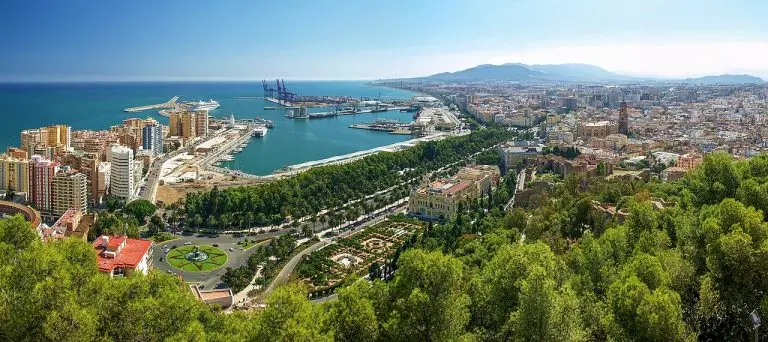
Granada → Málaga
125 kmSome journeys are a pleasure from the very first kilometre, and this is one of them: 125 km separating the magic of the Alhambra from the sparkle of the Mediterranean. The A-92 gives you a majestic farewell to the Sierra Nevada before plunging you into a sea of olive groves, and if you go by train, the AVANT puts you in Málaga in just over an hour and a half, leaving you the whole day to explore the Costa del Sol.
How to get from Granada to Málaga: quick summary
The route between Granada and Málaga can be covered by car, direct train or direct bus; there is no direct flight between the two cities. For those who prioritise flexibility and want to make gastronomic or scenic stops, the car is unbeatable (1h 20min without tolls). If you’re after comfort and speed, Renfe’s AVANT train is the most efficient option (89-94 minutes). The ALSA bus is a solid, budget-friendly alternative, with a journey time of 90 minutes.
By car from Granada to Málaga
The drive between Granada and Málaga is entirely on toll-free motorway, with an estimated duration of 1 hour and 20 minutes for the 125 km route. The route combines four main roads: you start on the A-92G (Avenida de Andalucía as it passes through Bobadilla) for about 9 km, then take the A-92, the backbone of the journey, which you’ll follow for approximately 53 km. After that, the A-92M takes you from the Estación de Salinas to Villanueva de Cauche over 26 km, and finally the A-45, the Autovía de Málaga, carries you the last 27 km to your destination. The road surface is in good condition and the landscape is a shifting spectacle: from the ochre and green tones of the Granada hinterland to hills dotted with cortijos and, at the end, the descent into the Guadalhorce valley.
By train from Granada to Málaga
Renfe operates direct trains between Granada and Málaga, with the AVANT being the fastest at between 89 and 94 minutes. According to Renfe’s timetables, there are 3 AVANT trains per day, departing from Granada station at 07:36, 18:29 and one intermediate service, arriving at Málaga María Zambrano station. No other types of direct train are listed on this route; the AVANT is the only direct rail option mentioned. The origin station is Granada and the destination station is Málaga María Zambrano, both central and well connected to local public transport.
By bus from Granada to Málaga
ALSA offers direct buses between Granada and Málaga with a journey time of 90 minutes. The company ALSA (also referred to as Alsa) covers this route without transfers, making it a very practical option for those travelling with luggage or who prefer not to drive. The price is not specified in the data provided, so it is advisable to check the ALSA website for updated fares. Granada bus station and Málaga bus station are both well located, making access to the main points of interest easy.
Recommended stops along the way
The following stops have been verified along the route between Granada and Málaga, ideal for stretching your legs, refuelling or discovering an unexpected corner. All are accessible from the main motorways without excessive detours.
Alhendín: Located on the outskirts of Granada, it is a quick stop to grab a coffee or buy provisions before setting off. Its surroundings blend the beginning of the Granada plain with the first foothills of Sierra Nevada.
Padul: Known for its lagoon and wetlands, Padul is a quiet stop for those looking for a short walk in the heart of nature. The town retains a traditional Andalusian feel and is a good option for breakfast.
Huétor Tájar: Famous for its asparagus and agricultural production, this municipality is ideal for buying local seasonal produce. Its town centre is small but welcoming, perfect for a brief stop.
Almuñécar: Although it is not directly on the fastest motorway route, it is listed as a recommended stop. It is a coastal destination that deserves a detour if you have extra time, with beaches and an old town full of Phoenician and Roman history.
Archidona: In the heart of the Antequera region, Archidona surprises with its octagonal plaza and its castle. It is a strategic stop to recharge your batteries and enjoy the inland cuisine of Málaga province.
Armilla: Practically integrated into the metropolitan area of Granada, Armilla is an urban stop with all services. Its park and youthful atmosphere make it pleasant for a quick break.
Atarfe: Gateway to the Granada plain, Atarfe is known for its production of broad beans and artichokes. A stop here allows you to buy fresh produce and enjoy a rural setting very close to the city.
Churriana de la Vega: Another municipality in Granada’s metropolitan belt, with a wide range of bars and restaurants. It is the last comfortable stop before taking the A-92 towards Málaga.
Where to sleep in Málaga
Málaga offers accommodation for every budget, from budget hostels in the historic centre to boutique hotels and tourist apartments with views of the port. The most recommended areas are the Centro Histórico (ideal for getting around on foot and close to calle Larios), the Soho district (alternative, with street art and a relaxed atmosphere) and La Malagueta (next to the beach and the promenade). For longer stays or family trips, apartments in the Ensanche or in Teatinos offer good value for money. Prices vary by season: in summer and Semana Santa they rise considerably, while in autumn and winter you can find options from around 50-70 € per night in hostels and from 90-120 € in mid-range hotels.
Where to eat along the route
The food between Granada and Málaga is a journey in itself, with essential stops to try sweets, stews and wines with a character all their own. These are the typical dishes and products you shouldn’t miss.
Piononos (area: Santa Fe, Granada): A typical sweet from Santa Fe consisting of a rolled sponge cake soaked in syrup, with a yolk cream filling. It is made with eggs, sugar, flour and syrup. It’s an almost obligatory stop if you pass through Santa Fe, just a few kilometres from Granada.
Tortilla del Sacromonte (area: Granada): A potato omelette characteristic of Granada, made with potatoes, eggs, onion and lamb brains (or sweetbreads). It is traditionally served in the Sacromonte neighbourhood, although many bars in Granada offer it as a hearty tapa.
Habas con jamón (area: Granada): A dish of tender broad beans stewed with serrano ham, garlic, onion and olive oil. It is a typical spring stew in the province of Granada, perfect to enjoy along the route if you travel between March and May.
Vino de la Tierra de Granada (area: Granada): Wines produced in the province of Granada, with varieties such as Tempranillo and Garnacha. The area holds the protected geographical indication “Vino de la Tierra de Granada”. Ideal for pairing with local meats or cheeses.
Porra antequerana (area: Antequera, Málaga): A cold dish similar to salmorejo but thicker, made with tomato, bread, garlic, olive oil and vinegar. It is served with chopped hard-boiled egg and serrano ham. It is the star dish of Antequera, halfway between Granada and Málaga.
Molletes de Antequera (area: Antequera, Málaga): Soft, round bread rolls typical of Antequera, made with flour, water, salt and yeast. They are usually eaten with olive oil, manteca colorá (paprika-lard spread) or cold meats. Perfect for a breakfast or snack along the route.
Vino de Málaga (area: Málaga): Fortified and sweet wines from the province of Málaga, made mainly with Pedro Ximénez and Moscatel grapes. They include types such as sweet wine, moscatel and Pedro Ximénez. They are the perfect finishing touch to a meal in Málaga.
Pasas de Málaga (area: Málaga): Raisins obtained from Moscatel de Alejandría grapes, sun-dried. They are a typical product of the Axarquía and are used in baking and traditional dishes. An excellent gourmet souvenir to take home.
Frequently asked questions about the Granada-Málaga route
How long does it take to get from Granada to Málaga?
By car, the 125 km journey takes approximately 1 hour and 20 minutes along the toll-free motorway. On Renfe’s AVANT train, the duration is 89 to 94 minutes. On an ALSA bus, the travel time is 90 minutes. There is no direct flight, so these are the main overland options.
Which is cheaper, the train or the bus?
The ALSA bus is usually the most economical option for this route, although the exact price is not specified in the data provided. Renfe’s AVANT train offers greater speed and comfort, but its fare may be higher. It is advisable to compare prices on the official ALSA and Renfe websites, as both operators release offers and discounts for advance booking.
Is it worth renting a car?
Renting a car is worth it if you want to make stops along the way such as Santa Fe, Antequera or Archidona, or if you plan to explore the province of Málaga beyond the capital. By car, the direct journey is 1h 20min and all roads are toll-free motorways. If you are only going to be in Málaga city, the train or bus are more practical and avoid the parking issue.
When is the best time to travel?
The best time to travel from Granada to Málaga is in spring (April-June) and autumn (September-October), when temperatures are mild and the landscape is at its most splendid. In summer, Málaga can be very hot and crowded, while in winter the weather is pleasant but some tourist services reduce their hours. To enjoy habas con jamón (broad beans with ham), travel in spring; for raisins and sweet wines, autumn is ideal.
💡 ¿Sabías que...?
- ● El Cementerio Inglés de Málaga es el primer cementerio protestante de la España peninsular y se empezó a construir en 1831. (https://visita.malaga.eu/es/que-ver-y-hacer/blog/diez-curiosidades-locales-que-no-sabias-de-malaga-y-sus-historias-p1849)
- ● La casa habitada más antigua de Málaga es el Palacio de Salinas, en la calle homónima número 6, un edificio del siglo XVI. (https://www.diariosur.es/sur-historia/diez-curiosidades-malaguenas-20200726194810-nt.html)
- ● En Puerta Nueva existió una plaza de toros con capacidad para unas tres o cuatro mil personas, que funcionó hasta 1837. (https://www.diariosur.es/sur-historia/diez-curiosidades-malaguenas-20200726194810-nt.html)
- ● La primera médica que hubo en Málaga fue Francisca Medina Verdeja, conocida como Fanny, quien se licenció en medicina en Cádiz en 1918 y fue la primera doctora colegiada en Málaga en 1928. (https://www.diariosur.es/sur-historia/diez-curiosidades-malaguenas-20200726194810-nt.html)
- ● La Farola de Málaga es el único faro de la península ibérica con nombre femenino, fue erigido en 1817 y recientemente declarado Bien de Interés Cultural. (https://visita.malaga.eu/en/what-to-see-and-do/blog/the-most-singular-malaga-anecdotes-symbols-and-curiosities-p1791)
- ● Málaga fue fundada por los fenicios en el siglo VIII a.C. (https://es.wikipedia.org/wiki/M%C3%A1laga)
📍 También te puede interesar
Qué ver en Granada →
Qué ver en Málaga →