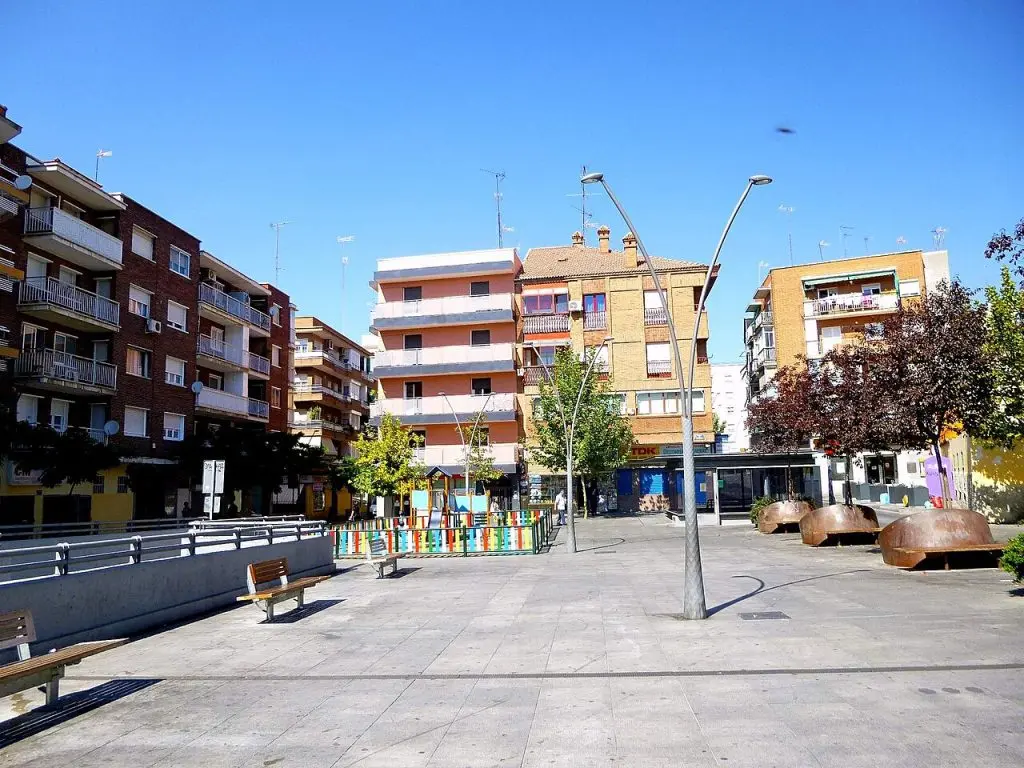
Alcorcón
Comunidad de MadridClimate
What to see in Alcorcón: the must-sees
Alcorcón holds surprises that go far beyond its image as a commuter town. From a fairytale castle set within an urban park to an aeronautical museum with more than half a century of history, the city offers a varied and accessible circuit. Here is what you shouldn’t miss.
Castillos de Valderas
Its silhouette of crenellated towers has made it a landmark of the city and one of the most photographed features of its skyline. They stand in the San José de Valderas neighbourhood, integrated into a 12.65-hectare urban park built in 1991. The complex serves as the neighbourhood’s cultural and leisure centre, with sports facilities, skating rinks, ping-pong tables, pétanque courts, fountains, a restaurant, children’s areas and a dog park. Besides the castles, the park is also home to the Museo de Arte en Vidrio de Alcorcón (Glass Art Museum) and the sculptural ensemble by Carlos Armiño. It remains open 24 hours, so you can come and see them lit up at night.
Museo de Aeronáutica y Astronáutica – Museo del Aire
Located in Cuatro Vientos since 1966, this museum aims to recount the history and development of Spanish aeronautics and astronautics. The collection is spread across seven hangars and seven open-air platforms, allowing you to see historic aircraft and unique pieces up close. It is an essential visit for aviation enthusiasts and for anyone curious about technology and military history. The museum sits just a step away from the Cuatro Vientos aerodrome, which adds authenticity to the experience.
Parque Oeste (Europe in Alcorcón)
This large urban park in the Oeste neighbourhood is one of the most extensive and most visited green spaces in Alcorcón. It includes walking areas, play areas and sports facilities, making it a benchmark for outdoor leisure in the city. It is perfect for escaping the asphalt without leaving the municipality, whether to run, stroll or simply sit and read for a while.
Zona Arqueológica del Casco Urbano de Alcorcón
The archaeological zone of Alcorcón’s old town is a site listed as a Site of Cultural Interest located within the municipality. The municipal area forms part of the so-called “Tagus depression”, which separates the basins of the Guadarrama and Manzanares rivers, and has a small river network but abundant underground water resources. It is one of the heritage elements most frequently cited in guides to places of interest in Alcorcón, ideal for those who want to trace the oldest traces of the territory.
Museo Municipal de Arte en Vidrio (MAVA)
A municipal museum dedicated to contemporary glass art, one of the most distinctive cultural facilities in Alcorcón. It houses collections of glass artworks by national and international artists, and forms part of the municipality’s standout museum offering.
Iglesia de Santa María la Blanca
A Catholic church of medieval origin located in Alcorcón’s historic centre, at calle de San Isidro, 2, declared a Site of Cultural Interest under code RI-51-0008298. The current building reflects Baroque architecture, with construction carried out between the 16th and 18th centuries, raised on the possible site of an old mosque. Inside, the main altarpiece and the religious architecture of the Mudéjar-Madrid tradition stand out, making it the most emblematic and visitable monument in the municipality.
Casa Consistorial de Alcorcón
An institutional building presiding over Plaza de España, number 1, and the seat of Alcorcón’s Town Hall, shaping the administrative and civic life of the municipality. Its location on Plaza de España makes it a reference point of the old town and a regular backdrop to civic life.
Museum of the Robot
The Museum of the Robot was created with the aim of bringing the fascinating world of entertainment robots closer to all kinds of audiences in a direct and real way, with a permanent exhibition and guided tours.
La Ribota Park (Visit to Olympus)
An urban park of around 5 hectares, located between Avenida del Oeste and the streets Nóbel, Juan Ramón Jiménez and Pinos, with a lake, a collection of mythological-themed sculptures, an amphitheatre, sports areas, chess tables, pétanque courts, fountains, a children’s area, a restaurant and a dog park.
Gardens of the Ermita de Nª Sra. de los Remedios (Chapel of Our Lady of Remedies)
The complex forms part of the traditional walking routes through the old town and its surroundings, offering a calm, shady setting around the sanctuary, combining the devotional value of the chapel with the neighbourhood use of the green space.
Plaza de la Constitución (Constitution Square)
It is the usual starting point for sightseeing walks through the centre, a pedestrian square with well-tended surfaces that brings together institutional buildings and civic life, designed for residents to enjoy and to host civic and institutional events.
Buero Vallejo Cultural Centre
A municipal cultural centre dedicated to programming theatre, music and the performing arts, regarded as one of the city’s main cultural leisure venues, with a theatre hall featuring a seating area, stage and technical equipment to host performances of various genres.
Alcorcón Centre for the Creation of the Arts (CREAA)
A municipal cultural facility dedicated to contemporary artistic creation, hosting exhibitions, workshops and activities linked to the visual and performing arts, and serving as a benchmark for artistic creation and dissemination in the municipality.
X-Madrid Shopping Centre
One of Alcorcón’s main shopping and leisure spaces, located at Calle Oslo, 53, with an area of 40,000 m², opened in November 2019 with a technological, urban and experiential approach that includes activities such as diving, surfing, climbing and skateboarding.
Fuente de los Músicos (Musicians’ Fountain)
An urban monument in Alcorcón.
Frontera 4-4
An urban monument in Alcorcón.
🍂 Otoño
Si visitas Alcorcón en otoño, el ambiente se vuelve más tranquilo y el clima sigue siendo agradable para caminar. Es buen momento para conocer los Castillos de Valderas o la Iglesia de Santa María la Blanca sin aglomeraciones. Lleva un paraguas plegable por si acaso, ya que las lluvias pueden aparecer.
What to do in Alcorcón
Alcorcón offers neighbourhood tapas bars between Parque Oeste and Alcorcón Central, strolls through urban parks with mythological sculptures, visits to unique museums such as the Glass Museum and the Robot Museum, and a lively cultural calendar in venues such as the Buero Vallejo Cultural Centre and the CREAA. In September, the Fiestas Patronales (Patron Saint Festivals) in honour of Nuestra Señora de los Remedios fill the Recinto Ferial (fairground) with an opening speech, free concerts, stalls, rides, fireworks and religious events such as the raising of the Virgin, the Misa Mayor (High Mass) and the procession. The neighbourhoods of La Fortuna and Parque Oeste add a university and family atmosphere respectively, with green spaces and dining options for all tastes.
Alcorcón in a day: express itinerary
This route lets you capture the essence of Alcorcón in a single day, combining heritage, green spaces and local gastronomy.
- 09:30 – Old Town: Start at Plaza de la Constitución (Constitution Square) and Plaza de España (Spain Square), visit the Church of Santa María la Blanca and the Town Hall. This is the historic and administrative heart of the town, with pedestrian streets ideal for a first taste of the area.
- 11:00 – Castillos de Valderas: Head to the San José de Valderas neighbourhood to photograph Alcorcón’s most iconic crenellated silhouette and stroll through its 12.65-hectare park, which includes the Museum of Glass Art.
- 13:30 – Lunch in the centre: Return to the area around Plaza de España or Calle Mayor to try cocido madrileño (Madrid-style stew) with an Alcorcón twist or a selection of neighbourhood tapas.
- 16:00 – Parque Oeste or Parque de La Ribota: Choose one of the large urban parks to digest and relax. La Ribota features mythological sculptures and a lake; Parque Oeste is the largest and most visited.
- 18:30 – Museo del Aire or X-Madrid: If aviation appeals to you, the Museo de Aeronáutica y Astronáutica (Aeronautics and Astronautics Museum) in Cuatro Vientos is a gem. If you prefer shopping and experiential leisure, X-Madrid offers indoor surfing, climbing and diving.
- 21:00 – Dinner and tapas: Finish at the bars in the town centre or between Parque Oeste and Alcorcón Central, ordering torreznos, croquetas or a hearty fabada.
Where to eat in Alcorcón: local gastronomy
Where to stay in Alcorcón
Casco Antiguo
Núcleo histórico de Alcorcón, con calles peatonales, plazas y edificios tradicionales. Ambiente tranquilo durante el día y animado los fines de semana. Aquí se encuentran el Ayuntamiento, la Iglesia de Santa María la Blanca y el Centro Cultural.
Parque de Lisboa
Zona residencial moderna con amplias avenidas y el gran Parque de Lisboa, ideal para pasear y hacer deporte. Cuenta con centros comerciales y buena conexión con Madrid. Ambiente familiar y tranquilo.
San José de Valderas
Barrio histórico con identidad propia, antigua localidad anexionada. Destaca la Iglesia de San José de Valderas y el ambiente de pueblo. Bien comunicado por cercanías y metro.
La Fortuna
Barrio residencial con gran presencia de población joven y ambiente universitario. Cuenta con el Campus de la Universidad Rey Juan Carlos y zonas verdes. Ambiente animado y buena oferta de restauración.
Parque Oeste
Zona en expansión con nuevos desarrollos residenciales y amplias zonas verdes. Alberga el Hospital Universitario Fundación Alcorcón y el Centro Comercial Tres Aguas. Ambiente moderno y familiar.
Centro
Zona céntrica alrededor de la Plaza de España y la calle Mayor, con comercios, bares y servicios. Es el corazón comercial y social de Alcorcón, con ambiente animado especialmente los fines de semana.
How to get to Alcorcón
From Madrid, the fastest option is the train: 18 min (Cercanías C5), 145 a day.
| From | Direct train | Direct bus | Car |
|---|---|---|---|
| Madrid | 18 min · 145/day Cercanías C5 | — | 24 min 19 km |
| Fuenlabrada | 46 min · 146/day Cercanías C5 | — | 16 min 12 km |
| Leganés | 40 min · 146/day Cercanías C5 | — | 12 min 9 km |
Direct trains and buses from the official timetables published by the operators on Spain's National Transport Access Point (a reference Wednesday); driving times from OpenStreetMap. Operators that do not publish their timetables may run more services. Check the timetable before you travel.
Getting around Alcorcón
Urban bus transport is the backbone of getting around Alcorcón, connecting the main neighbourhoods, shopping centres and amenities. The urban lines bring you close to areas such as Parque Oeste, San José de Valderas, La Fortuna and the town centre. For short trips within the old town and its surroundings, walking is the most practical option, since many of the main attractions are concentrated within a reasonable walking radius. If you are coming from Madrid or want to travel to other towns in the metropolitan area, the commuter rail and metro are the most efficient alternatives.
Weather in Alcorcón
Live webcam — Madrid*
Alcorcón* The nearest webcam to Alcorcón is in Madrid, 4.5 km away.
Source: Windy Webcams
Best time to visit Alcorcón
Day trips from Alcorcón
Alcorcón is an excellent base for exploring other cities in the region of Madrid, thanks to its south-western position within the metropolitan area and its road and public transport connections. You can plan excursions to Madrid itself to visit its great museums and urban life, or head to nearby towns with historic and natural charm. The commuter rail and intercity bus networks make it easy to get around without a car, and if you have your own vehicle, the M-40, M-50 and A5 motorways open up a wide range of destinations in the Community of Madrid for a day trip.
Curious facts about Alcorcón you didn’t know
The name Alcorcón comes from the Arabic al-gor or al-kur, meaning hill, hillock or pass, a clue to the geography that gave rise to the settlement.
The official demonym is alcorconero, but many know its inhabitants as alfareros (potters), a nickname that is no coincidence: pottery in Alcorcón lasted 1000 years, according to the Alcorcón Gráfico of 1972.
The coat of arms of Alcorcón, approved on 20 July 1974, shows three pots or stew pots that refer directly to that thousand-year pottery past.
Alcorcón was twinned with three American cities: Mayarí (Cuba), Nejpa (El Salvador) and Ancón (Peru), a reflection of the historic and migratory ties between the two shores.
Who is Alcorcón for
Alcorcón is a versatile city that works well for families, thanks to its large urban parks, quiet residential areas and amenities such as the Hospital Universitario Fundación Alcorcón and the Tres Aguas shopping centre. Backpackers and students will find a young, university atmosphere in La Fortuna, linked to the Universidad Rey Juan Carlos campus, with lively dining and more affordable prices. Lovers of history and heritage will enjoy the old town, the Iglesia de Santa María la Blanca (Church of Santa María la Blanca) and the Zona Arqueológica (Archaeological Zone), while foodies have in neighbourhood tapas and cocido madrileño (Madrid-style stew) a good enough reason to stay. And if you are after shopping and experiential leisure, X-Madrid adds a plus that is hard to match in the south of Madrid.
💡 ¿Sabías que...?
- ● El nombre de Alcorcón proviene del árabe al-gor o al-kur, que significa cerro, colina o collado. (https://elpais.com/diario/1999/08/27/madrid/935753069_850215.html)
- ● El gentilicio oficial es alcorconero, pero también se conoce a los habitantes como alfareros debido a la tradición alfarera. (https://balamorestaurante.es/10-curiosidades-alcorcon/)
- ● Alcorcón estuvo hermanada con tres ciudades americanas: Mayarí (Cuba), Nejpa (El Salvador) y Ancón (Perú). (https://balamorestaurante.es/10-curiosidades-alcorcon/)
- ● El escudo de Alcorcón fue aprobado el 20 de julio de 1974 y en él aparecen tres ollas o pucheros que hacen referencia a su pasado alfarero. (https://es.wikipedia.org/wiki/Alcorc%C3%B3n)
- ● La alfarería en Alcorcón duró 1000 años, según recoge el Alcorcón Gráfico de 1972. (https://www.ayto-alcorcon.es/sites/default/files/2024-07/Julio%202021.%20La%20alfarer%C3%ADa%20en%20Alcorc%C3%B3n.pdf)
Frequently asked questions about Alcorcón
How many days do I need to see Alcorcón?
With a full day you can cover the essentials: the old town, the Castillos de Valderas (Valderas Castles), an urban park and the Museo del Aire (Air Museum) or X-Madrid. If you want to visit the MAVA, the Museo del Robot (Robot Museum) and the Zona Arqueológica (Archaeological Zone) at a leisurely pace and enjoy some tapas, two days will give you plenty of time.
What is the best time of year to visit Alcorcón?
From May to September, with an average summer temperature of 24.8°C and the Fiestas Patronales (patron saint festivities) in September as a major draw. Winter averages drop to 7.1°C, and annual rainfall is 412.3 mm, so spring and early autumn are the most comfortable seasons.
How do I get to Alcorcón from Madrid?
You can take the Cercanías commuter train to Cuatro Vientos station, the metro (for example, Parque Oeste station) or intercity buses. By road, the M-40, M-50 and A5 motorways connect directly with the municipality.
What typical dishes should I try in Alcorcón?
Don’t leave without trying the cocido madrileño (Madrid-style stew) with an Alcorcón twist, served in three courses, the assorted neighbourhood tapas (croquettes, tortilla, bravas), fabada with compango and crispy torreznos. You’ll find them especially in the town centre, between Parque Oeste and Alcorcón Central.
Is Alcorcón a good base for visiting Madrid?
Yes, its connections by Cercanías, metro and bus make it a practical and often cheaper option for staying near Madrid, with the added advantage of having its own parks, museums and a lively tapas scene to return to after a day in the capital.