Torremolinos
AndalucíaClimate
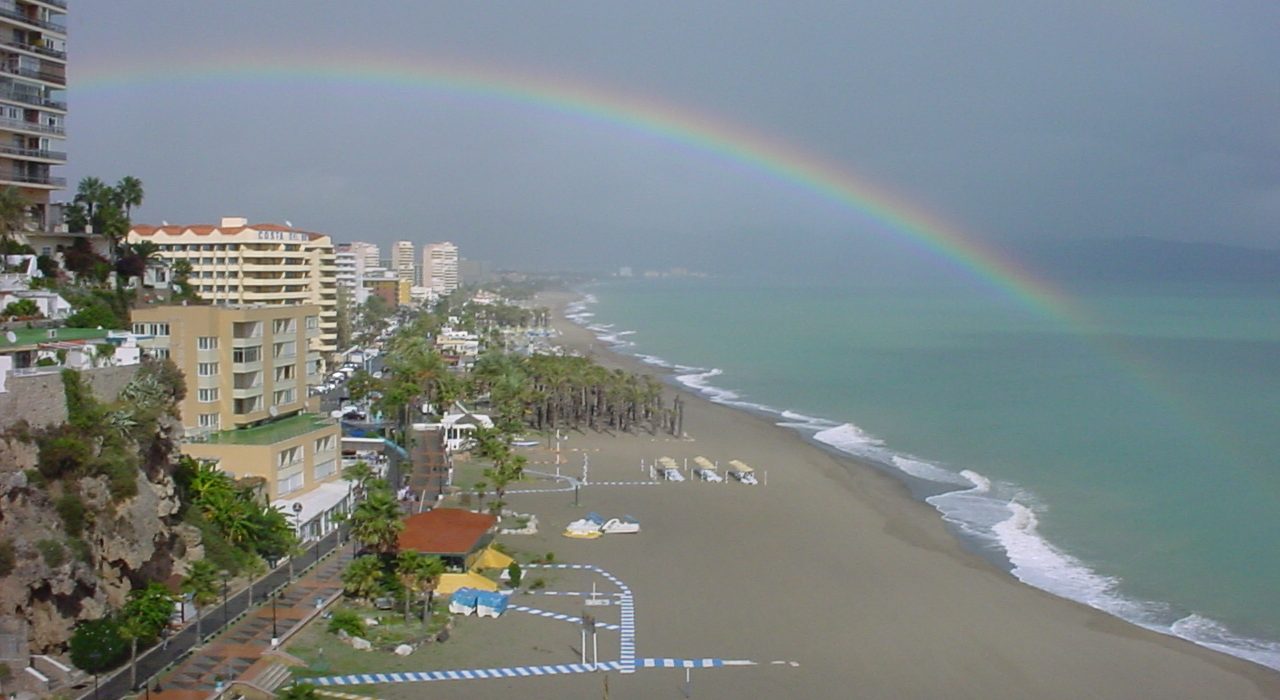
The sun beats down on the 40-meter-wide Playa del Bajondillo and the smell of sardines roasted on bamboo skewers drifts up from the chiringuitos (beach bars) along the seafront promenade. Higher up, silhouetted against the Mediterranean sky, the Torre de Pimentel has kept watch over the cliff since the 15th century, a silent witness to the days when the Nasrids defended this coast. This is Torremolinos: a Malaga municipality of 70,000 inhabitants on the Western Costa del Sol where sea, history, and food go hand in hand just 13 kilometers from the capital.
The must-seesWhat to see in Torremolinos: the must-sees
Parque de la Batería
Parque de la Batería covers more than 74,000 square meters and is, without question, Torremolinos’ main green lung. Here you’ll find over a thousand trees from 25 different species, a network of paths, a lake, children’s play areas, and a 15-meter lookout tower that rewards you with privileged views of the Mediterranean Sea. It sits north of La Carihuela, next to the Montemar Alto train station, and has a panoramic elevator for easy access. It’s perfect for a quiet morning, for a run, or simply for sitting down to read in the shade after a day at the beach.
Casa de los Navajas
Perched on the Bajondillo cliff stands this exposed-brick palace with oriental ornamental details that transports you to another era. Casa de los Navajas was built in the 20s and 30s of the 20th century, when wealthy families chose Torremolinos as a second residence, along with other unique enclaves such as the Parador de Montemar, the Castillo del Inglés, or the Casa Huerta del Rincón in La Carihuela. Admission is completely free, and exhibitions and cultural events are held inside. It’s accessed via Calle Bajondillo or Vía Las Mercedes, and the contrast between the oriental-style facade and the blue sea in the background is one of the most photogenic scenes in the municipality.
Centro Cultural Pablo Ruiz Picasso
The Centro Cultural Pablo Ruiz Picasso occupies the Antiguo Colegio de Huérfanos Ferroviarios (Former Railway Orphans’ School), a 1935 building declared a Bien de Interés Cultural (Asset of Cultural Interest) with Monument status (code RI-51-0006840), as recorded in the BOE (Official State Gazette) of June 29, 1985. Its architectural style belongs to the Modern Movement and it is one of the most distinctive protected buildings in the municipal area. Inside, temporary art exhibitions are programmed, mainly linked to the figure of the Malaga-born painter, as well as regular cultural activities for residents and visitors.
Torre de Pimentel (Torre de los Molinos)
The Torre de Pimentel is Torremolinos’ emblematic monument, originally known as Torre de los Molinos and renamed in honor of a military man who helped the Catholic Monarchs conquer Malaga at the end of the 15th century. It stands between Calle San Miguel and Cuesta del Tajo, on the path leading down to Playa del Bajondillo, and forms part of the extensive network of defensive towers developed by the Nasrids along the entire southern peninsular coast. You can visit its interior and take in magnificent views of the town and the Mediterranean coastline from above. Its location atop the cliff is no accident: its purpose was to warn of incursions from the sea.
Jardín Botánico Molino de Inca
The Jardín Botánico Molino de Inca is an oasis of nearly a thousand plant species set on the ruins of an old flour mill, the oldest in the area, which gives the complex its name. It is located on Camino de los Pinares, next to the Molino de Batán and El Pinar de los Manantiales, near the water park. Its history is tied to that of the municipality’s mills: for centuries the springs enabled flour production, the making of brown paper, and grain milling. Today it is an educational space devoted to Mediterranean flora and local hydraulic history, with watercourses fed by the historic springs. A refreshing and informative visit that breaks up the beach routine.
La Carihuela Beach
La Carihuela is one of the most important beaches on the Costa del Sol, with a seafront promenade dotted with chiringuitos (beach bars) specializing in pescaíto frito (fried fish) and beach clubs. Stars such as Grace Kelly, Ava Gardner, Orson Welles and Frank Sinatra spent their summers here in the 1950s and 60s, and the atmosphere of the old fishing quarter can still be felt. To the west it connects with Saltillo beach and Puerto Marina (Benalmádena), and to the east lies La Punta or Morro de Torremolinos, the natural monument that divides the seafront promenade in two.
Bajondillo Beach
Bajondillo is the main urban beach in Torremolinos: a stretch 40 meters wide and more than one kilometer long, with dark-toned sand, practically in the city center. It sits between La Carihuela and Playamar beaches, and is reached on foot from the center by walking down San Miguel street, where the Torre de Pimentel (Pimentel Tower) stands. It is one of the busiest beaches due to its central location and has all services close at hand.
Church of San Miguel Arcángel
The Catholic church in the center of Torremolinos dates from 1718 and combines traditional Andalusian architectural elements with modifications from later renovations. Inside, religious pieces linked to local devotion and patron saint celebrations are kept, especially during the Feria y Romería de San Miguel (San Miguel Fair and Pilgrimage) in September.
El Morro or La Punta de Torremolinos
This rocky natural monument divides La Carihuela and Bajondillo beaches and has documented history dating back to the 18th century, when its natural lookout housed a defensive battery. Today it is one of the most photographed spots in the municipality and offers panoramic views of the coastline that make the climb worthwhile.
Torre del Mirador
Torre del Mirador is located in the upper area of Torremolinos and is rated 4.6 out of 5 based on 157 reviews. It is a family-friendly and accessible space, suitable for children and wheelchair users, with free parking. It is recommended to visit during the day to make the most of the best views. Its address is 29620 Torremolinos, Málaga, Spain.
Plaza de Andalucía
Plaza de Andalucía is one of the most representative open spaces in the city center and a regular meeting point for locals and visitors. Surrounded by typical establishments, it hosts festive activities, markets and open-air events throughout the year that bring together much of the social life of the municipality.
Aqualand Torremolinos
Aqualand Torremolinos is the area’s leading water park, perfect for a family day out, especially during the central summer months.
🍂 Otoño
Si visitas Torremolinos en otoño, septiembre es el mes estrella: se celebra la Feria y Romería de San Miguel y también el Día del Turista, con actividades para todos. El calor afloja pero el mar sigue templado, perfecto para subir a El Morro o La Punta de Torremolinos y contemplar el atardecer. Consejo: reserva con antelación si viajas en septiembre, es temporada alta y el alojamiento se llena rápido.
What to do in Torremolinos
Torremolinos offers a festive calendar that sets the rhythm of the year, starting with the Cruces de Mayo (May Crosses), with its competition of altars set up in different parts of the municipality, and continuing with the Feria del Carmen in July, which turns the fishing quarter of La Carihuela into a pilgrimage with a maritime procession, an amusement park in Plaza del Remo and a lively caseta (festival tent) with live music. In September, the patron saint Feria y Romería de San Miguel fills the center with an opening speech, day and night fair, concerts and a procession, while Día del Turista (Tourist Day) honors visitors with tastings. If golf is your thing, the Torrequebrada area is home to a renowned course; if you prefer beach and party, Playamar and La Carihuela are your neighborhoods. For more practical information, opening hours, tickets and events, check the official Torremolinos tourism website.
Torremolinos in one day: express itinerary
- 09:00 — Parque de la Batería: start the day among the thousand trees of this green lung, climb the 15-meter lookout tower, and have breakfast by the lake.
- 11:00 — Torre de Pimentel: walk down Calle San Miguel to the Torre de los Molinos, visit its interior, and gaze at the Mediterranean from the cliff.
- 12:30 — Centro Cultural Pablo Ruiz Picasso: refresh body and mind with the current temporary exhibition in the 1935 building declared a BIC (Asset of Cultural Interest).
- 14:00 — Lunch in La Carihuela: pescaíto frito (assorted fried fish) and espeto de sardinas (sardine skewers) at one of the historic chiringuitos (beach bars) on the seafront promenade.
- 16:30 — Playa del Bajondillo or La Carihuela: swim, stroll along the shoreline, and don’t forget to photograph El Morro.
- 19:00 — Casa de los Navajas: end the day with a free visit to this exposed-brick palace and its sunset views.
- 21:00 — Dinner and tapeo around Plaza de Andalucía or the La Carihuela promenade.
Where to eat in Torremolinos: local gastronomy
Where to stay in Torremolinos
La Carihuela
Antiguo barrio de pescadores convertido en zona gastronómica premium junto al mar. Destaca por su paseo marítimo lleno de restaurantes de alta calidad y ambiente sofisticado pero tradicional.
Centro Ciudad
Núcleo urbano y administrativo donde se concentra el comercio local, servicios y vida cotidiana alejada del turismo masivo de playa. Ofrece una experiencia más auténtica y residencial.
Playamar
Zona turística clásica con gran concentración de hoteles, apartamentos y zonas comerciales peatonales. Es el corazón del turismo de sol y playa con acceso directo a una playa amplia.
El Bajondillo
Área residencial y turística situada entre el centro y La Carihuela, conocida por su acantilado y vistas panorámicas. Combina hoteles con urbanizaciones tranquilas y acceso a calas.
Montemar
Barrio elevado sobre el mar caracterizado por complejos hoteleros grandes y jardines extensos. Ofrece un ambiente más tranquilo y aislado del bullicio de las calles principales.
Torrequebrada
Zona occidental límite con Benalmádena que alberga un importante campo de golf y centro comercial. Ideal para quienes buscan actividades deportivas y entretenimiento específico.
How to get to Torremolinos
The main rail connection for Torremolinos is Los Prados station, which does not have AVE services, according to Renfe data. The municipality is integrated into the Malaga metropolitan transport network and is located 13 kilometers from the center of the capital. For greater convenience and international connections, the most common option is to fly to Malaga Airport and complete the journey by road or public transport.
| Medio | Duración aprox. | Precio orientativo | Frecuencia |
|---|---|---|---|
| Tren (cercanías, estación Los Prados) | Variable según origen | Billete medio según Renfe | Trayectos regulares de cercanías |
| Autobús interurbano | Variable según origen | Tarifa estándar | Servicios frecuentes desde Málaga capital |
| Coche / taxi desde Málaga | 15-20 minutos | Tarifa según trayecto | Acceso directo por autovía |
How to get around Torremolinos
The urban bus is the most practical way to move around the municipality, with lines connecting the main neighborhoods: La Carihuela, Bajondillo, Playamar, Montemar, the town center, and the Torrequebrada area. The Montemar Alto train station serves Parque de la Batería and the upper neighborhoods, and walking between the center, Bajondillo, and La Carihuela is short and pleasant, with the seafront promenade as a continuous axis. For excursions to Benalmádena or Malaga, the Renfe cercanías (commuter train) is very convenient.
Weather in Torremolinos
Best time to visit Torremolinos
Day trips from Torremolinos
Torremolinos is perfectly located to combine beach time with cultural getaways around the province of Malaga. Just 13 kilometers away lies the capital, Malaga, with its historic center, the Picasso Museum, the Alcazaba and the port, connected by Renfe Cercanías. To the west, Benalmádena offers Puerto Marina, one of the best-known marinas in the Mediterranean, and its cable car with views over the coast. Further south, Fuengirola combines family-friendly beaches with the Castillo de Sohail (Sohail Castle), while Marbella, a bit farther away, boasts an Andalusian old town and an upscale atmosphere. Finally, the town of Mijas, with its famous burro-taxi and its white village landscape perched above the coast, is a highly recommended half-day excursion. The Renfe Cercanías network and intercity buses cover all these connections with regular frequencies.
Who Torremolinos is for
Torremolinos is, above all, a destination for sun and beach lovers, but also for foodies thanks to the density of chiringuitos specializing in pescaíto frito (fried fish) and espeto de sardinas (sardine skewers) in La Carihuela. Families with children find a good fit in Playamar, Montemar and Aqualand Torremolinos, with wide beaches and services right on the sand. Couples looking for a mixed plan of sea, gastronomy and sunsets have El Bajondillo and La Carihuela as their ideal neighborhoods, while golf and nightlife enthusiasts feel at home in Torrequebrada. Travelers with a historical interest can dedicate a day to the Torre de Pimentel (Pimentel Tower), the Casa de los Navajas (House of the Navajas) and the Centro Cultural Pablo Ruiz Picasso (Pablo Ruiz Picasso Cultural Center), declared a BIC (Site of Cultural Interest) in 1985. It is not, however, the typical backpacker destination: the offering is clearly oriented toward tourists seeking comfort, services and a festive calendar all year round.
Frequently asked questions about Torremolinos
How many days do I need to see Torremolinos?
With two full days you can see the main attractions: the Torre de Pimentel (Pimentel Tower), the Casa de los Navajas (Navajas House), the Centro Cultural Pablo Ruiz Picasso (Pablo Ruiz Picasso Cultural Center), the Parque de la Batería (Battery Park) and the Jardín Botánico Molino de Inca (Molino de Inca Botanical Garden), as well as enjoying the beaches of La Carihuela and Bajondillo. If you want to add a day trip to Málaga or Benalmádena, add a third day without rushing.
What is the best time of year to visit Torremolinos?
According to AEMET data, the best time runs from April to October, with average temperatures of 13.0°C in winter and 25.5°C in summer and annual precipitation of 506.4 mm. May, June and September are especially recommended months for combining beach, culture and day trips without the crowds of high summer.
How do I get to Torremolinos from Madrid?
The fastest option is flying to Málaga Airport and from there completing the transfer by road or on Renfe Cercanías to Los Prados station, which does not have AVE services according to Renfe data. The road journey from Madrid is completed by highway in around five and a half hours, depending on traffic.
Is Torremolinos a beach-only destination?
No. Although the Costa del Sol is its hallmark, the municipality treasures the Torre de Pimentel (a 15th-century Nasrid symbol), the Casa de los Navajas from the 1920s, the Centro Cultural Pablo Ruiz Picasso declared a BIC (Asset of Cultural Interest) in 1985, the Parque de la Batería with its lookout tower and the Jardín Botánico Molino de Inca built around an old flour mill. The cultural offering perfectly complements the beach offering.
What typical dishes should I try in Torremolinos?
The pescaíto frito (small fried fish), born on the beaches of Torremolinos in the 1960s and considered a symbol of Málaga gastronomy; the espeto de sardinas (sardine skewers) roasted on a cane over the sand, and the cazuela de fideos con pintarroja (noodle casserole with small-spotted catshark), a local maritime stew. The chiringuitos (beach bars) of La Carihuela and Bajondillo are the best setting to enjoy them.