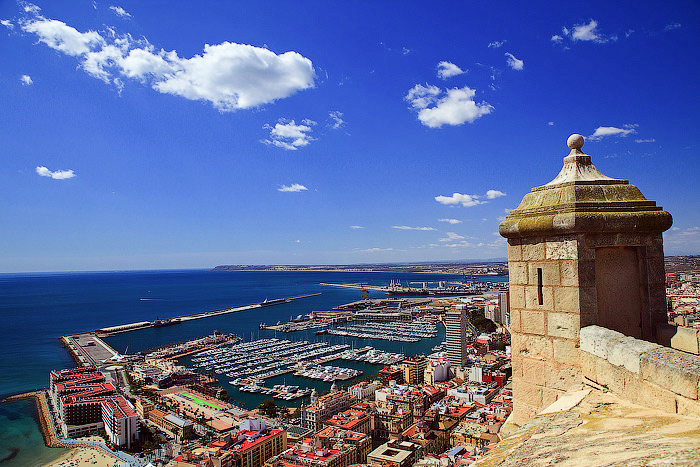
Torrevieja → Alicante
43 kmImagine driving with the window down, feeling the Mediterranean breeze on your face as the coastal landscape unfolds before you in a succession of blues and golds; this journey is not just a way to get from one place to another—it is the perfect prelude to a holiday on the Costa Blanca, where the short distance between two of Alicante’s gems lets you enjoy the trip as much as the destination.
How to get from Torrevieja to Alicante: quick overview
The most efficient and recommended option for covering this route is undoubtedly a private vehicle, given that there is no direct rail connection and the distance is short.
When planning your trip from Torrevieja to Alicante, you will find yourself in a scenario where the flexibility of a car beats other alternatives hands down. According to verified route data, we are looking at a journey of just 43 kilometres, making this one of the fastest connections in the province. Although many travellers often look for public transport options to avoid the stress of traffic or parking, in this specific case the rail infrastructure works against the tourist seeking immediate convenience. With no train station in Torrevieja and no direct line connecting the two points, the logistics are drastically simplified: your car is your best ally.
For the independent traveller or the family looking to explore the Costa Blanca at their own pace, the recommendation is clear. Forget about looking for train timetables that do not exist or relying on complex connections that could stretch out a journey that, under normal conditions, is a matter of minutes. If you are travelling alone and do not have access to a vehicle, you will need to look into intercity bus options, as the data confirms that the rail option is ruled out from the outset. However, for the vast majority of traveller profiles—especially those on holiday who want to move freely around the area—renting a car or using your own is the only sensible way to guarantee a punctual arrival with no transfers.
The beauty of this route overview lies in its simplicity. There are no complications with changing platforms or uncertain waits. It is a point-to-point route, designed by geography and road infrastructure to be seamless. Whether you are travelling to the capital on business or for pleasure to enjoy its beaches, the conclusion is unanimous: the road is the undisputed star of this journey.
Driving from Torrevieja to Alicante
Driving from Torrevieja to Alicante is a quick and straightforward journey that takes place entirely on toll-free motorways, taking approximately 35 minutes to cover the 43 kilometres of distance.
The driving experience on this route is remarkably pleasant, especially if you are lucky enough to travel at a time of year with good weather. As you leave Torrevieja, you will join the high-capacity road network that runs along the coast. The first main artery you will come across is the A-7, known as the Autovía del Mediterráneo (Mediterranean Motorway) or Autovia de la Mediterrània. This road is essential for transport in eastern Spain and, on this particular stretch, offers smooth traffic flow. The best thing for your wallet is that the A-7 in this sector has no tolls, which means you can enjoy high-quality motorway driving without having to stop at toll booths or worry about the additional cost of the journey beyond fuel.
As you approach the capital, the route will lead you to connect with the A-31, the Autovía de Alicante (Alicante Motorway) or Autovia d’Alacant. This road acts as the backbone that takes you directly into the city. Like its predecessor, the A-31 is a toll-free road, which greatly simplifies travel budget planning. The combination of these two motorways ensures that the journey is safe and well signposted. However, it is important to take the time variable into account. Although the estimated driving time is 35 minutes, this figure can fluctuate depending on the time of day. At peak times, especially if your arrival in Alicante coincides with the start or end of the working day, the 35 minutes could extend slightly due to traffic density on the approaches to the city.
The landscape during the journey is typically Mediterranean. Driving along the A-7 and the A-31 allows you to enjoy views that combine the proximity of the sea with the characteristic vegetation of the area. It is a journey that does not feel tedious; in fact, it is so short that there is barely time to put on a full playlist before you have to start looking for the exit towards your hotel or final destination. The quality of the asphalt on these motorways is usually good, allowing for comfortable and relaxed driving. That said, remember to keep your attention on the traffic signs, as the slip roads and exits on the motorways surrounding large cities can come up quickly and require a certain agility behind the wheel.
Where to stay in Alicante
Choosing where to stay in Alicante depends entirely on whether you prioritize nightlife and the urban buzz or you’re looking for peace and quiet and direct access to the sand.
Alicante is a city with a very varied accommodation offer, suited to all kinds of budgets and travel styles. After arriving from those 43 kilometers from Torrevieja, you’ll find several key areas to set up your base of operations. The most sought-after area tends to be the City Center and the Explanada. Staying here puts you in the heart of the action. You’ll be just steps away from the main shops, tapas restaurants, and the famous Explanada de España, that seaside promenade of colorful waves that is the city’s icon. Accommodations in this area tend to be mid-range and upscale hotels, as well as tourist apartments. Prices in this area tend to be higher, especially in high season, but the convenience of not needing the car to go out for dinner or take a stroll makes up for the cost.
For those travelers seeking a more relaxed, family-friendly experience, the Playa de San Juan area or the neighborhoods near Postiguet are excellent options. These areas let you combine cultural visits to the city with beach days. In these areas, it’s common to find apartment complexes and resort-style hotels. Price ranges here can be very broad: from budget options in hostales or guesthouses away from the beachfront, to luxury hotels with sea views. If you’re traveling by car, as is most likely coming from Torrevieja, staying in these outlying or beach areas can be an advantage, since it’s usually easier to find parking, though sometimes paid, than in the historic center.
If your budget is tighter, there are options in the residential neighborhoods surrounding the center, well connected by urban public transport or within walking distance of the points of interest. Price ranges in Alicante tend to fluctuate considerably depending on seasonality. In winter, you can find very competitive deals in central hotels, while in July and August prices skyrocket and availability drops drastically. There are no specific hotel names you should blindly search for; what matters is filtering by location. If you want atmosphere, search “Centro”. If you want sun and sand, search “Playa”. And if you want to save money, look for options 10-15 minutes’ walk from the main tourist hub.
Frequently asked questions about the Torrevieja-Alicante route
How long does it take to get from Torrevieja to Alicante?
The estimated time to complete this journey by private vehicle is approximately 35 minutes. This calculation is based on a road distance of 43 kilometers traveled mainly on the A-7 and A-31 highways. However, it is important to keep in mind that this time is an estimate under normal traffic conditions. During the summer months, when tourism on the Costa Blanca reaches its peak, or during weekday rush hours, travel time may increase due to the higher density of vehicles on the approaches to the city of Alicante.
Which is cheaper, the train or the bus?
This comparison has an important peculiarity on this route: there is no train option. According to verified data, there is no direct train and, in fact, there is no train station in Torrevieja, so the rail option is ruled out from the point of origin. Since train ticket prices cannot be compared because the service is not available for this direct journey, the real economic comparison is between using your own car (or a rental car) and the intercity bus. The car, being a short 43 km route on toll-free highways, can be very cost-competitive if traveling in a group, splitting the fuel cost. The bus is usually the economical alternative for individual travelers, but it requires checking specific schedules from private companies, since the public rail infrastructure does not cover this connection.
Is it worth renting a car?
Yes, renting a car is highly recommended and, in many cases, the most logical option for this route. The main reason is the lack of direct rail connectivity from Torrevieja, which limits mobility if you depend exclusively on the train. Additionally, the distance is very short, only 43 km, and the driving time is quick, barely 35 minutes. Having a car allows you not only to reach Alicante without depending on bus schedules, but also to enjoy the freedom to move around the city and its surroundings, visit secluded beaches, or return to Torrevieja whenever you wish. The existence of toll-free highways such as the A-7 and A-31 makes the decision to rent a vehicle even easier, eliminating toll costs from the trip.
When is the best time to travel?
The best time to travel depends on what you are looking for in your experience. If your goal is to enjoy beach weather and the summer atmosphere, the months from June to September are ideal, although you should expect more traffic on the A-7 and A-31 roads, which could increase travel time beyond the usual 35 minutes. On the other hand, if you prefer smoother driving, finding parking easily in Alicante, and enjoying the city without crowds, spring (April-May) and autumn (September-October) are excellent seasons. In these months, the weather remains pleasant on the Costa Blanca, but tourist pressure decreases, making the 43 km journey even more relaxed and quick.
📍 También te puede interesar
Qué ver en Torrevieja →
Qué ver en Alicante →