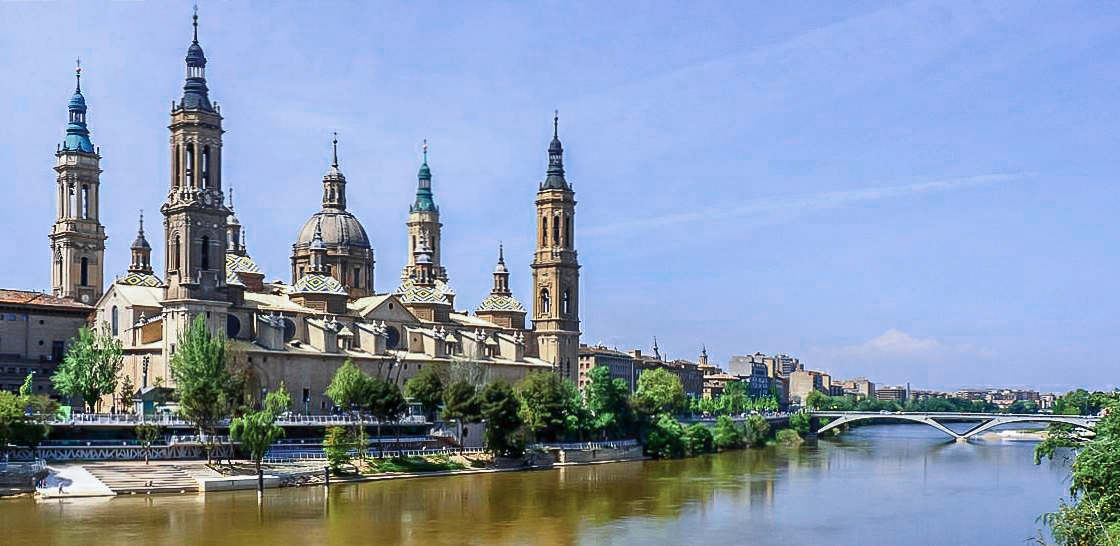
Logroño → Zaragoza
167 kmCrossing the border between La Rioja and Aragon means entering a landscape that subtly shifts from endless vineyards to the drier, more majestic lands of the Ebro Valley. This short but intense journey lets you connect two capitals brimming with history and gastronomy in less time than it would take you to enjoy a good set lunch menu, whether you’re savoring the freedom of the open road or relaxing in the comfort of the train.
How to get from Logroño to Zaragoza: quick overview
The fastest and most comfortable option for this route is Renfe’s ALVIA train, which covers the distance in 112 minutes, although driving offers total flexibility to explore the surrounding area on a 167 km journey.
If you’re looking for efficiency and don’t want to worry about traffic or parking, the train is your best ally, with up to six daily connections that drop you in the heart of Zaragoza-Delicias station. On the other hand, if your plan involves moving around freely once you arrive or you want to take a sightseeing route stopping in intermediate towns, driving is the logical choice, especially since there is no direct bus service covering this specific route. For the independent traveler who values their time, the train wins hands down in comfort, while for the roadtripper, the highway is an invitation to discover the Ribera Navarra and Bajo Aragón regions.
Driving from Logroño to Zaragoza
The drive covers a distance of 167 km and takes approximately 1 hour and 45 minutes using a network of toll-free highways.
Driving between these two cities is a smooth experience thanks to the excellent road infrastructure available. The main and most direct route usually involves taking the A-68 (Autovía del Ebro), a fast highway that follows the course of the river and connects both capitals without interruptions or tolls. However, depending on your exact departure point in Logroño or your route preferences, you have at your disposal a range of verified roads that guarantee a journey with no additional toll costs.
Among the options available for planning your route are the A-12 (Donejakue Bidearen autobia) and the A-15 (Autovía de Navarra), which will allow you to connect safely with the main network. It is also possible to use sections of the A-11 (Autovía del Duero) or the A-13 if your route deviates slightly north before descending toward the valley. For drivers who prefer conventional roads or alternative routes, the N-232 (Carretera de Vinaròs a Santander) and the N-122 (Carretera Zaragoza a Portugal por Zamora) are valid options, although they tend to be slower than the highways. As you approach Zaragoza, the A-2 (Autovía del Nordeste) and the A-23 (Autovía Mudéjar) are the main access routes that will leave you at the city’s entry points. The best part of this entire journey is that all these roads, from the A-68 to the national roads, are completely free, meaning the cost of the trip is reduced solely to fuel.
By train from Logroño to Zaragoza
The train is the most efficient means of transport, operated by Renfe, with a minimum journey time of 112 minutes and six daily departures.
Traveling by train between Logroño and Zaragoza is surprisingly fast and comfortable. The operator Renfe runs this service with a variety of train types that cater to different needs in terms of speed and comfort. The origin station is Logroño and the final destination is the modern Zaragoza-Delicias station, an excellent transport hub that connects you with the rest of the city.
If speed is your priority, you should look for the ALVIA services. According to frequency data, there is 1 ALVIA train per day that completes the journey in a record time of 112 minutes. This type of train offers a superior level of comfort and is ideal for business travelers or tourists who want to maximize their time at the destination. There is also the option of the MD (Media Distancia) train, with 1 daily service that also completes the journey in 112 minutes, offering a fast alternative similar to the ALVIA.
For those travelers seeking more schedule flexibility or possibly a tighter price, the most frequent option is the REG.EXP. (Regional Exprés) trains. There are 4 trains of this type per day, with a slightly longer duration of 131 minutes. Although they take about 20 minutes more than the high-speed trains, they remain a very competitive option compared to driving, as they allow you to read or work during the journey. In total, you have 6 daily trains, with the first at 6:15 in the morning and the last at 20:42, giving you ample margin to organize your day without extreme early-morning rushes.
Recommended stops along the way
If you decide to make the journey by car, you have eight verified stops ideal for stretching your legs, eating, or visiting briefly before arriving in Zaragoza.
The route is dotted with charming towns that deserve a pause. Here is the detail of each of the recommended stops according to the route data:
- Lardero: Located very close to the start of the route, it is a municipality that functions almost as an outer suburb of Logroño. It is a strategic point if you need to leave the city at a relaxed pace or run one last errand before getting on the highway.
- Villamediana de Iregua: Just after Lardero, this town offers a more rural and tranquil setting. It is perfect for a quick 10-minute technical stop to stretch your legs before heading onto the motorway.
- Alfaro: Already on the border with Navarre, Alfaro is known for its ceramics and its history. Stopping here allows you to breathe the air of the Ribera region and perhaps visit its old town if you have time for an hour-long break.
- Calahorra: This city is an important milestone on the route. Known as the “City of Vegetables,” it is the perfect place to stop for lunch. Its culinary offering is extensive and it is halfway along the route, making it the logical stop for a midday meal.
- Tudela: Capital of the Ribera of Navarre, Tudela is a must-stop if you like history and architecture. Its cathedral and its Plaza de los Fueros are points of interest that justify a slight detour or extending the stop for a coffee with a view.
- Soria: Although Soria requires a more significant detour to the west, it is included as a recommended stop for those travelers who want to turn the journey into a full-day excursion, enjoying the Castilian capital before resuming the road toward the Ebro.
- Ejea de los Caballeros: Already entering Aragonese territory, Ejea is a historic town with an imposing castle. It is the last major stop before reaching the capital, ideal for buying local products or visiting its museum before the final stretch.
- Utebo: Located right at the gates of Zaragoza, Utebo is famous for its Mudéjar tower, a World Heritage Site. Stopping here allows you to see an architectural gem without having to enter the dense traffic of central Zaragoza yet.
Where to stay in Zaragoza
To stay in Zaragoza, the best areas are the Historic Center for cultural tourism and the area around Delicias Station for transport convenience.
Zaragoza offers a variety of accommodations to suit all budgets, and although we cannot cite specific hotel names, we can guide you through the most convenient areas. If you arrive by train, the Zaragoza-Delicias area is extremely practical. Here you will find international chain hotels and mid-range options that allow you to leave the car (if you have rented one) or rest as soon as you get off the train. It is a modern area, well connected by tram and bus to the center.
If your goal is to enjoy the city to the fullest, we recommend looking for accommodation in the Historic Center, near Plaza del Pilar or Plaza de España. In this area, prices can range from budget hostels to high-end boutique hotels. The advantage is that you will have the Basilica, the Seo, and the Aljafería within a few minutes’ walk. Price ranges in the center tend to be higher, especially on weekends, but the experience of strolling at night through El Tubo (tapas area) makes the investment worthwhile. For travelers on a tighter budget, peripheral areas well connected by tram also offer apartment and guesthouse options at lower prices.
Frequently asked questions about the Logroño–Zaragoza route
How long does it take to get from Logroño to Zaragoza?
Travel time depends on the mode of transport you choose. By car, the 167 km journey takes approximately 1 hour and 45 minutes. By train, the time varies depending on the type of service: ALVIA and MD trains take 112 minutes, while Regional Exprés trains take 131 minutes.
Which is cheaper, the train or the bus?
There is currently no direct bus service between Logroño and Zaragoza, so a direct price comparison is not possible for a journey without transfers. The train is the only direct public transport option, with fares that vary according to how far in advance you book and the type of train (ALVIA, MD or REG.EXP.), while driving involves the fuel cost for 167 km.
Is it worth renting a car?
Renting a car is worth it if you plan to make several of the recommended stops along the route, such as Tudela, Calahorra or Ejea de los Caballeros, or if you need mobility once in Zaragoza. If your only goal is to get from point A to point B quickly, the 112-minute ALVIA train is more comfortable and avoids the stress of traffic and parking.
When is the best time to travel?
The best time to travel depends on your interests, but given the train frequency (6 per day) and the weather for driving on the A-68, any time of year is viable. However, avoiding local holidays in both cities will help you find accommodation in Zaragoza at better prices and enjoy smoother traffic on the toll-free motorways.
📍 También te puede interesar
Qué ver en Logroño →
Qué ver en Zaragoza →