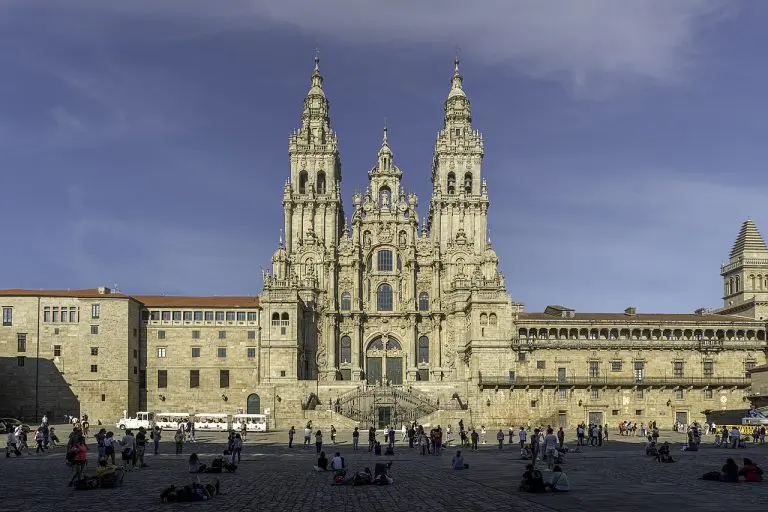
Vigo → Santiago de Compostela
90 kmHow to get from Vigo to Santiago de Compostela: quick summary
The fastest option is the train, with direct journeys from 52 minutes according to Renfe, while driving yourself will take roughly 1 hour on the motorway. The bus is the cheapest alternative, with tickets between 7 and 16 euros and a journey time of 75 minutes. For those who want to explore the Rías Baixas (estuaries) without rushing, the car lets you stop in Pontevedra or Vilagarcía, something impossible on a direct train.
Driving from Vigo to Santiago de Compostela
The drive covers 90 km in approximately 1 hour, making it the most flexible route for stopping off for food or scenery. The backbone of the trip is the AP-9V, which passes through the Túnel de Teis (Teis Tunnel) and accounts for around 76 km of the route, offering ever-changing views between the ría de Vigo and the inland valleys. You’ll then join the AP-9, the Autoestrada do Atlântico, for about 7 km of toll road that leads straight into Santiago. Bear in mind that the AP-9 is a toll road on this final stretch, so carry cash or a card for the toll. If you travel at peak times, access to Vigo via the Túnel de Teis can slow down, but once past it, traffic flows smoothly.
By train from Vigo to Santiago de Compostela
According to Renfe, there are 25 direct trains a day between Vigo Urzaiz and Santiago de Compostela-Daniel Castelao, with departures from 05:08 to 21:50. The fastest service is the MD (Media Distancia), with 13 daily trains completing the journey in just 52 minutes; it’s followed by the AVE (2 a day, 55 min), the ALVIA (1 a day, 56 min), the AVLO (1 a day, 60 min) and the REGIONAL (8 a day, 84 min). The departure station is Vigo Urzaiz, central and well connected, while arrival is at Santiago de Compostela-Daniel Castelao, about a 15-20 minute walk from the old town. Prices vary depending on how far in advance you book and the type of train, but the MD usually offers the best speed-to-price ratio for most travellers.
By bus from Vigo to Santiago de Compostela
The direct bus takes 75 minutes and costs between 7 and 16 euros, making it the cheapest option for this route. Three main companies operate: Transporte Público de Galicia, ALSA and Monbus, with regular departures throughout the day from Vigo bus station. Although it’s slightly slower than the fastest train, the bus makes up for it with stable prices and the chance to find last-minute tickets without the AVE’s fare spikes. If your priority is saving money and you don’t mind giving up 20-25 minutes compared with the MD, the bus is unbeatable.
Recommended stops along the way
If you’re travelling by car, these six stops turn a 1-hour journey into a memorable route through the Rías Baixas and the Galician interior.
- Redondela: The first possible stop after leaving Vigo, famous for its railway viaducts and its compact old town. Ideal for a quick coffee before carrying on.
- Pontevedra: The most recommended stop on the whole route. Its pedestrianised historic centre, the plaza de la Leña and the basílica de Santa María justify a 1-2 hour break. Perfect for eating pulpo a la gallega (Galician-style octopus) in its tascas.
- Marín: A coastal town with a fishing port and authentic seafaring atmosphere. Less touristy than Pontevedra, it offers a quiet seafront promenade and restaurants serving fresh fish.
- Vilagarcía: The capital of the O Salnés region, with an urban beach and seafront promenade. A good option for stretching your legs by the sea before heading inland.
- Bertamiráns: A small town on the doorstep of Santiago, useful for a final practical stop or to avoid the traffic entering the capital if you’re travelling at peak times.
- O Milladoiro: The last settlement before Santiago, with ample parking areas and good access. If you arrive late and want to avoid hunting for parking in the centre, you can leave the car here and take a city bus.
Where to stay in Santiago de Compostela
The best area to stay is the historic centre, around the Cathedral, with boutique hotels, guesthouses and tourist apartments in centuries-old stone buildings; prices usually range from 60 to 150 euros per night depending on the season. The Ensanche, the modern area between the train station and the old town, offers chain hotels and cheaper apartments, with ranges of 50 to 100 euros. For pilgrims and tighter budgets, hostels and guesthouses near Rúa do Vilar and the San Pedro area cost between 15 and 35 euros per bed. If you’re travelling by car, consider staying in O Milladoiro or Bertamiráns, where there are roadside hotels with free parking and prices 20-30% lower than in the centre.
Where to eat along the route
Galician gastronomy turns this 90 km journey into a culinary pilgrimage. In Pontevedra and Santiago, pulpo a la gallega (Galician-style octopus) is a must: slices of boiled octopus over potatoes, sprinkled with paprika, coarse salt and olive oil, typical of fiestas and romerías. The empanada gallega, a bread dough filled with tuna, onion and tomato (or meat and seafood), is the perfect bite to take in the car or have as a tapa in any bar in Redondela or Vilagarcía. Caldo gallego, a hearty soup of grelos (turnip greens), potatoes, white beans and pork, is ideal if you travel in winter. To drink, Albariño from the Rías Baixas, a young, fruity white, pairs perfectly with seafood, while Ribeiro from Ourense offers a fresher, more acidic profile. For dessert, the tarta de Santiago, flourless and made with ground almonds, is recognisable by the cross of Saint James drawn with icing sugar. Finish with a licor café, a digestif of aguardiente macerated with coffee, very popular in Santiago and Vigo.
Frequently asked questions about the Vigo-Santiago de Compostela route
How long does it take from Vigo to Santiago de Compostela?
By car, 1 hour to cover 90 km along the AP-9V and AP-9. By train, the fastest MD takes 52 minutes, the AVE 55, the ALVIA 56, the AVLO 60 and the REGIONAL 84. By bus, 75 minutes.
Which is cheaper, the train or the bus?
The bus is cheaper, with tickets between 7 and 16 euros depending on ALSA, Monbus and Transporte Público de Galicia. The Renfe train has variable prices depending on how far in advance you book and the type of service, but generally costs more than the bus, especially on AVE or ALVIA. The MD is usually the most economical rail option.
Is it worth renting a car?
Yes, if you want to stop in Pontevedra, Vilagarcía or Redondela, something impossible on a direct train or bus. The car gives you total flexibility on a journey of just 1 hour, and lets you explore the Rías Baixas at your own pace. If you’re only going to Santiago and don’t plan any stops, the 52-minute MD train is more efficient and avoids the AP-9 toll.
When is the best time to travel?
Spring and autumn are ideal: mild temperatures, fewer crowds than in summer and spectacular green landscapes. Summer offers more hours of daylight and a festive atmosphere, but Santiago fills up with pilgrims and accommodation prices rise. Avoid days of heavy rain in winter if you’re travelling by car, as the AP-9 can be foggy on high sections.
💡 ¿Sabías que...?
- ● Santiago de Compostela es, junto con Jerusalén y Roma, uno de los tres grandes núcleos de peregrinación del cristianismo. (https://es.wikipedia.org/wiki/Santiago_de_Compostela_(La_Coru%C3%B1a))
- ● La ciudad antigua de Santiago es Patrimonio de la Humanidad por la Unesco desde 1985. (https://es.wikipedia.org/wiki/Santiago_de_Compostela_(La_Coru%C3%B1a))
- ● El nombre de Compostela aparece citado por primera vez en un texto del año 955. (https://cvc.cervantes.es/artes/camino_santiago/decimotercera_etapa/santiago.htm)
- ● En el año 997 la ciudad fue saqueada por las tropas de Almanzor. (https://cvc.cervantes.es/artes/camino_santiago/decimotercera_etapa/santiago.htm)
📍 También te puede interesar
Qué ver en Vigo →
Qué ver en Santiago de Compostela →