Córdoba → Sevilla
143 kmHow to get from Córdoba to Seville: quick summary
The route between Córdoba and Seville can be done by car (1h 30min via the A-4), by direct high-speed train (52 minutes on the fastest service) or by bus (110 minutes). The train is the most efficient option for most travellers, with 51 daily services and departures from 06:20 to 23:03. If you’re looking for flexibility to explore the towns in between, a car will let you detour to places like Alcalá de Guadaíra or Carmona. The bus is the cheapest alternative, with tickets from 8.50€.
By car from Córdoba to Seville
The most direct option is to take the A-4 (Autovía del Sur, the Southern Motorway), which covers approximately 132 km of the 143 km total route with no tolls. The estimated driving time is 1 hour and 30 minutes under normal traffic conditions. The motorway crosses the typical landscape of the Andalusian countryside, with fields of olive trees, wheat and sunflowers that change colour with the seasons. As you approach Seville, the terrain becomes flatter and the first marshes of the Guadalquivir appear. Bear in mind that at peak times (especially Friday afternoons and Sunday evenings) traffic can build up on the approaches to Seville.
By train from Córdoba to Seville
According to Renfe, there are 51 direct trains a day between Córdoba and Seville, with departures from 06:20 to 23:03. The fastest journey takes 52 minutes and is offered by AVE trains (19 a day), AVLO (3 a day) and AVANT (11 a day). Ouigo trains also run (3 a day, 53 minutes), along with Intercity (6 a day, 63 minutes), ALVIA (2 a day, 70 minutes) and Media Distancia (7 a day, 94 minutes). The departure station is Córdoba-Julio Anguita and the arrival station is Sevilla-Santa Justa. Prices vary depending on the type of train and how far in advance you book, with AVLO and Ouigo generally the cheapest. Santa Justa station is well connected to the centre of Seville by city buses, taxi and metro line 1 (Nervión stop, about a 10-minute walk).
By bus from Córdoba to Seville
ALSA operates direct buses between Córdoba and Seville with a journey time of 110 minutes. The ticket price ranges from 8.50€ to 19.48€ depending on how far in advance you book, the time of day and the class of seat. Buses leave from Córdoba bus station and arrive at Plaza de Armas station in Seville, located next to the Guadalquivir river and about a 15-minute walk from the historic centre. It’s a comfortable option for those in no hurry who want to save money, although the frequency is lower than that of the train.
Recommended stops along the way
If you’re travelling by car, these eight towns are verified as accessible stops from the main route. None of them involves a significant detour, and all offer a glimpse of Andalusian life away from the tourist bustle.
Gelves
Gelves sits on the banks of the Guadalquivir, practically within the metropolitan area of Seville. It’s a quiet town with a pleasant riverside promenade where you can stretch your legs. Its proximity to the capital makes it a quick, hassle-free stop.
Posadas
Posadas is located in the Alto Guadalquivir region, right in the heart of the Cordoban plain. It’s a farming town surrounded by orange and olive trees. Its parish church and whitewashed streets are a typical example of popular Andalusian architecture. It’s a good option for a mid-journey coffee.
San Juan de Aznalfarache
San Juan de Aznalfarache looks out over the Guadalquivir from a hilltop, offering panoramic views of Seville. Its elevated position lets you take in the river and the city before entering the capital. The municipality has a long history dating back to Roman and Andalusian times.
Alcalá de Guadaíra
Alcalá de Guadaíra is known for its Moorish castle overlooking the Guadaíra river. The town is famous for its flour mills and its baking tradition, which supplies much of Seville. Its old quarter, with the church of Santiago and the Roman bridge, is well worth a leisurely stroll.
Alcalá del Río
Alcalá del Río lies north of Seville, on the right bank of the Guadalquivir. It’s a town with Roman roots, as the archaeological remains found in the area attest. Its riverside setting is ideal for a relaxing stop before tackling the final kilometres.
Brenes
Brenes is a town in the Vega del Guadalquivir, surrounded by farmland. Its economy revolves around agriculture and the food-processing industry. It’s a low-key but authentic stop, with tapas bars where you can try unpretentious local cooking.
Camas
Camas borders Seville to the west and is known for its pottery tradition. The town has a strong cultural identity, with deeply rooted Holy Week brotherhoods. Its proximity to the river and the capital makes it a quick and convenient stop.
Cantillana
Cantillana is located in the Vega Alta del Guadalquivir region. It’s a town with a notable religious heritage, such as the church of the Assumption. Its natural surroundings, beside the Viar river, offer short hiking routes for those wanting an active break.
Where to stay in Seville
Seville offers accommodation for every budget, from hostels and guesthouses in the old town to luxury hotels in palatial buildings. The most recommended areas to stay are the historic centre (the Santa Cruz, Alfalfa and El Arenal neighbourhoods), for its proximity to the Cathedral, the Alcázar and the Giralda; Triana, across the river, with a more local atmosphere and excellent tapas bars; and the Nervión-Santa Justa area, handy if you arrive by train and are looking for more moderate prices. Prices vary by season: in spring (Holy Week and the April Fair) and autumn, prices rise considerably, while in summer, despite the heat, you can find deals. A basic hostel can cost between €40 and €70 per night, a mid-range hotel between €80 and €150, and a luxury hotel from €200.
Where to eat along the route
The cuisine of this journey reflects the Andalusian pantry: olive oil, fortified wines, fried fish and hearty dishes of popular origin. These are the most representative products and dishes you can find along the route.
Salmorejo cordobés (Cordoban cold tomato soup)
Salmorejo is a thick cold soup made with tomato, bread, olive oil, garlic and salt. It is traditionally served with chopped hard-boiled egg and serrano ham on top. It is the most iconic dish of Cordoban cuisine and a refreshing option during the hot months. In Córdoba you will find it in practically any bar or restaurant, from traditional taverns to modern establishments.
Flamenquín cordobés (Cordoban breaded pork roll)
Flamenquín is a roll of pork stuffed with serrano ham, breaded and fried in olive oil. It is served as a tapa or a portion, often accompanied by fries or salad. Its origin lies in Córdoba and it is one of the most requested tapas in the city’s bars.
Montilla-Moriles wine
The wines of the Montilla-Moriles Denominación de Origen (Designation of Origin), in the province of Córdoba, are made mainly with Pedro Ximénez grapes. They include styles such as fino, amontillado, oloroso and sweet Pedro Ximénez. They are fortified wines with a personality similar to those of Jerez, but with their own nuances derived from the climate and soil of the Cordoban countryside.
Baena extra virgin olive oil
Baena extra virgin olive oil, with a Protected Designation of Origin, is made with varieties such as Picual and Hojiblanca. It has an intense, fruity flavour, with a characteristic slight bitterness and spiciness. It is the foundation of all Andalusian cooking and an essential product on any table in the region.
Alcalá la Real table olives
The table olives of Alcalá la Real, in the province of Jaén, are eaten as an aperitif throughout Andalusia. The most common varieties are Manzanilla and Gordal, dressed with aromatic herbs, garlic and pepper. They are the perfect accompaniment to a vermouth or a caña before lunch.
Jerez wine
The wines of Jerez, made in the province of Cádiz with Palomino Fino and Pedro Ximénez grapes, are a global benchmark. They include styles such as fino, manzanilla, amontillado, oloroso and Pedro Ximénez. Although their production area lies south of Seville, they are commonly found on wine lists throughout the region, including the restaurants of Córdoba and Seville.
Pescado frito (fried fish)
Fried fish is one of the hallmarks of Sevilian and Gaditan cuisine. Anchovies, squid, dogfish and other fresh fish are floured and fried in hot olive oil. It is served in freidurías, specialised establishments where you can order a varied selection to share.
Lebrija wine
The wines of Lebrija, in the province of Seville, are made with Palomino grapes and other local varieties. They include young and aged white wines, as well as fortified wines. It is a less well-known designation than that of Jerez, but with an equally ancient winemaking tradition.
Frequently asked questions about the Córdoba-Seville route
How long does it take to get from Córdoba to Seville?
The time varies depending on the means of transport. By car, the journey along the A-4 takes approximately 1 hour and 30 minutes to cover the 143 km. By train, the fastest service (AVE, AVLO or AVANT) takes 52 minutes, while Media Distancia trains take up to 94 minutes. By bus, ALSA completes the journey in 110 minutes.
Which is cheaper, the train or the bus?
The bus is generally cheaper, with ALSA tickets ranging from €8.50 to €19.48. High-speed trains (AVE, AVLO, AVANT) tend to be more expensive, especially if booked at short notice, although low-cost services such as AVLO and Ouigo can offer competitive prices if booked weeks in advance. Media Distancia (MD) trains have intermediate fares.
Is it worth renting a car?
It depends on your plans. If you’re only travelling between Córdoba and Seville, the train is faster (52 minutes versus 1h 30min by car) and avoids the parking problem in Seville. However, if you want to explore the stops in between such as Alcalá de Guadaíra, Posadas or Cantillana, a car gives you total freedom, since these towns are not well connected to each other by public transport. For an urban getaway, the train is the best option; for a gastronomic and rural route, a car is more practical.
When is the best time to travel?
Spring (from March to May) and autumn (from September to November) are the best seasons for this route. Temperatures are mild, the countryside is green in spring and golden in autumn, and you avoid the extreme heat of the Andalusian summer, when Seville can exceed 40°C. Bear in mind that during Semana Santa (Holy Week) and the Feria de Abril (April Fair, usually in April) accommodation prices in Seville soar and train demand is very high, so it’s worth booking in advance.
💡 ¿Sabías que...?
- ● Según una leyenda recogida por los primeros historiadores, Spal (el primer núcleo de población de la actual Sevilla) fue fundada por Hércules. (https://es.wikipedia.org/wiki/Historia_de_Sevilla)
- ● Durante el reino visigodo, Sevilla alojó la corte con Teudis, Teudiselo y Atanagildo. (https://es.wikipedia.org/wiki/Historia_de_Sevilla)
- ● Tras el descubrimiento de América, Sevilla se convirtió en el centro económico del Imperio español al monopolizar el comercio transoceánico con la Casa de Contratación de Indias desde 1503. (https://es.wikipedia.org/wiki/Historia_de_Sevilla)
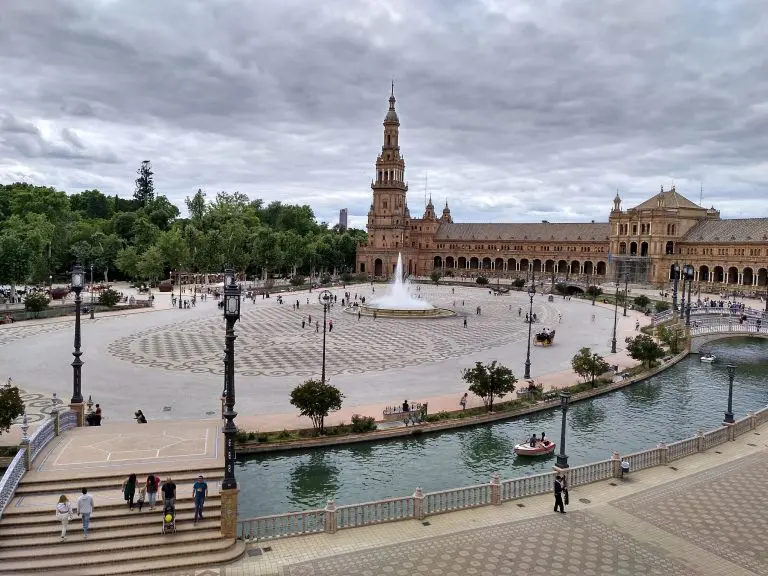
- ● La Plaza de España, construida en 1929 para la Exposición Iberoamericana, ha servido de escenario en películas de Hollywood como Star Wars: Episodio II y Lawrence de Arabia. (https://www.sevillaactualidad.com/sevilla/561068-diez-curiosidades-de-sevilla-que-puede-que-no-sepas/)
- ● Sevilla tiene más de 25.000 naranjos que fueron traídos de China, en su momento por pensar que era un árbol que atraía la felicidad. (https://www.20minutos.es/viajes/destinos/curiosidades-sevilla-que-ver-historia-cultura-5167910/)
- ● La Giralda fue originalmente el minarete de la gran mezquita de la ciudad durante la época almohade, construida en el siglo XII, y fue transformada en campanario. (https://www.sevillaactualidad.com/sevilla/561068-diez-curiosidades-de-sevilla-que-puede-que-no-sepas/)
- ● El Puente de Triana es una copia de un puente de París situado junto a Notre-Dame, aunque el puente parisino, el Pont du Carrousel, desapareció al ser destruido en 1931. (https://www.andaluciamia.com/es/sevilla-insolita-y-secreta/)
📍 También te puede interesar
Qué ver en Córdoba →
Qué ver en Sevilla →