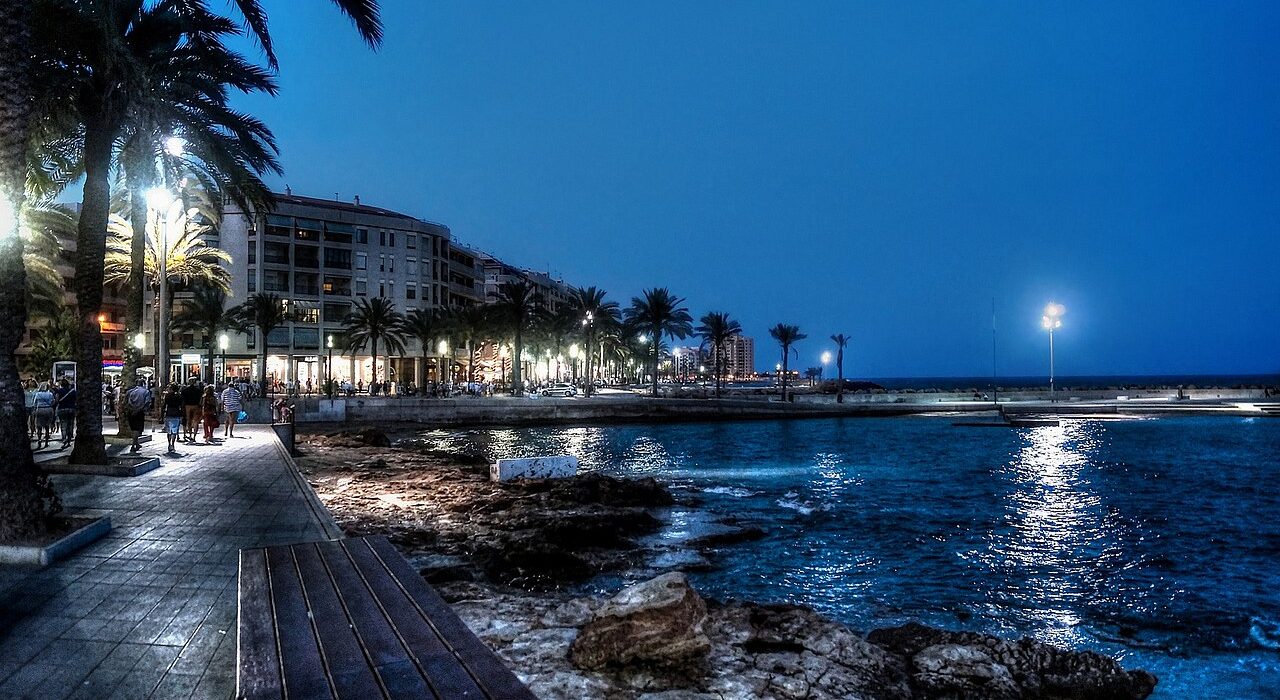
Alicante → Torrevieja
43 kmTraveling from Alicante to Torrevieja is to immerse yourself in the purest essence of the Costa Blanca, a short journey where the asphalt quickly melts into the intense blue of the Mediterranean and the dazzling white of the salt flats. You barely need half an hour to leave behind the urban bustle of the capital and find yourself facing a landscape where the light seems to have a different quality, more golden and calm, inviting you to slow down and savor the moment.
How to get from Alicante to Torrevieja: quick overview
The most efficient and recommended option for covering this route is to use a private vehicle, since it connects both points in just 35 minutes without logistical complications. Although public transport exists in the region, the absence of a direct rail connection makes the car the undisputed king of this route, offering total freedom to explore the area upon arrival. For the independent traveler or the family seeking comfort, renting a car or using your own is the winning strategy, allowing you to make the most of your vacation time without depending on external schedules. If your profile is that of a strict backpacker, you will need to research the bus connections, but keep in mind that the flexibility offered by the road is irreplaceable in this tourist corridor. The geographical proximity, with barely 43 kilometers of separation, makes Torrevieja a natural extension of Alicante, ideal for a day trip or for establishing yourself as a base of operations during a longer vacation.
By car from Alicante to Torrevieja
Driving from Alicante to Torrevieja is extremely simple and fast, requiring only 35 minutes to cover the 43 kilometers that separate both cities via modern, toll-free highways. The route is designed to flow without interruptions, mainly using two vital arteries of the Valencian Community’s road infrastructure that guarantee a safe journey with no toll costs. First, you will take the A-31, known as the Autovía de Alicante or Autovia d’Alacant, which acts as the backbone that takes you out of the metropolitan area. This road connects fluidly with the A-7, the famous Autovía del Mediterráneo or Autovia de la Mediterrània, which runs along the coast offering partial views of the sea as you head south. It is essential to note that both roads, the A-31 and the A-7, are completely free, which represents significant savings in the travel budget compared with other toll routes in Spain. The signage is clear and the road surface is usually excellent, allowing you to maintain a constant cruising speed without the stress of urban traffic jams, except during peak hours entering and leaving Alicante. Being such a short journey, fuel consumption is minimal, making this option not only the fastest, but also one of the most economical if traveling in a group. The driving experience is relaxed, allowing you to enjoy the landscape that gradually changes from the urban area to the more open and luminous surroundings of the south of the province.
Where to stay in Torrevieja
Torrevieja offers a wide variety of accommodation options to suit different budgets, from budget tourist apartments to top-category beachfront hotels. As there is no train service bringing mass day-trip tourism, the city is well prepared to receive overnight visitors, with a consolidated hotel infrastructure in several key areas. One of the most sought-after areas is the seafront promenade and the port area, where you will wake up to the sound of the waves and have immediate access to the dining and nightlife scene. For those seeking a quieter, more family-friendly experience, the residential areas away from the center but well connected to the A-7 offer more spacious apartments, ideal for stays of a week or more. Price ranges tend to fluctuate depending on the season, with summer being the period of highest rates, while in spring and autumn you can find very competitive offers. It is common to find complexes that include a swimming pool and common areas, taking advantage of the area’s mild climate for most of the year. If your priority is nature, looking for accommodation near the La Mata lagoons can be an interesting option, although it will require the use of a car to get around the city, something that, as we have seen, is very easy given the proximity to the main highways. The offer is diverse, but the general recommendation is to book in advance if you travel in the months of July and August, as demand increases considerably due to the fame of its beaches and its festive atmosphere.
Frequently asked questions about the Alicante-Torrevieja route
How long does it take to get from Alicante to Torrevieja?
The estimated travel time is 35 minutes under normal traffic conditions. This duration corresponds to the journey made by private car using the A-31 and A-7 motorways, covering a total distance of 43 kilometers. It is a short enough journey to be considered an immediate connection between two important population centers in the province.
Which is cheaper, the train or the bus?
This comparison is not possible in terms of train, as there is no train station in Torrevieja nor is there a direct connection from Alicante. Therefore, the train option is ruled out for this specific destination. The real economic choice is between using a private car (whose cost depends on fuel, but with the advantage of the toll-free A-7 and A-31 motorways) or the bus options, whose prices vary depending on the company and how far in advance you book, but which tend to be competitive for individual travelers who do not wish to take on the costs of a vehicle.
Is it worth renting a car?
Yes, renting a car is highly recommended and, in many cases, the most practical option for this route. Given that there is no train and the distance is short (43 km), having a vehicle allows you to manage your time freely and explore not only Torrevieja, but also the surrounding areas of the Costa Blanca. Furthermore, since the A-7 and A-31 roads are toll-free, you do not incur extra road infrastructure costs, making the rental very cost-effective if there are two or more of you. The lack of rail transport makes car mobility almost essential to enjoy the area with complete autonomy.
When is the best time to travel?
The best time to travel depends on your preferences regarding climate and crowds, although the Mediterranean climate allows you to visit the area for much of the year. The spring and autumn months tend to offer very pleasant temperatures for covering the 43 kilometers of the route and enjoying the city without the intense summer heat. However, if your goal is swimming in the sea and the festive atmosphere, the central summer months are the most suitable, although you should bear in mind heavier traffic on the A-31 and A-7 motorways. The light and landscape are spectacular in any season, but the 35-minute car journey experience will be more relaxed if you avoid peak hours during the high-season months.
📍 También te puede interesar
Qué ver en Alicante →
Qué ver en Torrevieja →