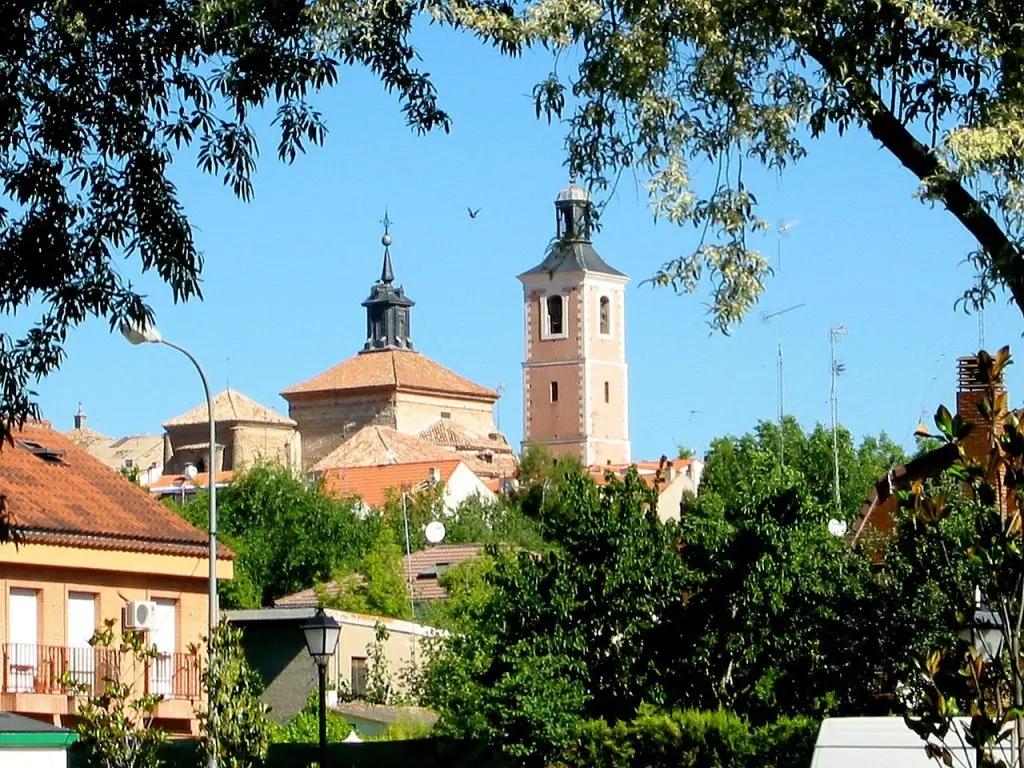
Valdemoro
Comunidad de MadridClimate
What to see in Valdemoro: the essentials
Valdemoro’s historic centre holds most of its monumental heritage, with a porticoed square, centuries-old convents and Baroque churches that can be explored on foot at a leisurely pace. The Church of the Assumption and the Convent of Santa Clara are the two must-see stops, but there is much more to discover among narrow streets and traditional façades.
Parish Church of Nuestra Señora de la Asunción
This is the main church of the historic centre, built over an earlier 16th-century temple, although reforms in the 17th and 18th centuries gave it its current appearance. Its slender exterior architecture, of considerable proportions, already invites you inside. Within, you will find a single nave with four chapels on each side; don’t miss the chapel of Nuestra Señora del Rosario, patron saint of the town, the chapel of San José and the chapel of the Cristo de la Agonía. The building enjoys full protection in the municipal catalogue along with the rollo de justicia.
Convent of Santa Clara (Convent of the Incarnation)
This cloister of Poor Clare Franciscan nuns is declared a Site of Cultural Interest and stands on the Plaza de las Monjas. It is one of the most significant convent complexes in Valdemoro and retains full protection in the municipal catalogue of protected elements. The square it overlooks is a quiet corner that neatly sums up the atmosphere of the old town.
Hermitage of the Santísimo Cristo de la Salud
An 18th-century Baroque construction that was originally a 17th-century Humilladero situated on the old Camino Real to Toledo. It has undergone successive restorations and is one of the most emblematic religious buildings in the municipality. It consists of a central nave covered by a barrel vault with lunettes, with three chapels on each side opening through semi-circular arches. Particularly noteworthy is the Baroque altarpiece with Solomonic columns decorated with acanthus leaves and vine clusters, which houses the image of the Cristo de la Salud.
Fuente de la Villa
One of the most interesting examples of Madrid’s Baroque fountains, commissioned by the Duke of Lerma in 1605, the period of greatest splendour for Valdemoro. It came about as a result of the Fair Privilege granted to the town: it was built so that the livestock of the merchants attending that market could drink. It is built in Colmenar stone and consists of three spouts, three pilasters and a trough that spans its entire front.
Monument to the victims of 11-M
Commemorative monument located in the municipality.
The Astronaut
Urban monument in Valdemoro.
Statue of the Duke of Ahumada
Statue dedicated to Francisco Javier Girón y Ezpeleta, 2nd Duke of Ahumada.
Pinares de Valdemoro
Among the most notable spots are the Cerro de la Mina, with its pine grove, and the surroundings of the Cerro de las Espartinas, from where you can walk through the pine forest and continue on towards the Cañada and the Fuente de la Teja, areas of interest for hiking and country walks.
Bolitas del Airón Nature Area
Commercial or entertainment establishment.
Toro de Osborne
Bull silhouette located within the municipal boundaries.
🍂 Otoño
Si visitas Valdemoro en otoño, el clima sigue siendo agradable, sobre todo en septiembre y octubre, con menos calor que en verano y poca lluvia. Septiembre es ideal para coincidir con las Fiestas Patronales de Nuestra Señora del Rosario y sentir el ambiente local. Aprovecha para callejear sin agobios y llevar un paraguas ligero por si acaso.
What to do in Valdemoro
Valdemoro offers patron saint festivals with bull runs and processions, tapas routes through the bars of its old town, hiking through pine forests and drovers’ paths, and leisurely strolls through a historic centre declared a Conjunto Histórico-Artístico (Historic-Artistic Site). The calendar blends Castilian tradition, bar-side gastronomy and open-air life in the hills surrounding the town.
- Experience the patron saint festivals: in May, the Fiestas del Santísimo Cristo de la Salud fill the streets with processions, bull runs, concerts and popular activities; in September, the Fiestas de Nuestra Señora del Rosario add children’s activities and fireworks.
- Join in Carnival: in February there’s a parade of troupes and costumes with a competition, music and the burning of the sardine in the Plaza de la Constitución.
- Follow the Ruta de la Tapa: the bars in the centre and local gastro-bars enter creative pinchos and tapas into a competition, such as grilled sirloin skewers, lamb and piparra fritters or picadillo torto in cabrales sauce.
- Head out into the countryside: the pine forests of Cerro de la Mina and Cerro de las Espartinas, with their paths and drovers’ routes, are perfect for a walk without straying too far from the town centre.
- Sip a Zecchini vermouth: made and aged in Valdemoro since the early last century, it’s enjoyed in local bars and vermouth houses as an aperitif before lunch.
Valdemoro in a day: express itinerary
With a full day you can see the essentials of the historic centre, enjoy tapas in the centre and take a peek at the nearby pine forests. This walking route is designed to be done without a car and at a relaxed pace.
- 10:00 – Plaza de la Constitución and Town Hall: start in the heart of the old town to get your bearings and soak up the atmosphere of the town.
- 10:30 – Iglesia Parroquial de Nuestra Señora de la Asunción: step inside to see its side chapels, especially the one dedicated to the patron saint, Nuestra Señora del Rosario.
- 11:30 – Convento de Santa Clara: head to the Plaza de las Monjas to see this Bien de Interés Cultural (Asset of Cultural Interest) and its peaceful surroundings.
- 12:15 – Fuente de la Villa: look for its three spouts and its stone trough from Colmenar; it’s one of the most interesting Baroque fountains in the region.
- 13:00 – Ermita del Santísimo Cristo de la Salud: round off the morning with its Baroque altarpiece of Solomonic columns and the image of the Cristo de la Salud.
- 14:00 – Tapas around the centre: try pinchos, grilled sirloin skewers or picadillo torto in cabrales sauce, accompanied by a Zecchini vermouth.
- 17:00 – Pinares de Valdemoro: in the afternoon, walk towards Cerro de la Mina or Cerro de las Espartinas to stretch your legs among pines and drovers’ paths.
Where to eat in Valdemoro: local cuisine
Where to stay in Valdemoro
Casco Antiguo
Núcleo histórico de Valdemoro, con calles estrechas y edificios tradicionales. Alberga la Iglesia de Nuestra Señora de la Asunción, la Plaza de la Constitución y el Ayuntamiento. Ambiente tranquilo y auténtico, ideal para pasear y conocer la historia local.
Barrio de la Estación
Zona alrededor de la estación de tren de Valdemoro, con edificios residenciales y algunos comercios. Es un área de paso y con fácil acceso a Madrid. Ambiente funcional y bien comunicado.
Barrio de El Restón
Barrio residencial moderno con amplias avenidas y zonas verdes. Cuenta con centros comerciales y servicios. Ambiente familiar y tranquilo, con parques y áreas de recreo.
Barrio de la Villa
Zona residencial consolidada, cercana al casco antiguo. Tiene calles tranquilas y algunos comercios locales. Ambiente de barrio tradicional, ideal para alojarse y descansar.
Barrio de San José
Barrio residencial con edificios de media altura y zonas verdes. Cuenta con equipamientos deportivos y educativos. Ambiente familiar y bien conectado con el centro.
Barrio de la Fuente
Zona residencial tranquila, con viviendas unifamiliares y adosados. Próxima a zonas verdes y con ambiente sosegado. Ideal para quienes buscan tranquilidad sin alejarse del centro.
How to get to Valdemoro
From Madrid, the fastest option is driving: 29 min.
| From | Direct train | Direct bus | Car |
|---|---|---|---|
| Madrid | 30 min · 59/day Cercanías C3 | 33 min · 6/day Consorcio Regional de Transportes de Madrid | 29 min 29 km |
| Getafe | 11 min · 58/day Cercanías C3 | 49 min · 33/day Consorcio Regional de Transportes de Madrid | 16 min 17 km |
| Aranjuez | 14 min · 59/day Cercanías C3 | 20 min · 10/day Consorcio Regional de Transportes de Madrid | 20 min 22 km |
| Pinto | — | 6 min · 33/day Consorcio Regional de Transportes de Madrid | 7 min 7 km |
Direct trains and buses from the official timetables published by the operators on Spain's National Transport Access Point (a reference Wednesday); driving times from OpenStreetMap. Operators that do not publish their timetables may run more services. Check the timetable before you travel.
Getting around Valdemoro
Valdemoro has an urban bus service for getting between neighbourhoods, but the historic centre and the main attractions are perfectly walkable. If you arrive by train, the station leaves you close to the centre, and from there you can walk to the Iglesia de la Asunción (Church of the Assumption), the Convento de Santa Clara (Convent of Santa Clara) and the Fuente de la Villa (Village Fountain) without needing transport. To reach the pine woods of Cerro de la Mina or Cerro de las Espartinas, the easiest option is to take a car or the urban bus to the vicinity and continue on foot.
Weather in Valdemoro
Best time to visit Valdemoro
Day trips from Valdemoro
Valdemoro lies in the south of the Community of Madrid, in the La Sagra district, and its location makes it a good base for exploring cities in the region. The Madrid-Aranjuez railway line, opened in 1851 and the third oldest in Spain, makes car-free getaways easy. Aranjuez, with its palace and gardens, is the classic day trip from Valdemoro; you can also head to other municipalities in the Madrid or Toledo parts of La Sagra to discover squares, churches and Castilian cuisine in a less touristy setting. Madrid, of course, is just a short train ride away if you want to combine the tranquillity of Valdemoro with the capital’s cultural offerings.
Valdemoro facts you never knew
A name with several legends. Popular etymology says that Valdemoro could come from the expression “En balde, moro, te cansas” (“In vain, Moor, you tire yourself out”), but other hypotheses are also on the table: “Val (valley) de Moro” or the Arabic “Wadi al-murr”, meaning “bitter river”.
Spain’s third oldest railway line passed through here. The Madrid-Aranjuez line, inaugurated in 1851, was the third oldest in the country and drew intellectuals such as Pedro Antonio de Alarcón and Luis Mariano de Larra to Valdemoro.
The entire historic centre is a Site of Cultural Interest. Valdemoro’s old town is included in the General Register of Sites of Cultural Interest as one of the seventeen towns in the Community of Madrid listed as a Historic-Artistic Complex.
A fair changed the face of the town. The Fair Privilege granted to Valdemoro led the Duke of Lerma to order the construction of the Fuente de la Villa (Village Fountain) in 1605, so that the merchants’ livestock could drink during the market.
Who Valdemoro is for
Valdemoro works especially well for couples and history lovers who want an old town with protected heritage and a laid-back atmosphere, without the crowds of other Madrid destinations. Families will find green spaces, facilities and services in neighbourhoods such as El Restón or San José, as well as festivals with activities for children. Backpackers and practical travellers can use it as a budget base near Madrid thanks to the train station and the Estación neighbourhood. And foodies have the Ruta de la Tapa (Tapas Route) and Zecchini vermouth as a perfect excuse to go from bar to bar.
💡 ¿Sabías que...?
- ● El nombre de Valdemoro podría provenir de la expresión 'En balde, moro, te cansas', según la etimología popular, o de 'Val (valle) de Moro' o del árabe 'Wadi al-murr' ('río amargo'). (https://es.wikipedia.org/wiki/Valdemoro)
- ● La línea de ferrocarril Madrid-Aranjuez, inaugurada en 1851, fue la tercera más antigua de España y atrajo a Valdemoro a intelectuales como Pedro Antonio de Alarcón y Luis Mariano de Larra. (http://turismo.valdemoro.es/wp-content/uploads/2019/07/Guia-de-turismo-y-naturaleza-de-valdemoro.pdf)
- ● El centro histórico de Valdemoro está incluido en el Registro General de Bienes de Interés Cultural como una de las diecisiete ciudades de la Comunidad de Madrid catalogadas como Conjunto Histórico-Artístico. (https://www.madridactual.es/municipios/valdemoro/que-ver-y-hacer-en-valdemoro-20230213-7876055.html)
Frequently asked questions about Valdemoro
How many days do I need to see Valdemoro?
With a full day you can explore the historic centre, enter the Iglesia de la Asunción (Church of the Assumption), see the Convento de Santa Clara (Convent of Saint Clare), the Fuente de la Villa and the Ermita del Cristo de la Salud (Chapel of Christ of Health), and finish up with some tapas. If you want to hike through the pine forests of Cerro de la Mina or Cerro de las Espartinas at a leisurely pace, or use it as a base for trips to Aranjuez or Madrid, 2 or 3 days is ideal.
What is the best time of year to visit Valdemoro?
From May to October, according to climate data. The average temperature in summer is 25.2°C and in winter 6.9°C, with annual rainfall of 355.0 mm (AEMET). May and September are the most recommended months because the weather is mild and they coincide with the patron saint festivals of Cristo de la Salud and Nuestra Señora del Rosario.
How do I get to Valdemoro from Madrid?
The most practical way is the Cercanías commuter train to Valdemoro station, which has no AVE. According to Renfe, there are frequent departures throughout the day and the journey is short. You can also arrive by car via the roads in the south of the Community of Madrid.
What typical dishes should I try in Valdemoro?
Don’t leave without trying the pinchos in the bars in the centre, the grilled sirloin skewer, the lamb and piparra buñuelo or the torto de picadillo in cabrales sauce, all typical of the Ruta de la Tapa. Pair it with a Zecchini vermouth, made and aged in Valdemoro since the beginning of the last century, or sit down for grilled red meat at a traditional restaurant.
Is Valdemoro a good base for visiting Madrid?
Yes, especially if you’re looking for more moderate prices and a quiet atmosphere. The train station connects Valdemoro with Madrid without AVE and with good frequency, making it possible to go and return in a day. What’s more, Valdemoro’s historic centre and its pine forests give you an alternative plan for days away from the city.
For up-to-date opening times for monuments, festival schedules and guided tours, check the official Valdemoro tourism website.