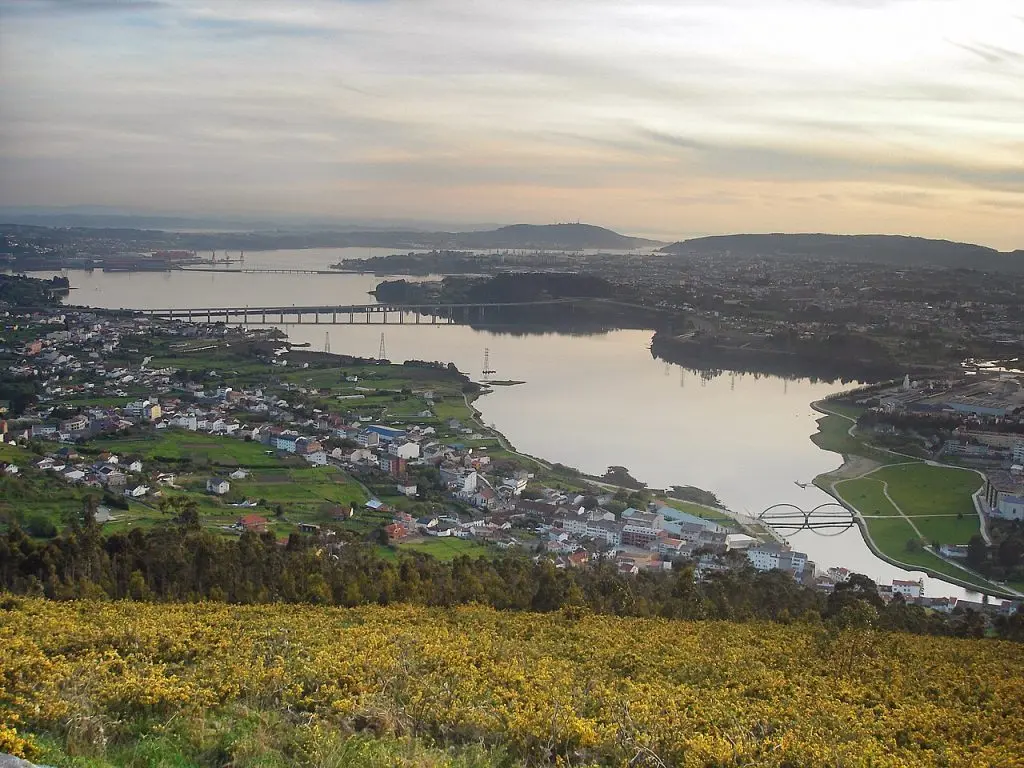
Ferrol
GaliciaClimate
What to see in Ferrol: the essentials
Ferrol concentrates its interest in a historic centre divided between the sailors’ quarter of Ferrol Vello and the Enlightenment-era expansion of A Magdalena, but it also holds natural and military treasures along its coastline. Here is what you shouldn’t miss.Barrio de la Magdalena
The Barrio de la Magdalena is the urban heart of Ferrol and one of the most singular examples of 18th-century Enlightenment architecture in Galicia. Its layout was approved by Charles III in 1761 and follows the prototype of a planned, rational city, with a rationalist grid unique in Galicia. It is popularly known for its “bar of chocolate” shape, and among its streets you’ll find Modernist buildings that break the Neoclassical uniformity. The visit is done on foot and is free, and it is the usual starting point for understanding the history and layout of Ferrol.Ferrol Vello
Ferrol Vello is the city’s old and historic quarter, declared a Site of Cultural Interest as a Historic Complex and part of the Camino de Santiago on its English Way variant. Its cobbled streets retain 18th- and 19th-century buildings, with a bohemian atmosphere and an ongoing process of rehabilitation that invites you to get lost without rushing. Here you’ll find the Plaza de Armas, the Town Hall and the church of San Francisco, as well as taverns where you can try seafood from the estuary.Concatedral de San Julián
The Concatedral de San Julián is Ferrol’s main Catholic church and one of the city’s religious landmarks. Its presence in the urban fabric of the historic centre makes it a natural stop when exploring Ferrol Vello. It is worth peeking inside to take in the atmosphere of quiet contemplation that contrasts with the seafaring bustle of the nearby streets.Castillo de San Felipe
The Castillo de San Felipe is one of the three fortresses that formed the so-called “triangle of fire” that protected the estuary of Ferrol, the largest naval base in Europe in its day. Inside, the bastions and the views over the estuary stand out, and they alone justify the visit. Entry to the grounds is free, with opening hours every day of the week, including public holidays: mornings from 10:00 to 14:00 and afternoons from 16:00 to 20:00. In addition, guided tours with an official tourism guide from the Xunta de Galicia are offered on Thursdays and Saturdays from 15 July to 10 September at 18:00, at a price of 10€ per person and lasting an hour and a half.Mirador de Cabo Prior
The Mirador de Cabo Prior is a natural balcony over the Atlantic coast of Ferrol, located at Cabo Prior within the municipal boundaries of Ferrol. The surroundings combine cliffs, coastal vegetation and sweeping panoramic views over the Atlantic Ocean and the estuary of Ferrol. At the cape stands the Cabo Prior lighthouse, a maritime signalling tower of historic and scenic interest that forms part of the lighthouse system of the Galician coast. Access is free and you can drive to the immediate vicinity, with footpaths running through the area; it is a highly valued spot for watching sunsets over the Atlantic.Ferrol Naval Museum
The Ferrol Naval Museum is a branch institution of the Madrid Naval Museum, state-owned and attached to the Ministry of Defence, inaugurated in March 1986 after decades of work collecting and cataloguing its holdings. It traces the history of the Spanish Navy and of shipbuilding in Ferrol through ship models, nautical instruments and historical documents. It is an essential visit for understanding the city’s military and maritime past. It has public opening hours and an indicative admission price; it is advisable to confirm closing days before going.A Graña Beach
A Graña Beach is an urban beach set in a seafaring environment with a promenade and free access. Its proximity to the town’s services and to Ferrol’s hospitality and restaurant establishments makes it a space frequented by both locals and visitors touring the estuary. It is a convenient option for a swim or a stroll without straying far from the town centre.Exponav Foundation (Museum of Naval Construction)
The Exponav Foundation complements the visit to the Naval Museum with a permanent collection that includes pieces and recreations of historic vessels, such as the frigate Santa María Magdalena, built at the Reales Astilleros de Esteiro (Royal Shipyards of Esteiro) and sunk in 1810 in the Viveiro estuary. In high season it opens Monday to Saturday from 10:00 to 19:00 and Sundays from 10:30 to 14:30. It is a highly recommended stop for those wishing to delve deeper into Ferrol’s naval shipbuilding tradition.Ateneo Ferrolán
The Ateneo Ferrolán is a leading cultural space in the city.Herrera Gardens
The Herrera Gardens are located behind the Palacio de Capitanía (Captaincy Palace) and the Ferrol Parador, on a defensive bastion that makes them a privileged viewpoint over the Arsenal and the estuary. They were designed by the naval engineer Andrés Comerma and among their most notable features is the “Churruca” obelisk. Access is free and they constitute a green space of historical and scenic interest next to the town centre.Alameda de Ferrol
The Alameda de Ferrol is considered the first public alameda in Galicia, created in 1784 with 210 poplars, mulberry trees and 7 rows of trees that bordered the northern area of the arsenal. Today it brings together more than half a hundred tree species, some of notable dimensions such as cedars and magnolias. It is a traditional green space with trees and pedestrian paths, located in the surroundings of the Camino Inglés (English Way) of Santiago, with free access.Plaza del Marqués de Amboage
The Plaza del Marqués de Amboage is a large central square located between Real, María, Arce and Méndez Núñez streets. At its centre stands the statue dedicated to the Marqués de Amboage, and its entire perimeter is populated with trees and surrounded by numerous terraces belonging to the cafés that ring it. It is an urban meeting point and a hub of communication in the city centre, with free access.Canido Neighbourhood
The Canido Neighbourhood preserves fishermen’s houses and offers a free walking route among murals, with places of interest such as Antón Varela park and the Insua washing place.Lobadiz Beach
Lobadiz Beach is a wild beach on the Ferrol coastline, with fine sand and a natural setting, frequented by surfers and lovers of the Atlantic coast for its constant swell.Castro de Santa Mariña
The Castro de Santa Mariña is an archaeological site catalogued under the code GA15036011.Castrense Parish Church of San Francisco
The Castrense Parish Church of San Francisco is a church located in El Ferrol.Mámoa da Chaeira (39)
The Mámoa da Chaeira is a funerary monument catalogued under the code GA15036055.🍂 Otoño
Si visitas Ferrol en otoño, el clima sigue siendo agradable hasta octubre, con luz suave ideal para el Mirador de Cabo Prior. El Samaín en octubre da un toque especial a la temporada y los atardeceres desde la costa son tranquilos. Lleva calzado cómodo y una capa impermeable por si cambia el viento.
What to do in Ferrol
Ferrol offers authentic neighbourhood life, festivals with more than a century of tradition, local markets and an Atlantic coast that’s perfect for surfing and sunsets. The festive calendar sets the pace of the city: in March, the Noite das Pepitas (Night of the Pepitas) fills the streets with roldas singing with more than 100 years of tradition; in June, the Luminarias de San Juan light bonfires all over the city, especially in the Esteiro neighbourhood; in August, the Summer Festivals in honour of San Ramón Nonato bring free concerts, verbenas, a market, sport and fireworks; and in October, the Samaín organised by ECHO Catabois in collaboration with the Concello turns the most terrifying night of the year into an unmissable date. For everyday life, getting lost in the markets of A Magdalena, Esteiro or Recimil, strolling along the A Graña seafront promenade or doing a tapas route along rúa Pardo Baixo are plans that never fail.Ferrol in a day: express itinerary
If you only have one day in Ferrol, this walking route gives you a complete overview of the city without rushing:- 10:00 – Barrio de la Magdalena: start with the Enlightenment-era expansion of Carlos III, wander its grid-plan streets and look for the Modernist buildings among the neoclassical façades.
- 11:30 – Ferrol Vello: head down to the old town, visit the Concatedral de San Julián and get lost in the cobbled streets of the historic quarter declared a BIC.
- 13:00 – Plaza del Marqués de Amboage: stop at one of its terraces for a drink and watch the pulse of the centre.
- 16:00 – Castillo de San Felipe: drive there along narrow roads, walk the bastions and enjoy the views over the ría that protected the fire triangle.
- 19:30 – Mirador de Cabo Prior: end the day watching the sunset over the Atlantic from the cliffs, with the lighthouse as your witness.
Where to eat in Ferrol: local cuisine
Where to stay in Ferrol
Ferrol Vello
Casco antiguo e histórico de Ferrol, con calles empedradas y edificios de los siglos XVIII y XIX. Es el corazón histórico de la ciudad, con ambiente bohemio y en proceso de rehabilitación. Se encuentran la Plaza de Armas, el Ayuntamiento y la iglesia de San Francisco.
A Magdalena
Barrio de ensanche del siglo XVIII, diseñado con un trazado ortogonal racionalista. Es el barrio más señorial y comercial de Ferrol, con amplias calles y plazas. Alberga el Mercado de la Magdalena y numerosos comercios y cafeterías.
Esteiro
Barrio popular y residencial situado al este del centro, con ambiente local y vida de barrio. Cuenta con el mercado de Esteiro y el parque de Reina Sofía. Es una zona tranquila con servicios y buena conexión con el centro.
Canido
Barrio costero y marinero al oeste de Ferrol, con vistas a la ría y playas cercanas. Tiene un ambiente tranquilo y tradicional, con el castillo de San Felipe en las proximidades. Es ideal para pasear y disfrutar del paisaje.
Caranza
Barrio residencial moderno al norte de Ferrol, con amplias avenidas y zonas verdes. Cuenta con el centro comercial Caranza y el parque de Caranza. Es una zona tranquila y bien comunicada, con ambiente familiar.
Recimil
Barrio obrero histórico, conocido por sus viviendas sociales de los años 50 y su ambiente auténtico. Es una zona con vida de barrio y comercio local, alejada del turismo masivo. Se encuentra el mercado de Recimil y la iglesia de San José.
How to get to Ferrol
Ferrol is well connected by road and has a bus station with long-distance routes. The main bus connection is the VAC-161 line linking Ferrol with Salamanca, with a subsequent connection to Algeciras.| Medio | Duración | Precio aprox. | Frecuencia |
|---|---|---|---|
| Bus de largo recorrido (VAC-161) | Variable según destino | €€ | Consultar horarios |
| Coche particular | Variable según origen | €€ | Libre |
Getting around Ferrol
Ferrol is perfectly walkable in its central area, as the main urban attractions are concentrated between Ferrol Vello and A Magdalena. For longer journeys, the city has an urban bus service connecting the centre with outlying neighbourhoods such as Caranza, Esteiro or Canido. If you want to explore the Atlantic coast, the Mirador de Cabo Prior or the Castillo de San Felipe (San Felipe Castle), the most practical option is to have a car, as access to these points is via narrow roads and the trails that run through the area.Weather in Ferrol
Live webcam — Ares*
Ferrol* The nearest webcam to Ferrol is in Ares, 6.7 km away.
Source: Windy Webcams
Best time to visit Ferrol
Day trips from Ferrol
Ferrol is an excellent base for exploring the Ferrolterra region and other cities in the Galician region. Its location on a peninsula, bordering only the municipality of Narón by land, makes it a convenient starting point for touring the estuary and the nearby Atlantic coast. From here you can head to other cities in the region to discover the contrast between Ferrol’s naval character and the rest of Galicia, whether on half-day or full-day trips.Ferrol curiosities you didn’t know
Europe’s largest naval base was here. Ferrol was home to Europe’s largest naval base, protected by three fortresses that formed the so-called “triangle of fire”. Today you can visit one of them, the Castillo de San Felipe (San Felipe Castle), and look out over the estuary they defended. A 16th-century writer was already blown away by its port. In 1550, the writer Juan de Molina described the port of Ferrol as “one of the safest in the world”. And no wonder: the estuary offers a natural shelter that explains centuries of naval history. Electric light dazzled for the first time in Galicia here. The Arsenal de Ferrol was the largest engineering work of its time, and there electric light dazzled for the first time in Galicia. It was also there that the first film was screened, the launching of the Cardenal Cisneros, on 19 March 1897. The city grew from 1,000 to 20,000 inhabitants in 35 years. Ferrol’s population went from 1,000 inhabitants in 1752 to 20,000 in 1787, driven by the State’s interest in the city. That vertiginous growth explains the Enlightenment-era planning of the Magdalena neighbourhood.Who Ferrol is for
Ferrol is a city for curious travellers who value authenticity over mass tourism. Lovers of naval and military history will find a destination unlike any other in Spain, with the Arsenal, the Naval Museum, Exponav and the fire triangle as its main draws. Couples will enjoy the sunsets at Cabo Prior, strolls through Canido and quiet dinners in Ferrol Vello. Families have Esteiro and Caranza, quiet neighbourhoods with green spaces and services, as well as urban beaches such as A Graña. Foodies have in the cockles, the Pías clams and the pulpo a feira (Galician-style octopus) more than enough reasons to extend their stay. And backpackers will find in Recimil an authentic, affordable neighbourhood, far from mass tourism, with local life and independent shops.💡 ¿Sabías que...?
- ● Ferrol fue la sede de la mayor base naval de Europa, protegida por tres fortalezas conocidas como el 'triángulo de fuego'. (https://www.elespanol.com/quincemil/cultura/historias-de-la-historia/20250216/triangulo-fuego-inexpugnables-fortalezas-proteger-mayor-base-naval-europa-ferrol/924158120_0.html)
- ● En 1550, el puerto de Ferrol fue descrito como 'uno de los más seguros del mundo' por el escritor Juan de Molina. (https://www.elespanol.com/quincemil/cultura/historias-de-la-historia/20250216/triangulo-fuego-inexpugnables-fortalezas-proteger-mayor-base-naval-europa-ferrol/924158120_0.html)
- ● El Arsenal de Ferrol fue la obra de ingeniería más grande de su tiempo y en él la luz eléctrica deslumbró por primera vez en Galicia; además, se proyectó la primera película, la botadura del Cardenal Cisneros, el 19 de marzo de 1897. (https://www.mundiario.com/articulo/cultura/ferrol-matria-marina/20231011135743283335.html)
- ● La población de Ferrol pasó de 1.000 habitantes en 1752 a 20.000 en 1787, impulsada por el interés del Estado en la ciudad. (https://galiciaartabra.es/archivos/135737)
Frequently asked questions about Ferrol
How many days do I need to see Ferrol?
With two full days you can see the essentials: one day for the city centre (Barrio de la Magdalena, Ferrol Vello, Concatedral de San Julián, Naval Museum and Plaza del Marqués de Amboage) and another for the coastal and military surroundings (Castillo de San Felipe, Mirador de Cabo Prior and a beach such as A Graña or Lobadiz). If you want to include the Fundación Exponav, the gardens and an unhurried food route, three days will give you enough leeway.
What is the best time to visit Ferrol?
The best time is from May to October, with an average summer temperature of 20.3°C according to AEMET, ideal for combining city and coast. August concentrates the Fiestas de Verano de San Ramón with free concerts, verbenas and fireworks, while June offers the Luminarias de San Juan and March the Noite das Pepitas. Winter is mild (10.6°C on average) but rainier and with shorter days.
How do I get to Ferrol from Madrid?
Ferrol has a bus station with the VAC-161 line connecting Ferrol with Salamanca, with a later connection to Algeciras. From Madrid, the most usual option is to combine train or bus to A Coruña or Santiago and from there continue by road or bus to Ferrol. For exact timetables and frequencies, check the official Ferrol tourism website.
Is Ferrol an expensive city for eating and sleeping?
Not especially. Ferrol keeps moderate prices compared with other more touristy Galician destinations. You can enjoy tapas in taverns on rúa Pardo Baixo or in Ferrol Vello with local produce at reasonable prices, and sleep in neighbourhoods such as Recimil or Esteiro for less than in the centre. The Michelin-selected restaurants, such as A Gabeira, BaceLo or Néboa, raise the budget but offer good value for money.
Can you visit the Castillo de San Felipe for free?
Yes. Entry to the Castillo de San Felipe grounds is free every day of the week, including public holidays, with morning hours from 10:00 to 14:00 and afternoon hours from 16:00 to 20:00. Guided tours with an official tourism guide from the Xunta de Galicia cost 10€ per person and are offered on Thursdays and Saturdays from 15 July to 10 September at 18:00.