Reus
CataluñaClimate
What to see in Reus: the essentials
Reus is a city best explored on foot, with your nose tilted up toward the Modernista façades and your feet keeping pace with a lively old town. Most of the essentials are concentrated in the historic centre, so forget the car and put on comfortable shoes: here every corner hides a palace, an athenaeum or a square with centuries of stories.
Casa Navàs
Casa Navàs is Reus’s great Modernista palace, commissioned by the Navàs family from the architect Lluís Domènech i Montaner. Inside, highlights include the central courtyard, the grand staircase and the rooms decorated with mosaics and stained glass that filter the light in spectacular fashion. Visits are by ticket and set timetable, and in high season it is advisable to book in advance to secure a place. It is one of those gems that justify a trip to the city on its own.
Gaudí Centre
This museum explores the origins and creative process of Antoni Gaudí through models, objects and audiovisual resources, and offers insight into the architect’s relationship with the landscape and nature that shaped his work. The building is a renovation of the former Banco Santander, which had previously been a toy shop known as l’Aliança; the refurbishment project began in 2002, designed by the architects Joan Sibina and Toshiake Tange, and the centre opened its doors on 27 April 2007. It is recommended to check updated opening hours and prices and to book in advance in high season.
Prioral de Sant Pere
The Prioral de Sant Pere is a priory church of medieval origin located in the historic centre of Reus, with Gothic elements and later architectural reforms over the centuries. Its bell tower is one of the city’s visual landmarks, and its interior houses altarpieces and significant religious heritage. The building combines the sobriety of Catalan religious architecture with ornamental details that reflect the different construction phases, and its location in the old town makes it easy to include in routes exploring Reus’s cultural heritage.
Casa Rull
Casa Rull is a Modernista building in Reus, the work of the architect Lluís Domènech i Montaner, built in 1900. It is located at Carrer de Sant Joan, number 27, and its façade is of brick. The property belongs to Reus City Council and serves as the headquarters of the Institut Municipal Reus Cultura. It is listed as a Bien de Interés Cultural (BIC), in the Monument category, with code RI-51-0011209, and its designation dates from 16 November 2004.
Institut Pere Mata
The Institut Pere Mata is a former psychiatric hospital designed by Lluís Domènech i Montaner and inaugurated in the early 20th century, considered one of the jewels of Catalan Modernisme. The architect’s connection with Reus stems from his friendship with Pau Font de Rubinat, promoter of the ‘Manicomio de Reus’ society established in 1896, who commissioned the architectural project; it was Domènech i Montaner’s first intervention in the city, before other commissions such as Casa Rull (1900-1902). Guided visits are offered with set times and rates, booking is recommended, and it is located on the outskirts of Reus, in the former healthcare complex.
Centre de Lectura
The Centre de Lectura is a cultural athenaeum and central library in Reus, a non-profit organisation dedicated to promoting and spreading culture in all its aspects; the original building dates from 1859 and was renovated in 1920 by the architect Josep Simó i Bofarull, adopting a Noucentista architectural style.
Palau Bofarull
Palau Bofarull is an urban palace of noble origin built in 1770 by the architect Francesc Bofarull on behalf of his brother Josep Bofarull i Gavaldà, mayor of Reus and holder of a noble title; its most remarkable feature is the salon, the only room that has been preserved unmodified, with a large ceiling decorated in 1788 by Pere Pau Montanyà with scenes referring to commerce and a glorification of the Bourbon monarchy.
Museu de Reus (Museu Salvador Vilaseca)
The Museu Salvador Vilaseca is the archaeology museum of Reus, located in the former Bank of Spain building; it owes its name to the Reus-born physician and prehistorian Salvador Vilaseca Anguera (1896–1975), who promoted the first municipal museum of Reus in 1933 and left behind a prehistoric collection of international prestige.
Plaça de Prim
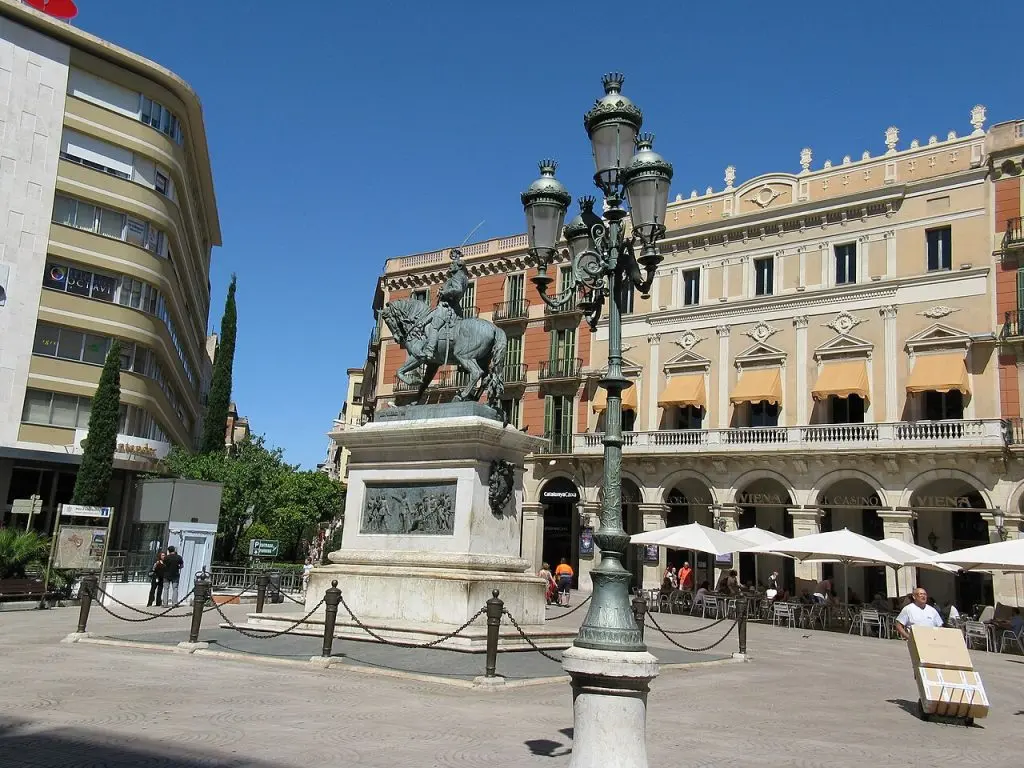
Plaça de Prim is the central square of the city of Reus, built at the end of the 19th century in eclectic style, where the streets of Sant Joan, Sant Llorenç, Monterols and Llovera converge, as well as the ravals of Jesús and Santa Anna.
Teatre Fortuny
The Teatre Fortuny is an emblematic building in the historic centre whose main auditorium, in eclectic style with Modernista details, hosts seasons of opera, music and the performing arts, and can be admired from outside and visited depending on the programme.
Santuari de la Mare de Déu de Misericòrdia
The Santuari de la Mare de Déu de Misericòrdia is linked to the figure of the Mare de Déu de Misericòrdia (Our Lady of Mercy), to the story of the Pastoreta and to the main festival of Reus, and is the destination of offerings and sung Goigs (traditional hymns) to the Mare de Déu de Misericòrdia.
Monument a Joan Prim
The Monument a Joan Prim stands in a prominent urban space and is among the monuments and statues that make up the local heritage, one of the city’s identifying features in the collective imagination.
Plaça del Mercadal
Plaça del Mercadal forms the historic and geographical core of Reus, the space where the market was traditionally held and which has been the setting for the town’s main social events.
Mercat Central de Reus
The Mercat Central de Reus is a municipal food market located on Carrer de Josep Sardà i Cailà, a testament to the city’s commercial tradition; the building, designed by the architect Antoni Sardà i Moltó and constructed between 1944 and 1949, is a freestanding single-storey work representative of architectural rationalism.
🍂 Otoño
Si visitas Reus en otoño, el clima sigue siendo templado y las lluvias son escasas, lo que permite seguir disfrutando de la calle. Es un buen momento para entrar en el Centre de Lectura o la Prioral de Sant Pere sin aglomeraciones. Un consejo: consulta la previsión y lleva un paraguas plegable, porque alguna tarde puede caer un chaparrón.
What to do in Reus
Reus offers a range of activities that combine Modernista heritage, festive tradition and neighbourhood life. The historic centre is an open-air museum where every façade tells a story, and the squares fill with life depending on the time of year.
- Modernista route through the old town: visit Casa Navàs, Casa Rull and the Gaudí Centre to understand why Reus is one of the capitals of Catalan Modernism. Most of these spaces offer guided tours or audio guides.
- Midday vermouth in Plaça del Mercadal: order a vermouth from Reus with ice, soda water and a slice of orange, and watch the square’s comings and goings. It’s the local ritual par excellence.
- Market and tapas: stop by the Mercat Central to see fresh zero-kilometre produce and then find a tapas bar where red prawns and grilled cuttlefish take centre stage.
- Festivals and traditions: if you coincide with Sant Jordi in April, you’ll see Plaça del Mercadal full of book and rose stalls, with sardanas, castells and the lighting up of the Drac i la Víbria. In January, the Festa de Sant Sebastià is celebrated with a dance in the plaza del Castell, and in March Els Tres Tombs fills the streets with carriages and animals with a blessing in the plaza de la Sang.
- Neighbourhood life in Santa Anna: lose yourself in this traditional neighbourhood near the centre to see everyday life in Reus without the crowds of the old town, with small local shops and an authentic atmosphere.
Reus in a day: express itinerary
With a well-used day you can get a very complete picture of Reus. This itinerary takes you through the essentials without rushing, with time to eat and have vermouth.
- 10:00 – Gaudí Centre: start here to understand Gaudí and his connection to the region. The models and audiovisual resources put the rest of the day into context.
- 11:30 – Casa Navàs: just a few steps from the Gaudí Centre, this Modernista palace will leave you open-mouthed with its central courtyard and stained glass. Book in advance if you travel in high season.
- 13:00 – Plaça del Mercadal and vermouth: head down to the city’s most emblematic square and sit on a terrace to order a vermouth from Reus with its slice of orange. It’s the moment to observe local life.
- 14:00 – Lunch in the historic centre: look for a tapas bar or restaurant serving red prawns, grilled cuttlefish or calçots if it’s the season (late winter and spring).
- 16:00 – Prioral de Sant Pere and Plaça de Prim: visit the priory church and its bell tower, one of the city’s visual landmarks, and then head to Plaça de Prim to see the equestrian statue of General Joan Prim.
- 17:30 – Casa Rull and Centre de Lectura: end the afternoon with the brick façade of Casa Rull and, if you fancy, pop into the Centre de Lectura, a benchmark of Catalan intellectual life since 1859.
Where to eat in Reus: local cuisine
Where to stay in Reus
Casco Antiguo (Centre Històric)
Es el corazón de la ciudad, famoso por su arquitectura modernista y calles peatonales llenas de comercio. Aquí se concentra la mayoría de los monumentos históricos y el ambiente es vibrante tanto de día como de noche.
Eixample
Zona residencial ordenada que rodea el casco antiguo, caracterizada por edificios modernistas y avenidas amplias. Es una área más tranquila que el centro pero muy cercana a las principales atracciones turísticas.
Mas Abelló
Barrio residencial situado al norte de la ciudad, conocido por albergar el campus universitario y zonas verdes. Es una zona funcional y tranquila, alejada del bullicio turístico del centro.
Pallarols
Área principalmente industrial y de polígonos comerciales en las afueras de la ciudad, donde se encuentran grandes superficies y naves logísticas. No es una zona turística ni cuenta con atractivo histórico o cultural para visitantes.
Santa Anna
Barrio tradicional ubicado cerca del centro que combina zonas residenciales con pequeños comercios locales. Ofrece una visión auténtica de la vida cotidiana en Reus sin la masificación del casco antiguo.
How to get to Reus
From Barcelona, the fastest option is driving: 1 h 27 min.
| From | Direct train | Direct bus | Car |
|---|---|---|---|
| Barcelona | 1 h 48 min · 37/day Regional | 1 h 50 min · 3/day La Hispano Igualadina | 1 h 27 min 108 km |
| Tarragona | 19 min · 44/day Regional | 10 min · 133/day La Hispano Igualadina, Teresa y José Plana, Empresa Plana | 18 min 14 km |
| Vilanova i la Geltrú | 57 min · 33/day Regional | — | 53 min 65 km |
| Zaragoza | 3 h 40 min · 2/day Regional | — | 2 h 37 min 228 km |
| Lleida | 2 h 26 min · 2/day Regional | — | 1 h 10 min 92 km |
Direct trains and buses from the official timetables published by the operators on Spain's National Transport Access Point (a reference Wednesday); driving times from OpenStreetMap. Operators that do not publish their timetables may run more services. Check the timetable before you travel.
How to get around Reus
Reus is perfectly walkable, especially the old town, where most of the attractions are concentrated. For longer journeys or to reach areas such as the Institut Pere Mata on the outskirts, the city has an urban bus service. The bus lines connect the centre with the residential neighbourhoods and industrial estates, and are a practical option if you are staying outside the old town. For day-to-day sightseeing, comfortable shoes and plenty of walking.
Weather in Reus
Best time to visit Reus
Day trips from Reus
Reus is an excellent base for exploring the province of Tarragona and the Costa Dorada. The provincial capital, Tarragona, is very close and offers an impressive Roman ensemble declared a UNESCO World Heritage Site, with an amphitheatre, circus and walls facing the Mediterranean. Other towns in the region let you combine beach, heritage and gastronomy in a day trip. Good road and rail connections make getting around the area easy and allow you to return to Reus for dinner and a good night’s sleep.
Little-known facts about Reus
A city with popes as feudal lords. In the Middle Ages, Reus had two feudal lords, and two of them went on to become popes; one, Benedict XIII, was both pope and feudal lord of Reus at the same time. Few cities can boast of having a pope on their feudal payroll.
The name comes from a crossroads. The name Reus derives from the Latin word ‘Reddis’, which referred to a crossroads. It is a reminder that this city was born as a meeting point and a place of passage, something it remains today.
Second city of Catalonia in the 18th century. In the 18th century, Reus became the second most populous town in Catalonia. Its commercial and craft-based dynamism turned it into an economic engine for the region.
130 ceramic artisans in a golden age. In the 16th and 17th centuries, the pottery district of Reus came to have 130 ceramic artisans, master potters, in a golden age of production and export. Reus ceramics travelled across the Mediterranean and beyond.
Repopulated by a Norman. Reus is documented from the year 1154 and around 1150 it was repopulated by the Norman Robert de Aguiló. A surprising fact that connects the city with European medieval history.
Who Reus is for
Reus is a city for lovers of Modernista architecture, foodies who enjoy a good vermouth and a grilled cuttlefish, and travellers who prefer the pace of a medium-sized Catalan city to the bustle of the big capitals. Couples will find an elegant and quiet setting in the Eixample and the old town, while families will appreciate the authenticity of neighbourhoods such as Santa Anna and the proximity of the beaches of the Costa Dorada. Backpackers can opt for Mas Abelló, a functional and affordable area near the university campus. If you are passionate about history, the legacy of Gaudí and Domènech i Montaner will give you material for days; if tapas are your thing, the vermouth of Reus and kilometre-zero produce will win you over. For more practical information on opening times, tickets and what’s on, see the official Reus tourism website.
💡 ¿Sabías que...?
- ● Reus está documentada desde el año 1154 y hacia 1150 fue repoblada por el normando Roberto de Aguiló. (https://es.wikipedia.org/wiki/Historia_de_Reus)
- ● En la Edad Media, Reus tenía dos señores feudales, y dos de ellos llegaron a ser papas; uno, Benedicto XIII, fue a la vez papa y señor feudal de Reus. (https://www.reus.cat/es/la-ciudad/la-historia)
- ● El nombre de Reus deriva de la palabra latina 'Reddis', que designaba un cruce de caminos. (https://es.wikipedia.org/wiki/Reus)
- ● En el siglo XVIII, Reus llegó a ser la segunda población de Cataluña en número de habitantes. (https://www.reus.cat/es/la-ciudad/la-historia)
- ● En el siglo XVI y XVII, el barrio de la cerámica de Reus llegó a tener 130 artesanos ceramistas, maestros alfareros, en una época dorada de producción y exportación. (https://www.diaridetarragona.com/reus/132386/los-hallazgos-del-pallol-piezas-clave-para-dibujar-la-sociedad-de-reus-de-los-siglos-xvi-xvii-20190810-0002-jrdt201908100002.html)
Frequently asked questions about Reus
How many days do I need to see Reus?
With a full day you can see the essentials of the historic centre: Gaudí Centre, Casa Navàs, Prioral de Sant Pere, Casa Rull and Plaça del Mercadal. If you want to add the Institut Pere Mata on the outskirts, the Museu de Reus and enjoy vermouth and tapas at a leisurely pace, two days are ideal. Reus also works very well as a base for excursions around the province of Tarragona, so three or four days will let you combine city and beach.
What is the best time to visit Reus?
The best time is from April to October, with pleasant temperatures and plenty of life on the streets. The average temperature in summer is 24.8°C and in winter 11.2°C, according to AEMET. April is especially recommended for Sant Jordi, with book and rose stalls in the Plaça del Mercadal, sardanas, castells and the lighting of the Drac i la Víbria.
How do I get to Reus from Madrid?
Reus has no AVE station, so the train option usually involves reaching Tarragona or Barcelona and from there taking a Cercanías or regional train to Reus station. According to Renfe, times and frequencies vary, so it is worth checking the official Renfe website to plan the journey. You can also arrive by road by car or bus.
Is Reus a good base for visiting the Costa Dorada?
Yes, Reus is very well located for exploring the province of Tarragona and the Costa Dorada. The provincial capital, Tarragona, with its Roman ensemble declared a UNESCO World Heritage Site, is very close. The city also has good road and rail connections, making it easy to take day trips and return to Reus to enjoy its food scene and nightlife.
What typical dishes should I try in Reus?
You can’t leave without trying Reus vermouth, served with ice, soda water and a slice of orange or lemon. If you travel between late winter and spring, calçots with romesco sauce are a must. And throughout the year, red prawns and grilled or rice-based cuttlefish, paired with wines from the Tarragona Denominación de Origen, are the essence of local zero-kilometre produce.