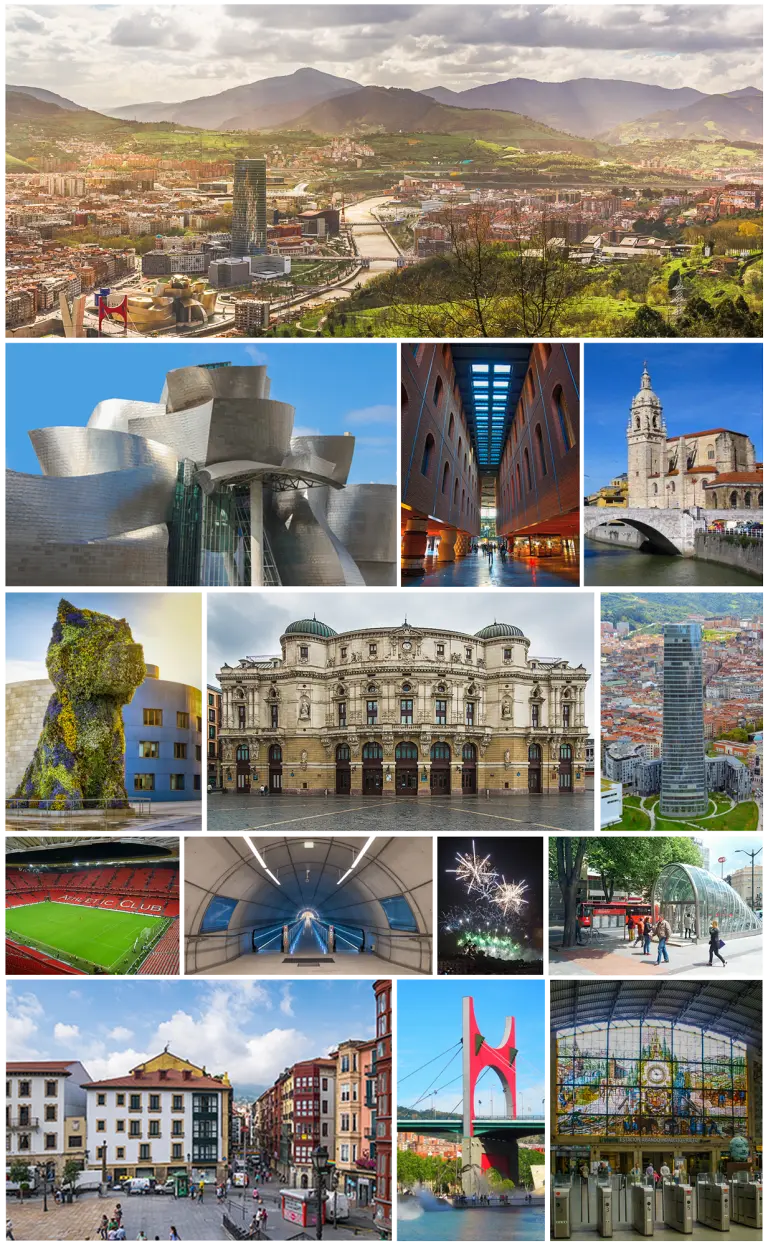
San Sebastián → Bilbao
102 kmFew roads in northern Spain give so much in so little time: 102 kilometres that take you from the green cliffs of Gipuzkoa to the mountains that embrace the Nervión estuary, with stops that smell of the sea, of cider and of freshly poured txakoli. A short journey, but with just the right density to turn it into a getaway with a flavour all of its own.
How to get from San Sebastián to Bilbao: quick summary
The fastest and most flexible option is the car, with 102 km of motorway covered in approximately 1 hour. If you’d rather not drive, the direct bus run by ALSA, Avanza Movilidad Gipuzkoa or FlixBus takes 72 minutes and costs between €18.98 and €27.98, while the Euskotren train covers the route in 155 minutes with frequent departures from Amara-Donostia. For those who want to make stops in Hernani, Zarautz, Zumaia, Elgoibar or Gernika, the car is clearly the best choice.
Driving from San Sebastián to Bilbao
The road journey between San Sebastián and Bilbao takes 1 hour and covers 102 km, almost entirely along motorways and well-signposted expressways. The route combines stretches of coastline, industrial valleys and inland corridors that allow you to keep up a steady pace without any complications.
The itinerary begins on the GI-20, the Donostia bypass, which skirts the city for some 6 km and connects with the AP-8, the Bay of Biscay motorway. You drive roughly 28 km along the AP-8 towards Bilbao, crossing the rolling landscape of Gipuzkoa and entering Bizkaia. After that you link up with the N-637, the Txorierri corridor, a toll-free stretch of about 14 km that avoids central Bilbao and brings the traveller closer to the northern part of the metropolitan area. The final stretch relies on the DO, the Kantauriko motorway, around 47 km long, which completes the connection to the capital of Bizkaia.
It’s worth remembering that the AP-8 has toll sections, while the N-637 is free. Combining the two makes for a fast journey with ever-changing views: first the Cantabrian Sea peeking out between hills, then the inland mountains and, finally, the approach to Bilbao through the Txorierri valley.
By train from San Sebastián to Bilbao
The direct train between San Sebastián and Bilbao is operated by Euskotren, with the Euskotren E1 service taking 155 minutes and departing from Amara-Donostia station for Matiko-Bilbao. There are 15 trains a day, with the first at 05:50 and the last at 19:50, which leaves plenty of room to plan your day.
It isn’t the fastest option, but it is the most relaxed, and the journey is highly entertaining: the train crosses the interior of Gipuzkoa and Bizkaia, stopping in towns such as Zarautz, Elgoibar and Amorebieta. It’s a good choice if you’re not in a hurry and want to take in the scenery without worrying about traffic. Tickets are bought directly at the stations or through Euskotren’s channels.
By bus from San Sebastián to Bilbao
The direct bus between San Sebastián and Bilbao takes 72 minutes and is operated by Avanza Movilidad Gipuzkoa, ALSA and FlixBus, with prices ranging from €18.98 to €27.98 depending on the company, the time and how far in advance you book. It’s the best option if you’re after speed without driving, as it clearly beats the train in travel time.
Buses leave from San Sebastián bus station and arrive at Bilbao Intermodal station, in the San Mamés district, very well connected to the metro and tram. Services are frequent throughout the day, so it’s easy to find a time that fits your plans.
Recommended stops along the way
If you’re driving, these eight stops turn a 1-hour journey into a half-day or full-day route. All of them are among the towns the road passes through or skirts between San Sebastián and Bilbao.
Hernani
Just a few minutes from San Sebastián, Hernani is one of the birthplaces of Gipuzkoan natural cider. Its old town retains an authentic feel, with farmhouses and cider houses in the surrounding area where you can try the txotx (cider poured directly from the barrel) in season. It’s a brief stop but full of local character.
Lasarte-Oria
Known for its culinary tradition and for being a crossroads between the interior and the coast, Lasarte-Oria is a practical stop for a coffee or a pintxo before carrying on. Its atmosphere is less touristy, which lets you see the real rhythm of Gipuzkoan towns.
Andoain
Andoain sits in the Oria river valley, surrounded by green mountains. It’s a quiet town with a pleasant pedestrian centre and access to nearby hiking trails. If you’re travelling at a relaxed pace, it’s a good place to stretch your legs without straying too far from the main route.
Zarautz
Zarautz is one of the most appealing stops on the Gipuzkoan coast. Its long beach, seafront promenade and surfer vibe give it a laid-back feel. It’s worth parking and walking along the sea, especially if the weather cooperates. It’s also a good spot for pintxos or fresh fish.
Zumaia
Zumaia is famous for its flysch, the striking layered rock cliffs that overlook the Cantabrian Sea. It’s a stop of great scenic value, with coastal paths that can be adapted to a short walk. If you’re into photography or geology, this stop is almost obligatory.
Elgoibar
Elgoibar is an inland town with a strong industrial tradition and an urban centre that combines historic buildings with a mountain setting. It’s a low-key stop, ideal for a quiet break or for getting to know life in the Gipuzkoan valleys away from coastal tourism.
Amorebieta
Now in Bizkaia, Amorebieta is an urban hub surrounded by mountains and close to Urkiola Natural Park. It’s a good stop to recharge and notice the change in landscape between Gipuzkoa and Bizkaia. Its atmosphere is relaxed and practical for a brief pause.
Gernika-Lumo
Gernika-Lumo is a stop with enormous symbolic weight. Famous for the 1937 bombing and for the Tree of Gernika, a symbol of Basque liberties, it deserves a more leisurely visit. The tree, the Casa de Juntas (Assembly House) and the Monday market are part of the living memory of the Basque Country.
Where to stay in Bilbao
Bilbao offers accommodation for every budget, from hostels and guesthouses in the Casco Viejo to design hotels in Abando and functional lodgings near San Mamés. The most recommended areas for a short stay are the Casco Viejo, for its atmosphere and pintxo bars, and Abando, for its central location and connections to the metro and tram.
Prices vary by season, but in general you can find a double room in a guesthouse or hostel from around €60-80 per night, while mid-range hotels usually range between €90 and €150. If you’re looking for something cheaper, hostels and guesthouses in the centre hover around €25-40 per person. The San Mamés area, next to the bus station, is handy if you arrive late or leave early.
Where to eat along the route
Food is one of the great arguments of this journey. In San Sebastián as well as in Bilbao and the towns in between, eating well is almost an obligation. These are the dishes and products that define the route.
Pintxos
Pintxos are small portions of food served in bars, usually on a slice of bread, with ingredients such as ham, tortilla, anchovies or gulas. In San Sebastián they are an absolute symbol, and bar-hopping through the old town sampling pintxos is an experience in itself.
Tortilla de patatas
Tortilla de patatas (Spanish potato omelette) is made with eggs, potatoes and optionally onion, set in a pan. In the Basque Country it is served both runny and fully set, and it is one of the most requested pintxos at any bar. Always ask whether they make it with onion or without, because local preferences are very strong.
Bacalao al pil-pil
Bacalao al pil-pil is a dish of flaked cod cooked at low temperature with olive oil and garlic, emulsified until a thickened sauce forms. It is served with the cod’s juices and guindillas (small green peppers). It is a classic recipe from Bilbao and all of Bizkaia, with a silky texture and a deep flavour.
Txipirones en su tinta
Txipirones en su tinta are baby squid stewed in a sauce made with their own ink, onion, tomato and wine. They are served with white rice or bread. It is a very popular dish in Bizkaia, ideal for those looking for an intense, comforting taste of the sea.
Merluza a la vasca
Merluza a la vasca (Basque-style hake) is cooked with clams, prawns, asparagus and hard-boiled eggs in a green sauce made with oil, garlic and parsley. It is a traditional dish of Basque cuisine that appears on many menus in both coastal and inland restaurants. The green sauce is the key to its freshness.
Chuletón de buey
Chuletón de buey is a large beef chop, usually grilled, served rare and accompanied by coarse salt. It is typical of Basque cider houses and steakhouses, both in Gipuzkoa and Bizkaia. For two people it is usually a generous and hearty portion.
Txakoli
Txakoli is a young white wine, lightly sparkling and with high acidity, made mainly from the Hondarribi Zuri grape. It is produced in Getaria, Bizkaia and Álava, and is traditionally poured from a height to enhance its aromas. It pairs wonderfully with fish and pintxos.
Sidra natural
Sidra natural (natural cider) is an alcoholic drink fermented from apple juice, with a tart flavour and low sugar content. It is consumed in cider houses during the txotx season, especially in the area around Astigarraga and Hernani. Drinking it straight from the barrel is quite a ritual.
Frequently asked questions about the San Sebastián-Bilbao route
How long does it take to get from San Sebastián to Bilbao?
By car, the journey takes 1 hour to cover 102 km on the motorway. By direct bus, the time is 72 minutes. By Euskotren train, the fastest journey takes 155 minutes. There is no direct flight between the two cities.
Which is cheaper, the train or the bus?
The bus has prices between €18.98 and €27.98 depending on the company and how far in advance you book. For the Euskotren train, no exact price is provided in this data, but the bus is usually competitive in price and clearly faster. Compare both according to your schedule and needs.
Is it worth renting a car?
Yes, especially if you want to make stops in Hernani, Zarautz, Zumaia, Elgoibar, Amorebieta or Gernika-Lumo. Public transport connects the main cities, but it doesn’t allow you to explore the intermediate towns freely. By car, the base journey is only 1 hour, which leaves room to make detours without rushing.
When is the best time to travel?
The route is pleasant all year round, but the best time is from May to October, when the weather is milder and the days are longer. In spring and summer you can combine it with stops along the coast and at cider houses. In autumn, the inland landscape fills with colour and the cider houses begin the txotx season.
💡 ¿Sabías que...?
- ● Bilbao fue puerto antes de ser villa: mucho antes de su fundación oficial en 1300, la ría del Nervión ya era un punto clave para el comercio marítimo, especialmente en el transporte del hierro procedente de las ferrerías vizcaínas. (https://www.elconfidencial.com/espana/pais-vasco/2025-07-27/bilbao-curiosidades-ciudad-historia-1qrt-1tna_4177575/)
- ● Puppy, la escultura monumental en forma de perro situada frente al Museo Guggenheim, está considerada la escultura floral más grande del mundo. (https://www.elconfidencial.com/espana/pais-vasco/2025-07-27/bilbao-curiosidades-ciudad-historia-1qrt-1tna_4177575/)
- ● El primer tranvía eléctrico de toda España circuló en Bilbao. (https://www.elconfidencial.com/espana/pais-vasco/2025-07-27/bilbao-curiosidades-ciudad-historia-1qrt-1tna_4177575/)
- ● La estatua más antigua de Bilbao es la de Diego López V de Haro, fundador de la ciudad, que en su mano derecha sostiene la carta fundacional de la villa. (https://www.elconfidencial.com/espana/pais-vasco/2025-07-27/bilbao-curiosidades-ciudad-historia-1qrt-1tna_4177575/)
- ● El compositor Juan Crisóstomo Arriaga, conocido como el 'Mozart Español', nació el 27 de enero de 1806 en el número 12 de la calle Somera, en el Casco Viejo de Bilbao. (https://bilbaosecreto.com/curiosidades-bilbao-que-no-conocias/)
- ● El Mercado de la Ribera cuenta con un Récord Guinness por ser el mercado municipal de abastos más grande de Europa. (https://turismo.euskadi.eus/es/blog/6-curiosidades-del-casco-viejo-de-bilbao/webtur00-contfichapost/es/)
- ● La vidriera en el interior de la estación de Abando tiene más de 15 metros de anchura. (https://www.elconfidencial.com/espana/pais-vasco/2025-07-27/bilbao-curiosidades-ciudad-historia-1qrt-1tna_4177575/)
- ● Las calles del Casco Viejo de Bilbao están ordenadas de arriba abajo desde Somera (la de arriba) hasta Barrenkale (la más baja de todas). (https://www.elconfidencial.com/espana/pais-vasco/2025-07-27/bilbao-curiosidades-ciudad-historia-1qrt-1tna_4177575/)
📍 También te puede interesar
Qué ver en San Sebastián →
Qué ver en Bilbao →