Málaga → Sevilla
210 kmHow to get from Málaga to Seville: quick summary
The route between Málaga and Seville connects the Costa del Sol with the Andalusian capital in just over two hours, crossing some of the most representative landscapes of inland Andalusia. You have three main options: the car, which gives you the freedom to stop in towns such as Antequera; the direct Renfe train, with frequent departures from first thing in the morning; and the ALSA bus, which tends to be the cheapest alternative. If speed is your priority and you don’t mind spending a little more, the AVANT is unbeatable. If you want to explore at your own pace and make a food stop or two, the car is your best ally. And if you’re looking to keep costs down, the direct bus more than does the job.
Driving from Málaga to Seville
The drive between Málaga and Seville takes approximately 2 hours and 15 minutes, covering a total distance of 210 km on toll-free motorways. The route combines two main motorways: the A-45, which accounts for about 43 km of the initial stretch out of Málaga, and the A-92, which takes on the longest section with some 152 km up to the outskirts of Seville. Both roads are in good condition and allow for smooth driving, although it’s worth avoiding the rush hours at the entrances and exits of both cities.
The A-45 takes you out of Málaga heading north, crossing a landscape that soon becomes more arid and rural. When you join the A-92, the motorway runs through inland Andalusia, passing near towns such as Antequera, a classic stop to stretch your legs and have a mollete for breakfast. As you approach Seville, traffic can build up on the access roads, especially on working days. There are no tolls along the entire route, which makes the car a comfortable option with predictable costs.
By train from Málaga to Seville
The direct train between Málaga and Seville is operated by Renfe and is the fastest option for covering the 210 km that separate the two cities. According to Renfe timetables, there are 12 direct trains a day, departing from Málaga María Zambrano station and arriving at Sevilla-Santa Justa. The first train leaves at 06:35 and the last at 20:28, which gives you scope for both a day trip and an afternoon journey.
There are two types of train on this route. The AVANT is the fastest, with 6 daily services and a journey time of 127 minutes. The MD (Media Distancia) train offers another 6 daily services and takes 194 minutes. The difference in time is considerable, so if you can choose, the AVANT is clearly preferable. Tickets can be bought on the Renfe website, at ticket offices or from the automatic machines at the stations. The departure station, Málaga María Zambrano, is well connected to the city centre, and Sevilla-Santa Justa leaves you a short walk or tram ride from Seville’s historic centre.
By bus from Málaga to Seville
The direct bus between Málaga and Seville is operated by ALSA and is the cheapest option for this journey. The trip takes 150 minutes, around 2 and a half hours, which places it somewhere between the car and the MD train. The ticket price ranges from 12 to 23 euros, depending on how far in advance you book and on demand.
ALSA buses usually depart from Málaga bus station, next to María Zambrano train station, and arrive at Seville bus station, near Santa Justa train station. The frequency is good throughout the day, although it’s worth booking in advance at weekends or on public holidays. If you’re travelling on a tight budget or don’t mind sacrificing a little time for a considerable saving, the bus is a sensible choice.
Recommended stops along the way
The route between Málaga and Seville offers several interesting stops, both in the province of Málaga and in the province of Seville. These are the verified towns you can visit without straying too far from the main route.
Antequera (Málaga) is the most highly recommended stop on the entire journey. Located in the heart of Andalusia, it is famous for its dolmens, its alcazaba and its gastronomy. It is the perfect place for breakfast with molletes or a porra antequerana.
Archidona (Málaga) is a town near Antequera, with a historic centre of whitewashed streets and a unique octagonal square. It is a quiet stop for a stroll and a drink without the crowds.
Dos Hermanas (Seville) is a large city located in the Seville metropolitan area. It is a good spot for a technical stop before entering Seville, with a wide range of bars and shops.
Gelves (Seville) is very close to Seville, on the banks of the Guadalquivir. It is a small village with river views and a relaxed atmosphere, ideal for a brief stop if you arrive with time to spare.
Arahal (Seville) is a municipality in the Seville countryside known for its production of table olives. Its historic centre preserves churches and manor houses that reflect traditional Andalusian architecture.
San Juan de Aznalfarache (Seville) is a town in the Aljarafe area of Seville, very close to the capital. Its main attraction is its elevated position over the Guadalquivir, with views towards Seville.
Alcalá de Guadaíra (Seville) is a city with a well-preserved Moorish castle and a natural setting beside the Guadaíra river. It is a pleasant stop if you want to avoid the bustle of the capital before arriving.
Arcos de la Frontera (Cádiz) is not exactly on the direct route between Málaga and Seville, but it appears on the list of recommended stops. If you have extra time and are travelling by car, it is a detour worth taking for its whitewashed old town and its views over the Guadalete valley.
Where to stay in Seville
Seville offers a wide variety of areas to stay, suited to different budgets and travel styles. The best option for a first visit is the historic centre, which includes neighbourhoods such as Santa Cruz, el Arenal and la Alfalfa. Here you will be just a few minutes’ walk from the Cathedral, the Alcázar and the Giralda, although prices tend to be higher and night-time noise can be a factor to consider.
The Triana neighbourhood, on the other side of the Guadalquivir, is an alternative full of character, with good tapas bars and a more local atmosphere. Prices are somewhat more moderate than in the centre, but the connection to the main monuments is still excellent on foot or by public transport. Another interesting option is the Nervión area, near Santa Justa station, especially practical if you arrive by train and want to get around easily.
As for types of accommodation, you will find everything from hostels and budget guesthouses to boutique hotels and tourist apartments. Prices vary greatly depending on the season: in spring, with Holy Week and the April Fair, demand soars and it is advisable to book months in advance. In summer, the heat is intense but prices tend to drop slightly. For a comfortable stay, budget between 50 and 80 euros per night in a central hostel, and from 100-120 euros in mid-range hotels.
Where to eat along the route
Food is one of the great attractions of this trip. The route crosses areas with a very distinct culinary identity, from the hearty stews of Antequera to the fortified wines of Montilla-Moriles.
In the Antequera (Málaga) area, you can’t leave without trying the porra antequerana, a cold soup of peasant origin similar to salmorejo but thicker. It is made with tomato, bread, olive oil, garlic and green pepper, and is served with hard-boiled egg and tuna or ham. The molletes de Antequera are another must: soft-crumbed rolls with a thin crust, typical for breakfast or an afternoon snack, usually eaten with manteca colorá (paprika-lard spread), extra virgin olive oil or cold meats.
The province of Córdoba contributes several classics that spread throughout all of Andalusia. Salmorejo cordobés is a cold cream of tomato, bread, extra virgin olive oil, garlic and salt, traditionally served with serrano ham and chopped hard-boiled egg. Rabito de cerdo a la cordobesa is a pork tail stew braised with vegetables, wine and spices, served with fried potatoes or bread to mop up the sauce. And the flamenquín cordobés, a pork fillet stuffed with serrano ham, breaded and fried, is a very popular dish in bars and taverns.
In the Écija (Seville) region, the salmorejo de Écija stands out, a variant of salmorejo cordobés with tomato, bread, olive oil, garlic and salt, served with hard-boiled egg and ham. It is typical of the Sevillian countryside and an excellent option for cooling off during the hot months.
The Montilla-Moriles (Córdoba) area is famous for its wines. Vino fino de Montilla-Moriles is a dry fortified wine, made mainly from Pedro Ximénez grapes and aged under a layer of flor yeast. Pedro Ximénez wine is a natural sweet wine made from grapes over-ripened in the sun, with aromas of raisins, figs and honey, ideal as a dessert wine. And vino oloroso de Montilla-Moriles, with oxidative ageing, amber colour and nutty aroma, is perfect to accompany appetisers and meats.
Frequently asked questions about the Málaga-Seville route
How long does it take from Málaga to Seville?
The time depends on the means of transport. By car, the journey along the A-45 and A-92 takes about 2 hours and 15 minutes for the 210 km route. By train, Renfe’s AVANT takes 127 minutes, while the MD takes 194 minutes. By ALSA bus, the trip lasts 150 minutes.
Which is cheaper, the train or the bus?
The ALSA bus is the most economical option, with tickets ranging from 12 to 23 euros depending on how far in advance you book and demand. The Renfe train tends to be more expensive, especially the AVANT, which is the fastest. If your priority is saving money, the bus is the best choice; if you value time, the AVANT is worth the extra cost.
Is it worth renting a car?
It depends on your travel plan. If you only want to go from Málaga to Seville, public transport is sufficient and cheaper. But if you want to make stops such as Antequera, Archidona or Alcalá de Guadaíra, the car gives you a freedom that the train and bus don’t offer. What’s more, the route is along motorway with no tolls, which simplifies the budget.
When is the best time to travel?
The best time to do this route is spring and autumn, when temperatures are pleasant and Seville doesn’t suffer the extreme heat of summer. Bear in mind, though, that spring coincides with Holy Week and the April Fair, with high demand for accommodation and higher prices. Winter is quiet and cheaper, although it may rain. Summer is hot, especially in Seville, but prices tend to drop.
💡 ¿Sabías que...?
- ● La Giralda fue construida sobre un observatorio astronómico, según el libro 'Historia desconocida de Sevilla'. (https://www.rtve.es/play/noticias/20230516/misterios-secretos-sevilla/2446147.shtml)
- ● En Sevilla hay más de 25.000 naranjos que fueron traídos de China, según una tradición que los consideraba árboles que atraían la felicidad. (https://www.20minutos.es/viajes/destinos/curiosidades-sevilla-que-ver-historia-cultura-5167910/)
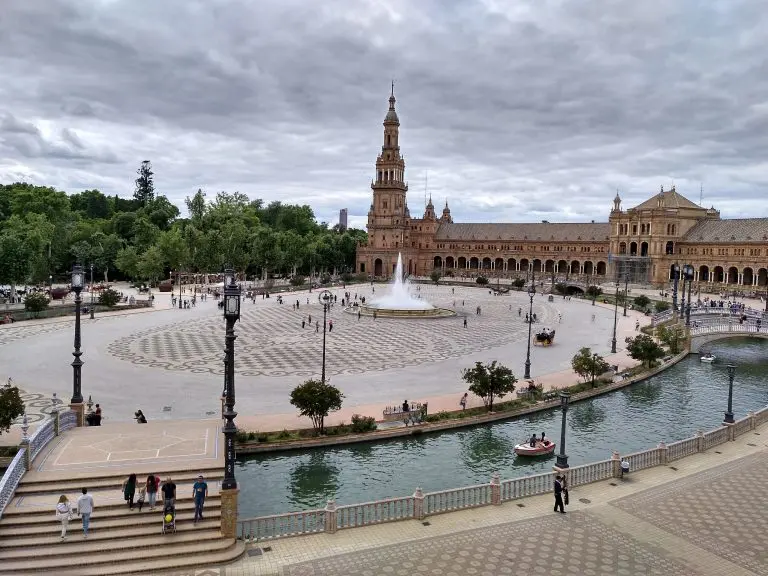
- ● La Plaza de España de Sevilla ha servido de escenario en películas de Hollywood como 'Star Wars: Episodio II' y 'Lawrence de Arabia'. (https://www.sevillaactualidad.com/sevilla/561068-diez-curiosidades-de-sevilla-que-puede-que-no-sepas/)
- ● El Puente de Isabel II (Puente de Triana) es una copia de un puente de París situado junto a Notre-Dame, el Pont du Carrousel, que fue destruido en 1931. (https://www.andaluciamia.com/es/sevilla-insolita-y-secreta/)
- ● La primera imprenta de Sevilla se estableció en el año 1511 en la actual Calle Pajaritos, por el alemán Iacome (Jacobo) Cromberger. (https://desevillalomejor.com/curiosidades-de-sevilla/)
- ● Sevilla tuvo el puerto más importante del mundo sin tener mar, gracias al río Guadalquivir, durante el Imperio Español. (https://www.20minutos.es/viajes/destinos/curiosidades-sevilla-que-ver-historia-cultura-5167910/)
📍 También te puede interesar
Qué ver en Málaga →
Qué ver en Sevilla →