Málaga → Ronda
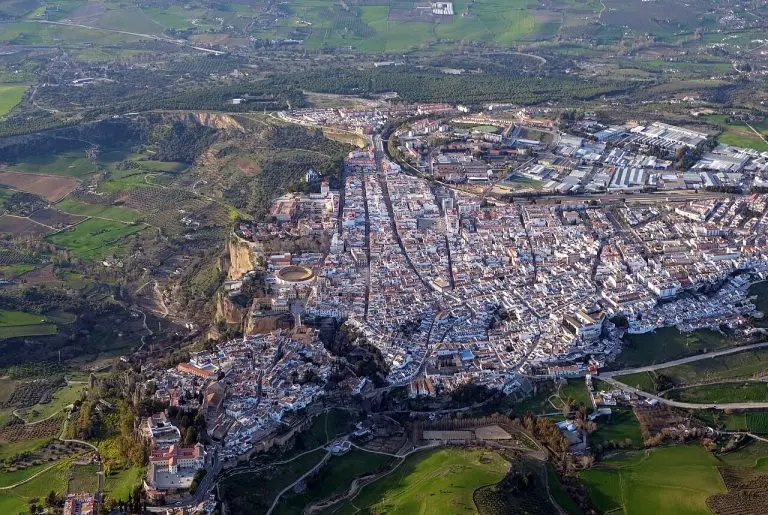
100 kmSome journeys are more than just a means of getting from one place to another, and this is one of them. Leaving the Costa del Sol behind to venture into the mountains of Málaga means trading the blue of the Mediterranean for the green of cork oak groves and the white of whitewashed villages, culminating in the spectacular gorge that splits Ronda in two.
How to get from Málaga to Ronda: quick summary
The fastest and most flexible way to cover the 100 km separating Málaga from Ronda is by car, with a journey of approximately 1 hour and 15 minutes along toll-free roads. If you don’t have your own vehicle, the direct bus operated by Damas is the only public transport alternative without transfers, taking 105 minutes. There is no direct train or flight between the two cities, so the choice comes down to prioritising the freedom to stop along the way or the convenience of not driving.
Driving from Málaga to Ronda
Driving from Málaga to Ronda is the most recommended option for those who want to enjoy the scenery and make stops, since the 100 km journey is completed in 1 hour and 15 minutes without the need to pay tolls. The route combines two main roads: first the A-357, known as the Campillos to Málaga road through the Guadalhorce Valley, which covers about 55 km of the route, and then the A-367, the Ardales to Ronda road, which accounts for the remaining 41 km.
The A-357 takes you out of the city along a wide, comfortable route, skirting the Guadalhorce river and offering views of the orchards and lemon groves that characterise this valley. It is a two-way road for much of its length, with good surfacing and moderate traffic, especially light on weekdays. As you progress, the landscape becomes increasingly arid and mountainous, hinting at the transition towards the mountains.
The junction with the A-367 marks a change of pace. This road, which links Ardales with Ronda, is more winding and serpentine, with curves that demand reduced speed and close attention. The reward is a setting of mountain ranges, holm oaks and, on clear days, distant views of the Ronda region. There are no tolls along the entire route, which makes the car an economical option if shared among several travellers.
For drivers with little experience on mountain roads, it is advisable to make the journey in daylight and to respect the speed limits on the A-367, where sharp bends are frequent. The road surface is well maintained, but in winter there can be fog on the higher sections.
By bus from Málaga to Ronda
The direct bus operated by Damas is the only public transport connection without transfers between Málaga and Ronda, taking 105 minutes to cover the 100 km route. Buses depart from Málaga bus station, located next to María Zambrano train station, and arrive at Ronda bus station, a few minutes’ walk from the historic centre.
This option is ideal for travellers without a car or for those who prefer to avoid driving on mountain roads. The bus follows the same route as private vehicles, so the scenery from the window is equally attractive. Timetables vary by season, with more frequent services in summer and at weekends, so it is worth checking the Damas website or the station ticket office in advance.
The ticket price is not confirmed in the verified sources, so it is advisable to check directly with the company for the updated fare. In general, the bus tends to be cheaper than hiring a car for a single traveller, but less flexible when it comes to making stops along the way.
Recommended stops along the way
The three verified stops on the route between Málaga and Ronda are Cártama, Pizarra and Estación de Cártama, all of them accessible from the A-357 in the first half of the journey. None of them involves a significant detour, so they can be combined without stretching the trip too much.
Cártama
Cártama is a municipality located about 20 km from Málaga, right at the start of the A-357, and it makes for a short but pleasant stop to stretch your legs. The town is divided into two centres: Cártama Pueblo, on top of a hill, and Cártama Estación, in the valley. From the road you can see the silhouette of the ermita de Nuestra Señora de los Remedios (Chapel of Our Lady of Remedies), visible from several kilometres away. It is a good place for a first coffee or to buy local products if you are travelling at a leisurely pace.
Pizarra
Pizarra lies about 10 km further on along the A-357, still in the heart of the Guadalhorce Valley. It is a town of whitewashed houses with a restored Moorish tower and surrounded by orchards and citrus groves. A stop here is recommended for those looking for a quiet break away from tourist crowds. There are bars and small shops near the main road, ideal for a quick snack before tackling the most mountainous part of the route.
Estación de Cártama
Estación de Cártama, contrary to what its name suggests, is not a train stop on the Málaga-Ronda route, but rather an urban centre belonging to the municipality of Cártama, located next to the A-357. It is a transit area with basic services such as petrol stations, supermarkets and cafés, very practical for refuelling or buying water before continuing. It has no notable tourist interest, but its location makes it the most functional of the three stops.
Where to stay in Ronda
Ronda offers accommodation for every budget, concentrated mainly in two areas: the old town, next to the Puente Nuevo (New Bridge) and the Tajo gorge, and the more modern neighbourhoods around the bus station and the main avenue. Staying in the old town means you can walk to the main viewpoints and monuments, but prices are higher and car access can be tricky due to narrow streets and traffic restrictions.
Hotels and guesthouses with views of the Tajo tend to fall into the higher price ranges, especially in high season and at weekends. Rural houses and holiday apartments around the centre offer good value for money, with mid-range rates. For tighter budgets, the hostels and guesthouses near the bus station are the cheapest option, with simple but decent rooms.
Booking in advance is recommended in spring and autumn, when Ronda receives the most visitors. In summer, the heat may make accommodation with a pool or air conditioning preferable, while in winter rural houses with a fireplace become more appealing. No specific hotel names are mentioned as they are not verified in the data provided, but the offer is wide and varied.
Where to eat along the route
The cuisine of inland Málaga is one of the great draws of this trip, with hearty dishes and local produce that change from one area to the next. From the Antequera region to the Serranía de Ronda (Ronda Mountains), the traditional repertoire is built on olive oil, bread, garlic and cured pork products.
Porra antequerana, originally from the Antequera region, is a thick cold soup similar to salmorejo but with a denser consistency. It is made with tomato, bread, garlic, olive oil and vinegar, and is usually served with chopped hard-boiled egg and serrano ham. It is a refreshing dish, ideal for the warm months, although in Ronda it is served all year round.
Migas is a traditional dish of the Province of Málaga, especially in the Serranía de Ronda and Antequera. It is prepared with crumbled stale bread fried in olive oil with garlic and other ingredients such as chorizo, pancetta or peppers. It is a thrifty recipe widely found inland, hearty and perfect for refuelling after a day of winding roads.
The tomato soup of the Serranía de Ronda is a hot soup made with tomato, onion, garlic, pepper and bread. It is usually served with hard-boiled egg and sometimes with pieces of ham or chorizo. Unlike porra, it is eaten hot and is more typical of the cold months or of light suppers.
Conejo al ajillo is a rabbit stew, made with wild or farmed rabbit, cooked with plenty of garlic, olive oil, white wine and herbs. It is a hearty dish and very popular in the villages of the mountains, and appears on the menus of many restaurants in and around Ronda.
Payoya goat’s cheese is an artisanal cheese made with milk from the payoya breed of goat, curdled and matured. It has a firm texture and an intense flavour, slightly spicy when cured. It can be bought directly from cheese shops in the Serranía de Ronda or enjoyed on local cheese boards.
To drink, Málaga wine is a fortified, sweet wine made mainly from Pedro Ximénez and Moscatel grapes, with oxidative ageing. It covers styles such as Málaga Dulce, Pajarete and Lagrima Christi. For its part, Ronda wine has earned a reputation in recent years, with quality productions based on Tempranillo, Syrah, Garnacha and Chardonnay. The area is home to well-known wineries that offer tours and tastings.
Frequently asked questions about the Málaga-Ronda route
How long does it take from Málaga to Ronda?
By car, the 100 km journey takes approximately 1 hour and 15 minutes along the A-357 and A-367 roads, with no tolls. On the direct bus with the Damas company, the duration is 105 minutes. There is no direct train or flight, so these are the only two reference times.
Which is cheaper, the train or the bus?
There is no direct train between Málaga and Ronda, so the comparison does not apply. The only public transport option without transfers is the direct Damas bus, whose price is not verified in the data provided. To obtain the updated fare, it is recommended to check directly with the company.
Is it worth renting a car?
Yes, especially if you want to make stops in Cártama, Pizarra or Estación de Cártama, or if you are travelling in a group. The car allows you to complete the 100 km in 1 hour and 15 minutes with total flexibility, without depending on bus schedules. For a solo traveller who does not plan to stop, the direct bus may be cheaper and more comfortable.
When is the best time to travel?
Spring and autumn are the best seasons to travel the Málaga-Ronda route, with mild temperatures and green or golden landscapes depending on the season. Summer can be very hot inland, and winter, although usually mild, can bring fog on the higher sections of the A-367. To avoid crowds in Ronda, it is recommended to travel on weekdays.
💡 ¿Sabías que...?
- ● Ronda es una de las ciudades más antiguas de España, con orígenes que se remontan al Neolítico o Paleolítico según hallazgos arqueológicos en su casco antiguo. (https://www.malaga.es/es/laprovincia/tradiciones/lis_cd-3662/historia-de-ronda)
- ● El Puente Nuevo de Ronda, en pie desde 1793, está considerado por los expertos como una obra maestra de la ingeniería y su material de construcción se obtuvo de la garganta del río. (https://mipuntodepartida.travelclub.es/5-curiosidades-sobre-ronda-que-te-van-a-sorprender/)
- ● Antes del actual Puente Nuevo de Ronda, un primer puente construido a mediados del siglo XVIII colapsó apenas seis años después de su inauguración, causando la muerte de cincuenta personas. (https://www.tiempo.com/noticias/actualidad/la-sorprendente-historia-de-uno-de-los-puentes-mas-bonitos-de-espana-su-diseno-provoco-dudas-tras-su-reconstruccion.html)
- ● Sobre el arco central del Puente Nuevo de Ronda hay una pequeña sala que en su día fue una cárcel y después un mesón; ahora es el Centro de Interpretación del Puente Nuevo. (https://wineandcountryclub.com/2021/05/14/curiosidades-ronda/)
- ● En Ronda se encuentra el Castaño Santo, estimado como el árbol más antiguo de Málaga, con cerca de 14 metros de perímetro. (https://wineandcountryclub.com/2021/05/14/curiosidades-ronda/)
- ● La plaza de toros de Ronda se utilizó durante algún tiempo como campo de fútbol. (https://wineandcountryclub.com/2021/05/14/curiosidades-ronda/)
- ● Vicente Espinel, poeta y músico nacido en Ronda en 1550, introdujo una nueva forma estrófica llamada espinela y añadió la quinta cuerda a la guitarra. (https://info.turismoderonda.es/historia/personajes-ilustres/)
📍 También te puede interesar
Qué ver en Málaga →
Qué ver en Ronda →